
The break entitlement for a 4-hour shift in the UK is normally zero minutes for workers aged 18 or over. Under the Working Time Regulations 1998, most adult workers qualify for a statutory 20-minute uninterrupted rest break only when they work more than six hours in a day.
However, a four-hour shift does not automatically mean an employer can refuse every type of break. Employment contracts, workplace policies, health and safety requirements and individual circumstances may provide additional protection.
For employers planning their 2027 rotas, the distinction matters because incorrectly recording unpaid breaks can also create payroll and minimum-wage compliance problems.
Our analysis of the rules applicable in November 2026 found no announced general change introducing compulsory rest breaks for ordinary four-hour shifts in 2027.
How Much Break Are You Entitled to for a 4-Hour Shift in the UK?
For most employees aged 18 and above, there is no automatic statutory entitlement to a 10-minute, 15-minute or 20-minute break during a four-hour shift.
The position changes according to age and the total time worked.
| Daily working time | Workers aged 18+ | Young workers aged 16–17* |
| 3 hours | No statutory break | No statutory break |
| 4 hours | No statutory break | No statutory break |
| Exactly 4.5 hours | No statutory break | No statutory break |
| 5 hours | No statutory break | 30 minutes |
| Exactly 6 hours | No statutory break | 30 minutes |
| More than 6 hours | 20 minutes | 30 minutes |
| 8 hours | 20 minutes | 30 minutes |
The young-worker column assumes the person has passed compulsory school-leaving age. Exceptions and different rules can apply to particular occupations.
The important legal distinction is more than six hours, rather than six hours or more, for adult workers.
For example, somebody working from 9 am until 3 pm without an unpaid break has completed exactly six hours. The general statutory 20-minute entitlement is not triggered. If their working time exceeds six hours, it normally applies.
The official GOV.UK rest-break guidance confirms the basic entitlement and explains the separate rules governing daily and weekly rest.
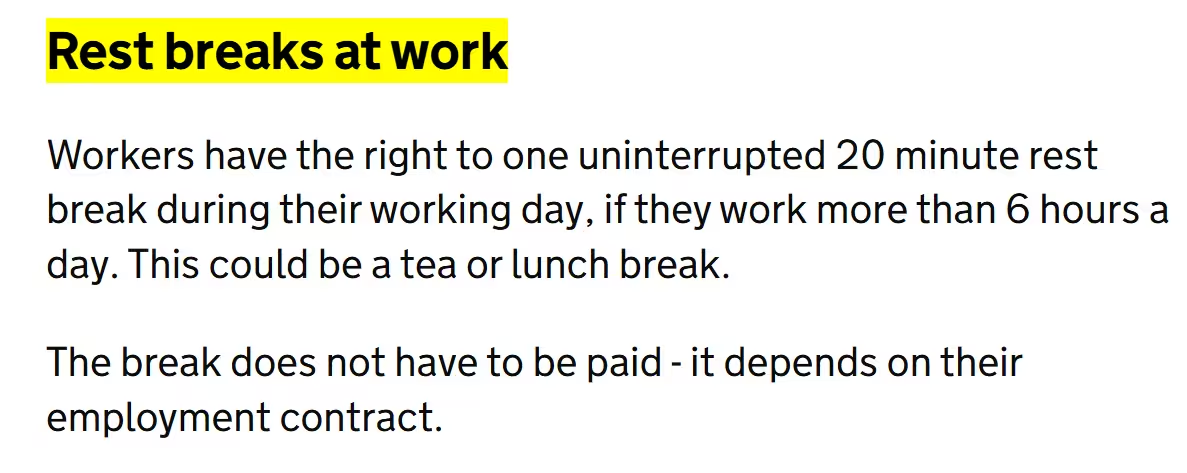
Official UK rest-break rules confirming the minimum 20-minute entitlement for adults working more than six hours.
Why Do 16 and 17-Year-Old Workers Have Different Break Rights?
Young workers who have passed compulsory school-leaving age but are under 18 receive stronger working-time protections.
Under the standard rules, they are entitled to at least 30 minutes of rest when their daily working time exceeds four-and-a-half hours.
For example:
- A 17-year-old working exactly four hours does not automatically qualify for a statutory rest break.
- A 17-year-old working five hours normally qualifies for 30 minutes.
- A 16-year-old apprentice working six hours normally receives the same young-worker protection.
Young workers are also normally restricted to eight working hours per day and 40 hours per week, with additional daily and weekly rest requirements.
These protections are particularly relevant to employers recruiting students for weekend retail, hospitality or warehouse roles. Young people considering part-time work should understand that being under 18 does not automatically guarantee a rest break during every short shift.
Children who have not reached compulsory school-leaving age are subject to different rules. In England, they generally cannot work more than four hours without a break of at least one hour, alongside other child-employment restrictions.
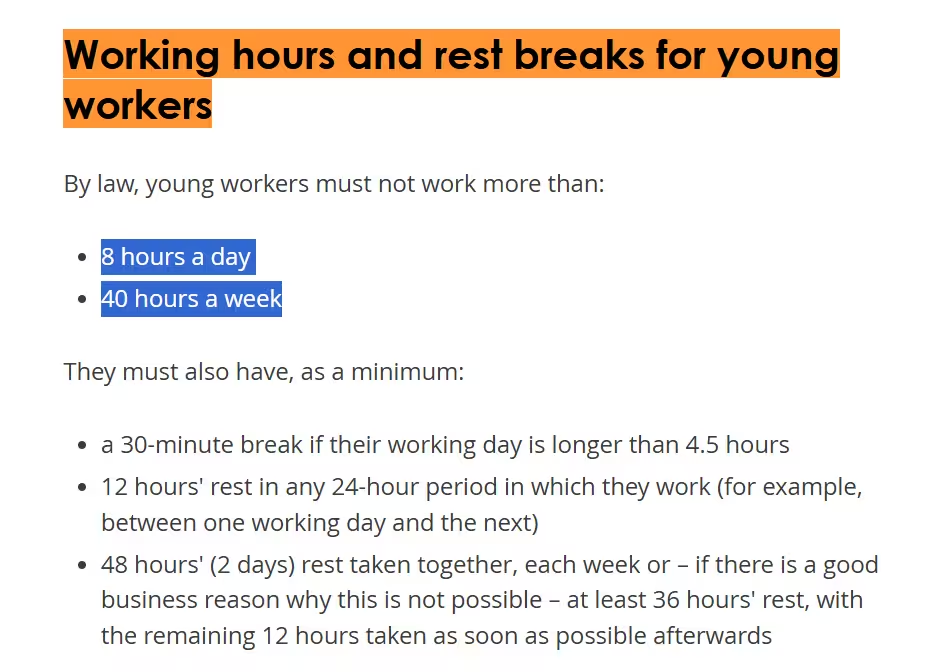
Acas guidance explaining the 30-minute rest-break entitlement and working-hour limits for young workers.
Are 15-Minute Breaks During a 4-Hour Shift Paid or Unpaid?
A common misunderstanding is that an employer must pay for every break taken during scheduled working hours.
In reality, ordinary rest breaks do not automatically have to be paid. The contractual terms and whether the employee actually continues working are important.
Consider a worker earning an illustrative £15 per hour.
| Four-hour roster arrangement | Paid working hours | Gross earnings |
| 9 am–1 pm, no break | 4 hours | £60.00 |
| 9 am–1 pm, genuine 15-minute unpaid break | 3.75 hours | £56.25 |
| 9 am–1 pm, contractual paid 15-minute break | 4 paid hours | £60.00 |
| 9 am–1:15 pm, including a 15-minute unpaid break | 4 hours | £60.00 |
These examples assume hourly payment for the relevant hours and no separate contractual guarantee of pay.
A 15-minute unpaid break represents 6.25% of a four-hour period, reducing gross earnings by £3.75 at the illustrative £15 hourly rate.
However, an employer cannot automatically deduct 15 minutes merely because a break appears on the rota. If an employee spends that time assisting customers, answering calls or performing duties, the period may count as working time.
This is particularly significant when calculating the effective hourly rate and checking National Minimum Wage compliance.
From a payroll perspective, employers should distinguish between genuine rest, paid contractual breaks and time worked. An incorrectly recorded deduction can create an underpayment even if the original rota appeared compliant.
Can Employers Refuse Breaks in Retail, Hospitality or Office Jobs?
An adult working an ordinary four-hour shift can generally be required to work without a scheduled statutory rest break. However, the type of work and the employer’s contractual arrangements still matter.
| Workplace | Four-hour shift consideration |
| Supermarkets and retail | Company policies may provide short paid or unpaid breaks |
| Restaurants and cafés | Busy service periods do not remove applicable contractual or safety obligations |
| Warehouses | Repetitive lifting and physical fatigue may require additional safety measures |
| Offices | Display-screen work may require suitable changes of activity or shorter screen breaks |
| Healthcare and care homes | Staffing, fatigue risks and individual health needs may justify additional breaks |
These are workplace considerations, not universal sector-specific break entitlements.
We would advise small-business employers to avoid assuming that compliance with the six-hour threshold automatically satisfies every workplace safety obligation.
For example, a four-hour shift involving repetitive manual work may require more frequent recovery periods than a relatively light administrative shift.
Employees with disabilities may also need additional rest as a reasonable adjustment. That obligation is separate from the ordinary Working Time Regulations threshold.
A clear employee–employer relationship depends on documented working conditions, consistent employment policies and properly communicated break arrangements.
What Happens If a 4-Hour Shift Is Extended?
One of the most important issues for 2027 workforce planning is the difference between scheduled hours and actual working time.
Suppose an adult worker is scheduled from 9 am until 1 pm but is asked to stay longer.
| Actual working period | Normal adult statutory entitlement |
| 9 am–1 pm | No automatic break |
| 9 am–2 pm | No automatic break |
| 9 am–3 pm | No automatic break |
| 9 am–3:15 pm | At least 20 minutes |
These examples assume the stated period is working time, with no genuine unpaid break already taken.
Where the adult worker’s daily working time exceeds six hours, the statutory break must normally be provided during the working day. Allowing the worker to finish 20 minutes early is not a substitute.
Employers should therefore anticipate possible overtime before extending a shift, rather than discovering at the end of the day that a rest break was required.
Multiple Jobs and Split Shifts
Working-time rights also apply to part-time, casual and zero-hours workers. An employer should consider total working time rather than examining only the original four-hour rota.
A worker who has a second job may also need to consider overall working hours and sufficient rest between jobs.
Genuinely self-employed business owners do not generally receive statutory employee rest-break rights from their clients. However, employment status depends on the actual arrangement, not simply the description used in a contract.
Are UK Rest-Break Rules Changing in 2027?
The Employment Rights Act 2025 introduced a wider programme of employment reforms being implemented across 2026 and 2027.
However, the reforms announced by 13 November 2026 do not introduce a general legal requirement for adults to receive a break after working four hours.
The existing statutory thresholds therefore remain the appropriate starting point for 2027 planning, unless further legislation changes them.
The new employment framework also addresses matters such as unpredictable working arrangements and shift notice, but these should not be confused with the separate legal entitlement to an uninterrupted rest break.
For businesses employing staff on short or variable shifts, our assessment is that the most useful preparation is practical rather than complicated: maintain accurate rotas, identify contractual break rights, record actual working time and review payroll deductions.
Employers should check for later legislation or updated government guidance before implementing policies for the whole of 2027.
What Can You Do If Your Employer Refuses a Break?
First, establish whether the break is a statutory entitlement, a contractual benefit or a necessary workplace adjustment.
If you are an adult working exactly four hours, there may be no automatic statutory break to enforce. But if your contract promises a paid 15-minute break, that contractual term may still be enforceable.
Where a disagreement arises, check your employment contract and handbook, keep copies of rotas and payslips, and record the hours actually worked.
Raise the issue with your manager or HR department in writing. If it remains unresolved, consider a formal grievance and independent advice from Acas.
Workers should also challenge automatic unpaid-break deductions when they continued working during the deducted period.
Final Answer
For 2027 planning, the general UK rule remains straightforward: most adult workers do not have an automatic statutory rest-break entitlement during a four-hour shift.
Adults normally qualify for 20 minutes after their daily working time exceeds six hours, while young workers above school-leaving age but under 18 generally qualify for 30 minutes when working more than four-and-a-half hours.
The practical issues are whether additional breaks are promised in the contract, whether they are paid, and whether the employer accurately records the hours worked. For workers and businesses alike, these distinctions matter more than the length of the rota alone.
Frequently Asked Questions
Do you get a 15-minute break for working four hours in the UK?
Not automatically. An employer may provide one under its employment contract or workplace policy, but most adults have no general statutory entitlement during a four-hour shift.
Can you legally work four hours without a break?
Yes. Most adults can legally work four hours without a scheduled rest break, subject to contractual rights and other relevant health and safety obligations.
Does a six-hour shift legally require a break?
Not ordinarily for an adult working exactly six hours. The general 20-minute statutory entitlement applies when daily working time exceeds six hours.
Do you get a break on a four-hour shift if you are 16?
A young worker above compulsory school-leaving age does not normally have an automatic statutory break entitlement during an exact four-hour shift. The 30-minute entitlement generally applies when working more than four-and-a-half hours. Separate rules apply below school-leaving age.
Can an employer deduct an unpaid break that was never taken?
An employer should not treat time actually spent working as an unpaid rest break. Any deduction also needs to comply with the worker’s contractual and statutory pay rights, including minimum-wage rules.

More in Tax, Legal & HMRC

Can I Be a Sole Trader and Employed at the Same Time in the UK?
Yes, a person can be employed and operate as a sole trader at the same time in the UK. Someone could work full-time or part-time for an employer while also running a freelance business, consultancy, online store, trade or other side business. HMRC specifically confirms that a person can be employed and self-employed simultaneously. For […]

Do I Need a Business Account as a Sole Trader in the UK?
A sole trader does not legally need a separate business bank account in the UK. Because a sole trader and their business are treated as the same legal person, business income can technically be received into a personal current account. However, the bank’s account terms still matter. Some personal current accounts prohibit or restrict business […]