
The NHS Learner Support Fund 2027, officially known as the NHS Learning Support Fund (NHS LSF), provides financial assistance to eligible nursing, midwifery and allied healthcare students studying in England.
Under the confirmed 2026–27 academic-year rules, qualifying students can receive a £5,000 annual Training Grant, an additional £1,000 for selected specialist courses and £2,000 in Parental Support. Funding is also available for eligible placement expenses and exceptional financial hardship.
Our analysis of the latest funding arrangements highlights an important development for 2027: eligible students can now access advance payments of up to £600 towards placement-related costs, subject to specific conditions.
The Department of Health and Social Care published its latest rules on 24 July 2026. These apply to the 2026–27 academic year, including payments made during 2027. Separate funding rates for the 2027–28 academic year have not yet been confirmed.
How Much Is the NHS Learning Support Fund in 2027?
Students can qualify for several different types of financial support depending on their course, study arrangements and personal circumstances.
| Funding type | Confirmed 2026–27 amount | Who qualifies? |
| Training Grant | £5,000 annually | Eligible healthcare students |
| Specialist Subject Payment | Additional £1,000 annually | Students on selected specialist courses |
| Parental Support | £2,000 annually | Eligible students responsible for dependent children |
| Travel and Dual Accommodation Expenses | Based on eligible costs | Students attending qualifying placements |
| Exceptional Support Fund | Up to £3,000 | Students facing unforeseen financial hardship |
| Placement Advance Payment | Up to £600 | Eligible students with approved placement-expense claims |
The Training Grant, Specialist Subject Payment and Parental Support are non-repayable when students remain eligible.
For example, a full-time mental health nursing student who qualifies for Parental Support could receive:
- Training Grant: £5,000
- Specialist Subject Payment: £1,000
- Parental Support: £2,000
Total annual entitlement: £8,000.
That is equivalent to approximately £667 per month for budgeting purposes, although actual payments are made in three termly instalments rather than monthly.
Students experiencing exceptional hardship might receive additional assistance, but the Exceptional Support Fund is assessed individually and cannot be treated as guaranteed income.
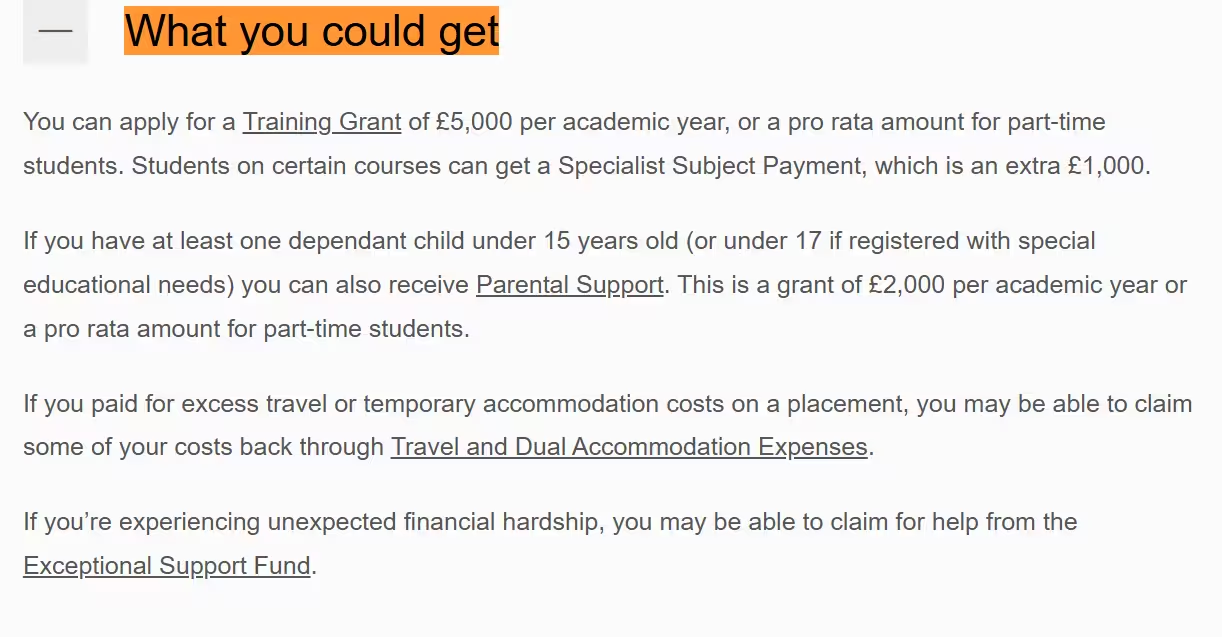
NHS Learning Support Fund allowances for 2026–27, including the £5,000 Training Grant and additional student support.
Who Is Eligible for the NHS Learner Support Fund?
Eligibility depends on more than simply studying a healthcare-related subject.
Under the published rules, applicants generally need to:
- Study an eligible pre-registration undergraduate or postgraduate healthcare course at an institution in England.
- Be ordinarily resident in the UK.
- Be eligible for tuition fee and maintenance support through the relevant UK student finance authority.
- Remain actively enrolled and attending their course.
- Meet the requirements of the particular funding allowance.
Students who qualify for student loans but choose not to take them may still be eligible, provided they can demonstrate that they satisfy the relevant student-finance criteria.
Which Healthcare Courses Qualify?
| Course category | Examples | £5,000 Training Grant |
| Nursing | Adult, children’s, mental health and learning disability nursing | Yes |
| Midwifery | Eligible pre-registration midwifery degrees | Yes |
| Allied health | Physiotherapy, occupational therapy and dietetics | Yes |
| Diagnostic services | Diagnostic and therapeutic radiography | Yes |
| Other professions | Podiatry, orthoptics and speech and language therapy | Yes |
| Dental professions | Dental hygiene and dental therapy at eligible levels | Yes |
| Pharmacy | Eligible undergraduate pharmacy | No — placement expenses only |
| Healthcare science | Eligible pre-registration healthcare science | No — placement expenses only |
Other qualifying programmes include operating department practice, prosthetics and orthotics, and eligible paramedicine degrees.
Foundation years and certain foundation-degree or diploma-level paramedicine courses are excluded.
Students already receiving an NHS Bursary, a Social Work Bursary or qualifying NHS salary support generally cannot receive NHS LSF for the same period.
Can Students With a Previous Degree Apply?
Yes, in some circumstances.
Having an existing degree does not automatically disqualify someone from the scheme. A graduate entering an eligible pre-registration healthcare programme may qualify if they satisfy the relevant student-finance and NHS LSF requirements.
However, eligibility for certain second-degree courses can require individual assessment. Students considering a career change should confirm their funding position before accepting a university place.
What Changed in the NHS Learning Support Fund During 2026?
Two developments are especially important for students budgeting for 2027.
- First, placement advance payments were introduced for 2026–27: Previously, students frequently needed to cover qualifying travel and accommodation expenses themselves and recover those costs afterwards.Under the updated arrangements, eligible students can request an advance towards future placement expenditure.
- Second, pharmacy and healthcare science placement support remains available: Since September 2025, eligible students on these courses have been able to access Travel and Dual Accommodation Expenses. However, they do not qualify for the other NHS LSF allowances, including the new advance-payment facility.
The distinction matters because students sometimes assume that access to one element of NHS LSF automatically provides access to every allowance.
Our assessment is that the advance-payment arrangement is particularly relevant to students who must travel significant distances or pay for temporary accommodation during mandatory placements.
How Does the New £600 Placement Advance Work?
Eligible students may request:
| Advance type | Maximum advance |
| Travel expenses | £200 |
| Accommodation expenses | £400 |
| Travel and accommodation combined | £600 |
To qualify, students must generally have an approved Training Grant and at least one approved TDAE claim for the type of advance requested. Students in the final term of their final year are excluded.
The advance is not an additional £600 grant. Future approved placement claims are deducted from the advance balance, and any outstanding balance may need to be recovered.
This improves cash-flow flexibility without increasing the underlying entitlement to reimbursement.
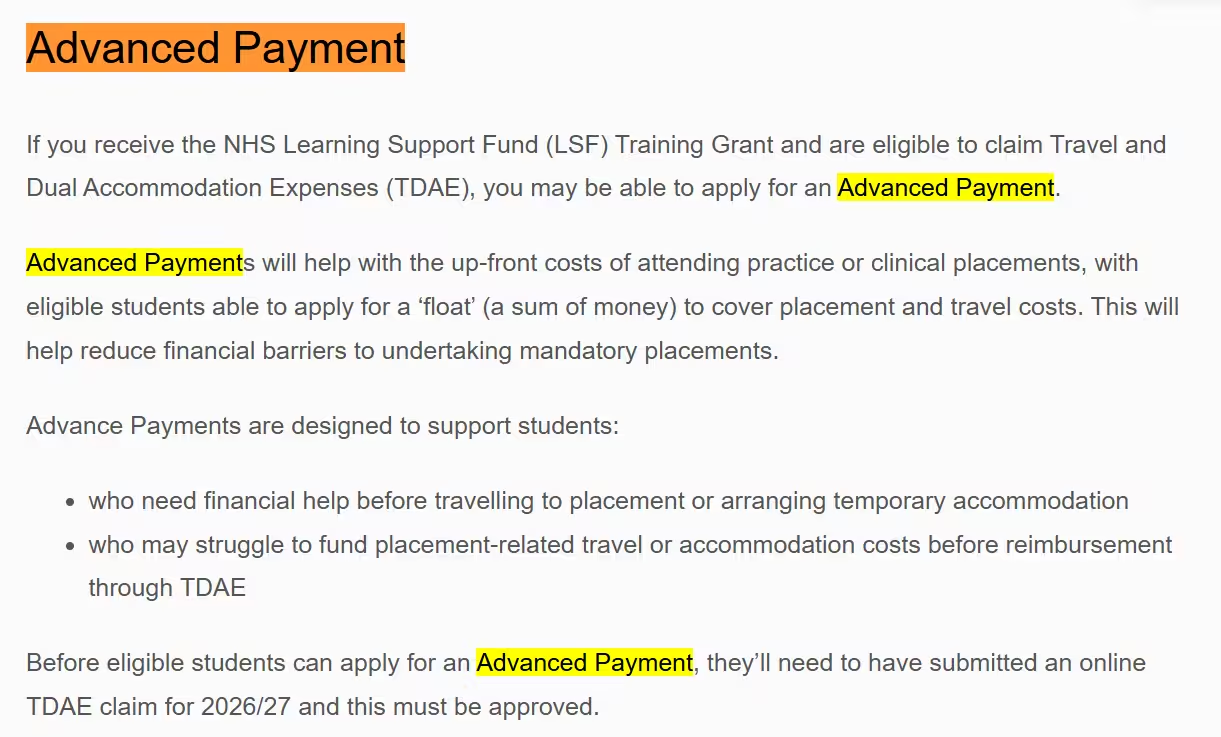
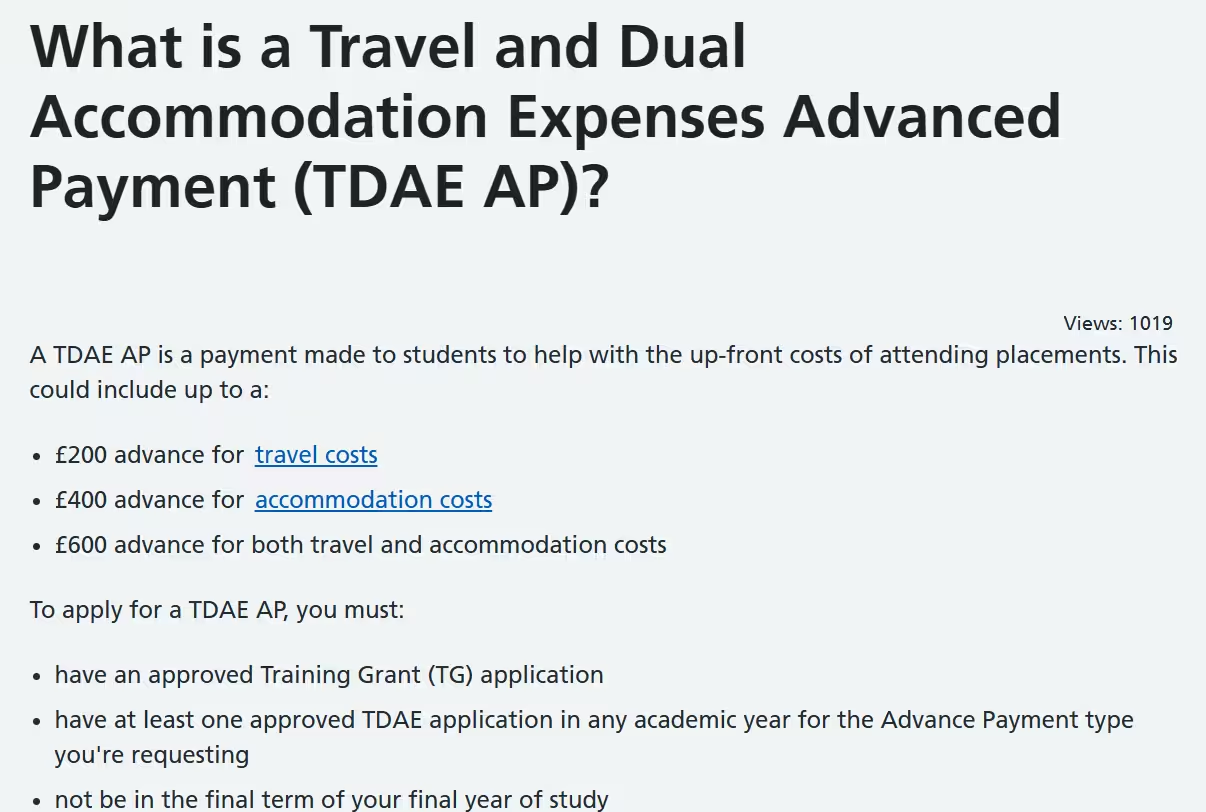
NHS placement advance payments introduced for 2026–27, with support for upfront travel and accommodation expenses.
When Will NHS Learning Support Fund Payments Arrive in 2027?
Students starting their course or next academic year in September or October 2026 have three main scheduled payments.
| Instalment | Payment date |
| Term 1 | 17 November 2026 |
| Term 2 | 16 March 2027 |
| Term 3 | 20 July 2027 |
These dates apply to the September and October 2026 cohorts. Students beginning in January, February, March or other months follow different schedules.
Payments are conditional on attendance confirmation.
During the first term, the university confirms the student’s attendance. For terms two and three, students must confirm their continued attendance through their NHS LSF account before their university completes its confirmation.
This process is called Confirmation of Student Attendance, or COSA.
A missed confirmation can delay payment even when the original grant application was successful.
Students who have not received an expected payment should therefore check their application status, bank details and attendance confirmation before assuming their funding has been withdrawn.
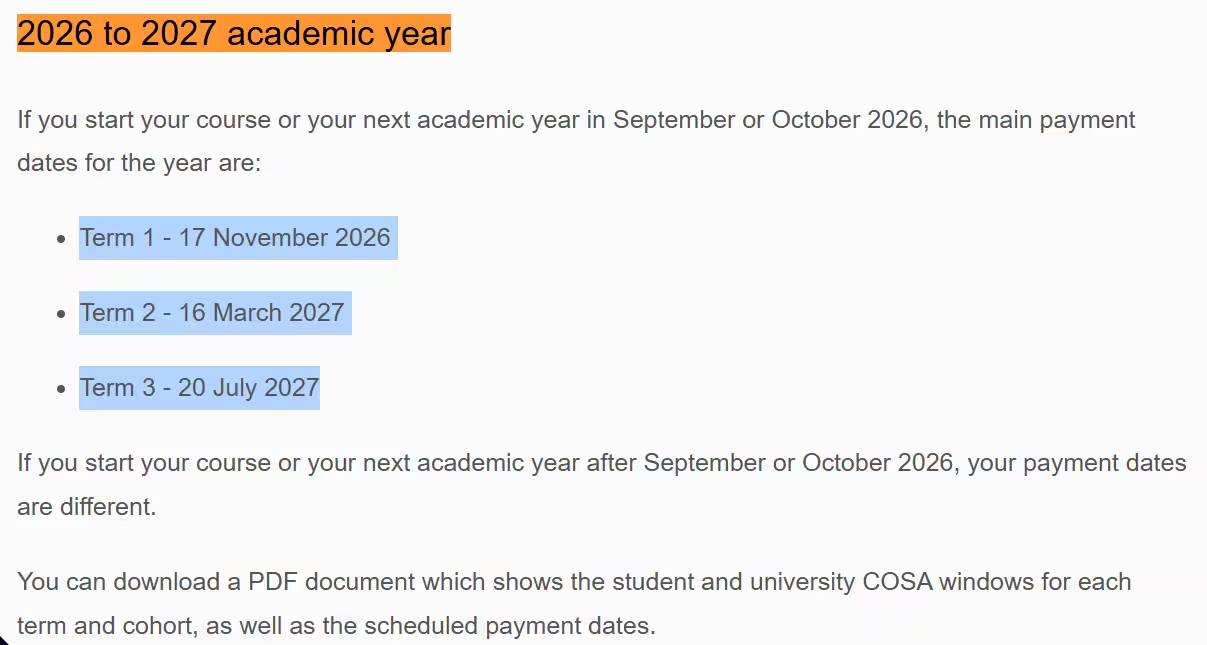
Official NHS Learning Support Fund payment dates for the 2026–27 academic year, including March and July 2027 instalments.
How Much Can Part-Time NHS Students Receive?
Full-time and part-time students do not necessarily receive identical annual grants.
The 2026–27 rules provide specific proportional rates for eligible programmes that would normally take three years to complete full-time.
| Study duration | Percentage of full-time allowance | Annual Training Grant |
| 3 years, full-time | 100% | £5,000 |
| 4 years, part-time | 75% | £3,750 |
| 5 years, part-time | 60% | £3,000 |
| 6 years, part-time | 50% | £2,500 |
Other programme structures may require a different calculation.
For example, a student completing an eligible mental health nursing degree over four years instead of three could receive £3,750 in Training Grant funding plus £750 in specialist funding.
If they also qualify for Parental Support, the proportional £1,500 allowance could bring their annual entitlement to £6,000.
These calculations highlight why prospective students should compare funding against the actual duration of their course rather than assume every eligible student automatically receives £5,000.
What Travel, Childcare and Hardship Costs Can Students Claim?
The NHS Learning Support Fund can help with several costs that ordinary student finance may not fully cover.
Placement Travel and Accommodation
Students attending qualifying clinical placements may claim excess travel costs compared with their normal journey to university.
Current reimbursement limits include:
| Expense | 2026–27 rate |
| Driving | 42p per mile |
| Cycling | 30p per mile |
| Public transport | Eligible actual costs |
| Commercial accommodation | Up to £82.50 per night |
| Non-commercial accommodation | Up to £37.50 per night |
Consider a student whose normal university journey costs £5 per day but whose clinical placement journey costs £13.
Across ten placement days, the additional eligible travel expense would be:
(£13 − £5) × 10 = £80
The example assumes both journeys qualify under the published travel rules and the student supplies the required evidence.
Claims generally must be submitted within six months of the final date of the relevant placement period.
Support for Parents
Eligible full-time students responsible for a child under 15, or under 17 where the child has registered special educational needs, can receive £2,000 annually.
This is a fixed amount regardless of the number of qualifying children, not an additional £2,000 for each child.
Exceptional Financial Hardship
Students experiencing unforeseen financial difficulties may apply for up to £3,000 through the Exceptional Support Fund.
NHSBSA assesses income, essential expenditure, available financial resources and whether other support has already been exhausted.
Applicants must normally approach their university’s hardship fund first. Routine increases in living costs do not automatically establish eligibility.
How Can Students Apply for NHS Learning Support Fund in 2027?
Applications are submitted through the official NHSBSA Learning Support Fund system.
The process involves creating an account, confirming the relevant course and academic year, submitting an application for the Training Grant and providing supporting documents.
Students applying for Parental Support can usually request it alongside their Training Grant.
Depending on their circumstances, evidence may include a student finance award notification, proof of identity, a child’s birth certificate or other documents requested by NHSBSA.
Application deadlines are particularly important.
The 2026–27 published rules require students to register their account within one calendar month of starting active study and apply for funding within six months.
Examples of published cohort application deadlines include:
| Course-start cohort | Application deadline |
| September | 31 March |
| October | 30 April |
| January | 31 July |
| March | 30 September |
These examples are based on the current NHSBSA deadline schedule. Students should confirm the deadline shown for their particular academic year.
Students must also reapply when entering a new academic year. Receiving the grant in the first year does not create an automatic entitlement for the remainder of the course.
The official NHS Learning Support Fund service provides the application route, while the government’s 2026–27 funding rules explain the eligibility requirements and allowances in detail.
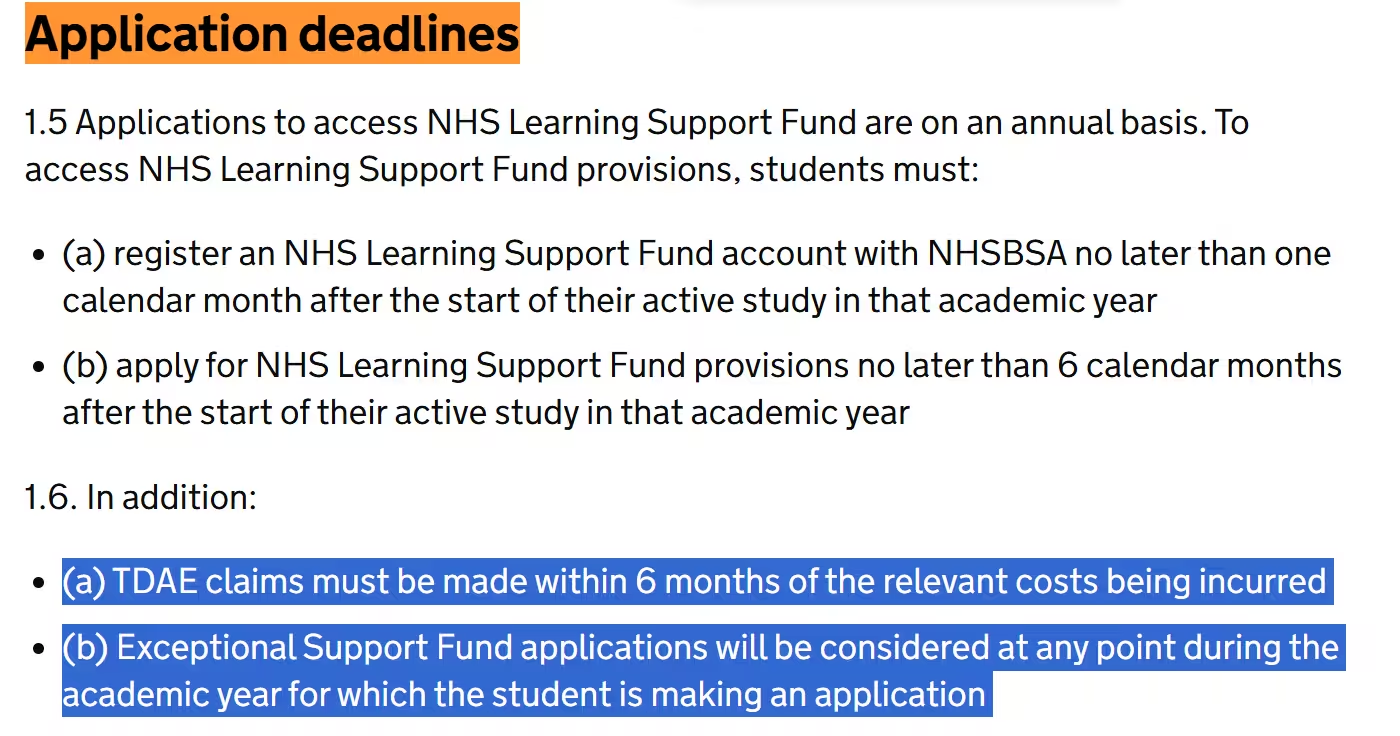
NHS Learning Support Fund 2026–27 application deadlines and eligibility conditions published by the Department of Health and Social Care.
Can NHS Students Receive the Fund Alongside Student Finance and Part-Time Earnings?
Yes. The NHS Learning Support Fund is designed to supplement mainstream student finance rather than replace it.
The Training Grant is non-means-tested, so higher household income alone does not reduce the £5,000 award for someone who satisfies the scheme’s eligibility conditions.
Students can also undertake paid work while studying, provided it does not interfere with course attendance, placement requirements or other eligibility conditions.
Those considering flexible employment can compare student side hustles that fit around university timetables. Nursing students can also explore nursing-related opportunities, taking care not to undertake regulated clinical work without the necessary qualifications and authorisation.
However, three financial considerations should remain separate:
- NHS LSF eligibility: Employment income does not automatically disqualify a student, although certain employer-funded training arrangements are excluded.
- Means-tested benefits: Student loans and grants can affect Universal Credit calculations, even where funding is non-means-tested. Rules for benefits and additional income should be considered alongside the student’s circumstances.
- Tax obligations: Earnings from employment or self-employment have their own reporting requirements. Students undertaking freelance work should understand how to declare income correctly.
Students already claiming Universal Credit should obtain an individual assessment of how their student funding will be treated rather than assume that non-repayable grants are automatically disregarded.
What Happens If NHS Learning Support Fund Payments Are Delayed or Rejected?
A delayed payment does not always mean an application has been refused.
Common causes include missing evidence, incorrect course information, incomplete attendance confirmation or an application awaiting assessment.
We recommend checking the NHS LSF account first and contacting the university’s student finance team if an attendance-related issue appears to be responsible.
Students who withdraw, interrupt their course or transfer to another programme must also report the relevant change. Their funding entitlement may be recalculated and overpayments can be recovered.
Where NHSBSA has made a decision that a student believes is incorrect, the published rules allow a formal review request, normally within 28 days of notification.
A further appeal to the Department of Health and Social Care may be available after the NHSBSA review process has been completed.
What Should NHS Students Expect From the Learning Support Fund in 2027–28?
Students planning to begin university in September 2027 should distinguish current eligibility rules from funding arrangements that have not yet been officially announced.
As of November 2026, the confirmed guidance is for 2026–27. There is no basis for promising an increase to the £5,000 Training Grant, a higher specialist payment or revised accommodation rates for the subsequent academic year.
Our financial assessment is that students planning for 2027–28 should use the current figures only as provisional budgeting assumptions and recheck the published scheme when the next annual guidance becomes available.
Prospective students should also confirm course eligibility directly with their university before relying on any grant in their financial plans.
Final Thoughts
The NHS Learner Support Fund remains an important source of financial assistance for eligible healthcare students entering or continuing their training in 2027.
The confirmed £5,000 Training Grant, specialist payments, Parental Support and reimbursement of placement expenses can significantly reduce the financial pressure of professional healthcare education.
The introduction of placement advance payments for 2026–27 also addresses a practical cash-flow problem for students who previously needed to finance placement journeys or accommodation before receiving reimbursement.
Students should prioritise checking eligibility, meeting application deadlines, confirming attendance and keeping their financial records organised. Those beginning courses in the 2027–28 academic year should monitor the next official funding announcement before making final budget decisions.
Frequently Asked Questions
Is the NHS Learner Support Fund Increasing to £6,000 in 2027?
No increase in the standard Training Grant to £6,000 has been confirmed. The published 2026–27 Training Grant remains £5,000. Some specialist students can receive an additional £1,000, giving them £6,000 combined.
Do NHS Learning Support Fund Payments Have to Be Repaid?
The main grants are non-repayable when students satisfy the eligibility requirements. However, overpayments resulting from withdrawal, changes in circumstances or incorrect entitlement can be recovered.
Can Student Nurses Receive £8,000 a Year?
Yes. Eligible full-time students on qualifying specialist courses who also receive Parental Support can receive £5,000 plus £1,000 plus £2,000, totalling £8,000 in annual support.
Can NHS Students Receive Universal Credit Alongside the Grant?
Some students can qualify for Universal Credit, but eligibility is restricted and student income can affect payment calculations. The outcome depends on individual circumstances and the applicable student-finance rules.
Can Pharmacy Students Claim the NHS Learning Support Fund?
Eligible undergraduate pharmacy students can claim qualifying placement travel and accommodation expenses. They are not eligible for the £5,000 Training Grant or the other main NHS LSF allowances under the 2026–27 rules.
What Happens If a Student Misses the NHS LSF Deadline?
Applications submitted after the relevant deadline may be rejected. Students should contact NHSBSA promptly if exceptional circumstances prevented a timely application, but acceptance cannot be guaranteed.

More in Guidance

PedroVazPaulo Business Consultant: What We Found When We Tried to Verify Him (2026)
Search for “PedroVazPaulo business consultant” and the results create the impression of an established consultant with years of experience in strategy, operations, finance, technology and executive coaching. The difficulty is that the deeper someone looks, the less straightforward the identity becomes. Several websites use the PedroVazPaulo name. They do not always agree on when the […]

LCWRA First Payment After Decision: When Will You Get Paid in 2026?
If someone has received an LCWRA decision, their first LCWRA payment after decision does not automatically arrive a fixed number of days later. In most cases, the important dates are when the claimant started providing medical evidence, such as fit notes, and their Universal Credit assessment period dates. Government guidance says the LCWRA extra amount […]