
Government backed business loans can help UK entrepreneurs and established companies access finance for starting, expanding or investing in a business. However, “government backed” does not normally mean that the government lends the money directly or repays the debt for the borrower.
Depending on the scheme, finance may be provided through commercial banks, specialist lenders or fund managers, with support from the UK Government, British Business Bank or UK Export Finance.
Some programmes are available nationwide, while others are restricted to businesses operating in particular parts of the UK.
What Government Backed Business Loans Are Available?
The main government backed business loan options in the UK include the Start Up Loans programme for newer businesses and the Growth Guarantee Scheme for smaller businesses seeking commercial debt finance.
Businesses in the North, Midlands, South West, Scotland, Wales and Northern Ireland may also qualify for debt finance through British Business Bank regional investment funds.
Exporting businesses can access additional government-backed finance through UK Export Finance.
A government guarantee usually protects part of the lender’s risk, not the borrower. Under the Growth Guarantee Scheme, for example, the borrower remains responsible for 100% of the debt, despite the government providing the lender with a 70% guarantee.
Government Backed Business Loans at a Glance
| Scheme | Typical Finance Available | Best Suited To | Coverage |
| Start Up Loans | £500–£25,000 per applicant | Start-ups and young businesses | UK-wide |
| Growth Guarantee Scheme | Generally up to £2 million | Established SMEs seeking growth finance | UK-wide |
| Northern Powerhouse Investment Fund II | £25,000–£2 million debt finance | Businesses in Northern England | North of England |
| Midlands Engine Investment Fund II | £25,000–£2 million debt finance | Midlands businesses | Midlands |
| South West Investment Fund | £25,000–£2 million debt finance | South West SMEs | South West England |
| Investment Fund for Wales | £25,000–£2 million debt finance | Welsh businesses | Wales |
| Investment Fund for Scotland | £25,000–£2 million debt finance | Scottish businesses | Scotland |
| Investment Fund for Northern Ireland | £25,000–£2 million loans | Northern Irish businesses | Northern Ireland |
| General Export Facility | Facilities up to around £25 million | UK exporters | UK-wide |
| Export Working Capital Scheme | Depends on facility | Businesses fulfilling export contracts | UK-wide |
1. Start Up Loans
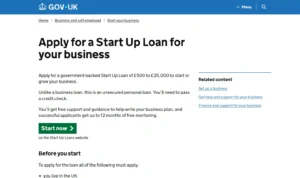
Best for: New entrepreneurs and businesses trading for less than five years
Loan amount: £500 to £25,000 per applicant
Interest rate: 7.5% fixed per year
Term: 1 to 5 years
The government-backed Start Up Loans programme is one of the most accessible finance schemes for people establishing or developing relatively young UK businesses.
Successful applicants can currently borrow between £500 and £25,000 at a fixed annual interest rate of 7.5%. The loan can be repaid over one to five years, and there are no arrangement or early-repayment fees.
Importantly, a Start Up Loan is an unsecured personal loan used for business purposes. The individual borrower is responsible for repayment.
Applicants must generally:
- be at least 18;
- be a UK resident;
- have the right to work in the UK;
- be starting a UK-based business or have traded for no more than 60 months;
- pass credit and affordability assessments; and
- demonstrate that the loan will be used for an eligible business purpose.
Several owners or partners can apply individually. The programme states that a maximum of £100,000 can be lent to one business, meaning, for example, four qualifying partners could potentially borrow £25,000 each.
This can make Start Up Loans particularly relevant for people who are moving a side hustle full-time and need capital for equipment, stock, premises, marketing or other legitimate startup costs.
2. Growth Guarantee Scheme
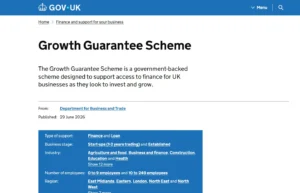
Best for: Viable smaller businesses that require commercial debt finance
Maximum facility: Generally up to £2 million
Government guarantee: 70% to the lender
Status: Open for applications
The Growth Guarantee Scheme is one of the most important government backed business finance programmes currently operating across the UK.
It is administered by the British Business Bank and delivered through accredited commercial lenders.
Depending on the lender, eligible finance may include:
- term loans;
- overdrafts;
- asset finance;
- invoice finance; and
- asset-based lending.
The scheme can generally support facilities of up to £2 million per business group, although different limits can apply to borrowers within the scope of the Northern Ireland Protocol/Windsor Framework and certain sectors.
Does the Government Repay 70% of the Loan?
No.
The 70% guarantee protects the lender against part of its losses after its normal recovery process.
The borrowing business remains 100% responsible for repaying the facility. Personal guarantees can also be requested at the lender’s discretion under normal commercial lending practices, although a principal private residence cannot be taken as security within the scheme.
2026 Growth Guarantee Scheme Changes
A significant expansion was announced on 12 July 2026.
The Government and British Business Bank announced an additional £6.5 billion of lending capacity, together with plans to:
- increase the turnover eligibility ceiling from £45 million to £54 million; and
- permit terms of up to 10 years for certain term loans and asset-finance facilities.
However, the British Business Bank stated that lenders were still working to operationalise these enhancements. Its live eligibility information continued to show the existing £45 million turnover limit while implementation was taking place. Businesses should therefore check the current terms directly with an accredited lender rather than assuming the announced £54 million threshold already applies to every application.
3. Northern Powerhouse Investment Fund II
Best for: New and growing businesses in Northern England
Loans: £25,000 to £2 million
Total fund: £660 million
Businesses based in the North of England should also consider the Northern Powerhouse Investment Fund II.
The government-backed British Business Bank programme provides finance through appointed fund managers rather than lending directly to businesses.
Its debt products are divided broadly into:
| Finance Type | Amount |
| Smaller Loans | £25,000–£100,000 |
| Debt Finance | £100,000–£2 million |
| Equity Finance | Up to £5 million |
The fund covers the North of England, including rural, coastal and urban locations, and now includes the whole North East.
It can therefore be particularly relevant to an established regional business seeking money for expansion, recruitment, new equipment, product development or other growth projects.
4. Midlands Engine Investment Fund II
Best for: Growing companies across the Midlands
Debt finance: £25,000 to £2 million
Total fund: £400 million
The Midlands Engine Investment Fund II provides commercially focused finance to smaller businesses across the Midlands.
Its finance includes smaller loans and debt funding from £25,000 to £2 million, alongside equity investment of up to £5 million.
It covers businesses across the:
- West Midlands;
- East Midlands; and
- South East Midlands.
The programme may be worth considering where a viable business requires substantially more than the £25,000 available through an individual Start Up Loan but is still within SME funding ranges.
5. South West Investment Fund
Best for: Start-ups and growing SMEs in South West England
Loans: £25,000 to £2 million
Total fund: £200 million
Businesses operating in South West England can consider the South West Investment Fund.
It provides:
- smaller loans of £25,000 to £100,000;
- debt finance of £100,000 to £2 million; and
- equity finance of up to £5 million.
Eligible geographical areas include Bristol, Cornwall and the Isles of Scilly, Devon, Dorset, Gloucestershire, Somerset, Wiltshire and surrounding parts of the South West.
As with the other Nations and Regions Investment Funds, funding is delivered through appointed managers rather than applicants borrowing money directly from the British Business Bank.
6. Investment Fund for Wales
Best for: Welsh SMEs requiring growth capital
Loans: £25,000 to £2 million
Total fund: £130 million
The Investment Fund for Wales provides commercially focused finance throughout Wales.
The fund offers:
| Type | Finance Available |
| Smaller Loans | £25,000–£100,000 |
| Debt Finance | £100,000–£2 million |
| Equity | Up to £5 million |
The programme covers rural, coastal and urban areas and is designed to increase the supply of finance to newer and growing Welsh businesses.
7.Investment Fund for Scotland
Best for: New and growing Scottish businesses
Loans: £25,000 to £2 million
Total fund: £150 million
The Investment Fund for Scotland provides debt and equity finance for smaller businesses throughout Scotland.
Available finance includes:
- £25,000 to £100,000 smaller loans;
- £100,000 to £2 million debt finance; and
- equity investment up to £5 million.
Unlike the nationwide Growth Guarantee Scheme, this funding is specifically intended to strengthen access to growth capital within Scotland.
The finance is commercial rather than a grant, so applicants still need to demonstrate a viable proposition and ability to service borrowing.
8. Investment Fund for Northern Ireland
Best for: Northern Irish businesses seeking growth finance
Loans: £25,000 to £2 million
Total fund: Around £100 million
The Investment Fund for Northern Ireland provides commercial finance throughout Northern Ireland.
Loan finance ranges from £25,000 to £2 million, while equity investment can reach £5 million.
The scheme covers businesses in rural, urban and coastal areas and is intended to increase the availability and diversity of finance for smaller companies.
It should not be confused with the Growth Guarantee Scheme, because the two programmes have different structures, delivery partners and eligibility requirements.
9. UK Export Finance General Export Facility
Best for: UK companies already generating export sales
Facility size: Up to around £25 million
Maximum term: Up to five years
Government backed business loans are not limited to businesses selling domestically.
The General Export Facility from UK Export Finance, the UK’s export credit agency, helps qualifying exporters secure trade finance from participating lenders.
The programme can support facilities worth up to around £25 million, including:
- trade loans;
- working-capital facilities;
- bonding; and
- letter-of-credit facilities.
Unlike some export finance products, businesses do not normally need to connect every facility to one particular export contract.
One important eligibility test relates to previous UK export sales. An applicant must generally be able to declare either that at least 20% of annual turnover came from UK export sales in one of the previous three financial years, or that at least 5% came from UK export sales in each of those three years, alongside other UK presence requirements.
This option is therefore more appropriate for genuine exporters than businesses that simply hope to begin exporting at some point in the future.
10. Export Working Capital Scheme
Best for: Businesses needing working capital to fulfil specific export contracts
Government support: UKEF guarantee to the lender of up to 80%
The UK Export Finance Export Working Capital Scheme is another government-backed financing route, but its purpose is more specific.
It can help a UK exporter obtain working capital associated with particular export contracts.
Under the programme, UKEF can guarantee up to 80% of a lender’s exposure to the loan, increasing the lender’s ability to provide pre- or post-shipment working capital.
For example, a manufacturer that wins a substantial overseas order may need money before the customer pays to purchase raw materials, increase production or cover contract-related expenditure.
Rather than turning down the order because of a temporary working-capital gap, UKEF-backed lending may potentially help finance its fulfilment.
Approval is not automatic and will depend on the business, lender, export contract and UKEF requirements.
Which Government Backed Business Loan Could Be Suitable?
There is no single “best” government backed business loan because the appropriate route depends on the age, location, financial position and funding requirement of the business.
| Business Situation | Scheme Worth Checking |
| Business not yet launched | Start Up Loan |
| Trading less than five years | Start Up Loan |
| Established SME needing general finance | Growth Guarantee Scheme |
| Business in Northern England | Northern Powerhouse Investment Fund II |
| Business in the Midlands | Midlands Engine Investment Fund II |
| Business in South West England | South West Investment Fund |
| Welsh business | Investment Fund for Wales |
| Scottish business | Investment Fund for Scotland |
| Northern Irish business | Investment Fund for Northern Ireland |
| Existing exporter needing flexible finance | General Export Facility |
| Exporter financing a specific contract | Export Working Capital Scheme |
Businesses should also search the Government’s broader business finance support finder because local authority, sector-specific and regional programmes may exist alongside the larger national schemes.
What Will a Business Usually Need Before Applying?
Government support does not remove normal commercial lending checks.
The Growth Guarantee Scheme, for example, requires participating lenders to conduct their standard credit, fraud, anti-money-laundering and Know Your Customer checks. Lenders may request management accounts, historic accounts, business plans, asset information and details of previous subsidies.
A business should therefore normally prepare:
- a clear explanation of how much money is required;
- details of exactly how the finance will be used;
- cash-flow forecasts;
- recent accounts where available;
- current debts and financial commitments;
- evidence that repayments are affordable; and
- a realistic business plan.
New sole traders should also make sure their business structure and tax registration are correct. The steps involved in registering as a sole trader differ from forming a limited company.
Separating commercial and personal finances can also make financial records easier to assess. The business bank account rules explain when a separate account is legally required and when it is simply good financial practice.
Businesses preparing cash-flow projections should also understand their genuine operating costs. Reviewing allowable self-employed expenses can help sole traders distinguish business costs from personal spending when preparing forecasts and tax records.
Are Government Backed Business Loans Easier to Get?
Sometimes government backing can enable a lender to provide finance it might otherwise be unwilling to offer, but it does not guarantee approval.
Under the Growth Guarantee Scheme, the purpose of the government guarantee is to give lenders additional confidence over credit risk. The lender still decides whether the business is commercially viable and can afford the borrowing.
The same principle applies to most schemes in this list.
Applicants should not assume that government involvement means:
- credit history is ignored;
- affordability checks disappear;
- every applicant receives the maximum amount;
- interest will always be lower than normal commercial lending; or
- the debt does not need to be repaid.
Comparing the total borrowing cost remains important.
Government Backed Loan vs Business Grant
A business loan and a grant are fundamentally different.
Government Backed Business Loan
Money is borrowed and normally repaid with interest.
Business Grant
Qualifying funding is generally provided without normal loan repayments, although grant conditions, reporting obligations and clawback provisions may apply.
A business should therefore avoid applying for a loan simply because it carries government backing if non-repayable funding is genuinely available for the same project.
At the same time, grant programmes can be highly competitive, narrowly targeted and time limited, whereas commercial finance may be available for a broader range of legitimate business purposes.
Government Backed Does Not Mean Risk-Free
The phrase government backed business loans can create the misleading impression that taxpayers absorb the borrower’s loss if the business fails.
That is generally incorrect.
For example, the Growth Guarantee Scheme explicitly states that its 70% guarantee is provided to the lender and that the borrower always remains 100% liable for the debt.
Start Up Loans are also personal loans. The individual applicant remains responsible for repayment even if the business does not perform as planned.
Borrowing should therefore be assessed against realistic cash flow rather than optimistic revenue forecasts.
What Government Business Finance Is Coming Next?
The UK business-finance landscape continues to develop.
The British Business Bank currently lists East of England Investment Fund and South East Investment Fund programmes as coming soon, rather than open for applications.
The Government also announced a new joint British Business Bank and UK Export Finance programme for smaller exporters in July 2026. That programme is expected to launch in spring 2027, so it should not currently be presented as an available loan scheme.
Businesses should check the official programme pages before making funding decisions because launch dates and eligibility terms can change.
Common Misconceptions About Government Backed Business Loans
“The Government Gives the Business the Money”
Not always. Most schemes use banks, specialist lenders or appointed fund managers to provide finance.
“Government Backing Means the Loan Does Not Need Repaying”
Incorrect. Government backing normally reduces the lender’s risk. The borrower remains responsible for repayment.
“Only Limited Companies Can Apply”
Not necessarily. Some programmes can support sole traders and partnerships, subject to their individual rules. Start Up Loans are actually personal loans provided to qualifying individuals for business purposes.
“A Poor Credit Score Automatically Prevents a Start Up Loan”
Not necessarily, although a full credit check and affordability assessment are carried out. Start Up Loans states that poor credit is not automatically a barrier, but certain credit circumstances can prevent approval.
“The Recovery Loan Scheme Is Still Open”
No. The Recovery Loan Scheme was extended and renamed the Growth Guarantee Scheme from 1 July 2024. New applicants should therefore look at the Growth Guarantee Scheme rather than trying to apply to the old programme.
Final Takeaway
There are several government backed business loans and government-supported finance programmes available across the UK in 2026, but they serve very different types of businesses.
For a new or recently established company, the Start Up Loans programme is usually the first government-backed option worth checking, with individual borrowing of up to £25,000.
For an established SME seeking substantially more finance, the Growth Guarantee Scheme can support commercial facilities generally reaching £2 million, subject to lender approval.
Businesses in Northern England, the Midlands, South West England, Wales, Scotland and Northern Ireland should also examine the British Business Bank’s regional investment funds, while exporters can investigate UK Export Finance facilities.
Most importantly, government backing should never be interpreted as a guarantee that an application will be accepted or that the borrower is protected from repayment. The business should compare rates, fees, security requirements, repayment terms and the effect of debt on future cash flow before accepting finance.
Frequently Asked Questions
What are government backed business loans?
Government backed business loans are finance arrangements where a government body supports access to borrowing, commonly by guaranteeing part of a lender’s risk or providing capital through a government-owned development bank.
What is the main government loan for starting a business?
The Start Up Loans programme is the principal nationwide government-backed scheme aimed specifically at new and younger UK businesses. Eligible applicants can currently borrow £500 to £25,000 at a fixed interest rate of 7.5% per year.
How much can a business borrow from the Government?
There is no single maximum because different programmes apply. Start Up Loans offer up to £25,000 per applicant, while the Growth Guarantee Scheme can generally support facilities up to £2 million. Regional British Business Bank funds commonly provide debt finance between £25,000 and £2 million, while certain UKEF-backed export facilities can be substantially larger.
Can a sole trader get a government backed business loan?
Potentially, yes. Eligibility depends on the programme and lender. A Start Up Loan can be available to an eligible individual operating a sole-trader business, provided the programme’s residency, trading-age, credit and affordability requirements are satisfied.
Can someone get a government business loan with bad credit?
Bad credit does not automatically prevent every application, but government backing does not remove credit checks. Start Up Loans conducts a full credit assessment, while commercial lenders participating in the Growth Guarantee Scheme apply their standard credit and fraud checks.
Are government backed business loans interest-free?
Generally, no. Start Up Loans currently charge a fixed 7.5% annual interest rate for new qualifying applications, while interest rates and fees under the Growth Guarantee Scheme vary between lenders and financing proposals.
Is the Growth Guarantee Scheme the same as a government loan?
Not exactly. A participating commercial lender provides the finance. The Government provides the lender with a 70% guarantee against the outstanding balance after its normal recovery process. The borrower remains liable for the entire debt.
Can a Start Up Loan be used to buy an existing business?
Potentially. Start Up Loans confirms that someone buying an existing business may apply provided the applicant satisfies the scheme’s eligibility rules. The applicant may need to provide the existing business’s financial accounts.
Are there government backed loans for buying a franchise?
Potentially. The Start Up Loans programme states that an eligible person starting a franchise may apply. Approval still depends on affordability, credit checks, the business plan and the proposed use of the money.
Do government business loans require a business plan?
Requirements vary, but a credible business plan, financial forecasts and evidence supporting affordability are commonly required or strongly expected. Start Up Loans provides business-plan and cash-flow support, while Growth Guarantee Scheme lenders may request business plans and financial accounts.

More in Guidance

PedroVazPaulo Business Consultant: What We Found When We Tried to Verify Him (2026)
Search for “PedroVazPaulo business consultant” and the results create the impression of an established consultant with years of experience in strategy, operations, finance, technology and executive coaching. The difficulty is that the deeper someone looks, the less straightforward the identity becomes. Several websites use the PedroVazPaulo name. They do not always agree on when the […]

LCWRA First Payment After Decision: When Will You Get Paid in 2026?
If someone has received an LCWRA decision, their first LCWRA payment after decision does not automatically arrive a fixed number of days later. In most cases, the important dates are when the claimant started providing medical evidence, such as fit notes, and their Universal Credit assessment period dates. Government guidance says the LCWRA extra amount […]