Spending pension savings before withdrawing money from an Individual Savings Account (ISA) is becoming an increasingly important retirement-planning decision in the UK.
The tax implications can be substantial, particularly for people approaching retirement, higher-rate taxpayers, company directors and families planning to leave wealth to the next generation.
For years, the conventional approach was to spend ISA savings first while preserving pensions for inheritance. That strategy benefited from the fact that most unused pension funds could pass outside an individual’s estate for Inheritance Tax (IHT) purposes.
However, the rules are changing.
From 6 April 2027, most unused pension funds and pension death benefits will be included in a deceased person’s estate for Inheritance Tax purposes. This could expose more retirement wealth to the standard 40% IHT rate where the estate exceeds the available exemptions and allowances.
Does that mean spending a pension before an ISA is now the better financial decision?
Not necessarily.
Although pension-first withdrawals could reduce future estate values when the money is genuinely spent or gifted, they may also produce immediate Income Tax bills. ISA withdrawals, by comparison, are normally free from Income Tax and Capital Gains Tax.
Our analysis of current HMRC rules, retirement withdrawal strategies and published commentary from pension specialists suggests that the most effective approach is often to use both accounts strategically rather than exhaust either one first.
The central question is not simply which account should be spent first, but how much can be withdrawn from each account without creating unnecessary tax liabilities or compromising long-term retirement security.
Is It Better to Spend Your Pension Before Your ISA?
Spending pension money before ISA savings can be beneficial when taxable pension withdrawals can be made at relatively low Income Tax rates, when substantial unused pensions could create future Inheritance Tax exposure, or when the withdrawals are needed for genuine retirement expenditure.
However, an ISA-first strategy can remain more attractive when drawing from a pension would push income into a higher tax band, trigger the Money Purchase Annual Allowance or reduce flexibility for future pension contributions.
The distinction becomes clearer when comparing the two accounts.
| Financial consideration | Pension withdrawals | ISA withdrawals |
| Income Tax | Usually payable on the taxable portion | Normally 0% |
| Tax-free access | Usually up to 25%, subject to limits | Normally 100% |
| Capital Gains Tax within account | Generally exempt | Exempt |
| Annual contribution allowance | Normally £60,000, subject to conditions | £20,000 |
| Withdrawal age | Normally from 55, rising to 57 in April 2028 | Generally accessible at any age, subject to account rules |
| Inheritance Tax from April 2027 | Most unused funds included in estate | Normally included in estate |
| Effect of withdrawals on pension contribution limits | May trigger £10,000 MPAA | No MPAA |
| Tax treatment for beneficiaries | Depends partly on age at death and benefit rules | No pension-withdrawal Income Tax, but ISA inheritance rules apply |
The figures reflect the standard UK rules for the 2026/27 tax year. Pension contribution limits can be lower for high earners or people who have already flexibly accessed their savings.
Our assessment is that an effective retirement strategy must consider Income Tax, IHT, investment growth, emergency liquidity and the beneficiary’s future tax position together.
What Are the Tax Implications of Spending Pension Before ISA?
The most immediate consequence is the potential Income Tax payable when money leaves a pension.
Most people can normally take up to 25% of their qualifying defined contribution pension savings tax-free, subject to a standard lump sum allowance of £268,275 across their pensions. The remaining taxable withdrawals are added to their other taxable income.
An ISA works differently. Money deposited into an ISA has generally already come from income or capital that has been taxed, where applicable. Once inside the wrapper, qualifying investment gains and interest are sheltered from UK Income Tax and Capital Gains Tax.
For retirees, this means a £20,000 ISA withdrawal can normally provide £20,000 of usable money without an additional Income Tax charge.
A £20,000 fully taxable pension withdrawal may provide significantly less after tax.
UK Pension Income Tax Rates for 2026/27
The following table illustrates the main Income Tax bands for England, Wales and Northern Ireland.
| Annual income | Marginal Income Tax rate |
| Up to £12,570 | 0% standard Personal Allowance |
| £12,571–£50,270 | 20% |
| £50,271–£125,140 | 40% |
| Above £125,140 | 45% |
The Personal Allowance reduces by £1 for every £2 of adjusted net income above £100,000, creating a potential effective marginal Income Tax rate of 60% in the allowance-withdrawal range.
Scottish residents have different non-savings Income Tax bands, including 19%, 20%, 21%, 42%, 45% and 48% rates for 2026/27.
Consequently, large pension withdrawals can become particularly expensive for people who already receive employment income, rental income, dividends or other taxable pension payments.
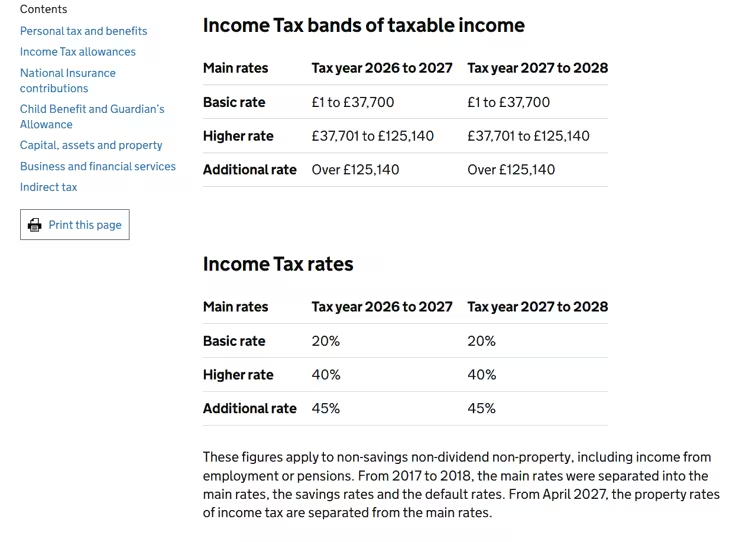
HMRC’s official 2026/27 Income Tax bands demonstrate how additional taxable pension withdrawals can increase a retiree’s tax liability.
Example: What Happens When You Withdraw £20,000 From a Pension?
Consider someone who already receives £30,000 in taxable annual income and decides to withdraw another £20,000.
Assume the individual lives in England, qualifies for the standard Personal Allowance and the additional pension withdrawal is fully taxable.
| Calculation | Amount |
| Existing annual taxable income before Personal Allowance | £30,000 |
| Additional taxable pension withdrawal | £20,000 |
| Total annual income | £50,000 |
| Additional Income Tax at 20% | £4,000 |
| Net amount received from pension withdrawal | £16,000 |
If the same person withdrew £20,000 from an ISA instead, they would normally receive the entire £20,000 without additional Income Tax.
That is a £4,000 immediate tax difference, although the two withdrawals reduce the underlying accounts by different net amounts.
This example demonstrates why pension-first strategies cannot be judged solely by potential IHT savings.
In practice, the correct comparison must consider the amount of spendable retirement income required, the assets remaining after withdrawal and the future tax consequences for beneficiaries.
How Will the April 2027 Inheritance Tax Changes Affect Pension Withdrawals?
The upcoming pension Inheritance Tax reform is the principal reason many retirees are reconsidering their withdrawal strategies.
Under the rules applying to most discretionary defined contribution pensions before 6 April 2027, unused funds generally remain outside the deceased person’s estate for IHT.
For deaths on or after 6 April 2027, most unused pension funds and relevant pension death benefits will become part of the IHT calculation.
This change was legislated through Finance Act 2026.
The standard IHT rate remains 40% on the taxable part of an estate exceeding the relevant allowances.
However, the change does not mean every pension will face a 40% charge.
Tax depends on the total estate, exemptions, the identity of beneficiaries, available nil-rate bands and the type of pension benefits involved.
Inheritance Tax Thresholds
| IHT allowance or rate | Amount |
| Standard nil-rate band | £325,000 |
| Residence nil-rate band, where eligible | Up to £175,000 |
| Potential combined allowance for an individual | Up to £500,000 |
| Potential combined allowances for a qualifying married couple or civil partners | Up to £1 million |
| Standard IHT rate on taxable value | 40% |
The residence nil-rate band normally requires a qualifying home to pass to direct descendants. It is tapered for estates worth more than £2 million.
Transfers to a spouse or civil partner generally remain exempt from IHT, meaning the reform may have a greater impact when assets eventually pass to children or other non-exempt beneficiaries.
We examined the wider changes to UK Inheritance Tax and family wealth planning, particularly the combined effect of frozen tax thresholds and the inclusion of unused pensions in estates.
For business owners, these changes also make it important to review how personal pensions, company ownership and family assets interact within the estate.
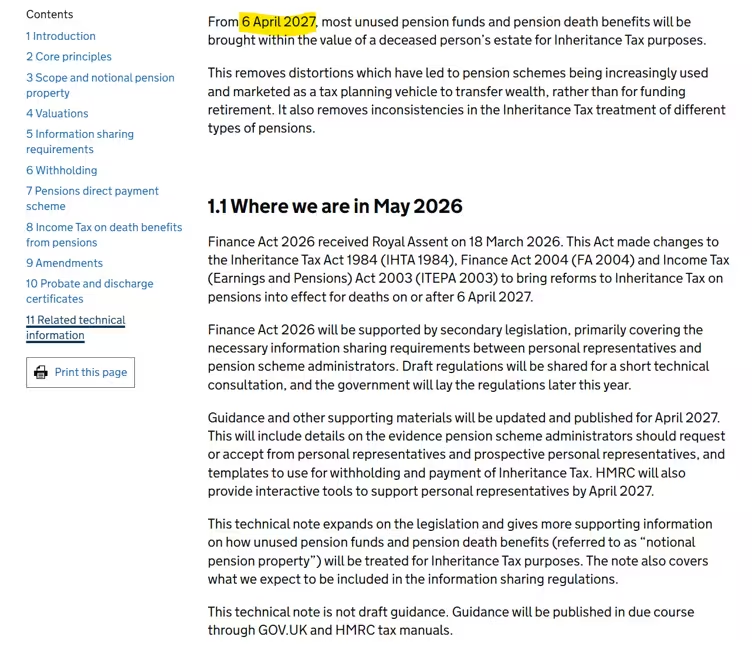
HMRC confirms that most unused pension funds and pension death benefits will enter the Inheritance Tax calculation from 6 April 2027.
Example: How Much Additional Inheritance Tax Could a Pension Create?
Consider a simplified estate belonging to an unmarried individual.
| Estate calculation | Before April 2027 | From April 2027 |
| Property and other estate assets | £400,000 | £400,000 |
| Unused pension funds | £300,000 | £300,000 |
| Amount included in IHT estate | £400,000 | £700,000 |
| Standard nil-rate band | £325,000 | £325,000 |
| Taxable estate | £75,000 | £375,000 |
| Illustrative IHT at 40% | £30,000 | £150,000 |
The difference is £120,000 in potential IHT.
This example assumes the pension is excluded under the earlier rules but included under the new rules, with no residence nil-rate band, spouse exemption, other reliefs, debts or relevant gifts. It is not a prediction of an actual estate’s tax bill.
Nevertheless, the example demonstrates why a pension that was previously preserved for inheritance might now require a different withdrawal strategy.
An important distinction is that withdrawing £100,000 from a pension and placing the proceeds into an ISA does not automatically remove that money from the estate. Both pension funds and ISA savings can be included in the IHT calculation from April 2027.
In contrast, money legitimately spent on living expenses no longer remains in the estate, while qualifying lifetime gifts may also reduce future IHT exposure.
What Do Pension and Financial Experts Say About Spending Pensions First?
Our review of published retirement-planning commentary reveals an important shift in professional thinking.
Previously, advisers often recommended preserving pension assets because they could potentially be passed to beneficiaries outside the IHT estate.
That reasoning will need to change for some households after April 2027.
Paul Squirrell, Head of Retirement and Savings Development at Fidelity Adviser Solutions, examined the implications of the new rules in April 2026.
He observed:
“From April 2027, that approach may be flipped 180 degrees”
Squirrell’s wider analysis emphasised the importance of considering a client’s total assets, particularly where beneficiaries could face both inheritance-related charges and Income Tax on inherited pension withdrawals.
However, the possibility of additional taxes does not automatically justify withdrawing an entire pension.
Rachel Vahey, Head of Public Policy at AJ Bell, addressed this distinction in her October 2026 analysis of moving retirement savings from a SIPP into an ISA.
She explained:
“Moving money from a SIPP into a Stocks and shares ISA will not, by itself, solve an IHT problem.”
This is particularly relevant for retirees who believe that moving pension savings into an ISA before April 2027 will automatically protect those assets from IHT.
It will not.
Our assessment of these published expert views is that retirement planning is moving away from rigid withdrawal rules towards a more individualised approach involving marginal tax rates, estate values and beneficiaries’ circumstances.
For professionals, company directors and entrepreneurs, the practical implication is that pension drawdown should be coordinated with salary, business income, dividends and other retirement resources.
Can Spending Your Pension First Reduce Your Inheritance Tax Bill?
Yes, but the outcome depends on what happens to the money after it leaves the pension.
There are three different situations.
Spending the Withdrawal on Retirement Living Costs
Using pension withdrawals for ordinary expenditure, travel, household bills or other genuine personal consumption can reduce the value of assets left at death.
If that reduces a taxable estate, it may also reduce the potential IHT liability.
Spending the Withdrawal on Retirement Living Costs
This changes the tax wrapper rather than automatically reducing the estate. The withdrawn money may also suffer Income Tax before being placed into the ISA.
Gifting Withdrawn Pension Money
Making qualifying gifts could reduce future IHT exposure, but the rules depend on the type of gift, whether an exemption applies and how long the donor survives.
These distinctions are essential because a pension-first strategy may produce a tax cost today without providing the expected IHT benefit later.
How Do the Seven-Year Rule and Gifting Allowances Work?
Individuals can normally make gifts using the following IHT provisions.
| Gifting provision | General rule |
| Annual gift exemption | £3,000 per tax year |
| Unused annual exemption | Can normally be carried forward one tax year |
| Small gifts | Up to £250 per recipient, subject to conditions |
| Potentially exempt transfers | Usually become exempt if the donor survives seven years |
| Normal expenditure out of income | Qualifying regular gifts may be exempt without a fixed monetary limit |
| Gifts to spouses or civil partners | Generally exempt, subject to applicable conditions |
For someone who receives regular pension income exceeding their living expenses, the normal expenditure out of income exemption can be worth investigating.
However, the payments must satisfy the relevant conditions, including being part of normal expenditure, coming from income and leaving the donor with sufficient income to maintain their usual standard of living.
A pension tax-free lump sum is capital rather than automatically qualifying income, so it should not be assumed to qualify for the normal expenditure exemption.
Business owners and wealthy retirees may benefit from documenting the purpose, timing and source of any gifts.
What Happens if You Spend Your ISA Before Your Pension?
An ISA-first approach allows someone to meet expenditure without creating additional taxable pension income.
This is particularly useful if the individual already receives substantial pension income, continues working or expects to enter a higher tax band.
An ISA withdrawal can also help smooth household cash flow during periods of irregular business or investment income.
For example, someone receiving £48,000 annually may want an additional £20,000 for home improvements.
If they withdraw £20,000 of fully taxable pension income, their annual taxable income increases to £68,000.
Assuming England’s 2026/27 rates and a standard Personal Allowance, the extra pension withdrawal would generate approximately £7,546 in Income Tax.
They would receive approximately £12,454 after that additional tax.
Withdrawing £20,000 from an ISA would normally produce £20,000 without an additional Income Tax liability.
This is an important difference, although preserving pension funds could create a different estate-planning outcome in future.
ISA-first withdrawals can therefore remain sensible for higher earners, retirees still receiving employment income and people who want to avoid crossing tax thresholds in a particular year.
Can You Withdraw Pension Money Tax-Free and Move It Into an ISA?
In certain circumstances, yes.
A saver can normally take up to 25% of eligible pension funds tax-free, subject to their remaining tax-free lump sum allowance, and subsequently pay the money into an ISA within the applicable subscription limit.
For 2026/27, the standard ISA subscription allowance is £20,000.
The same £20,000 annual allowance will remain in place for 2027/28.
An important development from the October 2026 Budget is that the government reversed the previously announced plan to reduce the Cash ISA subscription limit to £12,000 for people under 65.
Therefore, the earlier £12,000 restriction will not take effect in April 2027.
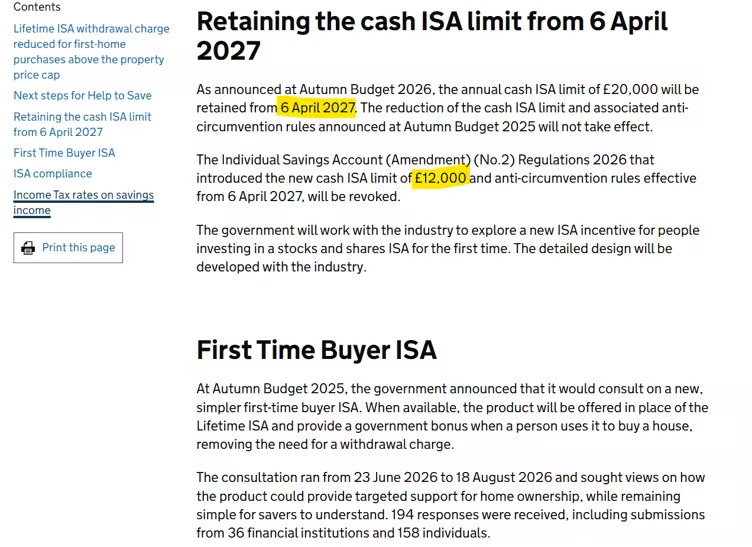
HMRC’s October 2026 update confirms that the £20,000 Cash ISA limit will be retained from April 2027.
Nevertheless, moving tax-free pension cash into an ISA does not automatically produce a financial advantage.
Pension funds and ISA investments can both benefit from tax-efficient investment growth.
The decision also uses ISA subscription capacity and may reduce the tax-free pension withdrawal opportunities available later.
Where a retiree wants to compare different cash savings options, reviewing Cash ISA interest rates and account conditions can help identify how fixed-term restrictions could affect retirement liquidity.
Importantly, new pension contributions funded indirectly from tax-free pension withdrawals may be affected by HMRC’s pension recycling rules. A withdrawal-and-reinvestment strategy should therefore be checked before implementation.
How Does the Money Purchase Annual Allowance Affect Pension-First Withdrawals?
One potentially expensive consequence of pension-first withdrawals is the Money Purchase Annual Allowance (MPAA).
The standard annual allowance for tax-relieved pension saving is generally £60,000 in 2026/27, subject to earnings and other restrictions.
However, flexibly accessing taxable defined contribution pension savings can trigger a lower MPAA of £10,000.
This restriction matters particularly for people who continue working, operate a limited company, receive employer pension contributions or intend to increase pension saving before fully retiring.
| Pension activity | Normally triggers MPAA? |
| Taking only a qualifying 25% tax-free cash lump sum | No |
| Taking taxable flexi-access drawdown income | Yes |
| Taking an uncrystallised funds pension lump sum | Usually yes |
| Receiving a conventional defined benefit pension | No |
| Taking a qualifying small-pot lump sum under the specific rules | Generally no |
| Withdrawing money from an ISA | No |
An owner-director continuing to receive employer pension contributions could inadvertently reduce their future defined contribution pension-saving allowance by accessing taxable pension income.
In our assessment, this is one of the most significant practical considerations for business owners approaching retirement.
Before beginning pension drawdown, it is important to establish whether future employer contributions, pension tax relief and annual allowance planning could be affected.
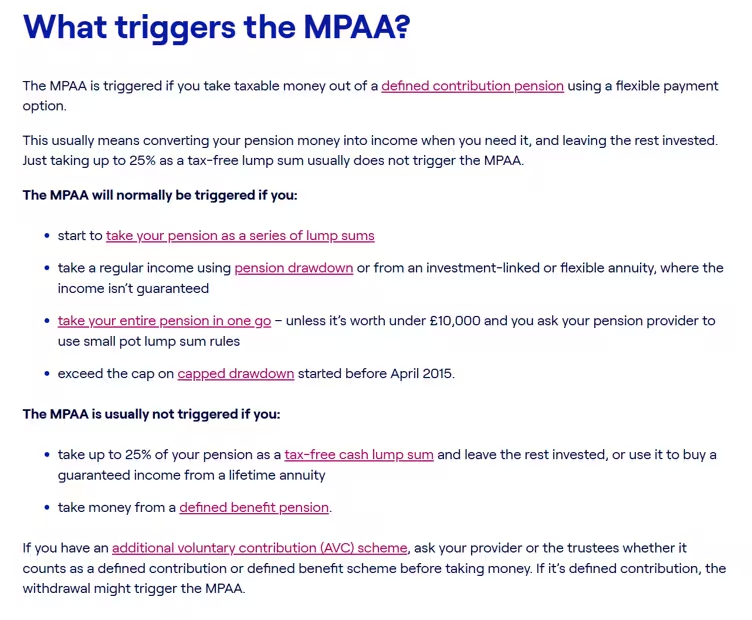
MoneyHelper explains when taxable pension withdrawals trigger the £10,000 Money Purchase Annual Allowance.
Should You Spend Your Pension First if You Are Over 75?
The decision can become more complicated after age 75 because of the tax treatment of inherited pension benefits.
Where the pension holder dies before age 75, qualifying inherited pension benefits are generally capable of being received without Income Tax, subject to the applicable rules and allowances.
If the pension holder dies aged 75 or over, beneficiaries normally pay Income Tax at their own marginal rate when withdrawing taxable inherited pension benefits.
From April 2027, most unused pension funds will also enter the estate’s IHT calculation, unless an exemption or exclusion applies.
This creates the possibility of both IHT and subsequent beneficiary Income Tax charges.
However, these charges should not simply be added together as if they were one tax rate. The new rules include provisions affecting the interaction of IHT and Income Tax, and the precise outcome depends on the benefits, estate and beneficiaries.
This makes the beneficiary’s tax position particularly relevant.
For example, leaving an inherited pension to an additional-rate taxpayer may have a different outcome from leaving it to someone with comparatively modest taxable income.
Preserving ISA assets can sometimes be advantageous because withdrawals by the recipient are not taxed as inherited pension income, although the ISA’s own inheritance treatment and whether the beneficiary is a spouse or civil partner must still be considered.
A spouse or civil partner may also benefit from the special Additional Permitted Subscription rules, allowing an additional ISA subscription based on the deceased partner’s ISA value, subject to the qualifying conditions.
Our assessment is that retirees over 75 with large pension balances should evaluate both their own Income Tax exposure and the likely tax treatment for their intended beneficiaries before accelerating withdrawals.
What Is the Most Tax-Efficient Way to Withdraw Money From a Pension and ISA?
A blended approach can often provide better control over annual taxation than withdrawing money exclusively from one account.
Rather than deciding to spend all pension savings before touching an ISA, retirees can identify how much taxable pension income can be withdrawn within a chosen tax band and then use ISA savings to meet any remaining spending requirement.
Example: Combining Pension and ISA Withdrawals
Consider a retiree in England who receives £32,000 in taxable annual income and wants an additional £20,000 in spendable money.
The individual has sufficient pension savings and ISA assets but wants to avoid entering the 40% Income Tax band.
One possible approach is:
| Withdrawal component | Amount |
| Existing annual income | £32,000 |
| Additional fully taxable pension withdrawal | £15,000 |
| Additional Income Tax on pension withdrawal at 20% | £3,000 |
| Net cash from pension withdrawal | £12,000 |
| ISA withdrawal | £8,000 |
| Total additional spendable money | £20,000 |
| Total annual taxable income after withdrawals | £47,000 |
This example deliberately keeps taxable income below the £50,270 higher-rate threshold.
It assumes the pension withdrawal is fully taxable and ignores other adjustments or reliefs.
The combination can provide a controlled income stream while gradually using pension assets and retaining some ISA flexibility.
However, the most effective split will depend on the individual’s annual spending requirement, other income, tax residence, pension tax-free cash entitlement and long-term estate position.
A saver seeking a Cash ISA for emergency access should also assess provider protections and account structures, including the considerations covered in Cash ISA safety and savings protection.
What Are the Biggest Mistakes When Spending Pensions Before ISAs?
- Withdrawing too much in a single tax year: Large pension withdrawals can push taxable income into higher bands, reduce the Personal Allowance or create unexpected tax bills.
- Assuming an ISA removes Inheritance Tax: ISA savings are generally included in the estate for IHT. Transferring pension cash into an ISA does not automatically prevent an IHT liability.
- Ignoring the Money Purchase Annual Allowance: People continuing to work or receive pension contributions could face reduced pension-saving flexibility after taxable withdrawals.
- Taking tax-free pension cash before it is needed: Withdrawing early can reduce future options for accessing tax-free pension money. It may also mean moving assets out of a pension wrapper unnecessarily.
- Overlooking temporary emergency tax deductions: The first taxable pension payment may be taxed using an emergency code, resulting in more tax being deducted initially than is ultimately due.
- Running down retirement savings too quickly: Tax efficiency should not come at the expense of sustainable retirement income. Investment losses, inflation, unexpected medical expenditure and longevity can materially affect a retirement plan.
- Ignoring fixed-rate ISA withdrawal restrictions: Some Cash ISAs impose early access penalties or restrictions. A saver should understand these conditions before relying on the account for regular retirement spending.
- Overlooking the impact on means-tested support or care costs: Withdrawal decisions can affect assessable income or capital for some benefits and care-funding calculations, depending on the applicable rules.
How Should Business Owners and Self-Employed People Plan Pension and ISA Withdrawals?
Retirement planning for business owners requires additional consideration because personal taxable income may fluctuate between years.
Directors may receive salary, dividends, rental income or proceeds from business disposals alongside pension withdrawals.
A year with unusually high income may be a poor time to take a substantial taxable pension lump sum.
Conversely, a year with relatively low taxable income could present an opportunity to withdraw pension money at a lower marginal tax rate.
For example, a director who has stopped drawing a full salary but has not yet begun receiving the State Pension may have unused Personal Allowance or basic-rate Income Tax capacity.
Gradual pension withdrawals during this period could reduce future pension balances without creating the same immediate tax burden that would arise during higher-income years.
Our analysis suggests that business owners should also consider the following factors before choosing a withdrawal sequence:
- Whether they intend to continue receiving employer pension contributions.
- Whether future dividends or business income could push them into higher Income Tax bands.
- Whether they need liquid ISA savings for personal or business-related emergencies.
- Whether they are likely to leave a taxable estate after April 2027.
- Whether family succession plans involve substantial business or investment assets.
- Whether they have defined benefit pensions providing guaranteed retirement income.
A company’s financial position should not be confused with the owner’s personal retirement finances. Business expenditure, company dividends and pension contributions all have separate tax and legal consequences.
Does Spending Your Pension Before ISA Always Save More Tax?
No. The financial outcome depends on the interaction of several taxes rather than a single percentage.
For some households, pension-first withdrawals can reduce the eventual amount of taxable inherited pension wealth.
For others, ISA-first withdrawals can avoid an immediate 40% or 45% pension Income Tax liability while preserving investment growth within the pension.
A hybrid approach can also limit annual tax exposure while gradually reducing future pension balances.
The following comparison summarises where each strategy may be more appropriate.
| Financial circumstances | Strategy worth considering | Main reason |
| Retiree with unused basic-rate tax capacity | Gradual pension withdrawals | Potentially lower immediate Income Tax |
| Higher-rate taxpayer with substantial ISA savings | ISA withdrawals or a blend | Avoid additional higher-rate pension tax |
| Person with a potentially IHT-liable estate | Review pension-first spending or gifting | May reduce estate value |
| Individual continuing pension contributions | ISA withdrawals or carefully structured pension access | Avoid triggering MPAA |
| Retiree with unused tax-free pension cash | Assess phased tax-free withdrawals | Potential tax-free liquidity |
| Retiree aged 75+ with non-spouse beneficiaries | Full estate and beneficiary-tax analysis | IHT and inherited pension Income Tax may interact |
| Individual dependent on savings for emergencies | Preserve accessible cash reserves | Liquidity and financial resilience |
These are planning considerations rather than guaranteed recommendations. A different withdrawal order may be preferable after modelling the full household finances.
Final Thoughts: Should You Spend Your Pension Before Your ISA?
The decision to spend pension savings before ISA funds is becoming more important as the UK prepares to include most unused pensions in estates for Inheritance Tax from April 2027.
However, treating pension-first withdrawals as a universal tax-saving strategy would be a mistake.
Our analysis shows that the most effective approach frequently involves balancing taxable pension income against ISA withdrawals, using available tax bands sensibly and considering future inheritance liabilities.
For retirees with substantial assets, the key is to assess the total tax impact over their lifetime and the subsequent transfer of wealth rather than concentrating solely on one year’s tax bill.
The objective should be to retain more after-tax retirement wealth, preserve sufficient financial security and transfer assets efficiently—not simply to empty a pension before an ISA.
Tax legislation, investment values and individual circumstances can change. Anyone considering significant withdrawals, gifts or pension restructuring should obtain regulated financial advice and, where appropriate, specialist tax advice before making irreversible decisions.
Frequently Asked Questions
Is it better to use your pension or ISA first in retirement?
Neither is automatically better. Pension-first withdrawals may help use lower Income Tax bands or reduce future estate values, while ISA-first withdrawals generally avoid additional Income Tax.
Will pensions be subject to 40% Inheritance Tax from 2027?
From 6 April 2027, most unused pension funds will enter the estate for IHT. The 40% rate applies only to the taxable portion after relevant exemptions, allowances and reliefs.
Can I withdraw £20,000 from an ISA without paying tax?
Normally, yes. Withdrawals from an ordinary Cash ISA or Stocks and Shares ISA do not incur Income Tax or Capital Gains Tax.
Is transferring pension money into an ISA a way to avoid Inheritance Tax?
No. An ISA is normally included in the estate for IHT, so moving pension savings into an ISA does not automatically reduce inheritance tax.
Does taking pension tax-free cash trigger the MPAA?
Taking only a qualifying pension tax-free lump sum normally does not trigger the MPAA. Flexibly accessing taxable defined contribution pension income generally does.
Can I spend my pension first and leave my ISA to my children?
Yes, but the overall tax consequences depend on the size of the estate, your pension withdrawals, and the beneficiary’s circumstances. ISA assets may still be subject to IHT.

More in Finance & Tax

UK Budget Starter Investment ISA: How Will the New ISA Incentive Work in 2026 and Beyond?
The UK Budget Starter Investment ISA is one of the latest proposals intended to encourage more British savers to enter the investment market. Announced by Chancellor John Healey during the Autumn Budget on 28 October 2026, the proposed initiative could introduce financial incentives for people investing through a Stocks and Shares ISA for the first […]
Is Trading 212 Cash ISA Safe in 2026? FSCS Protection, Risks and Our Expert Review
Is Trading 212 Cash ISA safe? Yes, Trading 212’s UK Cash ISA is generally considered a well-protected savings option because it is offered by an FCA-regulated firm, with eligible deposits held at partner banks covered by the Financial Services Compensation Scheme (FSCS). However, understanding how that protection works is essential before depositing substantial savings. As […]