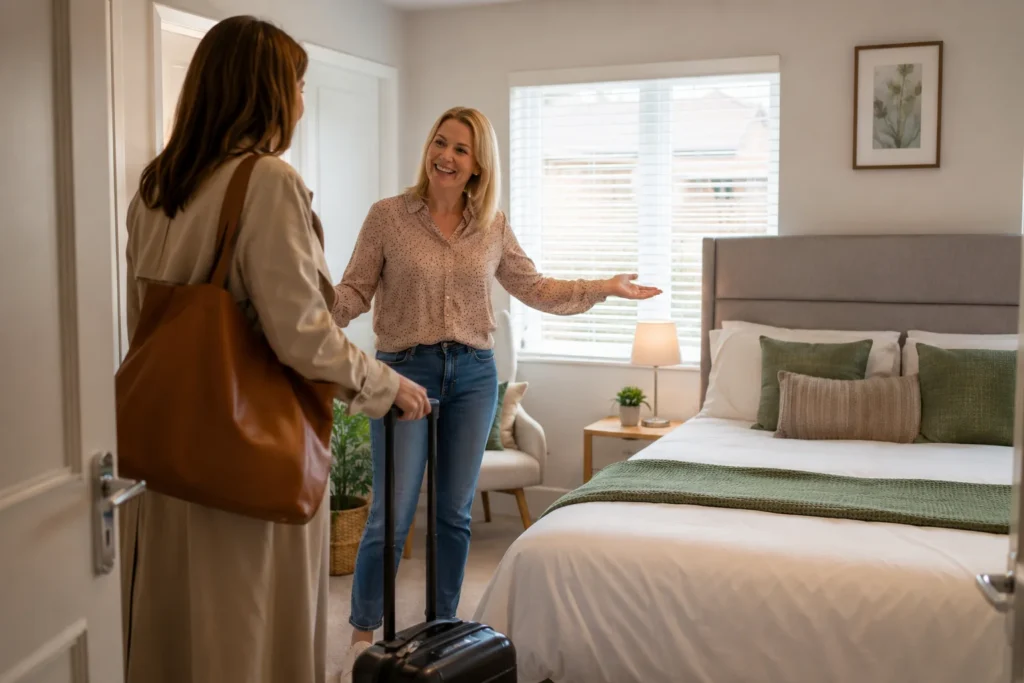
Renting out a spare room on Airbnb can be one of the more tax-efficient ways to earn extra income from a UK home, but the rules are more detailed than simply listing a bedroom and keeping the first £7,500 tax-free.
Where furnished accommodation forms part of the host’s only or main home, the Rent-a-Room Scheme can provide up to £7,500 of tax-free gross receipts each tax year. The threshold falls to £3,750 for each person if someone else also receives income from accommodation in the same property. HMRC confirms that the relief is available to both homeowners and tenants, provided the qualifying conditions are met.
However, Airbnb fees changed during 2026, Scotland has a licensing regime for short-term lets, Wales is introducing compulsory visitor-accommodation registration from October 2026, Northern Ireland has its own certification rules, and Airbnb now supplies host information to tax authorities under digital-platform reporting rules.
That makes an Airbnb spare room less of a completely passive side hustle than the headline £7,500 allowance might suggest.
Can You Airbnb a Spare Room in the UK?
In principle, yes. Someone who lives in their own home can normally offer a furnished bedroom for short stays, provided they also comply with any mortgage, lease, tenancy, insurance, planning, licensing and local-authority restrictions that apply.
For tax purposes, HMRC’s Rent-a-Room rules are particularly important. The relief applies to furnished residential accommodation in the individual’s only or main residence. It can cover conventional lodgers as well as activities that amount to a trade, such as providing meals or cleaning services alongside accommodation.
The fact that Airbnb is being used as the booking platform does not by itself prevent Rent-a-Room relief.
What matters is the underlying accommodation and how the property is being used.
How Much Can an Airbnb Spare Room Earn?
There is no dependable nationwide figure for what one spare bedroom will generate. Nightly prices vary substantially according to postcode, room quality, transport links, events, seasonality, private bathroom availability and local demand.
A better way to estimate potential income is to work from realistic local nightly prices and expected booked nights.
| Example | Listed Nightly Price | Booked Nights | Gross Accommodation Income |
| Occasional hosting | £45 | 50 | £2,250 |
| Weekend-focused hosting | £60 | 80 | £4,800 |
| Higher-demand room | £75 | 100 | £7,500 |
| Busy premium room | £80 | 120 | £9,600 |
These are illustrations rather than UK averages.
A host should search comparable private-room listings in the same postcode or neighbourhood, rather than using figures for entire homes. Whole-property Airbnb revenue data can significantly overstate what a single spare bedroom is likely to produce.
The £7,500 Rent-a-Room threshold is also based on qualifying gross receipts, not what is left after Airbnb’s fee, laundry, heating, cleaning and other hosting costs.
Airbnb Changed Its Host Fees in 2026
This is one of the most important updates missing from older UK Airbnb articles.
Airbnb has been phasing out its traditional split-fee structure for home hosts and moving towards a single host-paid service fee. Airbnb’s 2026 guidance uses 15.5% as its standard single-fee example and says the old split-fee arrangement is being phased out as hosts migrate.
Under the older arrangement, many hosts paid around 3% while guests paid a separate service fee. Under the single-fee structure, Airbnb deducts the larger service fee from the host’s listed price instead.
For example, at an illustrative £60 nightly price with a 15.5% Airbnb fee:
| Item | Amount |
| Listed price | £60.00 |
| Illustrative 15.5% Airbnb fee | £9.30 |
| Host payout before other costs | £50.70 |
A host charging £60 for 80 booked nights would therefore have £4,800 of accommodation revenue before considering the applicable tax calculation, but the platform payout after a 15.5% fee would be approximately £4,056 before cleaning, laundry, utilities and other costs.
Hosts should check the fee breakdown shown on their own Airbnb account because the applicable structure and final percentage can vary.
How the £7,500 Rent-a-Room Scheme Works
The Rent-a-Room Scheme allows qualifying hosts to receive up to £7,500 of gross receipts tax-free from furnished accommodation in their only or main home.
If somebody else also receives income from letting accommodation in the same residence during the relevant period, the individual limit is normally reduced to £3,750.
If qualifying receipts remain within the applicable limit, the exemption generally applies automatically.
HMRC says gross Rent-a-Room receipts include more than the nightly room charge. They can include amounts received for associated services such as:
- meals;
- cleaning;
- laundry; and
- other goods or services supplied in connection with the accommodation.
The amount therefore needs to be considered before deducting hosting expenses.
Hosts wanting a wider explanation of reliefs available against property income can also compare the Rent-a-Room rules with other legal ways to reduce tax on rental income.
Does a Self-Contained Annex Qualify?
This requires more care than many Airbnb guides suggest.
A permanently separate flat or annexe that is genuinely a different residence will not normally fall within Rent-a-Room relief simply because it is next to the host’s home.
However, HMRC does not say that every self-contained area is automatically disqualified.
Its Property Income Manual specifically says furnished accommodation in a self-contained flat within the individual’s only or main residence can potentially qualify where the division into separate accommodation is only temporary.
HMRC considers factors including whether structural work would be needed to reverse the division, whether the accommodation has separate utilities, its own postal address, its own entrance and whether it could realistically be sold or mortgaged separately. Each case depends on its facts.
A normal spare bedroom sharing the kitchen, hallway or bathroom with the host presents a much simpler Rent-a-Room position.
What Happens If Airbnb Income Goes Above £7,500?
Once qualifying gross receipts exceed the Rent-a-Room limit, HMRC provides two possible calculations.
Method A: Normal Profit Calculation
Under the normal method:
Taxable profit = qualifying receipts minus allowable expenses
The normal property or trading-income rules determine which expenses are deductible.
Potential costs might include qualifying platform fees, cleaning expenses, utilities attributable to the letting, repairs and other genuine business expenses, subject to the normal tax rules.
Method A is HMRC’s default calculation where receipts exceed the threshold unless the host elects to use the alternative method.
Method B: Rent-a-Room Alternative Calculation
The alternative calculation is:
Taxable amount = gross qualifying receipts minus £7,500
No additional expenses or capital allowances can then be deducted against that income.
For example, if qualifying receipts were £9,600:
£9,600 − £7,500 = £2,100 taxable
If that £2,100 all fell within a 20% Income Tax band, the illustrative Income Tax would be £420.
The host’s actual liability depends on their wider taxable income and, in Scotland, the applicable Scottish Income Tax bands.
Method B is frequently attractive where genuine deductible expenditure is substantially below £7,500. Method A can be more favourable where allowable costs are unusually high.
Can the £1,000 Property Allowance Be Used Instead?
The £1,000 property allowance and the £7,500 Rent-a-Room Scheme should not be treated as two allowances that can simply be stacked on the same Airbnb spare-room income.
GOV.UK specifically states that the property allowance cannot be used on income from letting a room in a person’s home under the Rent-a-Room Scheme.
The £1,000 property allowance is more relevant when someone has qualifying property income that falls outside Rent-a-Room—for example, certain income from another property.
This distinction is important because generic “Airbnb tax” articles often combine spare-room hosting, second homes and entire-property holiday letting even though the tax treatment can be different.
Airbnb Reporting to HMRC
Online platforms have had additional UK reporting obligations since 1 January 2024.
HMRC states that digital-platform operators may need to collect and verify seller information and report relevant seller details and income annually. The information for a calendar year is normally submitted to HMRC by the following January.
That does not create a new Airbnb tax.
A host who legitimately qualifies for full Rent-a-Room relief does not suddenly become taxable merely because Airbnb reports their activity.
There is, however, an important accounting detail.
The platform’s annual report can show the amount earned after fees, commissions or taxes deducted by the platform. That figure should not automatically be treated as the Rent-a-Room gross-receipts figure, because Rent-a-Room tests gross qualifying receipts before deductible expenses.
Hosts should therefore keep their Airbnb transaction records rather than relying only on the amount that reaches their bank account.
Where taxable property income from earlier years has been missed, the site’s explanation of HMRC landlord tax disclosures and reporting missed rental income covers the separate disclosure issue.
Does Making Tax Digital Affect Airbnb Hosts?
Making Tax Digital for Income Tax became compulsory for the first qualifying group from 6 April 2026.
The current rollout is:
| Previous Tax Return’s Qualifying Income | MTD Start Date |
| More than £50,000 | 6 April 2026 |
| More than £30,000 | 6 April 2027 |
| More than £20,000 | 6 April 2028 |
Qualifying income broadly means gross income from self-employment and property before expenses, based on the relevant previous tax return.
An occasional host earning a few thousand pounds from one room will therefore not generally enter MTD merely because of that activity. It becomes more relevant where the individual also has substantial property or sole-trader income.
Rules Before Putting a Spare Room on Airbnb
Tax is only one part of the decision.
A homeowner with a mortgage should check the mortgage conditions before accepting bookings. Some lenders permit a resident homeowner to take paying guests, while others require notification or consent and may treat short-term accommodation differently from a conventional lodger.
Leaseholders should separately check their lease. A freeholder, management company or superior landlord can restrict short-term letting even where local planning rules would otherwise permit it.
A tenant should obtain the landlord’s written consent before subletting or accepting paying guests where the tenancy agreement requires it.
Insurance should also be checked before the first booking.
Airbnb’s AirCover currently includes up to US$3 million of Host Damage Protection and US$1 million of Host Liability Insurance, subject to its terms. However, Airbnb explicitly states that Host Damage Protection is not an insurance policy and that AirCover is not a substitute for adequate personal home, renter or liability insurance.
The existing home insurer should therefore be told about the proposed Airbnb activity rather than assuming AirCover replaces the household policy.
Safety Responsibilities Still Apply
Accepting paying guests creates responsibilities for the condition and safety of the accommodation.
Requirements vary according to the type of letting and which UK nation the property is in, but hosts should check fire precautions, smoke and carbon-monoxide alarms, gas appliances, electrical installations, furniture safety and safe escape routes before taking bookings.
GOV.UK’s resident-landlord guidance, for example, covers repairs, gas and electrical safety and furniture requirements for relevant arrangements in England.
Scottish licensing and Northern Irish accommodation-certification rules introduce additional standards of their own.
Airbnb Spare Room Rules Differ Across the UK

This is now one of the most important sections for UK hosts because the regulatory position is no longer adequately explained by one nationwide rule.
England and the London 90-Night Rule
Greater London has the best-known short-let restriction.
An entire residential property can generally be used for short-term accommodation for no more than 90 nights in a calendar year without the relevant planning permission, provided the statutory conditions are met.
This should not be confused with renting one spare room while the host continues to live in the home.
Airbnb and Greater London Authority material distinguish spare-room home sharing from an entire-home short let, and the platform’s automatic 90-night limit is applied to entire-home London listings.
Elsewhere in England, hosts should still check the relevant council because planning, licensing and property-specific restrictions can vary.
Scotland
Scotland has a much more formal short-term-let licensing regime.
The Scottish Government recognises four licence categories: home sharing, home letting, combined home sharing and home letting, and secondary letting.
Home sharing specifically covers the situation where all or part of a person’s own home is used for short-term guests while the host remains there.
A Scottish Airbnb host should therefore check the short-term-let licensing requirements with the relevant council before accepting bookings rather than assuming a spare room is exempt.
Wales
Wales introduces another major change in autumn 2026.
Visitor-accommodation registration opens on 1 October 2026, and providers must register with the Welsh Revenue Authority by 31 March 2027 where the rules apply.
The Welsh Government expressly includes main homes and spare rooms, even where accommodation is only offered occasionally. Bookings of 31 nights or less fall within the registration rules.
This means someone advertising a spare bedroom in Cardiff, Swansea or elsewhere in Wales through Airbnb needs to consider the registration regime even if hosting only takes place during a small number of events each year.
Northern Ireland
Northern Ireland operates its own tourist-accommodation certification system.
Tourism Northern Ireland states that tourism and visitor accommodation must hold the appropriate current Tourism NI certificate, involving inspection against the applicable certification requirements.
Anyone planning regular Airbnb room stays in Northern Ireland should therefore check which Tourism NI accommodation category applies before trading.
Airbnb Spare Room vs a Long-Term Lodger
The Rent-a-Room tax relief can apply to both arrangements, but the commercial experience is very different.
| Factor | Airbnb Spare Room | Longer-Term Lodger |
| Income | Variable | Usually predictable |
| Nightly potential | Higher | Lower |
| Occupancy certainty | Lower | Higher |
| Cleaning | Frequent | Much less frequent |
| Guest messaging | Regular | Limited after move-in |
| Turnovers | Frequent | Rare |
| Privacy | Different guests regularly | One person sharing the home |
| Pricing flexibility | High | Low during agreement |
| Seasonal demand | Important | Usually limited |
| Platform fee | Usually applies | Usually none after finding lodger |
Airbnb can suit someone who wants control over availability and can close the calendar whenever the room is needed.
A conventional lodger can suit someone who values predictable income and wants to avoid repeated check-ins, cleaning and guest communication.
Neither arrangement automatically produces the higher net return. Location, occupancy, cleaning costs, Airbnb fees and the value of the host’s time all matter.
How to Work Out Whether Airbnb Is Worth It?
Hosts should look beyond the advertised nightly rate.
Suppose a room is priced at £65 and receives 70 booked nights during the year.
Gross accommodation revenue would be:
£65 × 70 = £4,550
Using an illustrative 15.5% Airbnb single service fee:
£4,550 × 15.5% = £705.25
This leaves approximately:
£3,844.75
before laundry, cleaning products, extra energy use, breakfast or refreshments, replacements, insurance changes and the value of the host’s own time.
The income may still fall fully within Rent-a-Room relief, but “tax-free” and “cost-free” are not the same thing.
This is why net earnings per booked night are usually more useful than gross annual revenue when deciding whether Airbnb is worthwhile.
How to Improve Spare-Room Earnings?
The strongest room listings generally remove uncertainty for the guest.
Photography should accurately show the bedroom, bathroom arrangement, workspace, storage and shared areas. The listing should make clear whether the bathroom is private or shared, whether the host lives at the property, whether breakfast is available, and what check-in arrangements apply.
Pricing should be compared against private rooms, not whole flats.
Local events, conferences, university dates, concerts and transport connections can justify temporary price adjustments, but rates should still reflect the quality of the room.
A two-night minimum can reduce changeover work in some markets, while one-night availability can increase occupancy where the property serves airports, railway stations, hospitals or business districts.
The most profitable strategy therefore depends on the type of traveller the location naturally attracts rather than one universal Airbnb pricing formula.
Records an Airbnb Spare-Room Host Should Keep
Even where income remains within the Rent-a-Room exemption, keeping a basic hosting record makes it much easier to demonstrate how the figures were calculated.
The record should cover booking dates, accommodation charges, cleaning or other guest charges, Airbnb fees, refunds, platform payouts and relevant hosting expenses.
The host should also retain the annual platform information Airbnb provides under the digital-platform reporting regime.
The key figure for Rent-a-Room is not simply the amount transferred to a bank account.
Is Renting a Spare Room on Airbnb Worth It in 2026?
A spare-room Airbnb can still be an attractive use of unused space, particularly because qualifying hosts can receive up to £7,500 of gross receipts under the Rent-a-Room exemption.
But the calculation should be based on net income and compliance, not the advertised nightly rate alone.
Airbnb’s changing service-fee structure reduces the amount retained from each booking, and hosts now need to pay closer attention to regional regulation. Scottish licensing, Welsh registration from October 2026 and Northern Irish certification requirements make a generic UK-wide “just list your room” approach increasingly inaccurate.
For someone who already has a furnished spare room, remains resident in the property, has permission to host and expects moderate occupancy, the initial capital requirement can still be relatively low. The sensible approach is to confirm the property’s legal and insurance position first, estimate earnings using genuine nearby private-room listings, and then work out the likely return after Airbnb fees and running costs.
Frequently Asked Questions
How Much Can Someone Earn From an Airbnb Spare Room Tax-Free?
Qualifying Rent-a-Room gross receipts can be exempt up to £7,500 a tax year. The individual limit is normally £3,750 where another person also receives letting income from accommodation in the same residence.
Does Airbnb Income Need to Be Declared If It Is Under £7,500?
Where all the Rent-a-Room conditions are met and gross receipts remain within the applicable limit, the exemption is normally automatic. Someone who has another reason to complete Self Assessment should still make sure the return is completed correctly.
Does Airbnb Report UK Hosts to Hmrc?
Digital platforms may be required to collect and report seller information annually under rules introduced from January 2024. Platform reporting itself does not mean that tax is automatically due.
Does the £7,500 Limit Apply After Airbnb Fees?
No. Rent-a-Room works from qualifying gross receipts before expenses. The net payout reaching the host’s bank account should not automatically be treated as the figure used for the £7,500 test.
Can Airbnb Fees Be Deducted as an Expense?
Where the host calculates taxable profit under the normal income-and-expenses method, qualifying platform fees may form part of the relevant expenses. They cannot be deducted in addition to the £7,500 allowance when the alternative Rent-a-Room calculation is used.
Does London’s 90-Night Airbnb Limit Apply to a Spare Room?
The well-known 90-night restriction concerns entire-home short-term letting. Home sharing where the host continues living in the property is treated differently, and Airbnb’s automatic London cap applies to entire-home listings.
Does an Airbnb Spare Room in Scotland Need a Licence?
Scotland’s short-term-let system includes a specific home-sharing licence category covering short-term letting in the host’s own home while the host remains resident.
Will Airbnb Spare Rooms in Wales Have to Register?
Yes, where the Welsh visitor-accommodation registration rules apply. Registration opens on 1 October 2026 and includes main homes and spare rooms offered for qualifying overnight bookings. Providers must register by 31 March 2027.
Is Airbnb Aircover Enough Instead of Home Insurance?
It should not be treated as a replacement for personal insurance. Airbnb itself recommends that hosts review their homeowner or renter policy and says Host Damage Protection is not an insurance policy.

More in Platforms & Apps
How to Sell Tickets on Ticketmaster in the UK?
To sell tickets on Ticketmaster, sign in to your Ticketmaster account, open My Tickets, select the relevant booking and choose Sell. Select the tickets you want to list, set an allowed resale price, enter your payout details and confirm the listing. The Sell option is not available for every ticket. Resale must be enabled by […]

AI Side Hustles UK 2026: Real Platforms, Real Earnings
AI training and evaluation is the most genuinely new side hustle category of the past three years. It did not exist in any meaningful scale before 2022, and by 2026 it is one of the most searched UK side hustle categories — partly because the pay rates are genuinely high for specialist contributors, and partly […]