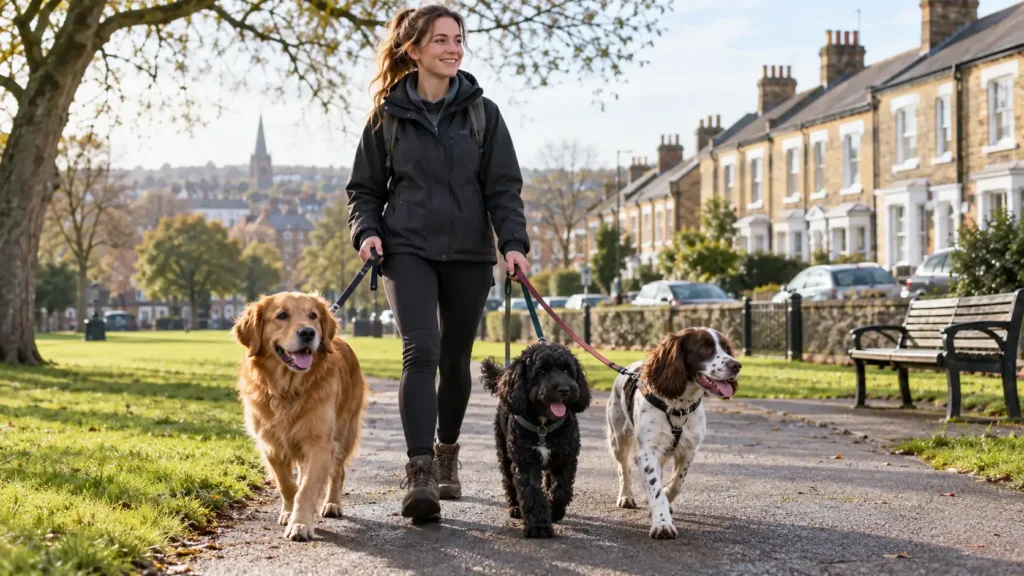
Starting a dog walking side hustle in the UK remains one of the more accessible ways to turn a few spare hours into recurring local income. It requires comparatively little equipment, can fit around another job and, unlike many online side hustles, does not require months of building an audience before somebody will pay.
The potential customer base is substantial. UK Pet Food estimates that Britain had around 15.5 million pet dogs in 2026, with approximately 41% of households owning at least one dog. That does not mean every neighbourhood automatically has room for another walker, but it does show why dependable pet-care businesses can build a recurring client base rather than continually searching for one-off customers.
Our assessment is that the strongest dog-walking businesses are not really selling an hour-long walk. They are selling reliability, safe handling, convenience and trust. Owners are handing over their dog, often a house key and sometimes access to an empty property. Treating the work as a professional local service rather than casual cash-in-hand work makes an enormous difference.
Anyone still comparing dog walking with other opportunities can look at the complete UK side-hustle comparison for 2026.
Our 2026 Dog Walking Side Hustle Rating
These percentages are our editorial assessment of the business model rather than survey statistics.
| Factor | Our Rating | Why |
| Startup Affordability | 95% | Little equipment or premises required |
| Local Demand | 91% | Very large UK dog-owning population |
| Flexibility | 88% | Can work around another job, although lunchtime demand dominates |
| Repeat-Income Potential | 92% | Regular weekly clients are common |
| Profit Potential | 82% | Strong when routes are dense and group walks are viable |
| Ease of Starting | 87% | Relatively low regulatory barrier for walking-only services |
| Scalability | 76% | Capacity eventually becomes limited by time, transport and safe dog numbers |
| Risk Management | 70% | Animals, keys, roads, public liability and unpredictable behaviour add risk |
| Overall Side-Hustle Score | 86% | One of the stronger local service opportunities for suitable operators |
The key financial point is route density. A walker charging £20 but spending 25 minutes driving between customers can make less per working hour than somebody charging £16 with six clients concentrated within the same neighbourhood.
How Much Can a Dog Walking Side Hustle Make in 2026?
Current published pricing indicates that a typical 60-minute solo dog walk is around £16–£25, while 30-minute solo walks are commonly around £10–£15. Group walks are normally charged per dog and can produce substantially higher revenue for the same hour once a walker has compatible clients. London and parts of the South East tend to sit above national rates.
| Service | Typical 2026 Price |
| 30-Minute Solo Walk | £10–£15 |
| 60-Minute Solo Walk | £16–£25 |
| 30-Minute Group Walk | £8–£12 per dog |
| 60-Minute Group Walk | £12–£18 per dog |
| Additional Dog From Same Household | Around £4–£8 extra |
| London 60-Minute Walk | Roughly £20–£30 |
Those are market ranges rather than guaranteed prices. Local competition, parking, travel distances, experience, canine first-aid training and whether the service includes GPS tracking or post-walk updates all affect what clients are prepared to pay.
What Could That Mean Per Month?
Consider three simplified examples before expenses and tax.
| Business Model | Example Schedule | Approx. Gross Income |
| Very Small Side Hustle | 5 walks/week × £16 | £347/month |
| Established Part-Time Group Model | 3 dogs × £13 × 2 walks/day × 3 days/week | £1,013/month |
| Hybrid Model | 2 solo £20 walks + 4-dog £14 group, 4 days/week | £1,663/month |
These examples use an average 4.33 weeks per month. They are turnover figures, not take-home profit.
Fuel, vehicle wear, insurance, payment fees, advertising, cancellations, equipment and unpaid travel time all reduce actual earnings. This is why somebody asking how to start a dog walking business should calculate profit per working hour, not simply the advertised price per walk.
How to Set Up a Dog Walking Business Properly?
A small dog walking business can start with one customer and a few hours per week. However, it should still be operated as a genuine business from the beginning.
Step 1: Pick a Small Service Area
Do not start by advertising across an entire town.
Choose perhaps two or three neighbouring postcodes and establish where your ideal customers live. A compact route makes it possible to complete more paid walks without filling the day with unpaid driving.
For example, three £15 walks located five minutes apart can be financially better than three £20 walks scattered across a city.
That geographic discipline becomes particularly valuable when moving into group walks.
Step 2: Decide What You Will Actually Sell
A sensible starter service menu might contain a 30-minute solo walk, 60-minute solo walk, small compatible group walk, puppy visit and occasional pet drop-in.
Avoid adding boarding and day care purely because customers ask for them. In England, commercial dog day care and home boarding can fall within the animal activity licensing regime, whereas businesses caring for dogs in their owners’ homes, including dog walkers, are specifically excluded from that day-care licensing requirement.
Rules differ between England, Wales, Scotland and Northern Ireland, so check the relevant local authority before extending beyond straightforward walking.
Do You Need a Licence to Start a Dog Walking Business?
There is no single UK-wide professional dog-walker licence that everybody must obtain before offering normal walking services.
That does not mean a walker can go anywhere with any number of dogs.
Councils, parks, estates and other landowners may impose commercial-walker permits, maximum dog numbers, exclusion areas, seasonal restrictions or lead requirements. Public Spaces Protection Orders can also impose local dog-control rules.
This is one area where simplistic advice such as “you can legally walk four dogs” is misleading. There is no universal four-dog UK limit. Four may be a local, park or insurance limit, while another area may permit a different number.
A professional should therefore check both the council and every major park or estate used for commercial walks.
Wales Dog Walking Fines: What Should Professional Walkers Know?
People searching for Wales dog walking fines often expect one national figure, but the practical position is more localised.
Welsh councils can impose dog-control requirements through Public Spaces Protection Orders. These may cover dog fouling, carrying suitable waste bags, keeping dogs on leads, obeying an instruction to put a dog on a lead, or keeping dogs away from specified areas.
For example, current Welsh council schemes demonstrate £100 fixed penalties for breaches, with prosecution potentially resulting in fines of up to £1,000. Exact restrictions and payment arrangements can differ between councils.
For somebody operating commercially in Wales, checking the PSPO for every regular walking area should therefore be part of route planning rather than something discovered after receiving a fine.
Other Dog-Control Rules a Walker Should Understand
A professional walker becomes the person physically in charge of the dog during the walk, so basic dog-control legislation matters.
Dogs in public generally need a collar displaying the owner’s name and address, subject to specific exemptions. Dogs must also remain under proper control; a dog can be considered dangerously out of control where it injures someone or causes reasonable concern that it might injure somebody.
Special care is required before accepting restricted dog types. In England and Wales, an exempt XL Bully must still be muzzled and kept on a lead in public, with the lead securely held by somebody aged at least 16.
A sensible client intake process should therefore establish breed or type, bite history, reactivity, recall, medical issues and any legal conditions applying to the dog before the first paid walk.
Dog Walking Insurance: Do You Actually Need It?
A common question is do you need insurance for dog walking?
For a solo dog walker, specialist dog walking insurance is not generally a nationwide legal requirement. But operating without it creates a substantial financial risk, and a local permit, landowner or contract may require particular insurance.
Once employees are involved, employers’ liability rules can also become relevant.
From a commercial perspective, we would not recommend building a professional service without suitable cover.
What Insurance Do I Need for a Dog Walking Business?
The strongest dog walking business insurance policies usually combine several forms of protection.
| Cover | What It Is Intended to Protect Against |
| Public Liability | Third-party injury or property damage |
| Care, Custody and Control | Injury, illness, loss or death involving animals in your care, subject to policy terms |
| Key Cover | Replacement keys or locks if clients’ keys are lost |
| Personal Accident | Injury that prevents the walker from working |
| Equipment Cover | Business equipment that is lost, damaged or stolen |
| Employers’ Liability | Usually relevant when employing people |
| Professional Indemnity | Potentially relevant if providing professional training or behavioural advice |
Do not assume that general public liability automatically provides adequate protection for animals in your care. Check the wording for care, custody and control, the maximum number of dogs covered and any breed or behavioural exclusions.
Dog Walking Insurance Cost in 2026
The dog walking insurance cost can still be relatively low compared with many businesses.
Protectivity currently advertises specialist cover from £5.41 per month, with its example including £1 million public liability, care/custody/control, loss-of-keys cover and limited equipment protection. Simply Business has advertised public-liability dog-walker quotations from around £5.05 per month for qualifying customers. These are starting prices, not an indication that every walker will receive the same premium.
For budgeting purposes, a new sole trader might reasonably allow roughly £60–£150+ per year, depending on the cover chosen. Higher public-liability limits, employees, larger groups, boarding or other services can raise the price.
Buying the cheapest policy solely to say “fully insured” is poor risk management. The exclusions and claim limits matter more than saving £20 on the premium.
Should a Dog Walker Get a DBS Check?
A Basic DBS check is not normally compulsory simply because somebody walks dogs, but it can be a valuable trust signal when customers are giving a stranger access to their home.
This is one point that needs updating in the existing article. From 5 October 2026, a Basic DBS check costs £20, reduced from £21.50.
It shows unspent convictions and can be requested directly by an eligible individual.
For a local business built almost entirely on trust, £20 can be a sensible credibility investment.
Create a Proper Client Contract
A text conversation saying “£15, see you Tuesday” is not a sufficient operating system for a serious business.
The agreement should establish the service, duration of the walk, fees, payment date, cancellation terms, owner contact details, emergency contact, veterinary details, medical conditions, medication instructions, temperament and bite history, off-lead permission, group-walk consent, transport permission and what the walker is authorised to do during a veterinary emergency.
It should also cover keys and access to the property.
Key rings should ideally use an internal customer code rather than displaying a client’s full home address.
Think About Data Protection Too
A dog walker may hold customers’ names, addresses, telephone numbers, alarm instructions, key information and potentially photographs or location information.
The ICO states that organisations including sole traders which use personal information can need to pay the data-protection fee unless an exemption applies. Rather than assuming either way, a new business can use the ICO data protection fee checker.
That is an important content gap in many “start a dog walking business” articles because the customer data involved can be considerably more sensitive than it first appears.
How to Price a Dog Walking Business?

Do not simply find the cheapest walker nearby and charge £1 less.
Price backwards from the amount the business needs to generate.
Suppose a 60-minute walk costs £18. If it requires 15 minutes to collect the dog, an hour to walk, ten minutes to return it and another 15 minutes to reach the next customer, £18 of turnover has consumed roughly 100 minutes.
The advertised rate is £18 per walk, but revenue is effectively only around £10.80 per working hour before expenses.
That is why good dog-walking economics normally come from three things: compact routes, recurring customers and safely managed group walks.
Solo Walks vs Group Walks
A beginner is usually better starting with solo walks.
They provide time to learn each dog’s temperament without simultaneously managing several unfamiliar animals.
Once reliable customers have been established, compatible dogs can potentially be moved into small groups where local rules, client consent and insurance permit it.
Four dogs each paying £13 produce £52 from the walking hour. However, that does not automatically mean £52 hourly profit. Collection, drop-off and transport may turn the one-hour walk into a two-hour operation.
The goal should be profitable density rather than simply adding more dogs.
How to Find Your First Dog Walking Clients?
A new service does not require an expensive advertising campaign. Trust is more valuable than reach.
A practical acquisition sequence is: start with dog owners already within the operator’s personal or neighbourhood network; create a complete Google Business Profile; participate genuinely in neighbourhood Facebook and Nextdoor groups; introduce the business to local groomers, pet shops and veterinary practices where appropriate; ask satisfied customers for genuine reviews; and create a simple referral incentive once the service is established.
Rover can also provide access to pet owners without building an audience from zero. However, its UK help centre currently states that sitters and dog walkers take home 85% of earnings from each booking, so platform-generated work needs to be priced with that margin in mind.
Direct customers usually offer better long-term margins, while platforms can help solve the initial problem of having no reviews or customer base.
Build Recurring Revenue Rather Than Chasing Random Walks
The financial quality of a dog walking side hustle improves dramatically when the diary becomes predictable.
A customer booking Monday, Wednesday and Friday at lunchtime is far more valuable than three unrelated one-off enquiries because regular bookings reduce marketing work, simplify route planning and improve cash-flow visibility.
Fixed weekly slots also make it easier to identify genuine spare capacity.
A written cancellation policy is useful from the start. Whether the business charges 50% or 100% for late cancellations is a commercial decision, but customers should know the terms before booking rather than after a disagreement.
How Much Does It Cost to Start?
A walking-only operation can remain inexpensive.
| Startup Item | Indicative Cost |
| Dog Walking Insurance | Roughly £60–£150+ a year |
| Basic DBS Check | £20 |
| Spare Leads and Basic Walking Kit | Around £30–£80 |
| Canine First-Aid Kit | Around £15–£30 |
| Poo Bags, Towels and Water Equipment | Around £15–£40 |
| Business Cards/Flyers | £0–£40 |
| Google Business Profile | Free |
| Website | Optional initially |
| Canine First-Aid Training | Optional but worthwhile |
The equipment itself is unlikely to determine whether the business succeeds. Transport, customer acquisition and the time taken between appointments have a much bigger effect on profitability.
Tax Rules for a Dog Walking Side Hustle
Paid dog walking undertaken independently is normally self-employment income.
For most beginners, the simplest structure is operating as a sole trader.
HMRC says a person generally needs to register as a sole trader for Self Assessment when gross trading income exceeds £1,000 during a tax year. The tax year runs from 6 April to 5 April.
The official process is available through GOV.UK’s sole-trader registration service, while the site’s existing article on declaring side-hustle income to HMRC fits naturally here.
The £1,000 Trading Allowance
The £1,000 trading allowance relates to gross qualifying trading income, not £1,000 of profit.
Where full relief applies and qualifying gross trading income does not exceed £1,000, it can be treated as nil for Income Tax purposes. Where income exceeds £1,000, somebody may be able to use the allowance against income instead of claiming actual expenses. They cannot normally deduct both against the same income.
The fuller rules are covered in the site’s UK trading allowance explanation.
For example, somebody receiving £6,000 from dog walking with only £300 of allowable expenses might obtain a better taxable-profit result by using the £1,000 allowance, subject to eligibility. Someone with £1,500 of genuine allowable expenses could be better using actual expenses instead.
What Expenses Can Dog Walkers Claim?
Business insurance, qualifying advertising, business equipment and eligible training or travel costs may potentially be deductible where HMRC’s conditions are met.
Vehicle expenses need particular attention because an important rate changed in April 2026.
For the 2026/27 tax year, HMRC’s simplified vehicle expense rate for cars and goods vehicles is 55p per business mile for the first 10,000 miles and 25p thereafter. The previous first-10,000-mile rate was 45p, so the existing article’s 45p figure is outdated.
Keep a mileage record from day one rather than attempting to reconstruct several months of journeys from memory.
The site’s side-hustle tax calculator can also provide a useful internal link for readers trying to estimate the tax impact of additional profits.
Income Tax and National Insurance
Earning more than £1,000 does not automatically mean that £1,001 becomes taxable.
The eventual tax bill depends on taxable profit and the person’s other income.
For 2026/27, the standard Personal Allowance is £12,570, although its availability depends on total income and individual circumstances. Self-employed Class 4 National Insurance is generally charged at 6% on profits above £12,570 up to £50,270 and 2% above that. Scottish Income Tax bands differ from those applying in England, Wales and Northern Ireland.
Someone who already has a salary may have used all of their Personal Allowance through PAYE, which is why setting aside part of dog-walking profit for tax is sensible.
If the walker already has employment, the site’s article covering whether a person should tell an employer about a side hustle is also highly relevant.
Equipment Every Professional Walker Should Carry
A commercial walker needs more than the lead handed over by the client.
At minimum, the working kit should cover secure backup restraint, waste bags, fresh water, a collapsible bowl, suitable clothing, charged telephone, emergency contact details and basic canine first-aid equipment. A towel and high-visibility clothing are also useful depending on weather and walking times.
Anyone transporting client dogs should make sure the vehicle and restraint system are appropriate and tell their insurer how the vehicle is being used.
Meet Every Dog Before Accepting It
The pre-service meet-and-greet is one of the best risk-control measures in the business.
Ideally, observe the dog outside rather than relying solely on an owner’s description.
Ask how it behaves around dogs, children, cyclists, runners, livestock, traffic and food. Establish recall reliability, prey drive, pulling strength, resource guarding, bite history, separation behaviour and whether there are situations where the dog freezes or refuses to continue.
A walker is entitled to decline a customer where they cannot safely manage the dog.
The £15 or £20 walk is never worth taking an animal that exceeds the handler’s experience.
Why Does My Dog Stop Walking and Want to Go Back?
This is not simply an SEO question; it is something professional walkers genuinely encounter.
A dog may stop walking and try to return home because it is nervous about an unfamiliar environment, has encountered something frightening, is tired, is uncomfortable in the weather or may be experiencing pain or another health problem.
A professional walker should not drag the dog onwards merely to complete the booked distance.
Where the behaviour is unusual or persistent, finish the walk safely, document what happened and tell the owner. Sudden signs of pain, collapse, breathing difficulty or significant distress warrant prompt veterinary advice.
Why Is My Dog Walking in Circles?
Some circling can be entirely ordinary for example before lying down, investigating a smell or finding somewhere to toilet.
However, new, persistent or unexplained circling should not be treated as a training issue by a dog walker. It can sometimes accompany balance, neurological, ear or other medical problems.
If a client’s dog suddenly starts repeatedly walking in circles, the safer professional response is to stop strenuous exercise, keep the dog secure, contact the owner and recommend veterinary advice rather than attempting to diagnose the cause.
Recognising when behaviour has crossed from “difficult dog” to “possible health issue” is part of being a responsible professional.
How to Grow From Side Hustle to Dog Walking Business?
Once demand exceeds the available diary, there are several ways to grow without immediately employing somebody.
The first is reducing the service radius. The second is increasing prices for new customers. The third is moving suitable dogs into compatible groups. The fourth is concentrating customers into fixed morning, lunchtime and afternoon rounds.
Only after those options are exhausted does hiring another walker become an obvious next step.
At that stage, payroll, employment status, employers’ liability insurance, training, supervision and standard operating procedures become significantly more important.
Expanding into dog day care or home boarding is another possible route, but it should be viewed as a different regulated service, not simply an add-on to dog walking.
Common Mistakes That Reduce Dog Walking Profit
The biggest financial mistake is trying to cover too large an area.
Other costly problems include underpricing the first customers indefinitely, accepting unsuitable dogs because the diary is empty, taking group bookings before learning each dog’s behaviour, failing to record mileage, operating without clear cancellation terms, keeping identifiable house keys together, buying insurance without reading its animal exclusions and treating all revenue as spendable income instead of reserving money for tax and business costs.
A £1,500-a-month dog walking operation can still be a poor side hustle if hundreds of pounds disappear into transport and large amounts of unpaid time.
A £700-a-month operation within one compact neighbourhood can sometimes produce a better effective hourly return.
Is a Dog Walking Side Hustle Worth It in the UK?
Yes, for the right person.
Dog walking scores particularly highly for low startup costs, recurring revenue, flexibility and comparatively fast access to paying customers. It is less attractive for somebody who dislikes bad weather, cannot reliably commit to weekday daytime appointments, has little confidence handling unfamiliar dogs or lives somewhere where clients are widely dispersed.
The strongest model in 2026 is not trying to become the cheapest dog walker in town. It is building a small, highly concentrated client base, operating with proper dog walking insurance, clear contracts and strong safety procedures, then gradually increasing the percentage of revenue coming from predictable recurring bookings.
For somebody investigating how to set up a dog walking business, the progression can therefore be deliberately conservative: start with one or two solo clients, learn the operational side, establish local reviews, calculate the real hourly profit after travel and only then increase capacity.
That approach keeps the initial financial exposure low while testing whether there is enough local demand to turn a straightforward dog walking side hustle UK opportunity into a sustainable small business.

More in Side Hustles & Self-Employment

Highest Paid Jobs UK: Top 20 Careers by Salary in 2026
The highest paid jobs in the UK are concentrated around senior business leadership, medicine, technology, aviation, finance, transport and specialist management. But there is an important difference between the highest typical salary and the highest salary someone could potentially earn. For the clearest comparison, this guide ranks occupations using median full-time gross annual earnings from […]

SOC Code With Salary: UK Skilled Worker Rates List 2026
A UK SOC code identifies the type of work a person will perform. For most new Skilled Worker visa applications, the salary must be at least £41,700 per year or the full going rate for the relevant SOC 2020 occupation code, whichever is higher. Lower thresholds may apply to qualifying new entrants, people with relevant […]