
National Insurance contributions for self-employed people will continue to follow the 6% and 2% Class 4 rates in the 2027/28 tax year, with compulsory payments generally applying to annual taxable profits above £12,570.
However, the 2026 Budget introduced important changes for 2027. The Class 2 Small Profits Threshold will rise to £7,355, voluntary Class 2 contributions will increase to £3.80 per week, and the government has announced a higher £3,000 trading allowance from April 2027.
Our analysis of the updated HMRC figures suggests that the most important distinction for freelancers, contractors and sole traders is not simply how much National Insurance they pay, but whether their earnings protect their State Pension record.
What Are the Self-Employed National Insurance Rates for 2027?
The 2027/28 tax year runs from 6 April 2027 to 5 April 2028. Self-employed people generally deal with two National Insurance categories: Class 2 and Class 4.
Class 2 is primarily relevant to State Pension and certain benefit entitlements. Class 4 is calculated on taxable self-employment profits.
The following comparison incorporates the rates published in HMRC’s November 2026 Budget documentation.
| National Insurance category | 2026/27 | 2027/28 |
| Class 2 Small Profits Threshold | £7,105 | £7,355 |
| Voluntary Class 2 weekly rate | £3.65 | £3.80 |
| Class 4 Lower Profits Limit | £12,570 | £12,570 |
| Class 4 Upper Profits Limit | £50,270 | £50,270 |
| Main Class 4 contribution rate | 6% | 6% |
| Additional Class 4 rate | 2% | 2% |
| Voluntary Class 3 weekly rate | £18.40 | £19.05 |
The Class 2 threshold increases by approximately 3.52%, while its voluntary weekly contribution rises by around 4.11%.
By comparison, the Class 4 rates and main thresholds remain unchanged.
The complete figures are available in the official HMRC 2026 Budget rates and allowances.
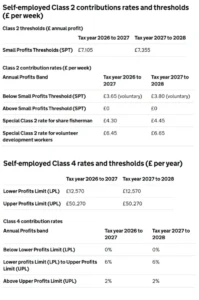
HMRC’s published National Insurance rates and profit thresholds for self-employed workers in 2026/27 and 2027/28.
How Much National Insurance Will Self-Employed People Pay in 2027?
The amount payable depends on taxable business profits, rather than total sales or business turnover.
For most sole traders, the standard Class 4 calculation is:
- £0–£12,570: No Class 4 National Insurance.
- £12,570–£50,270: 6% on profits above £12,570.
- Above £50,270: 2% on the additional profits, alongside 6% on the preceding band.
Our calculations show the following annual liabilities, assuming one standard self-employment business, no special adjustments and a full tax year.
| Annual taxable profit | Class 4 National Insurance | Effective NIC rate |
| £7,000 | £0 | 0% |
| £15,000 | £145.80 | 0.97% |
| £20,000 | £445.80 | 2.23% |
| £30,000 | £1,045.80 | 3.49% |
| £40,000 | £1,645.80 | 4.11% |
| £60,000 | £2,456.60 | 4.09% |
| £100,000 | £3,256.60 | 3.26% |
Effective NIC rate means Class 4 contributions divided by total taxable trading profit. Income Tax is excluded.
Example: A Self-Employed Consultant Earning £60,000
Consider an independent consultant who earns £75,000 in annual business revenue and incurs £15,000 in allowable expenses.
Their taxable profit is £60,000.
The National Insurance calculation is:
First profit band: (£50,270 − £12,570) × 6% = £2,262
Higher profit band: (£60,000 − £50,270) × 2% = £194.60
Total annual Class 4 National Insurance: £2,456.60
This demonstrates why calculating 6% against an entire business profit produces an inaccurate liability.
Self-employed people can compare their deductions using our side hustle tax calculator, although its published calculations currently use 2026/27 rates.
What Happens to Class 2 National Insurance in April 2027?
One significant misconception is that Class 2 National Insurance has disappeared completely.
Compulsory Class 2 payments were removed for most self-employed people in April 2024, but Class 2 remains relevant for National Insurance records and voluntary contributions.
From April 2027, the expected position is:
| Annual self-employed profit | Class 2 treatment |
| Below £7,355 | Voluntary Class 2 may be available |
| £7,355–£12,570 | Class 2 generally treated as paid |
| Above £12,570 | Class 2 generally treated as paid; Class 4 becomes payable on excess profits |
This distinction matters particularly for people starting a business, working part-time or earning occasional freelance income.
Consider a sole trader with £7,200 in taxable annual profits.
In 2026/27, those profits exceed the £7,105 Small Profits Threshold, so Class 2 would generally be treated as paid.
In 2027/28, the same £7,200 falls below the new £7,355 threshold. The trader may therefore need to consider voluntary contributions or other qualifying National Insurance credits.
A full 52 weeks of voluntary Class 2 in 2027/28 would cost £197.60, compared with £189.80 in 2026/27.
Our financial assessment is that low-profit traders should examine their National Insurance record before deciding whether to make voluntary payments. Paying unnecessarily does not improve every individual’s pension entitlement.
For a more detailed distinction between the contribution categories, see how Class 2 and Class 4 operate.
Will the New £3,000 Trading Allowance Reduce National Insurance in 2027?
The October 2026 Budget introduced another significant change affecting smaller self-employed businesses.
The government announced that the trading allowance will increase from £1,000 to £3,000 from 6 April 2027, subject to the relevant legislation.
The associated Income Tax Self Assessment reporting threshold for trading income is also set to increase to £3,000.
During his 28 October 2026 Budget speech, Chancellor John Healey described the measure as “tripling the trading allowance”.
This change could be particularly beneficial for people undertaking occasional consultancy, tutoring, digital services, content creation or other smaller trading activities.
How the Allowance Affects Taxable Profit?
Suppose a freelance designer receives £12,000 in annual client payments and incurs £1,500 in allowable business expenses.
| Calculation method | Taxable profit |
| Deduct actual £1,500 expenses | £10,500 |
| Claim proposed £3,000 trading allowance instead | £9,000 |
For eligible traders, choosing the allowance rather than actual expenses can reduce both taxable trading profits and the profits used for Class 4 National Insurance purposes.
However, the allowance and actual expenses cannot normally be deducted together for the same relevant income.
There is also an important pension consideration.
A trader receiving £10,000 in gross income with £1,000 of allowable expenses could have £9,000 taxable profit using actual expenses, but £7,000 if electing to deduct the proposed £3,000 allowance.
The first calculation exceeds the 2027/28 Class 2 threshold, while the second falls below it.
Consequently, the deduction method that produces the lowest taxable profit may also change whether Class 2 contributions are treated as paid.
This is especially relevant to anyone relying on self-employment to build qualifying years towards their State Pension.
Our coverage of the trading allowance explains the existing relief mechanism, while the government’s official April 2027 policy announcement sets out the proposed increase.
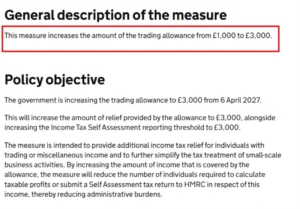
HMRC’s 2026 Budget policy announcement increasing the trading allowance to £3,000 from April 2027.
Do Freelancers and Side Hustlers Pay Different National Insurance?
Freelancers, delivery workers, online sellers, tradespeople and independent consultants generally follow the same self-employment contribution structure when their income is taxable as trading profits.
However, their business arrangements can produce different outcomes.
| Worker profile | National Insurance consideration |
| Part-time freelancer | May qualify for Class 2 protection without paying |
| Full-time sole trader | Generally pays Class 4 above £12,570 profit |
| PAYE employee with side income | May have both Class 1 and Class 4 obligations |
| Limited company director | Normally follows employment-related NIC rules on salary |
| Self-employed pensioner | Special Class 4 cessation rules apply |
One area frequently misunderstood is the interaction between employment and self-employment.
Someone working a PAYE job and operating a separate business can face Class 1 deductions on employment earnings and Class 4 contributions on qualifying self-employed profits.
The precise calculation can involve adjustments where earnings and profits interact with National Insurance maximum contribution rules.
This is why a person with a regular salary should not automatically assume that extra freelance earnings are exempt from National Insurance.
We have examined the combined obligations in our PAYE tax comparison and the rules for being employed and self-employed.
How Can Self-Employed Workers Reduce National Insurance Legally?
Effective National Insurance planning starts with accurate business accounts rather than attempting to manipulate the contribution thresholds.
Our analysis identifies three practical priorities.
1. Record Genuine Business Expenses.
Eligible software subscriptions, equipment costs, insurance, qualifying travel and professional fees may reduce taxable business profits.
For example, £1,000 of additional legitimate deductible expenses could reduce Class 4 National Insurance by £60 where the entire deduction falls within the 6% contribution band.
The appropriate treatment depends on the expense and the applicable tax rules. Review which business expenses qualify before claiming deductions.
2. Compare the Trading Allowance With Actual Costs.
From April 2027, the announced £3,000 allowance could offer greater relief to qualifying smaller traders with relatively low expenditure.
However, businesses with substantial operating costs may benefit more from deducting their actual allowable expenses.
3. Separate Business Turnover, Profit and Personal Drawings.
Money withdrawn from a sole-trader business for personal spending does not become a deductible business expense simply because it leaves the bank account.
Maintaining accurate records and, where useful, a separate business account can make annual profit calculations easier.
How Will Making Tax Digital Affect Self-Employed National Insurance in 2027?
Making Tax Digital for Income Tax is expanding in stages.
From 6 April 2027, it will generally apply to eligible sole traders and landlords whose qualifying gross self-employment and property income exceeded £30,000 in the 2025/26 tax year, subject to the relevant exemptions.
Unlike Class 4 National Insurance, the Making Tax Digital threshold is assessed using qualifying gross income before business expenses.
For example, a sole trader with £42,000 turnover and £20,000 allowable expenses might have £22,000 taxable profit, but their gross income could still bring them into the 2027 Making Tax Digital rollout.
Qualifying businesses must use compatible software, maintain appropriate digital records and submit periodic updates.
Importantly, Making Tax Digital changes how information is reported, not the 6% and 2% Class 4 rates.
Our Making Tax Digital coverage examines the reporting requirements for self-employed businesses.
When Must Self-Employed People Pay National Insurance for 2027?
Most Class 4 contributions are paid through Self Assessment alongside Income Tax.
The relevant dates depend on the tax year being reported.
| Tax obligation | Deadline |
| File 2025/26 online tax return | 31 January 2027 |
| Register for 2026/27 Self Assessment, if required | 5 October 2027 |
| File and settle 2026/27 tax liabilities online | 31 January 2028 |
| Register for 2027/28 Self Assessment, if required | 5 October 2028 |
| File and settle 2027/28 tax liabilities online | 31 January 2029 |
These are the standard deadlines; individual circumstances and Making Tax Digital obligations may affect the reporting process.
Payments on account can also create advance payment obligations in January and July.
From a cash-flow perspective, self-employed workers should budget for Income Tax and National Insurance together.
A business paying a 20% marginal Income Tax rate and 6% marginal Class 4 rate can face a combined 26% marginal liability on the relevant slice of profit, before considering other obligations.
Our registration deadlines and HMRC reporting articles cover the administrative process in greater detail.
Frequently Asked Questions
Do Self-Employed People Pay National Insurance Under £12,570 in 2027?
They generally do not pay compulsory Class 4 National Insurance on profits at or below £12,570. However, voluntary Class 2 payments may be worth considering if profits fall below £7,355 and the individual needs to protect their National Insurance record.
Does Class 4 National Insurance Increase the State Pension?
No. Class 4 payments do not themselves build State Pension entitlement. Class 2 contributions, including contributions treated as paid, are relevant to qualifying years.
Is National Insurance Payable After State Pension Age?
Self-employed people generally stop paying Class 4 from 6 April following the date they reach State Pension age. They may still owe Class 4 for an earlier tax year, and Income Tax obligations can continue.
Can a Self-Employed Person Pay National Insurance Monthly?
Class 4 is normally calculated annually through Self Assessment. Business owners can nevertheless put money aside monthly or use HMRC’s available payment arrangements where eligible.
What Is the Main National Insurance Change for Self-Employed People in 2027?
The Class 4 rates remain unchanged, but the Class 2 Small Profits Threshold increases to £7,355 and voluntary Class 2 rises to £3.80 per week.
The announced £3,000 trading allowance could also change taxable profits and National Insurance outcomes for qualifying small traders.
What Should Self-Employed People Prepare for Before April 2027?
The 2027 National Insurance changes are relatively modest for established sole traders paying Class 4, but potentially more significant for low-profit freelancers.
Our assessment highlights three priorities: calculate taxable profits accurately, check whether the new Class 2 threshold affects pension protection, and examine whether the higher trading allowance offers a genuine financial advantage.
Businesses approaching the Making Tax Digital income threshold should also review their reporting systems.
For self-employed people, effective financial planning is not simply about paying the lowest possible contribution. It is about understanding the interaction between business profits, tax relief, National Insurance records and long-term financial security.

More in Tax, Legal & HMRC

Can I Be a Sole Trader and Employed at the Same Time in the UK?
Yes, a person can be employed and operate as a sole trader at the same time in the UK. Someone could work full-time or part-time for an employer while also running a freelance business, consultancy, online store, trade or other side business. HMRC specifically confirms that a person can be employed and self-employed simultaneously. For […]

Do I Need a Business Account as a Sole Trader in the UK?
A sole trader does not legally need a separate business bank account in the UK. Because a sole trader and their business are treated as the same legal person, business income can technically be received into a personal current account. However, the bank’s account terms still matter. Some personal current accounts prohibit or restrict business […]