
Retirement no longer means giving up the opportunity to earn. For many people over 60 in the UK, a small, flexible business can supplement pension income, cover rising household costs and provide a sense of purpose without returning to full-time employment.
The most practical side hustles for UK pensioners in 2027 include online tutoring, freelance administration, proofreading, bookkeeping, craft selling, market research, consulting and home-based digital services.
Some require little more than a phone or laptop, while others make use of professional experience built over several decades.
However, retirement income needs a different financial approach from a conventional second job. A pensioner earning an additional £200 a month must consider not only business expenses but also Income Tax, Pension Credit and whether the work remains manageable.
Our analysis of the UK side-hustle market and recent tax announcements highlights an important development: the government plans to increase the trading allowance to £3,000 from 6 April 2027, potentially making modest self-employed earnings more tax-efficient.
We examine which opportunities suit different retirement circumstances, what it costs to start, how the 2027 rules differ from 2026, and how pensioners can build a reliable supplementary income without unnecessary financial risk.
What Are the Best Side Hustles for UK Pensioners Over 60 in 2027?
The most suitable opportunities generally combine flexible working hours, limited start-up costs, manageable physical demands and skills that retirees already possess.
Rather than choosing an activity solely because of its advertised earnings, pensioners should consider how much money they retain after expenses and how consistently customers are likely to pay.
| Side hustle | Illustrative gross earnings | Start-up budget | Work from home? |
| Online tutoring | £20–£45/hour | £0–£80 | Yes |
| Virtual administration | £15–£25/hour | £0–£100 | Yes |
| Proofreading | £15–£30/hour | £0–£100 | Yes |
| Freelance bookkeeping | £18–£35/hour | £50–£250 | Yes |
| Business consulting | £35–£80/hour | £0–£150 | Yes |
| AI evaluation tasks | £12–£30/hour when available | £0–£50 | Yes |
| Market research | Variable, per study | £0 | Yes |
| Sewing and alterations | £10–£40 per order | £30–£150 | Yes |
| Digital guides and templates | Variable, per sale | £0–£100 | Yes |
| Family history research | £60–£200 per project | £0–£100 | Yes |
| Online group workshops | £10–£20 per participant | £0–£100 | Yes |
| Renting a driveway | £30–£200/month | Usually minimal | Property-based |
These are illustrative prices and planning ranges, not verified UK-wide averages, guaranteed earnings or income forecasts. Actual results depend on demand, experience, location, costs and available assignments.
For someone seeking around £100–£300 per month, a specialised service requiring only a few paid hours could be more efficient than spending substantial time completing low-paying online tasks.
Those exploring a broader range of opportunities can compare the options in the UK side hustles overview.
Which Home-Based Side Hustles Make the Best Use of Retirement Experience?
A significant advantage for pensioners is that they may not need to learn an entirely new profession.
Former teachers, administrative employees, accountants, engineers and managers can often adapt their existing knowledge into a smaller, flexible service.
Online Tutoring and Practical Skills Teaching
Online tutoring can suit retired teachers and anyone with strong subject knowledge.
Opportunities extend beyond school subjects. Pensioners can teach conversational English, basic computer skills, music, business mathematics, languages or professional communication.
For example, a retired teacher offering two online lessons each week at £25 per session could generate approximately £200 in gross revenue over four weeks.
Tutoring platforms such as Tutorful and Superprof may help connect tutors with learners, although platform charges and customer demand must be checked.
Our analysis suggests that specialist knowledge and a clear teaching proposition are more useful than trying to teach every possible subject.
Someone considering private lessons can explore the requirements for starting a tutoring business, including pricing, finding students and safeguarding considerations.
Practical starting point: Offer one clearly defined service, such as GCSE mathematics revision or beginner computer lessons, and test demand before paying for advertising.
Virtual Administration for Small Businesses

Virtual administration is particularly suitable for pensioners who previously worked in offices, reception, customer services or business support.
Small businesses may need help with customer emails, appointment scheduling, spreadsheet updates, document preparation and basic record management.
A retired administrator could offer a package of five hours per month for £100, equivalent to £20 an hour before costs.
Working with three clients on that arrangement would produce £300 in monthly gross revenue.
The commercial advantage is recurring work. A business that requires regular administrative assistance may be more valuable than a succession of unpredictable one-off projects.
Pensioners should establish clear working hours, confidentiality arrangements and procedures for handling customer information.
Freelance Bookkeeping and Invoice Support
Retired finance professionals and experienced office workers may find opportunities assisting small businesses with invoices, payment records and reconciliations.
Bookkeeping can be performed remotely using accounting software, with workload arranged around agreed deadlines.
A bookkeeper working four billable hours per week at £25 an hour would generate approximately £400 over four weeks, before expenses.
However, this work requires accuracy and an understanding of modern accounting practices. Independent bookkeeping businesses may also need appropriate anti-money-laundering supervision and professional insurance.
Our financial assessment favours recurring monthly bookkeeping agreements over irregular tasks because they improve revenue predictability.
Proofreading and Document Editing
Proofreading is an accessible home-based option for retirees with strong written English and attention to detail.
Potential customers include authors, independent businesses, postgraduate researchers and organisations preparing professional publications.
A proofreader might charge £20 for an hour of straightforward editing, although specialist projects can command different rates.
The key is to price the work according to the actual time required rather than the number of pages alone.
A 20-page document containing complex corrections could take considerably longer than a similar document requiring only minor changes.
Pensioners should also consider concentration, eyesight and screen-related fatigue. This is physically light work, but it is not necessarily effortless.
Independent Business Consulting
For retired managers, engineers, finance specialists and former business owners, consulting may provide strong earnings from relatively few assignments.
Smaller companies often need temporary expertise without employing another full-time manager.
Examples include reviewing operational costs, improving procurement procedures, mentoring a new manager or advising on a specialist technical problem.
A retired operations manager charging £300 for a defined one-day assignment could generate more revenue than several weeks of lower-paid online activities.
However, consultancy depends heavily on professional credibility, established contacts and clearly defined client deliverables.
Our preferred approach is to sell a specific outcome, such as an operational review or management mentoring package, rather than advertising general advice.
Which Side Hustles Suit Pensioners Without Professional Qualifications?
Not everyone retires from a specialist profession. Many people simply want an opportunity to use their interests, household resources or everyday skills to earn modest amounts.
The following activities can be developed gradually without committing to a conventional working schedule.
Selling Handmade Products or Clothing Alterations
Pensioners who enjoy knitting, sewing, embroidery, painting or making home accessories may be able to turn an established hobby into supplementary income.
For example, someone offering clothing alterations could charge £15 for a straightforward job.
Completing eight paid alterations during a month would produce £120 in revenue before materials and other costs.
A handmade-products business can also operate through Etsy or local customer referrals.
However, costs are particularly important. Materials, marketplace fees, packaging and postage can significantly reduce the amount retained.
Someone selling a handmade product for £30 with £12 in total associated costs makes £18 before tax and other overheads, representing a 60% margin on that sale.
Understanding this calculation is important when setting up an Etsy shop.
Home Baking for Local Customers
Baking can provide occasional income through celebration cakes, biscuits and specialist food products.
A pensioner who enjoys baking may already own much of the necessary equipment, limiting initial spending.
However, selling food commercially is different from preparing it for family or friends.
Home food businesses must comply with relevant registration, food hygiene and allergen requirements.
Before accepting paid orders, pensioners should understand the legal obligations involved in home baking.
This is better suited to people who genuinely enjoy the process and can manage production safely, rather than those looking for effortless income.
Paid Market Research and Consumer Studies
Market research provides a different type of earning opportunity.
Businesses and research organisations sometimes recruit participants from particular age groups to understand shopping habits, financial services, technology use and consumer preferences.
People over 60 may qualify for studies specifically seeking older consumers.
Assignments can include online interviews, product feedback sessions, usability testing and questionnaires.
However, opportunities are irregular. Some studies offer worthwhile payments, while others provide only modest compensation.
Our assessment is that market research works better as occasional supplementary income than as a reliable way to pay monthly bills.
Pensioners should avoid paying membership fees merely to access supposed research opportunities.
AI Training and Quality Evaluation
Artificial intelligence has created opportunities for people who can assess written answers, check factual accuracy, compare explanations and identify reasoning errors.
Retired teachers, editors and industry professionals may possess useful skills for this type of work.
Some providers recruit contributors remotely for specialised evaluation tasks.
However, income depends on passing assessments, eligibility and the availability of suitable projects. Work may stop with little warning.
Pensioners interested in these opportunities should examine the requirements of legitimate AI side hustles before applying.
It is especially important not to confuse flexible, project-based work with guaranteed employment.
Selling Digital Guides and Templates

One of the more scalable home-based options is turning practical knowledge into a downloadable resource.
A retired gardener might produce a seasonal planting planner. A former office manager could create spreadsheet templates for local clubs. An experienced seamstress might prepare beginner sewing patterns.
These products can be sold repeatedly without physically producing every new copy.
However, creating the product is only part of the business. Sellers still need to attract customers, maintain accurate information and respond to occasional enquiries.
Digital products are not automatically passive income.
The strongest opportunities generally solve a specific problem for a clearly identifiable audience.
Family History and Genealogy Research
Genealogy offers an unusual niche for pensioners interested in local history, archives and historical records.
Customers may need assistance tracing family connections, interpreting census records, organising photographs or documenting a family history.
The work can often be undertaken from home using online archives and research databases.
A pensioner might offer a fixed-price introductory family history project for £75, with a clearly defined amount of research.
Additional archive costs should be agreed before the work begins.
This activity requires careful handling of personal information and honest communication about what historical evidence can establish.
Can Pensioners Make Money From Assets They Already Own?
Not every retirement side income needs to involve providing a service.
Some households have unused space that could generate revenue without requiring regular computer work.
- Driveway rental: Homeowners near stations, hospitals or busy commercial areas may find demand for parking. The income is generally property-related rather than ordinary trading income, so it is important not to assume that the new £3,000 trading allowance applies.
- Spare-room rental: Eligible people providing furnished accommodation in their main home may qualify for up to £7,500 annually under the Rent-a-Room scheme, subject to its conditions. The threshold is generally shared where more than one person receives qualifying income from the same home.
- Occasional equipment hire: Hiring out personal tools or equipment may qualify for trading allowance treatment, depending on the activity and circumstances.
These opportunities require an assessment of insurance, household privacy, security, additional costs and the potential effect on means-tested benefits.
A spare-room arrangement may offer substantial income, but it also introduces responsibilities and ongoing disruption that ordinary freelance work does not.
What Changes for Pensioner Side Hustles in 2027 Compared With 2026?
Two important announcements from October 2026 could materially change the financial position of pensioners with modest supplementary earnings.
The first concerns the trading allowance. The second concerns the interaction between the State Pension and Income Tax.
| Financial rule | 2026/27 | Announced or proposed 2027/28 position |
| Full new State Pension | £241.30/week | £250.70/week |
| Annualised full new State Pension | £12,547.60 | £13,036.40 |
| Standard Personal Allowance | £12,570 | £12,570 |
| Trading allowance | £1,000 | £3,000 |
| Trading income reporting threshold | Normally £1,000 | Planned £3,000 |
| New Pension Tax Allowance | Not available | Planned for eligible pensioners |
| State Pension age | Gradual increase from 66 to 67 underway | Transition continues |
The figures reflect announcements and proposed rates available in November 2026. Measures requiring legislation should be checked when the 2027/28 tax year begins.
The £3,000 Trading Allowance
Under the rules applying in 2026/27, individuals can generally receive up to £1,000 of qualifying gross trading income without having to declare that income to HMRC, subject to exceptions.
The government announced on 28 October 2026 that the allowance and associated reporting threshold would rise to £3,000 from 6 April 2027.
For pensioners operating small, low-cost services, the measure could significantly simplify their tax affairs.
For example, consider a retired person who earns £2,400 annually from occasional online tutoring.
Under the planned 2027/28 rules, the qualifying trading allowance could cover the entire £2,400.
There would generally be no taxable trading income from that activity, assuming the individual qualifies for full relief.
However, this does not mean someone can receive £3,000 from every separate activity. The trading allowance is shared across qualifying trading income.
Nor does the exemption apply automatically to employment wages, pensions or property rental income.
The updated rules are explained in the trading allowance guide.
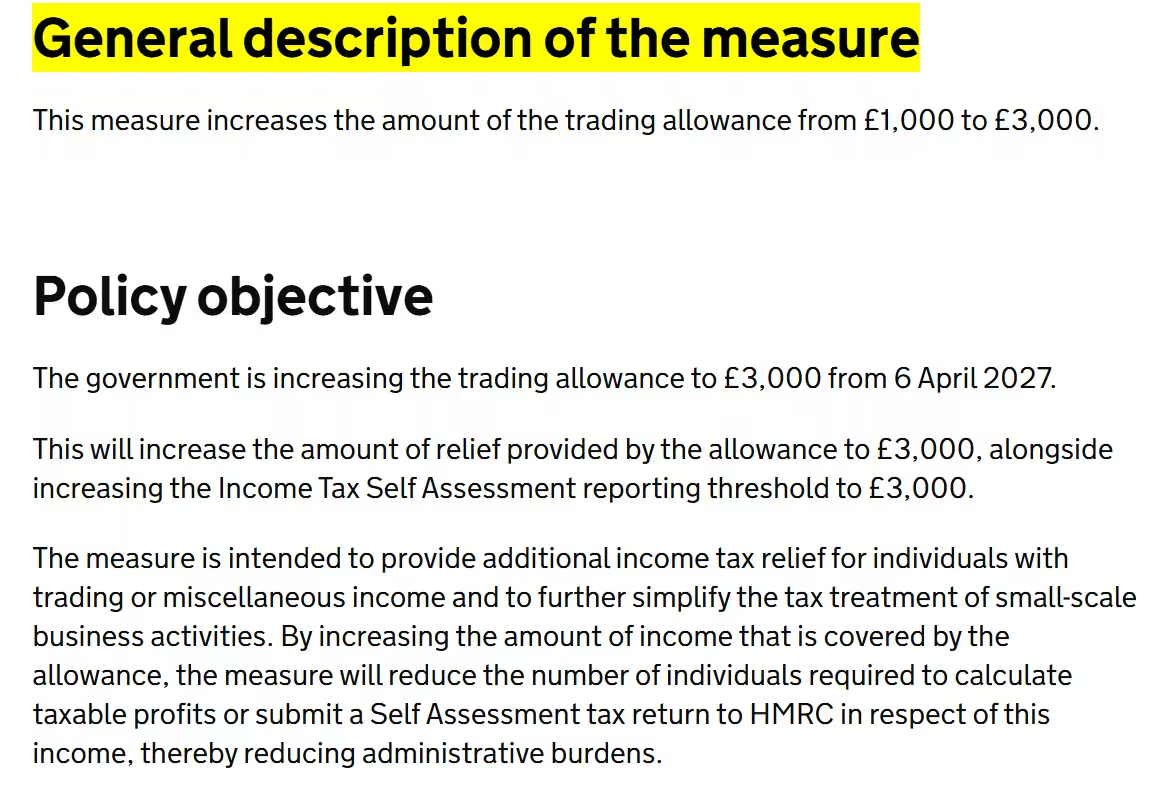
HMRC’s October 2026 announcement confirming the proposed increase in the trading allowance and Self Assessment reporting threshold from £1,000 to £3,000, effective 6 April 2027.
The New Pension Tax Allowance
A separate 2027 change addresses the effect of State Pension increases on Income Tax.
The full new State Pension is proposed to rise to £13,036.40 annually in 2027/28, exceeding the £12,570 Personal Allowance.
Without additional measures, a person receiving only the full new State Pension could face a relatively small Income Tax liability.
The government therefore announced a new Pension Tax Allowance, structured as a tax reduction for eligible people at or above State Pension age, including those who reach that age during the tax year.
Under the planned 2027/28 rules:
- Total income up to £12,570 remains below the standard Personal Allowance.
- Eligible pensioners with total income up to £13,036.40 can receive the full tax reduction where needed.
- Some reduction may remain available with income between approximately £13,037 and £13,319.
- No Pension Tax Allowance is available once total income reaches £13,319.
The maximum reduction is approximately £93.28 for 2027/28.
Importantly, this measure does not increase the standard Personal Allowance. It reduces qualifying Income Tax liabilities.
It is also not restricted to people whose income comes entirely from the State Pension. Eligibility is based on age and total income.
This distinction matters for pensioners who combine a small private pension, employment income and earnings from self-employment.
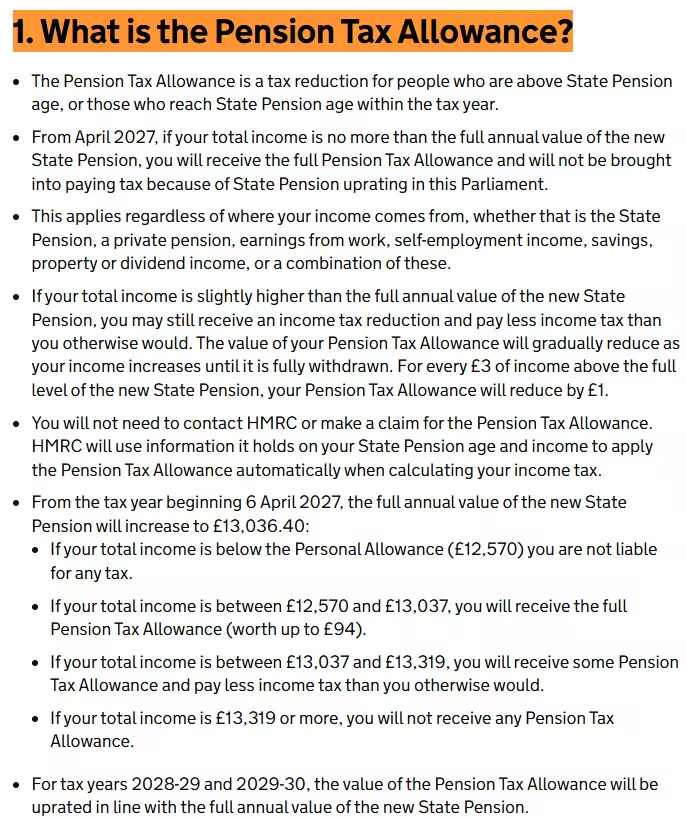
The government’s Pension Tax Allowance explanation showing how the new tax reduction is intended to prevent eligible pensioners from paying Income Tax solely because of the 2027 State Pension increase.
Will a Side Hustle Affect Your State Pension or Other Benefits?
This is one of the most important considerations for anyone earning additional income after 60.
The financial consequences depend on the person’s age, pension arrangements, benefits and type of income.
If You Receive the State Pension
The UK State Pension is not means-tested. Working part-time or generating self-employed income does not directly reduce the State Pension payment.
However, the earnings may affect total taxable income and consequently the Income Tax due.
If You Receive Pension Credit
Pension Credit is means-tested, and earnings can affect entitlement.
The Department for Work and Pensions uses its own rules for calculating relevant income, including applicable deductions and disregards.
A pensioner should not assume that income exempt from Income Tax under the trading allowance is automatically ignored for Pension Credit purposes.
Anyone receiving Pension Credit should report relevant changes in work and income promptly and consider a benefits calculation before committing to a new arrangement.
If You Are Aged 60–65
Being over 60 does not necessarily mean someone has reached State Pension age.
The State Pension age is rising gradually from 66 to 67 between 2026 and 2028, depending on date of birth.
People who have retired early may receive a private pension while still being below State Pension age.
They can still start a side hustle, but different National Insurance and benefit rules may apply.
Those receiving Universal Credit or other means-tested support must also consider the relevant earnings rules.
The official GOV.UK State Pension age checker, which helps people over 60 establish when they will qualify for their State Pension.
Do Pensioners Pay National Insurance on Side Hustle Income?
People generally stop paying employee National Insurance once they reach State Pension age.
Self-employed National Insurance requires additional care. Class 4 contributions generally stop from the beginning of the tax year following the tax year in which State Pension age is reached.
Therefore, a person who turns State Pension age partway through a tax year should not automatically assume their entire self-employed profit for that year is exempt from Class 4 contributions.
People under State Pension age may still have National Insurance liabilities depending on their earnings and employment status.
How Much Extra Income Could a Pensioner Actually Keep?
Gross earnings are not the same as disposable income.
A pensioner should consider working hours, business costs, platform fees, potential tax, and any reduction in benefits before deciding whether an opportunity is worthwhile.
Example: Online Tutoring for Four Hours a Week
Suppose a pensioner charges £25 per hour and provides four paid hours per week for 46 weeks.
| Calculation | Annual amount |
| Total billable hours | 184 |
| Gross revenue | £4,600 |
| Illustrative business costs | £300 |
| Revenue minus costs | £4,300 |
The £4,300 is an illustrative commercial profit before calculating the final tax position.
Under the planned 2027/28 rules, an eligible sole trader might compare using the £3,000 trading allowance with deducting actual allowable expenses.
Using the full trading allowance could produce £1,600 of taxable trading income, while claiming £300 of actual expenses would leave £4,300.
The better approach depends on eligibility and individual circumstances. The trading allowance cannot ordinarily be combined with a deduction for those same business expenses.
A pensioner with other taxable income may still owe Income Tax, and the new Pension Tax Allowance may be reduced or unavailable.
The distinction between sales and deductible expenses therefore has a direct effect on how much income is retained.
Example: A Small Side Hustle Alongside the Full New State Pension
Consider a pensioner whose only existing taxable income in 2027/28 is the proposed full new State Pension of £13,036.40.
They also earn £2,400 gross from qualifying occasional freelance services.
If the announced £3,000 trading allowance applies in full, the freelance income may be entirely relieved for Income Tax purposes.
Assuming there is no other income or complication, the proposed Pension Tax Allowance could then remove the small Income Tax liability arising from the State Pension itself.
The result may be no Income Tax due, although genuine business costs still reduce the amount of cash the person keeps.
This illustrates why pensioners should not simply assume that every pound of side-hustle revenue becomes taxable because their State Pension is close to the Personal Allowance.
For larger activities, learning how to declare earnings correctly remains essential.
How Can Pensioners Start a Side Hustle Without Spending Their Savings?
Our preferred approach is to test demand before making significant financial commitments.
Many retirees already possess a laptop, telephone, practical equipment or professional contacts. Using these resources first can reduce the financial risk of starting a business.
A practical first-month plan would look like this:
| Period | Action | Commercial objective |
| Days 1–3 | Select one service based on an existing skill | Avoid unnecessary retraining |
| Days 4–7 | Research what customers need | Identify a specific problem |
| Week 2 | Prepare a simple service offer and price | Test whether customers will pay |
| Week 3 | Approach potential customers or apply for assignments | Secure an initial opportunity |
| Week 4 | Review time, costs and customer response | Decide whether to continue |
A retired administrator could offer a basic invoicing support package.
A former teacher could advertise a one-hour lesson.
An experienced gardener could create a seasonal planting plan.
The first objective should be to secure a genuine paying customer, not to purchase expensive training or build a complicated website.
Pensioners who establish regular commercial activity may eventually need to register as self-employed.
Those who are still employed should also consider any contractual restrictions before starting independent work. The implications of combining a side hustle with employment can be different from those of someone who has retired completely.
Which Side Hustles Are Suitable for Pensioners With Limited Mobility?
A successful retirement side hustle should not require people to work beyond their physical capacity.
Individuals with restricted mobility or fluctuating energy levels may benefit from tasks that can be completed in short sessions without travel.
| Personal requirement | Potentially suitable work |
| No regular travel | Proofreading, remote administration |
| Short work sessions | Surveys, digital research |
| Minimal equipment | Online tutoring, basic document preparation |
| No fixed weekly schedule | Digital product creation, craft selling |
| Limited computer experience | Local alterations, telephone-based arrangements |
| Specialist professional experience | Consulting, mentoring, online teaching |
However, physically undemanding does not necessarily mean low-effort.
Proofreading can involve extended concentration, while online tutoring requires preparation and scheduled attendance.
Someone experiencing variable health or energy levels should prioritise realistic deadlines and avoid contracts involving substantial penalties for missed work.
A broader discussion of flexible home-based work may be useful when assessing accessible opportunities.
What Financial Mistakes Should Pensioners Avoid?
A small retirement business can be worthwhile, but poor financial decisions can reduce or eliminate its benefits.
Investing Too Heavily Before Finding Customers
A pensioner does not need to spend £1,000 on equipment or courses simply to begin testing a £200-per-month income idea.
Where possible, the first sale should come before significant capital expenditure.
Confusing Turnover With Profit
A £500 monthly sales figure is not necessarily £500 of income available for household spending.
Materials, fees, postage, insurance and other operating costs must be considered.
Assuming All Additional Income Is Tax-Free
The proposed £3,000 trading allowance has eligibility conditions and is not a general exemption for all earnings.
A person with multiple income sources should calculate their complete tax position.
The rules governing small self-employed income are especially important for people beginning in the 2026/27 tax year before the announced increase takes effect.
Overlooking benefits and household finances
A pensioner may gain extra trading revenue but experience a change in a means-tested benefit.
The financial assessment should therefore consider net household income, not simply the business’s earnings.
Falling for Online Work Scams
Fraudulent opportunities may promise guaranteed daily earnings, immediate withdrawals or employment after an upfront registration payment.
Pensioners should be cautious about unsolicited messages, requests to transfer money, and supposed employers who require cryptocurrency deposits or expensive starter packages.
Understanding common side hustle scams can help distinguish genuine earning opportunities from fraudulent offers.
Should Pensioners Save or Spend Their Side Hustle Income?
The answer depends on financial security, tax liabilities and short-term household needs.
A person earning an additional £250 a month might choose to divide the income between essential expenditure, emergency savings and discretionary spending.
For illustration, an allocation after accounting for business expenses and taxes could be:
| Allocation | Percentage | Amount from £250 |
| Household expenditure | 50% | £125 |
| Emergency savings | 30% | £75 |
| Leisure and personal spending | 20% | £50 |
This is an illustrative budget, not a universal recommendation.
A pensioner with outstanding high-interest debt, limited cash savings or irregular healthcare-related expenditure may need a different allocation.
Those with substantial retirement assets should also consider how additional earnings affect the need to withdraw money from private pensions or ISAs.
The financial implications of spending pension before ISA savings can be significant, depending on the individual’s tax position and retirement strategy.
Our analysis suggests that preserving access to emergency cash and avoiding unnecessary business debt are particularly important when supplementary earnings are unpredictable.
Are Side Hustles Worth Starting After 70?
Yes. There is no general legal maximum age for working or starting a business in the UK.
For someone aged 70 or older, the most useful considerations are flexibility, physical demands, customer obligations and the level of responsibility involved.
A retired professional may prefer occasional consulting assignments.
Someone who enjoys reading could provide a limited proofreading service.
A person with an established craft hobby may choose to accept only a small number of monthly orders.
The objective does not need to be substantial business growth.
For many retirees, an activity generating £100–£200 a month with minimal inconvenience can be more suitable than a demanding enterprise promising much greater revenue.
The best arrangement is one that supports retirement rather than turning it into another full-time working commitment.
Final Thoughts: Building a Sustainable Retirement Side Income in 2027
Side hustles for UK pensioners over 60 do not need to involve expensive training, complicated technology or substantial business investment.
For many retirees, the strongest opportunity comes from skills and knowledge they already possess.
Tutoring, freelance administration, proofreading, bookkeeping and specialist consultancy can provide flexible earnings without requiring a return to conventional full-time employment.
Creative activities and digital services may offer alternatives for people who prefer working independently or at home.
The financial environment is also changing. The announced £3,000 trading allowance and new Pension Tax Allowance are particularly relevant to pensioners planning their finances for 2027.
Nevertheless, extra income should always be assessed alongside tax, business expenses, Pension Credit and existing retirement savings.
The most sustainable side hustle is not necessarily the one with the highest advertised hourly rate. It is the one that produces worthwhile net income while preserving the flexibility, financial security and independence that retirement should provide.
Frequently Asked Questions About Side Hustles for Pensioners UK
Can I earn money while receiving my State Pension?
Yes. The UK State Pension is not means-tested, so additional earnings from a side hustle will not directly reduce your pension payments. However, Income Tax may apply depending on your total income.
Can a 60-year-old start a business from home?
Yes. Anyone aged 60 or over can start a home-based business, including tutoring, freelancing, bookkeeping or selling handmade products. However, people aged 60 may not yet qualify for State Pension or age-related National Insurance exemptions.
How much can pensioners earn tax-free in 2027?
The UK government has announced plans to increase the trading allowance from £1,000 to £3,000 from April 2027.
This could allow eligible pensioners to earn up to £3,000 in qualifying gross trading income without paying Income Tax on that income. The allowance is separate from the standard Personal Allowance.
Can I start a side hustle without using a computer?
Yes. Pensioners can earn money through sewing alterations, handmade crafts, home baking and other practical services. Many activities can be managed through telephone bookings, local recommendations and repeat customers.
Will additional earnings affect Pension Credit?
Yes, additional earnings can affect Pension Credit because it is a means-tested benefit. Pensioners should report changes in their income to the Department for Work and Pensions and check how earnings could affect their entitlement.
Do I need to register for Self Assessment?
It depends on your gross trading income, tax year and personal circumstances. Under the announced 2027 changes, the reporting threshold for qualifying trading income is planned to increase to £3,000. However, some pensioners may still need to complete a Self Assessment return for other reasons.
Which side hustle is most suitable for pensioners with no savings?
Online tutoring, virtual administration, proofreading and freelance consulting are practical options because they can use existing skills and require little initial investment. Pensioners should prioritise opportunities with low operating costs and flexible working hours.

More in By Profession

Highest Paid Jobs UK: Top 20 Careers by Salary in 2026
The highest paid jobs in the UK are concentrated around senior business leadership, medicine, technology, aviation, finance, transport and specialist management. But there is an important difference between the highest typical salary and the highest salary someone could potentially earn. For the clearest comparison, this guide ranks occupations using median full-time gross annual earnings from […]

SOC Code With Salary: UK Skilled Worker Rates List 2026
A UK SOC code identifies the type of work a person will perform. For most new Skilled Worker visa applications, the salary must be at least £41,700 per year or the full going rate for the relevant SOC 2020 occupation code, whichever is higher. Lower thresholds may apply to qualifying new entrants, people with relevant […]