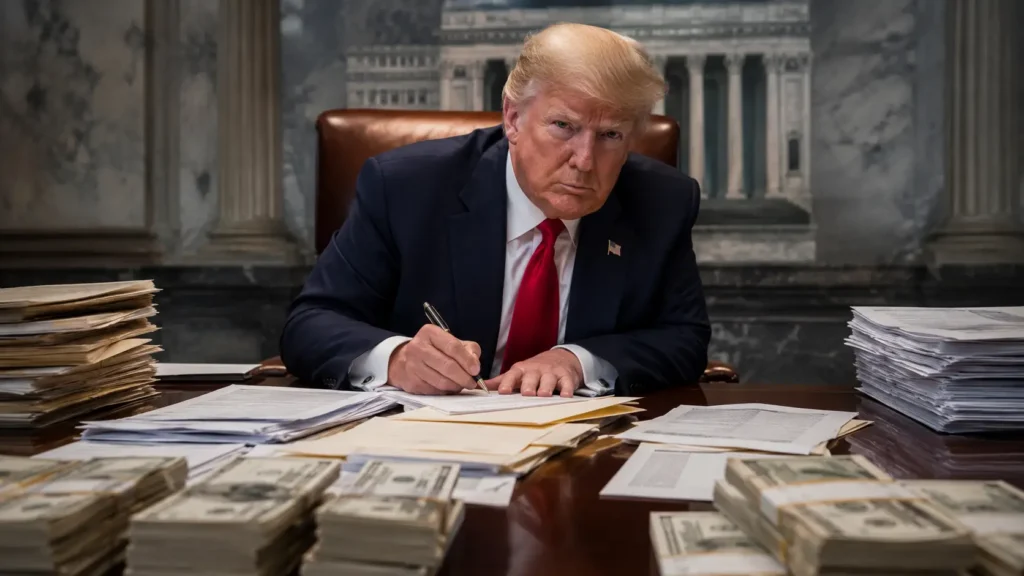
The Trump tax immunity deal refers to a disputed agreement arising from Donald Trump’s lawsuit against the US Internal Revenue Service.
The arrangement sought to protect Trump, members of his family, the Trump Organization and potentially related entities from certain existing tax audits, claims and government investigations.
It formed part of a wider settlement that also proposed a $1.776 billion “Anti-Weaponization Fund” for people claiming they had been unfairly targeted by the federal government.
However, the agreement has faced judicial criticism, opposition from both Republican and Democratic lawmakers, and uncertainty over whether any of its tax protections can legally be enforced.
Trump’s lawyers have now indicated that they will appeal a federal judge’s July 2026 ruling restricting the use of the settlement.
What Is the Trump Tax Immunity Deal?
The arrangement followed a $10 billion lawsuit filed by President Trump, Donald Trump Jr, Eric Trump and the Trump Organization against the IRS and the US Treasury Department.
The plaintiffs claimed that the government had failed to protect confidential tax information that was unlawfully disclosed by former IRS contractor Charles Littlejohn.
Littlejohn had previously been prosecuted for leaking tax information relating to Trump and thousands of wealthy Americans.
A settlement was announced on 18 May 2026. According to the Justice Department’s announcement, Trump and the other plaintiffs agreed to withdraw the lawsuit and related administrative claims.
They were to receive a formal government apology but no direct damages payment.
The following day, acting Attorney General Todd Blanche signed a separate release order concerning the settlement. Its wording purported to release the plaintiffs from a broad range of current or potential claims, examinations, appeals and related proceedings.
What Tax Protection Did the Deal Attempt to Provide?
The May 19 order stated that the United States released and discharged the plaintiffs from claims that had been or could have been asserted as of the settlement’s effective date.
The wording covered matters connected with:
- issues raised, or which could have been raised, in the IRS lawsuit;
- allegations described as “lawfare” or government “weaponization”;
- pending agency claims;
- matters already pending or which could be pending before government departments; and
- tax returns filed before the settlement’s effective date.
The listed beneficiaries were not limited to Donald Trump personally. The language referred to the named plaintiffs, related or affiliated individuals, family members filing jointly, trusts, parent or sister companies, subsidiaries and other affiliates.
That breadth is one reason the arrangement has been described as a tax immunity deal rather than an ordinary settlement of a damages claim.
Does the Deal Give Trump Permanent Immunity From All Taxes?

No. It should not be understood as a permanent exemption from US taxation.
The order does not state that Trump, his family or their businesses are exempt from paying all future federal taxes. Nor does it clearly prevent the IRS from reviewing every future tax return filed after the agreement.
Its wording is nevertheless unusually broad. It seeks to prevent the government from pursuing claims and examinations connected with matters existing at the effective date, including returns filed before that date.
Republican senators John Cornyn and Thom Tillis have sought written confirmation that the protection is:
- retrospective rather than prospective;
- limited to the parties involved in the original litigation; and
- incapable of shielding a potentially wider network of Trump-affiliated companies from future audits.
Cornyn said Todd Blanche had represented the protection as retrospective and limited to the litigants, but the senator wanted those limitations formally recorded.
He also raised concerns that the wording could affect more than 100 Trump Organization subsidiaries.
The distinction is important. Protection from identified existing audits would already be exceptional, but it is narrower than immunity from all future tax enforcement.
What Was the $1.776 Billion Anti-Weaponization Fund?
The tax protection was linked to another controversial part of the settlement: the proposed Anti-Weaponization Fund.
The Justice Department initially said the fund would receive $1.776 billion from the US Judgment Fund.
It was intended to process claims from people alleging that they had been targeted for political, personal or ideological reasons.
Under the original proposal:
- payments would come from a permanent federal appropriation used for judgments and settlements;
- a claims process would distribute relief;
- quarterly reports would be sent to the attorney general;
- the fund could be audited at the attorney general’s direction; and
- claims processing would end no later than 1 December 2028.
The Justice Department argued that the arrangement provided redress for victims of politically motivated government action.
Critics argued that it could distribute public money to Trump supporters, including people prosecuted in connection with the 6 January 2021 attack on the US Capitol.
The fund and the tax release were legally connected to the same settlement, but they were separate forms of relief. Abandoning the fund would not automatically clarify or cancel the tax protections.
Is the Anti-Weaponization Fund Still Going Ahead?

Its current position is uncertain, although Trump said on 31 July 2026 that the fund was “dead”.
Todd Blanche had previously told lawmakers that it would not proceed. The Justice Department also supplied draft wording stating that the May 18 order establishing the fund was rescinded and would have no legal effect.
Cornyn and Tillis have nevertheless demanded a binding written commitment.
Their concern is that verbal assurances could later be reversed, particularly because Trump has continued to defend the principle of compensating people he believes were mistreated by the government.
The Senate Judiciary Committee is scheduled to reconsider Blanche’s nomination as permanent attorney general on Tuesday, 4 August 2026. That timetable may still change if negotiations over the settlement remain unresolved.
What Did the Federal Judge Decide?
On 13 July 2026, US District Judge Kathleen Williams issued a strongly critical ruling concerning the litigation and purported settlement.
The judge found that there had never been a genuinely adversarial dispute because Trump, as president, exercised authority over the executive agencies he had sued.
The Justice Department did not file an appearance or defend the IRS and Treasury Department before the settlement was announced.
The court concluded that the lawsuit had been presented for an improper purpose and that the plaintiffs had acted in bad faith.
It described the litigation as an attempt to give judicial legitimacy to an arrangement providing immunity to Trump-affiliated people and entities while allocating billions of taxpayer dollars to claims not clearly defined in law.
The ruling imposed several sanctions:
- Trump lawyer Alejandro Brito was referred to the Florida Bar for possible disciplinary consideration.
- Daniel Epstein was barred for one year from obtaining special permission to appear in future cases in the Southern District of Florida.
- The parties were prohibited from presenting or citing the purported settlement as evidence of a valid settlement in judicial, administrative, regulatory, arbitration or other official proceedings.
The complete 13 July federal court order provides the primary legal record of the decision.
Did the Judge Completely Cancel the Tax Immunity Deal?

Many reports have described the ruling as voiding or nullifying the settlement. Its practical effect is clearly damaging to the arrangement, but the precise legal position requires qualification.
The court barred the parties from relying on the settlement in official proceedings. That restriction could make the tax release extremely difficult to enforce against the IRS or another government body.
However, the judge also stated that the wider question of whether the agreement could survive as a private arrangement—and whether it amounted to an unlawful grant of immunity—was not directly before the court.
The safest conclusion is therefore:
The court prevented the settlement from being used as an officially recognised resolution of the IRS lawsuit, but further proceedings may determine whether any part of the separate tax release remains enforceable.
Trump’s attorneys notified the court on 31 July that they intended to appeal the ruling.
Why Is Todd Blanche’s Nomination Involved?
Todd Blanche previously worked as Trump’s personal defence lawyer. He later became acting attorney general and signed the documents creating both the fund and the tax release.
Trump subsequently nominated him to become the permanent US attorney general.
However, Cornyn and Tillis have withheld their support while seeking written assurances that:
- the $1.776 billion fund has been permanently abandoned;
- the tax release does not protect future returns;
- its coverage is limited to the actual plaintiffs; and
- it cannot be interpreted as general immunity for Trump-affiliated businesses.
Because the Senate Judiciary Committee’s political balance means Blanche needs every Republican committee vote, opposition from even one or two Republican senators can prevent the nomination from advancing.
The dispute is therefore no longer only about Trump’s tax affairs. It has become part of a broader contest over the leadership and independence of the US Justice Department.
Why Is the Trump Tax Immunity Deal So Controversial?
The controversy centres on four connected issues.
Equality Before the Tax System
Ordinary taxpayers cannot normally negotiate an agreement preventing the tax authority from examining earlier returns simply by suing the government.
Cornyn said the protection appeared to provide immunity from audits that no other taxpayer could obtain. Critics argue that such treatment would undermine confidence that tax laws are administered consistently.
Conflict of Interest
Trump was both the private plaintiff seeking relief and the president overseeing the executive departments being sued.
The court found that the supposed opposing parties had a shared interest rather than a genuine dispute requiring judicial resolution.
The Scope of the Release
The reference to family members, trusts, affiliates, related companies and subsidiaries creates uncertainty about who could claim protection.
Lawmakers are particularly concerned that a settlement involving four named plaintiffs might be used to protect a much larger corporate network.
Use of Public Money
The proposed fund would have received $1.776 billion from a federal appropriation, despite the plaintiffs themselves receiving no direct damages.
The court questioned whether the lawsuit had been used to create access to public funds for claimants whose potential grievances were not legally defined.
Does the Trump Tax Deal Affect UK Taxpayers?

The arrangement concerns US federal agencies, US litigation and American tax enforcement. It does not alter HMRC rules, UK Income Tax, Corporation Tax, VAT or Self Assessment obligations.
UK residents and businesses must continue following domestic reporting rules regardless of developments in the United States.
Those earning additional business income can check the current UK side hustle tax rules, while higher-income sole traders and landlords may need to comply with Making Tax Digital requirements.
Anyone receiving undeclared trading income should address their own position through the correct process for declaring side-hustle income to HMRC. A US political settlement does not provide any defence against UK reporting or payment obligations.
A UK company with American subsidiaries, US-source income or a taxable presence in the United States may need specialist cross-border tax advice, but the Trump settlement does not create a general rule available to other businesses.
What Happens Next?
Several developments will determine whether the Trump tax immunity deal has any lasting effect.
First, the federal appeal will test the July ruling and its restrictions on using the settlement in official proceedings.
Second, negotiations between the Justice Department and Republican senators may produce a written document formally rescinding the fund and narrowing—or abandoning—the tax release.
Third, the Senate must decide whether Blanche’s involvement in the agreement prevents his confirmation as permanent attorney general.
Finally, the IRS and other agencies may need to determine whether existing Trump-related audits can proceed while the legal status of the May 19 order remains disputed.
Until those issues are resolved, claims that Trump has received permanent and uncontested tax immunity are misleading.
Final Position
The Trump tax immunity deal attempted to resolve a $10 billion IRS lawsuit while providing unusually broad protection from certain tax audits and government claims.
It was accompanied by plans for a $1.776 billion fund, although Trump now says that fund is no longer proceeding.
A federal judge has ruled that the underlying lawsuit lacked a genuine dispute and barred the parties from relying on the settlement in official proceedings.
An appeal is planned, while Republican senators continue to demand written limits on both the fund and the tax protections.
As of 1 August 2026, Trump does not possess a clear, uncontested or unlimited exemption from US tax law. The scope and enforceability of the arrangement remain subject to court proceedings, political negotiations and possible formal rescission.
Frequently Asked Questions
What is the Trump tax immunity deal?
It is the name commonly given to a May 2026 arrangement that attempted to release Donald Trump, his sons, the Trump Organization and certain affiliates from existing or potential government claims and tax examinations connected with matters predating the settlement.
Was Trump awarded $1.776 billion?
No. The Justice Department said Trump and the other plaintiffs would receive an apology but no direct damages. The $1.776 billion was intended for a separate Anti-Weaponization Fund that would process claims from other alleged victims of government action.
Can the IRS ever audit Trump again?
The May order did not clearly prohibit every audit of every future return. It attempted to end or prevent claims and examinations relating to matters existing at the effective date, including earlier tax returns. Its breadth and enforceability remain disputed.
Has the court cancelled the agreement?
The court prohibited the parties from relying on the purported settlement in official proceedings and found that the lawsuit had been brought for an improper purpose. Trump’s lawyers have announced an appeal.
Is the $1.776 billion fund still active?
Trump and Blanche have said it will not proceed, but Republican senators have demanded definitive written confirmation. The fund’s status remains part of negotiations over Blanche’s attorney general nomination.
Does it change British tax law?
No. UK taxpayers remain subject to HMRC rules and the applicable requirements for Income Tax, Corporation Tax, VAT, National Insurance, Self Assessment and Making Tax Digital.

More in UK Business News

How to Keep a Rental Property Business Legally Compliant?
Keeping a rental property business legally compliant in 2026 means following the rules that apply where the property is located, completing required safety checks, protecting deposits correctly, using appropriate tenancy documentation and maintaining accurate tax and compliance records. Safety obligations should be managed proactively. Where a property contains relevant gas appliances, landlords should arrange the […]

Raising Cane’s UK: When Is It Coming to the UK and Where Will It Open?
Raising Cane’s is officially coming to the UK, with its first British restaurant scheduled to open in Piccadilly Circus, London, in early 2027. The American chicken chain has confirmed that its UK flagship will occupy 21–22 Coventry Street, between Piccadilly Circus and Leicester Square. More restaurants are expected to follow around The Strand, Oxford Circus […]