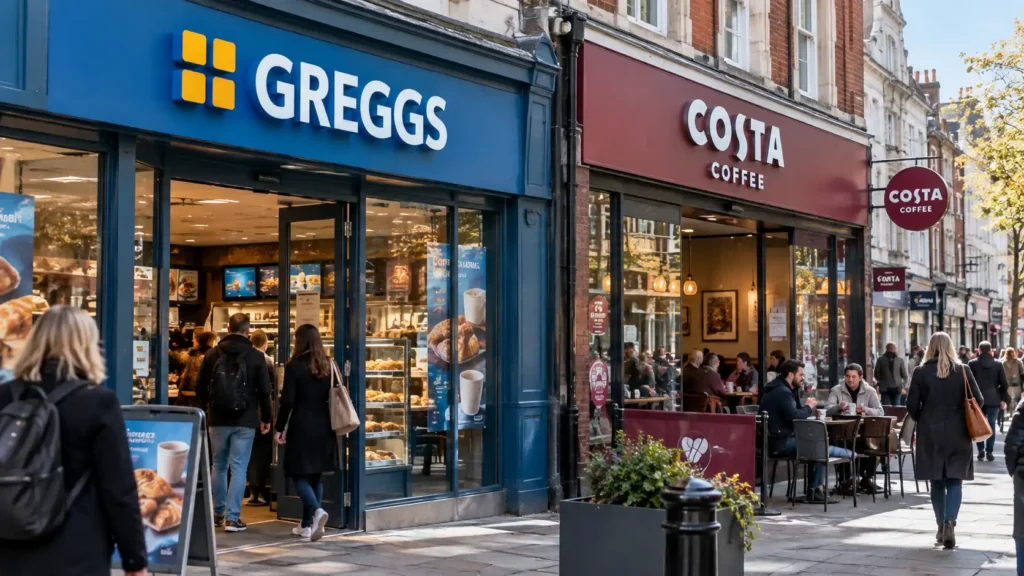
Greggs has overtaken Costa Coffee to become the largest overall operator in the UK branded coffee shop market by outlet count, according to Allegra World Coffee Portal’s Project Café UK 2026 research.
The market study counted 2,737 Greggs outlets versus 2,707 Costa Coffee locations, giving Greggs a narrow lead of 30 sites. Starbucks remained third with 1,424 outlets.
But the headline needs some context.
This is not simply a story of Britons suddenly abandoning Costa for sausage rolls and £2 coffee. Greggs has spent years expanding outside traditional high streets, developing breakfast and drinks, using franchise partners to reach travel and roadside locations, and positioning itself firmly around value.
Costa, meanwhile, has lost the outlet-count crown but is showing signs of a financial and operational recovery.
And despite a fresh wave of headlines in September 2026, the underlying Greggs-versus-Costa crossover was identified by Project Café UK 2026, published on 21 January 2026, and was being reported within the hospitality industry by early February. The September coverage has brought the change to a much wider audience rather than marking the precise date on which Greggs suddenly overtook its rival.
Greggs vs Costa UK at a Glance
| Measure | Greggs | Costa Coffee |
| Outlets in Project Café UK 2026 | 2,737 | 2,707 |
| Difference | 30 ahead | — |
| Approximate market outlet share | 22% | 22% |
| Main positioning | Value-led food-to-go with coffee | Dedicated coffee-shop brand |
| Recent strategy | Expansion, convenience, alternative locations | Refurbishment, menu development and renewed expansion |
| Key competitive strength | Price, food bundles, accessibility | Coffee heritage, café experience and established brand |
Allegra says both businesses effectively command around 22% of the branded market by outlet numbers, which demonstrates how close the competition remains.
That is an important qualification. Greggs has overtaken Costa, but this is not a runaway lead.
Has Greggs Really Overtaken Costa?
Yes. within Allegra World Coffee Portal’s definition of the UK branded coffee shop market, Greggs is now the largest overall operator by number of outlets.
Project Café UK 2026 recorded:
- Greggs: 2,737 outlets
- Costa Coffee: 2,707 outlets
- Starbucks: 1,424 outlets
The wider branded coffee shop market reached 12,313 outlets during 2025, an increase of 3.5%, while market sales increased 5.5% to approximately £6.8 billion.
The interesting part is that Greggs is not, traditionally, a coffee-shop company.
It is primarily a food-to-go retailer. Its inclusion at the top of the ranking illustrates how blurred the boundary between bakeries, cafés, convenience operators and coffee chains has become.
Consumers no longer need to enter a traditional café to buy freshly made coffee. Bakeries, fast-food businesses, convenience stores, petrol stations and food-to-go brands increasingly compete for the same morning coffee purchase.
Why Do Some Reports Say Greggs Has 2,737 Shops While Greggs Says 2,773?
This is one of the details that deserves more attention.
Allegra’s UK coffee-market research puts Greggs at 2,737 outlets.
Greggs’ own corporate reporting subsequently showed a larger estate.
Its preliminary results said the company had 2,739 shops at 27 December 2025 after 121 net openings during the year.
By 9 May 2026, Greggs reported 2,759 shops, consisting of:
2,141 company-managed locations and 618 franchised units.
By 27 June 2026, Greggs said its total estate had reached 2,773 shops following 34 net openings during the first half.
These figures should not be mixed together without qualification.
Allegra’s 2,737 figure belongs to its UK branded-coffee-market dataset. Greggs’ later figures represent the company’s corporate shop estate at specific reporting dates. Greggs also opened its first international travel-hub shop at Tenerife South Airport during 2026.
The small difference between the market-research and company figures may involve timing or classification methodology. Allegra’s publicly accessible summary does not provide enough information to reconcile every individual outlet.
Therefore, the safest statement is:
Greggs overtook Costa in Allegra’s comparable UK branded coffee shop ranking, while Greggs’ own subsequently reported estate has continued to expand beyond the 2,737 outlets recorded in that study.
Why Has Greggs Overtaken Costa?
Price is certainly part of the answer, but it is not the whole answer.
LBC’s September 2026 price comparison put a Greggs Americano at £1.80, compared with £4.20 at Costa. Those prices should be treated as a snapshot rather than permanent nationwide pricing because drink prices and available sizes can change.
The Beverage Standards Association’s Peter Backman similarly highlighted Greggs’ £2.40 latte when analysing the shift.
For customers buying breakfast or grabbing a drink on the way to work, the difference becomes particularly significant when coffee is combined with food.
Greggs does not necessarily have to persuade a dedicated speciality-coffee customer to abandon their favourite café. It can win a different occasion: the commuter who wants coffee plus breakfast quickly and affordably.
That creates an important competitive advantage.
Greggs Is Selling Convenience as Much as Coffee
Greggs’ expansion strategy also explains why simply comparing latte quality misses the wider business story.
The company has increasingly targeted locations beyond traditional shopping streets, including transport hubs, supermarkets, roadside sites, retail parks and other high-footfall destinations.
Franchise partners have become a substantial part of that strategy.
At 9 May 2026, 618 of Greggs’ 2,759 shops were franchised, representing roughly 22% of the estate. Seventeen of the 41 gross openings during the first 19 weeks of 2026 were opened with franchise partners.
Businesses looking more closely at that model can see how the company’s Greggs franchise network and commercial partner strategy differs from the conventional single-store franchise model often described online.
Greggs is therefore expanding not only through conventional shops but by putting the brand in places where customers already travel, shop or refuel.
That is particularly powerful for coffee because morning drinks are highly dependent on convenience and routine.
Coffee Has Become a Bigger Part of the Greggs Business
Greggs’ rise should not be dismissed as a bakery merely being counted as a café.
The company has deliberately expanded its drinks business.
Its 2025 results said Greggs had increased its market share across categories including coffee, breakfast and iced drinks, while the company remained the number-one food-to-go brand for value in its cited YouGov Brand Index measure.
Its menu has also moved beyond basic tea and traditional coffee.
During 2026, Greggs highlighted products including iced matcha lattes, while continuing to develop its iced-drink and coffee range.
The strategy appears designed to capture more customer occasions throughout the day rather than depending solely on the traditional lunchtime bakery visit.
Greggs reported that its share of food-to-go visits increased by 0.5 percentage points to 8.6% in the year to December 2025, according to Circana data cited in its results. Its Rewards app was scanned in 26.7% of company-managed transactions, while delivery sales increased 8.1%.
That suggests physical expansion is being accompanied by broader customer engagement.
Greggs’ Sales Are Still Growing
Greggs reported £1.1 billion of total sales for the 26 weeks ended 27 June 2026, up 7.2% year on year.
Like-for-like sales at company-managed shops increased 2.1%.
Chief executive Roisin Currie CBE said:
“We remain focused on opening shops in more catchments.”
She also pointed to menu innovation, convenience and supply-chain investment as important parts of the company’s longer-term expansion.
Greggs currently sees the potential for at least 3,500 UK shops over the longer term, supported by new logistics infrastructure in Derby and Kettering.
That ambition matters because Greggs’ lead over Costa in the coffee-market ranking is currently only 30 outlets.
If its proposed estate expansion is delivered, the gap could become more substantial — although Costa’s own expansion plans mean that cannot be assumed.
Does Greggs Overtaking Costa Mean Costa Is Struggling?
Not quite.
This is another area where the simple headline can be misleading.
Costa unquestionably faced difficulties. Its 2024 accounts showed operating losses of approximately £13.5 million, compared with £5.8 million the previous year.
Coca-Cola also explored selling Costa before abandoning the sales process after reported bids failed to meet expectations.
However, more recent information presents a considerably stronger picture.
Reporting in September 2026 showed Costa’s 2025 revenue rising approximately 3.5% to £1.74 billion, while pre-tax profit increased to around £63 million. Costa also reportedly recorded its strongest first-half like-for-like transaction growth in more than a decade.
Costa is therefore losing one ranking while apparently improving several important financial and trading metrics.
Those two things can happen simultaneously.
Costa Is Changing Its Strategy
Costa chief executive Philippe Schaillee has overseen a programme of store and menu changes intended partly to reconnect the business with younger customers.
More than 1,000 locations have reportedly undergone refurbishment or refresh work, alongside increased attention to cold beverages and the customer experience.
Schaillee described the challenge facing the old format particularly clearly:
“Customers under 35 weren’t there.”
He said younger consumers were not finding the experience or drinks they expected from the brand several years ago.
That helps explain why Costa’s response is not simply to open as many stores as possible.
It has also been modernising existing shops and refreshing its menu before accelerating expansion again.
Reports in September indicate that Costa plans around 51 new stores during 2026 as the turnaround progresses.
Is Cheap Coffee the Real Reason Greggs Won?
Industry consultant Peter Backman argues that the competitive shift goes deeper than customer taste.
His concise assessment was:
“The driver isn’t taste — it’s cost.”
Backman’s analysis describes a market increasingly divided between low-cost, highly efficient operators at one end and premium specialist brands at the other, leaving established middle-market chains under pressure.
This is one of the most important business lessons behind the Greggs-Costa story.
Coffee quality has become easier to deliver consistently through better equipment, automated processes and tightly controlled systems.
A company therefore does not necessarily need a large traditional coffeehouse with extensive seating and substantial staffing to sell a credible cup of coffee.
Greggs can combine coffee with an existing bakery operation, high transaction volumes and food sales.
That changes the economics.
The UK Coffee Market Is Splitting Between Value and Premium
Greggs’ rise does not mean British consumers are universally trading down.
Premium operators are expanding too.
Allegra Group founder and chief executive Jeffrey Young describes the UK market as entering what Allegra calls the “Fifth Wave” of coffee – an era where businesses attempt to combine quality with scalable systems, strong branding, sustainability and operational discipline.
Challenger brands such as Blank Street, Black Sheep Coffee and WatchHouse have been expanding alongside food-led operators.
That creates a fascinating market structure.
At one end sits value and convenience.
At the other sits experience, speciality products and premium positioning.
Traditional chains operating between those extremes must demonstrate why consumers should pay more than they would at Greggs without necessarily receiving the boutique experience available from premium specialists.
That may be the bigger competitive threat to established operators than Greggs’ 30-store lead itself.
Why Coffee Shop Economics Are Becoming More Difficult?
A £4 coffee can look expensive to consumers without necessarily producing a large profit for the café selling it.
Grind founder David Abrahamovitch illustrated the problem during 2026 when he gave a cost breakdown suggesting that his business could retain only around 18p of profit from a £4.10 flat white after labour, ingredients, VAT and operating costs.
Coffee businesses are dealing simultaneously with wage costs, rents, energy, packaging and volatile coffee-bean prices.
That makes Greggs’ operating structure particularly interesting.
Coffee does not need to carry the economics of an entire dedicated café. A customer may purchase a drink alongside a breakfast roll, bake, sandwich, doughnut or other food item.
The coffee can therefore contribute to a broader transaction rather than functioning as the sole reason the property exists.
Greggs Is Also Experimenting With Smaller Formats
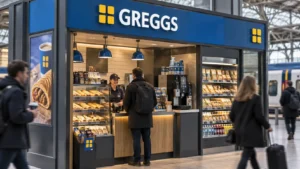
The next stage of the competition may involve formats rather than conventional high-street shops.
Greggs has been testing Bitesize Greggs locations designed for smaller high-footfall spaces and a Greggs Express concept centred on self-service coffee and food.
Property director Tony Rowson described Greggs Express as focusing on:
“convenience and speed”
The concept allows customers to collect food and serve coffee themselves, making it particularly relevant to roadside and travel environments.
This could allow Greggs to enter locations where a full conventional shop would be impractical.
For the coffee industry, that means the competitive unit is increasingly not “coffee shop versus coffee shop”.
It can be café versus bakery, convenience counter, petrol station, supermarket concession or self-service machine.
What Does Greggs Overtaking Costa Mean for UK Businesses?
The biggest lesson is not that inexpensive products always beat premium ones.
It is that a clear value proposition is increasingly important.
Greggs knows what customers are being offered: accessible locations, recognisable products, speed and relatively low prices.
Premium operators also have a clear proposition built around coffee quality, store environment and brand experience.
Businesses caught between those positions may face greater difficulty.
Operators therefore need to understand whether customers are paying primarily for convenience, price, product quality, environment or experience.
Attempting to compete simultaneously with Greggs on price and speciality cafés on experience can create an expensive middle ground.
Could Costa Take the Number-One Position Back?
It is possible, particularly because the current difference in the comparable Allegra ranking is only 30 outlets.
Costa has returned to expansion while Greggs continues opening new locations.
There is therefore no reason to treat today’s ranking as permanent.
Greggs expects approximately 100 to 110 net openings during 2026, according to its latest half-year guidance, while its longer-term infrastructure is being developed to support at least 3,500 UK locations.
Costa, meanwhile, is moving from refurbishment towards renewed growth after its recent trading improvement.
The competitive position should therefore be judged through comparable market data rather than simply comparing whichever headline store numbers the companies publish at different points during the year.
What Happens Next to the UK Coffee Market?
Allegra expects continued expansion rather than saturation across the entire sector.
Project Café forecasts indicate that the branded UK market could exceed 12,780 outlets in 2027 and reach approximately 14,380 locations by January 2031.
Market sales are projected to approach £9 billion over the same period.
That suggests the Greggs-Costa battle is happening inside a growing market rather than a straightforward zero-sum contest.
The next winners may therefore be the operators that can expand while keeping labour, property and operating costs under control.
Final Answer
Greggs has overtaken Costa Coffee as the UK’s largest overall branded coffee shop operator by outlet count in Allegra World Coffee Portal’s Project Café UK 2026 ranking.
The report counted 2,737 Greggs outlets against 2,707 Costa locations, putting Greggs ahead by 30.
But the deeper story is more significant than the league table.
Greggs has combined low prices, food-and-drink transactions, aggressive estate growth, franchise partnerships and expansion into travel, roadside and alternative locations. Its total corporate estate subsequently reached 2,773 shops by 27 June 2026, although that later figure should not be directly substituted into Allegra’s UK-only comparative market table.
Costa has simultaneously been refurbishing stores and improving its financial performance. Recent reporting puts 2025 revenue at around £1.74 billion and pre-tax profit at approximately £63 million, meaning the loss of its outlet-count crown should not be interpreted as evidence that the business has stopped growing.
The more important shift is happening across the entire UK coffee industry: food-led value operators such as Greggs can now compete directly for coffee occasions, while premium specialist brands continue growing at the opposite end of the market.
For traditional coffee chains caught between those two positions, differentiation may now matter just as much as the number of shops they operate.
Frequently Asked Questions
Has Greggs Overtaken Costa in the UK?
Yes. Allegra World Coffee Portal’s Project Café UK 2026 ranked Greggs as the UK’s largest overall branded coffee-market operator by outlet count, with 2,737 locations compared with Costa’s 2,707.
Is Greggs Now the UK’s Biggest Coffee Chain?
Greggs is the largest overall operator included in the UK branded coffee shop market by outlet count. However, Greggs is fundamentally a food-to-go and bakery business rather than a conventional dedicated coffeehouse chain.
How Many Greggs Shops Are There in 2026?
Greggs reported 2,773 shops trading at 27 June 2026. That is a later corporate estate figure than the 2,737 locations used in Allegra’s Project Café UK comparison.
How Many Costa Coffee Shops Are There in the UK?
Project Café UK 2026 counted 2,707 Costa outlets in its comparable UK branded coffee market analysis. Costa’s estate continues to change as shops are refurbished, opened and closed.
Why is Greggs Coffee Cheaper Than Costa?
Greggs operates primarily as a high-volume food-to-go retailer rather than a traditional café. Its coffee can form part of a wider food transaction, while its compact formats, operational systems and large estate support its value-led positioning.
Is Costa Coffee Losing Money?
Costa recorded a £13.5 million operating loss for 2024, but more recent reporting indicates a substantial improvement, with 2025 revenue of about £1.74 billion and pre-tax profit of approximately £63 million.
Who is the Third-largest Coffee Operator in the UK?
Starbucks ranked third in Project Café UK 2026 with 1,424 outlets, behind Greggs and Costa.
When Did Greggs Overtake Costa?
Project Café UK 2026, published on 21 January 2026, identified Greggs as the new overall market leader. Hospitality publications were reporting the crossover by early February 2026, although it received renewed mainstream coverage in September.

More in UK Business News
Banking Industry Tax Warning UK: Why Banks Fear a New Windfall Tax?
The banking industry tax warning UK debate has intensified as Britain’s largest banks push back against the possibility of another tax increase on the financial sector. On 21 August 2026, reports said major UK banks had warned Prime Minister Andy Burnham against introducing what they regard as a potentially damaging windfall tax on financial institutions. […]

RevolverTech Crew: Inside the Team and Business Model Behind the Platform
The RevolverTech Crew is the group associated with RevolverTech, an online platform publishing content across technology, gaming, home computing and business topics. Searches for the term can be confusing because different websites describe the crew in very different ways. Some portray RevolverTech as a large technology collective with developers, designers and innovation teams, while others […]