
The UK Budget Starter Investment ISA is one of the latest proposals intended to encourage more British savers to enter the investment market.
Announced by Chancellor John Healey during the Autumn Budget on 28 October 2026, the proposed initiative could introduce financial incentives for people investing through a Stocks and Shares ISA for the first time.
The announcement came alongside a significant reversal of previously planned savings reforms. The Government confirmed that the annual Cash ISA allowance would remain at £20,000 rather than fall to £12,000 for adults under 65 from April 2027.
Instead of restricting how much people can save in cash, ministers now intend to explore incentives designed to make long-term investing more attractive and accessible.
However, an important distinction remains: the Starter Investment ISA is currently a proposal under development, not a financial product available to open. The Government has not confirmed a contribution limit, bonus percentage, age restriction or launch date.
We analysed the official Budget documents, HMRC updates, existing ISA regulations and published comments from financial-sector representatives to explain what has actually changed, what remains uncertain and how the proposed incentive could affect households, employees, self-employed professionals and entrepreneurs.
What Is the UK Budget Starter Investment ISA?
The UK Budget Starter Investment ISA is the name being used for a proposed incentive to encourage individuals to make their first investments within a Stocks and Shares Individual Savings Account.
Rather than introducing a compulsory investment requirement, the Government intends to work with investment providers to explore ways of rewarding people who begin investing.
A Stocks and Shares ISA is already an established UK investment account. It allows eligible individuals to hold investments such as shares, funds and bonds without paying UK Capital Gains Tax or Income Tax on investment income held within the ISA.
The new proposal could build upon this existing structure by introducing an additional reward for qualifying first-time investors.
The Chancellor described the initiative as a Starter ISA, but HM Treasury’s more detailed documentation refers to a new ISA incentive. This difference matters because a separate fifth ISA category has not been formally established.
Key Facts About the Starter Investment ISA
| Feature | Position as of 30 October 2026 |
| Announcement date | 28 October 2026 |
| Announced by | Chancellor John Healey |
| Main objective | Encourage first-time investing |
| Intended investment vehicle | Stocks and Shares ISA |
| Incentive amount | Not confirmed |
| Government bonus | Not confirmed |
| Maximum qualifying contribution | Not confirmed |
| Minimum investment | Not confirmed |
| Age eligibility | Not confirmed |
| Launch date | Not announced |
| Industry involvement | Confirmed |
| Applications currently open | No |
| Existing overall ISA allowance | £20,000 per tax year |
The proposed scheme should therefore be understood as a potential enhancement to the existing investment system rather than a completed Government savings product.
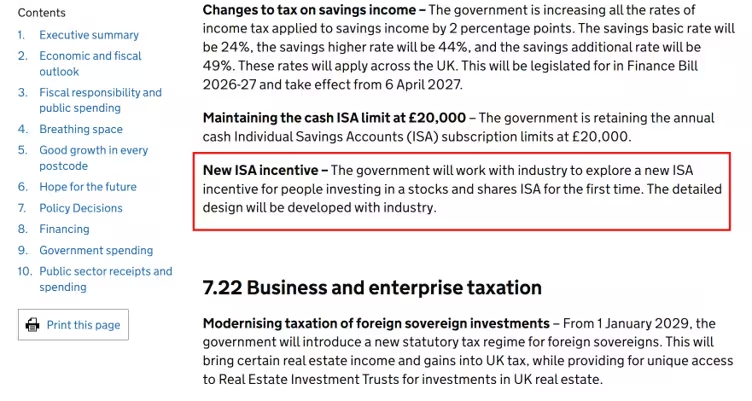
The official Autumn Budget 2026 confirms plans to explore a new incentive for first-time Stocks and Shares ISA investors.
What Did the UK Budget 2026 Announce About ISAs?
The 28 October Budget introduced a different approach to encouraging investment participation compared with the previous Government’s proposed ISA reforms.
During the 2025 Autumn Budget, plans were announced to reduce the amount that savers under 65 could contribute to Cash ISAs from £20,000 to £12,000 annually, beginning in April 2027.
The intention was to encourage people to direct more of their available money towards investment accounts.
However, critics argued that limiting cash savings could penalise cautious savers without necessarily persuading them to invest.
The October 2026 Budget abandoned that approach.
The Chancellor confirmed that the full £20,000 Cash ISA allowance would remain available for adults, regardless of age.
At the same time, the Government committed to exploring an investment incentive that could encourage more individuals to take their first step into financial markets.
What Has Changed Between the 2025 and 2026 Budget Plans?
| Policy area | Previous proposal | Budget 2026 position |
| Annual Cash ISA limit for under-65s | Reduce to £12,000 from April 2027 | Retain £20,000 |
| Cash ISA limit for older savers | £20,000 | Retain £20,000 |
| Overall ISA allowance | £20,000 | £20,000 |
| First-time investor incentive | No established scheme | Explore a new incentive |
| Restrictions on cash held in investment ISAs | Planned | Will not take effect |
| Investment participation strategy | Encourage investment partly through cash restrictions | Explore positive incentives |
| Starter ISA launch | Not applicable | Date unconfirmed |
This represents a substantial change in savings policy.
For existing Cash ISA holders, the outcome provides greater certainty about their annual tax-free savings allowance.
For prospective investors, the possibility of an introductory incentive creates a new potential opportunity, although the financial details remain unresolved.
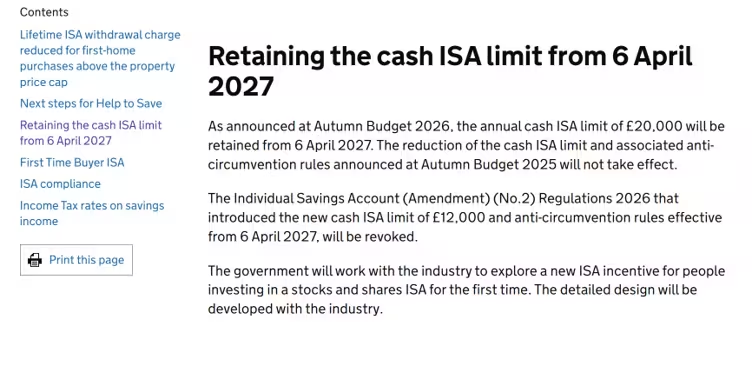
HMRC confirms that the £20,000 Cash ISA limit will remain in place from April 2027 and the associated restrictions will be withdrawn.
Why Does the Government Want to Introduce a Starter Investment ISA?
The principal objective is to encourage greater participation in long-term investing.
Although Cash ISAs and Stocks and Shares ISAs provide tax advantages, they serve different financial purposes.
Cash ISAs are generally designed for capital preservation and interest earnings. Stocks and Shares ISAs offer exposure to financial markets, where investments can generate returns through capital appreciation and income but can also lose value.
Many households remain more comfortable holding cash than investing.
HMRC’s annual savings statistics published in September 2026 demonstrate the scale of that preference.
During the 2024–25 tax year, approximately 16.8 million adult ISA accounts received subscriptions, with Cash ISAs representing around 64% of those accounts.
The amount subscribed to Cash ISAs increased by 37.5%, equivalent to an additional £26.1 billion compared with the previous year.
These figures demonstrate that Cash ISAs remain a major component of British household savings.
They also explain why reducing the Cash ISA allowance was a controversial strategy.
A financial incentive could provide a more attractive route towards increasing investment participation while preserving the choice to hold cash.
The Economic Argument Behind Encouraging Investment
Greater investment participation can potentially benefit both households and the wider economy.
For individuals, diversified long-term investments may provide opportunities for capital growth, although returns are uncertain.
For businesses, investment markets help finance corporate expansion, employment, innovation and infrastructure.
Publicly listed businesses can benefit when investors supply capital through new share issues, while active investment markets can support access to finance more broadly.
Nevertheless, purchasing existing shares on the stock exchange does not automatically provide new funding directly to the company concerned.
The economic benefits depend partly on how additional investment activity influences companies’ financing conditions.
Richard Stone, Chief Executive of the Association of Investment Companies, welcomed the October 2026 announcement, stating:
“A new ISA incentive for first-time investors is great news.”
His published response also expressed support for industry collaboration to broaden investment participation.
From our financial analysis, the potential value of the proposal is not simply increasing investment volumes. It is encouraging people to develop sustainable investment habits without sacrificing essential savings or misunderstanding financial risk.
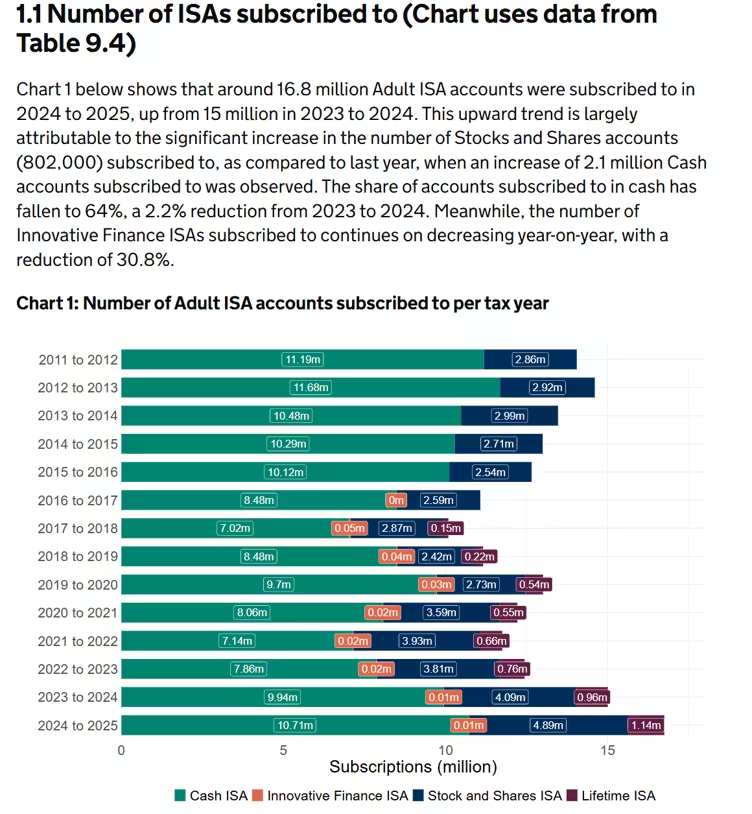
Official HMRC figures show the continued popularity of Cash ISAs among British savers.
How Could the Starter Investment ISA Work?
The Government has not published the operational rules.
However, one concept discussed publicly is providing a percentage-based financial incentive when an eligible individual invests through a Stocks and Shares ISA for the first time.
For example, a provider or Government-supported programme might offer an introductory contribution bonus.
An investor depositing £1,000 could receive an additional amount credited towards their investments if they satisfy qualifying conditions.
The reward could depend on several factors, such as the amount invested, how long investments remain held and whether the individual has previously invested.
Importantly, these are possible design features, not confirmed requirements.
Martin Lewis’s Proposed Investment Incentive
Consumer finance expert Martin Lewis has advocated an incentive-led approach to investment participation.
Following the October 2026 Budget, Lewis clarified that his concept was not necessarily to introduce an entirely new ISA category.
Instead, he proposed offering a reward to people investing in a Stocks and Shares ISA for the first time.
In his published comments on 29 October 2026, he explained:
“my suggestion was not for a new ISA.”
He discussed a potential introductory bonus of approximately 10% or 15% on the first £2,000 to £3,000 invested.
An earlier version of his idea used an illustrative 5% bonus on contributions of up to £1,000.
These figures are examples from his evolving proposal, not rates adopted by the Treasury.
Lewis also suggested that investment providers might contribute towards the incentive, potentially limiting the need for direct Government funding.
Whether the Government adopts any of these suggestions remains uncertain.
What Percentage Bonus Could a Starter Investment ISA Offer?
No official bonus percentage has been announced.
Nevertheless, evaluating hypothetical percentages helps explain how an incentive could affect an investment’s starting value.
The following examples assume that the entire qualifying contribution receives the stated bonus and that the bonus can be invested alongside the original contribution.
| Initial investment | Hypothetical bonus | Bonus amount | Starting investment value |
| £500 | 5% | £25 | £525 |
| £1,000 | 5% | £50 | £1,050 |
| £1,000 | 10% | £100 | £1,100 |
| £2,000 | 10% | £200 | £2,200 |
| £2,000 | 15% | £300 | £2,300 |
| £3,000 | 15% | £450 | £3,450 |
All percentages and amounts in this table are hypothetical illustrations, not Government-approved bonuses.
An incentive of this kind would improve the initial investment amount before market gains, losses and charges.
For example, an investor contributing £2,000 with a hypothetical 10% reward would begin with £2,200 invested.
However, the final account value would still depend on investment performance.
The Government has not established whether a future bonus would be paid immediately, after a holding period or through another mechanism.
It is also unknown whether any reward would count towards the £20,000 annual ISA subscription allowance.
Who Could Qualify for the New Starter Investment ISA?
Eligibility is one of the largest unanswered questions.
The official announcement specifically refers to people investing through a Stocks and Shares ISA for the first time.
That indicates a clear policy intention, but it does not establish exactly how first-time investor status will be assessed.
Several situations require clarification.
| Potential applicant | Eligibility position |
| Adult who has never invested | Intended target group, subject to final rules |
| Existing Cash ISA holder who has never invested | Potentially eligible, not confirmed |
| Person with a workplace pension | Treatment not confirmed |
| Person who invested through a general investment account | Treatment not confirmed |
| Existing Stocks and Shares ISA investor | Eligibility uncertain |
| Self-employed individual investing personally for the first time | Potentially eligible, subject to final rules |
| Adult aged over 40 | No confirmed age restriction |
| Adult aged over 65 | No confirmed age restriction |
| Person under 18 | Eligibility not established |
| Non-UK resident | Eligibility not established |
Ordinary adult ISA rules generally require an individual to be at least 18 and satisfy UK residence or other qualifying conditions.
However, those existing requirements should not be mistaken for confirmed Starter ISA eligibility rules.
Will Existing Cash ISA Holders Be Eligible?
Someone who has previously saved in a Cash ISA but never purchased investments may fall within the Government’s intended target audience.
However, holding a Cash ISA does not automatically establish eligibility for a future incentive.
The eventual rules will need to define what counts as a first investment.
For example, the Government may need to decide whether previous share ownership, pension investments or investment accounts held abroad should affect qualification.
Until those rules are published, savers should avoid making financial decisions based on an assumed entitlement.
When Will the Starter Investment ISA Launch in the UK?
As of 30 October 2026, the Government has not announced a launch date.
There is no confirmed application opening date, participating provider list or implementation timetable.
The next stage involves further work with the investment industry.
This could include deciding whether the scheme should operate as a standardised incentive within existing Stocks and Shares ISAs or through a more distinct account structure.
Any arrangement would also need to address eligibility verification, funding, provider administration and consumer protection.
The proposal should not be confused with the separate First Time Buyer ISA reforms, which have their own policy timetable.
There is currently no official Starter Investment ISA application form.
Consumers should therefore be cautious of online promotions claiming that a Government Starter ISA bonus can already be claimed.
How Is the Starter Investment ISA Different From Existing ISAs?
Understanding the distinction is important because the UK already has several tax-advantaged savings and investment accounts.
The proposed incentive is aimed specifically at investment participation, rather than replacing every existing ISA.
| Account | Main purpose | Current allowance or position | Investment risk |
| Cash ISA | Tax-free cash savings | Up to £20,000 within the overall allowance | No normal stock-market exposure |
| Stocks and Shares ISA | Tax-free investing | Up to £20,000 within the overall allowance | Yes |
| Lifetime ISA | First-home or later-life savings | Up to £4,000 annually within the overall allowance | Depends on whether cash or investments are held |
| Innovative Finance ISA | Certain qualifying alternative investments | Within the overall ISA allowance | Yes |
| Proposed Starter Investment ISA incentive | Encourage first-time Stocks and Shares ISA investment | Rules not announced | Yes, where money is invested |
| Planned First Time Buyer ISA | Support eligible first-home purchases | Separate future scheme | Design depends on final arrangements |
The central distinction is that the Starter Investment ISA proposal is not currently an additional established ISA category.
The Government may ultimately choose to deliver the incentive through ordinary Stocks and Shares ISA accounts.
Starter Investment ISA vs Lifetime ISA
The Lifetime ISA already offers a Government bonus of 25% on qualifying contributions, subject to its rules.
However, its purposes are restricted primarily to eligible first-home purchases and later-life savings.
The proposed Starter Investment ISA has a different objective: encouraging investment experience.
A Lifetime ISA bonus should therefore not be confused with an unconfirmed Starter ISA reward.
Anyone comparing these arrangements should also understand the Lifetime ISA’s bonus rules, charges and withdrawal conditions.
An attractive bonus alone does not establish which account is appropriate.
Will the £20,000 ISA Allowance Change Under the New Budget?
No. The October 2026 Budget confirmed that the annual Cash ISA limit will remain at £20,000.
The overall annual ISA allowance also remains £20,000.
That allowance can currently be distributed across eligible ISA types, subject to the relevant account-specific restrictions.
For example, an individual might contribute:
| ISA account | Annual contribution |
| Cash ISA | £10,000 |
| Stocks and Shares ISA | £6,000 |
| Lifetime ISA | £4,000 |
| Total ISA contributions | £20,000 |
Under existing rules, investment income and capital gains earned within an ISA are generally exempt from UK tax.
The tax year runs from 6 April to 5 April.
The Government has not indicated that the Starter ISA incentive will increase the overall annual contribution allowance.
Therefore, readers should not assume the proposed scheme will permit an additional £1,000, £2,000 or £3,000 on top of the existing £20,000 limit.
The official ISA rules and subscription examples explain how the existing allowance can be divided across accounts.
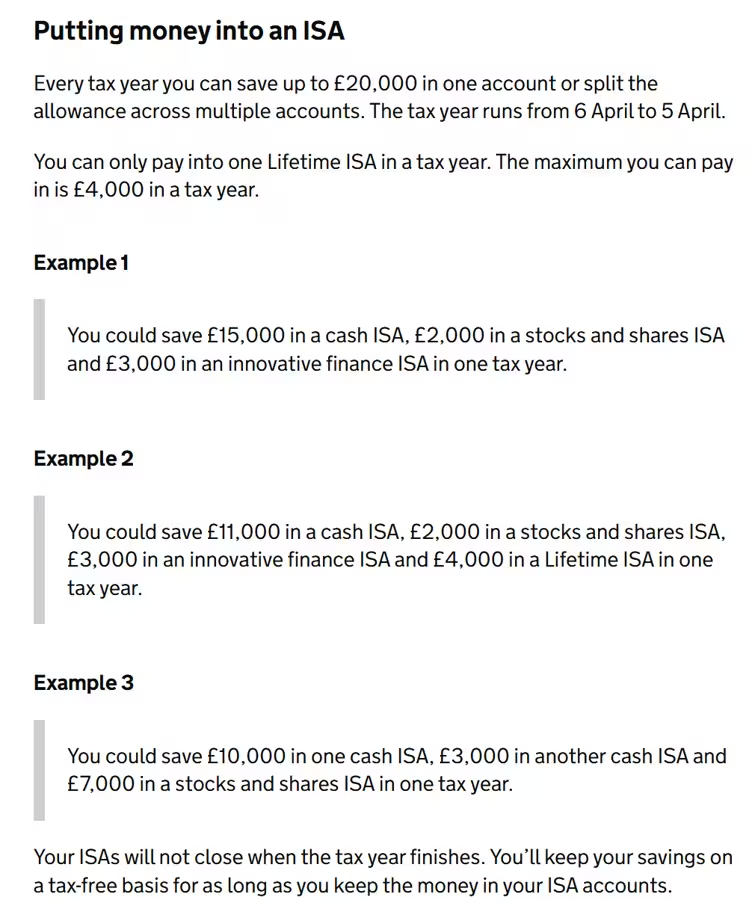
The existing ISA rules allow eligible savers to distribute their £20,000 annual allowance across different ISA types.
What Happened to the Planned 2027 Investment ISA Restrictions?
One particularly important development following the October 2026 Budget concerns the earlier anti-circumvention proposals.
Those measures had been designed to prevent investors from using Stocks and Shares ISAs to avoid the planned lower Cash ISA limit.
The proposed rules included restrictions involving transfers between ISA types and the treatment of cash or cash-like holdings within investment accounts.
However, HMRC’s Tax-Free Savings Newsletter published on 29 October 2026 confirmed that the planned Cash ISA reduction and associated anti-circumvention rules would not take effect.
The relevant 2026 amending regulations were to be revoked.
This matters because the earlier proposals had introduced considerable uncertainty over how savers could manage cash within investment accounts.
The reversal preserves the existing framework rather than requiring savers to navigate those additional restrictions from April 2027.
Nevertheless, individual ISA providers may still impose their own contractual conditions concerning account transfers, investment dealing and withdrawals.
Can Investors Still Lose Money With a Starter Investment ISA?
Yes.
A potential introductory bonus does not eliminate market risk.
Stocks and Shares ISAs hold investments whose market values may rise or fall.
Even if an investment begins with an additional financial incentive, poor market performance can produce losses that exceed the value of the reward.
Consider an illustrative investor contributing £2,000 and receiving a hypothetical 10% bonus.
Their starting investment value would be £2,200.
If the investment subsequently fell by 20%, its value would decline to £1,760 before fees.
The investor would have lost £240 relative to the original £2,000 contribution, despite receiving the bonus.
How Market Performance Could Affect a £2,000 Investment?
| Investment performance | Without bonus | With hypothetical 10% bonus |
| Starting value | £2,000 | £2,200 |
| Market increases 10% | £2,200 | £2,420 |
| Market remains unchanged | £2,000 | £2,200 |
| Market falls 10% | £1,800 | £1,980 |
| Market falls 20% | £1,600 | £1,760 |
| Market falls 30% | £1,400 | £1,540 |
These examples assume that any bonus has already been invested, with no fees, withdrawals or additional contributions.
They do not represent investment forecasts.
A 10% incentive could provide some initial protection against losses, but it could not guarantee that an investor would recover their original contribution.
This distinction is especially important for people who are investing for the first time.
The financial benefit of a potential bonus must be considered alongside investment volatility, portfolio diversification, platform charges and the possibility of needing access to money during a market downturn.
What Investment Risks Should Beginners Understand?
Investment risk depends on the assets selected, the time horizon and the investor’s financial circumstances.
For example, a broadly diversified investment fund usually behaves differently from a concentrated holding in one company’s shares.
Beginners should understand the following considerations before investing:
- Market risk: Investments can decrease in value, sometimes significantly.
- Concentration risk: Holding a small number of investments can increase exposure to individual company or sector problems.
- Liquidity risk: Selling investments quickly may be difficult or financially disadvantageous.
- Inflation risk: Investment returns may not keep pace with rising living costs.
- Fee risk: Platform and fund charges reduce investment returns.
- Behavioural risk: Emotional decisions during market downturns can turn temporary declines into realised losses.
For many individuals, a diversified portfolio held over an extended period may be more appropriate than speculative short-term trading.
The Financial Conduct Authority encourages consumers to consider their financial circumstances, time horizon and ability to tolerate losses before investing.
Its investment guidance commonly identifies a period of at least five years as a useful starting point when evaluating long-term market exposure.
However, five years is not a guarantee against losses.
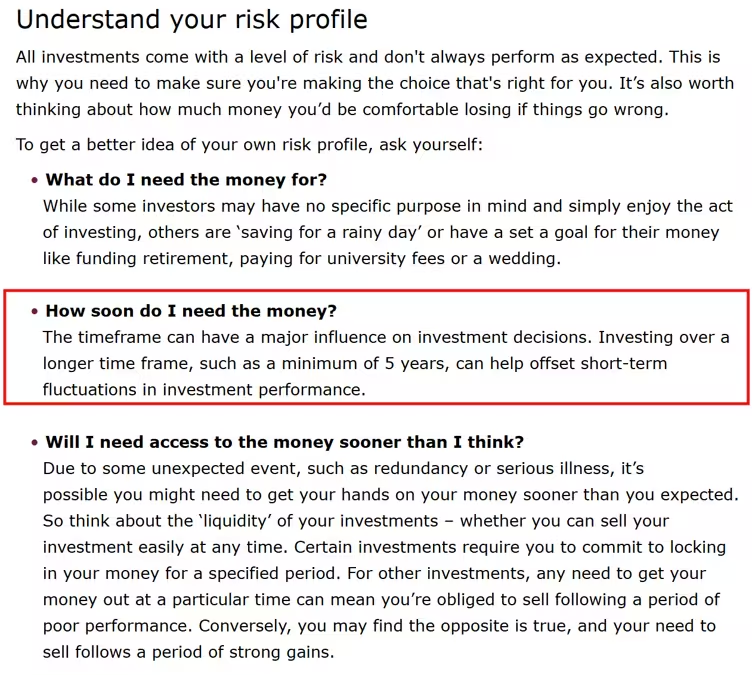
The Financial Conduct Authority explains why investment time horizons and potential losses matter when entering financial markets.
Could the Starter Investment ISA Help Small Business Owners and Entrepreneurs?
The proposed incentive could be relevant to entrepreneurs, freelancers and self-employed professionals who have not previously invested through a Stocks and Shares ISA.
However, the eventual eligibility conditions are not yet known.
For business owners, personal investment planning requires particular care because income may fluctuate and funds may be needed to support business operations.
Someone operating a small business might hold personal savings to cover living expenses while retaining separate business reserves for supplier payments, wages, taxes and unexpected costs.
Only money that can reasonably be committed to long-term investment should generally be considered for market exposure.
Example: A Self-Employed Professional Building an Investment Portfolio
Consider a self-employed consultant with £12,000 in personal savings and a stable business income.
They may choose to retain £9,000 as an accessible emergency reserve while considering investing £3,000 over a longer period.
If a future Starter ISA incentive provided a hypothetical 10% bonus on the full £3,000, the starting portfolio could increase to £3,300.
However, the extra £300 would not justify investing if the individual expected to need that £3,000 for tax liabilities, personal emergencies or short-term living expenses.
Business owners should also remember that ISAs are personal accounts.
A limited company cannot simply place its own untaxed business funds into a director’s personal ISA.
Money must first become the individual’s funds through an appropriate, properly accounted-for route, with any applicable tax consequences considered.
For entrepreneurs, the financial strength of the underlying business and the adequacy of cash reserves remain more important than chasing an uncertain introductory incentive.
How Could Investment Platform Fees Affect a Starter ISA?
Investment costs are another important issue that has not yet been addressed in the proposed scheme’s detailed design.
Providers may charge platform fees, fund management charges, dealing fees or other costs.
Consider a £2,000 investment subject to a combined annual platform and fund charge of 0.40%.
If the portfolio value remained unchanged, the equivalent annual charge would be approximately £8.
That may appear small, but charges accumulate over time and can significantly affect long-term investment outcomes.
| Combined annual fee | Approximate yearly cost on £2,000 |
| 0.15% | £3 |
| 0.25% | £5 |
| 0.40% | £8 |
| 0.75% | £15 |
| 1.00% | £20 |
These figures are simple illustrations, not current quotations from specific providers.
A starter incentive would be less valuable if the investor were required to use an expensive platform or investment product.
The design should therefore encourage transparent charges and allow investors to assess total costs, rather than concentrating solely on the headline introductory reward.
Will the Starter Investment ISA Be Better Than a Cash ISA?
Neither account is automatically better.
The appropriate choice depends on what the money is intended for and when the individual expects to use it.
A Cash ISA typically provides access to savings products with a defined or variable interest rate.
A Stocks and Shares ISA exposes money to investments that may provide higher long-term returns but involve the possibility of capital losses.
For example, an individual planning to spend money within 12 months may reasonably prefer to preserve capital rather than expose it to short-term market volatility.
Those prioritising predictable interest returns may find one-year fixed-rate Cash ISA options useful when comparing savings arrangements.
Someone with a slightly longer savings timeframe might also assess two-year fixed-rate Cash ISA accounts, while remaining aware that fixed-term products can restrict early access.
For people with a five-year or longer investment horizon, diversified Stocks and Shares ISAs may be worth considering, provided they can tolerate losses.
The proposed Starter Investment ISA could make that transition more attractive, but a bonus should not override the investor’s underlying financial objectives.
How Will the Starter ISA Affect Existing Cash ISA Savers?
For existing Cash ISA savers, the Budget’s most immediate impact is the preservation of the £20,000 annual contribution allowance.
Someone who already holds £15,000 in a Cash ISA does not need to transfer that money into shares because of the Starter ISA announcement.
Equally, people who have no interest in investing are not required to participate.
The choice between saving and investing remains personal.
When assessing a Cash ISA, factors such as withdrawal flexibility, provider regulation, interest rates and deposit protection remain important.
For example, understanding how Cash ISA protection operates through regulated investment platforms can help savers distinguish between protected cash deposits and investments that fluctuate in market value.
The Government’s proposed incentive should therefore be viewed as a possible additional option rather than a replacement for existing savings arrangements.
What Should First-Time Investors Do Before the Starter ISA Launches?
The proposed incentive does not need to prevent individuals from improving their financial knowledge or assessing their investment readiness.
Several steps may help people prepare.
1. Establish a Financial Safety Buffer
Accessible emergency savings can help avoid selling investments during market downturns.
The appropriate amount depends on household expenses, income stability and existing financial commitments.
2. Understand Existing Stocks and Shares ISAs
Learn how investment funds, individual shares, bonds and platform fees operate.
A tax-free account does not guarantee that the investments held within it will increase in value.
3. Consider the Investment Time Horizon
Money needed for a short-term purchase should generally be treated differently from money intended for retirement or long-term wealth accumulation.
4. Compare Total Investment Costs
Platform charges, investment fund fees and trading costs can affect net returns.
A provider offering a future bonus may not necessarily offer the lowest ongoing charges.
5. Follow Official Policy Developments
Watch for confirmed Government information concerning eligibility, participating providers, bonus funding and application processes.
People who are considering investing immediately should also understand that the Government has not explained whether investments made before the future scheme begins will affect eligibility.
There is no basis for assuming either automatic retrospective qualification or permanent exclusion.
Could the Starter Investment ISA Increase UK Investment Participation?
The proposal has the potential to encourage participation, but its eventual impact will depend on policy design.
A financial incentive may encourage people who have been reluctant to invest to consider opening their first Stocks and Shares ISA.
However, attracting new investors is only one measure of success.
A sustainable scheme would ideally encourage participants to understand diversification, costs and risk rather than focus exclusively on introductory rewards.
From an economic perspective, several design questions will be particularly important.
First, the incentive must be sufficiently clear for ordinary savers to understand.
Second, the costs of operating the arrangement should not outweigh the financial benefits.
Third, participating providers should not use the scheme to promote investments that are unsuitable for beginners.
Finally, the policy should measure meaningful participation rather than simply account openings.
For example, someone who receives a one-off reward and closes their account after a short period has not necessarily developed a long-term investment habit.
By contrast, a person who begins investing a modest amount regularly and develops greater financial confidence may represent a more sustainable outcome.
It is also possible that an incentive could mainly reward people who were already planning to invest.
That would reduce the policy’s additional impact, even if participation figures initially appeared stronger.
The Government will therefore need to balance accessibility, cost, consumer protection and effectiveness.
What Questions Must the Government Answer Before Launch?
Several practical decisions remain outstanding.
| Outstanding question | Why it matters |
| What counts as a first-time investor? | Determines eligibility |
| Will there be a minimum age or upper age limit? | Establishes the target audience |
| Will the bonus be 5%, 10%, 15% or another amount? | Determines the financial value |
| Who will fund the reward? | Affects public spending and provider participation |
| Will the incentive use existing Stocks and Shares ISAs? | Determines account complexity |
| Will there be a qualifying contribution cap? | Sets the maximum possible benefit |
| Is a minimum holding period required? | Affects access to money |
| Can investors withdraw the bonus? | Influences liquidity |
| What happens if investments fall in value? | Determines the treatment of losses |
| Will existing investors qualify? | Affects fairness and eligibility |
| Can existing ISA funds be transferred into the arrangement? | Influences switching decisions |
| When will applications open? | Determines implementation |
Until these matters are settled, financial projections based on the proposed incentive should be treated as conditional.
Conclusion: What Does the UK Budget Starter Investment ISA Mean for Savers?
The UK Budget Starter Investment ISA represents a possible change in how the Government encourages British households to build long-term investment portfolios.
Instead of restricting Cash ISA subscriptions, the October 2026 Budget preserves the £20,000 annual Cash ISA allowance and introduces plans to explore an incentive for first-time Stocks and Shares ISA investors.
This approach could make investing more accessible, particularly for individuals who have sufficient financial reserves but remain uncertain about entering investment markets.
However, the policy is still at an early stage.
No bonus percentage, contribution cap, eligibility framework or launch date has been formally announced.
Martin Lewis’s proposed investment bonuses provide a useful illustration of how the scheme might operate, but they should not be interpreted as confirmed Government benefits.
Our analysis suggests that the eventual success of the Starter ISA will depend on whether the incentive genuinely improves investment access while maintaining consumer protection, transparent fees and financial education.
For now, the most important development is that Cash ISA savers retain their existing allowance, while prospective investors may eventually gain an additional reason to consider long-term investing.
The central message is straightforward: the Government has announced an intention to reward first-time investors, but the actual financial reward and qualification rules have yet to be decided.
Frequently Asked Questions About the UK Budget Starter Investment ISA
Is the Starter Investment ISA Available Now?
No. As of 30 October 2026, the Government is exploring the incentive with the investment industry. No launch date or application process has been confirmed.
Will the Government Give Investors a 10% Bonus?
No 10% Government bonus has been confirmed. Figures such as 5%, 10% and 15% have appeared in illustrative proposals, but they are not official scheme rates.
Is the Starter ISA the Same as a Stocks and Shares ISA?
Not necessarily. The proposed incentive is intended for first-time Stocks and Shares ISA investors, but the Government has not confirmed whether it will create a separate product or operate through existing accounts.
Will the Cash ISA Allowance Fall to £12,000 in 2027?
No. The October 2026 Budget reversed the planned reduction. The annual Cash ISA limit will remain £20,000 from April 2027.
Can Someone Over 40 Apply for the Starter Investment ISA?
There is no confirmed upper age limit. The final rules will establish who can qualify.
Is a Starter Investment ISA Risk-Free?
No. Any financial incentive would not eliminate investment losses. Shares and investment funds can decrease in value.
Can I Open a Stocks and Shares ISA Before the Starter ISA Launches?
Yes. Existing Stocks and Shares ISAs are already available through qualifying providers. However, whether opening or investing in one now affects eligibility for the proposed future incentive remains unknown.

More in Finance & Tax
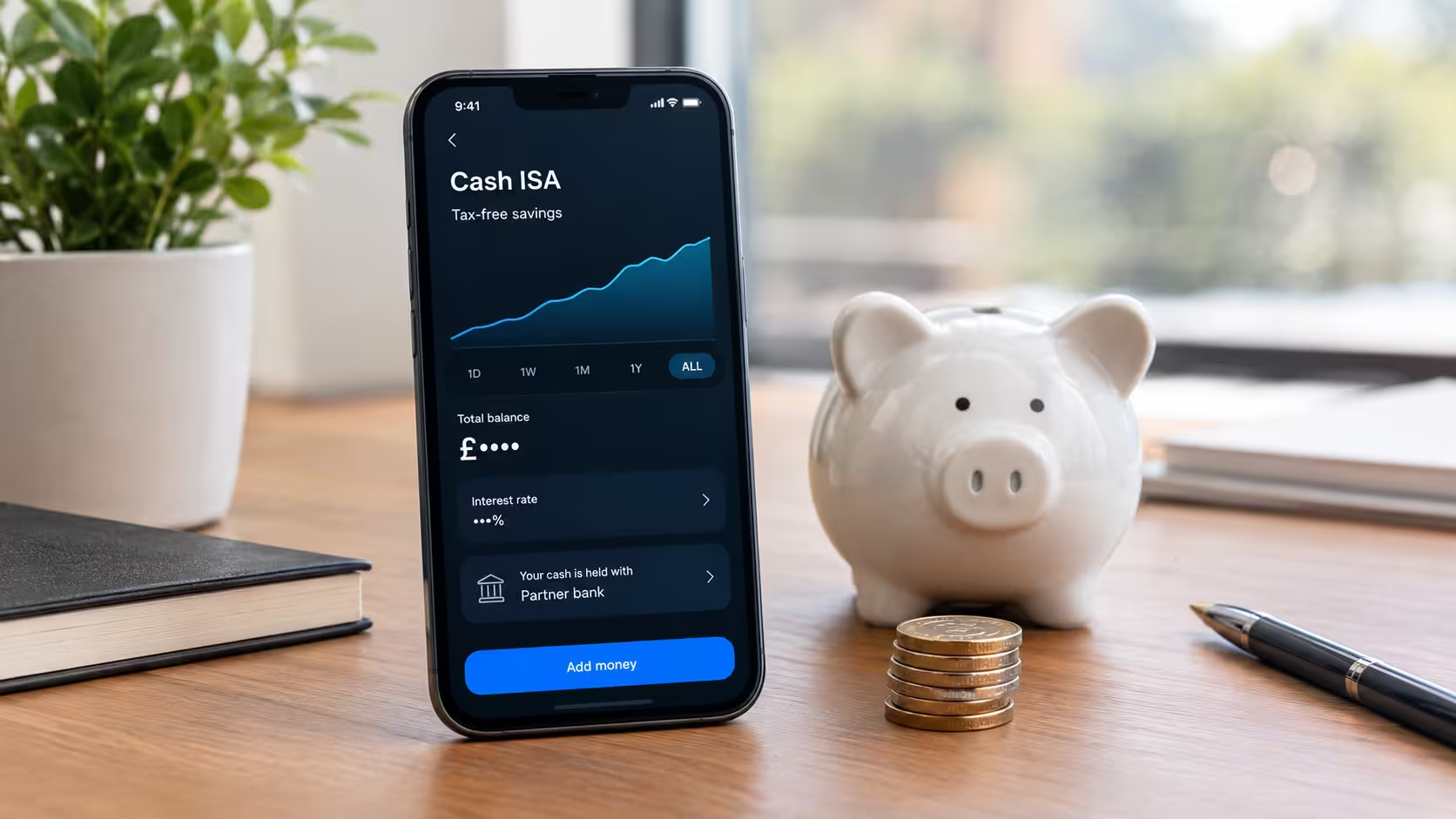
Is Trading 212 Cash ISA Safe in 2026? FSCS Protection, Risks and Our Expert Review
Is Trading 212 Cash ISA safe? Yes, Trading 212’s UK Cash ISA is generally considered a well-protected savings option because it is offered by an FCA-regulated firm, with eligible deposits held at partner banks covered by the Financial Services Compensation Scheme (FSCS). However, understanding how that protection works is essential before depositing substantial savings. As […]

Best 2 Year Fixed Rate ISA UK 2026: Top 10 Interest Rates Compared
Finding the best 2 year fixed rate ISA in the UK involves more than choosing the bank offering the highest interest rate. Savers must also consider minimum deposits, early withdrawal penalties, ISA transfer rules and how interest is calculated over the two-year period. Our analysis of the UK savings market in October 2026 found several […]