
The Moneybox Lifetime ISA is a UK savings and investment account designed to help eligible adults save for their first home or retirement.
It offers a 25% government bonus on contributions of up to £4,000 each tax year, potentially adding £1,000 annually to a saver’s money.
Moneybox offers both Cash and Stocks & Shares Lifetime ISAs. Its Cash Lifetime ISA currently advertises an introductory rate of 4.75% AER, while the Stocks & Shares option allows savers to invest for longer-term growth.
We analysed Moneybox’s published account conditions, government regulations, interest arrangements, customer review data and account fees.
Our assessment focuses on the financial benefits, restrictions and practical considerations that matter to first-time buyers, working professionals and entrepreneurs managing their personal savings.
What Is the Moneybox Lifetime ISA and How Does It Work?
The Moneybox Lifetime ISA, commonly called a LISA, is a tax-efficient savings account supported by a UK government incentive.
Eligible savers can contribute up to £4,000 every tax year and receive a government bonus equal to 25% of their qualifying contributions.
Unlike an ordinary savings account, the money is primarily intended for two purposes: purchasing a qualifying first home or accessing savings from age 60.
The account is available through the Moneybox app, and savers can start with a contribution of just £1.
| Feature | Moneybox Lifetime ISA |
| Account types | Cash LISA and Stocks & Shares LISA |
| Opening age | 18–39 |
| Minimum opening deposit | £1 |
| Annual contribution limit | £4,000 |
| Government bonus | 25% |
| Maximum annual bonus | £1,000 |
| Overall ISA allowance for 2026/27 | £20,000 |
| First-home property price limit | £450,000 |
| Minimum period before a qualifying home purchase | 12 months from first contribution |
| Retirement withdrawals | From age 60 |
| Non-qualifying withdrawal charge | 25% of amount withdrawn |
The Lifetime ISA is part of the wider UK ISA system. Its £4,000 annual allowance is included within the £20,000 overall annual ISA allowance.
Anyone comparing personal savings products should understand how much can be contributed to an ISA before deciding how to divide their money between different accounts.
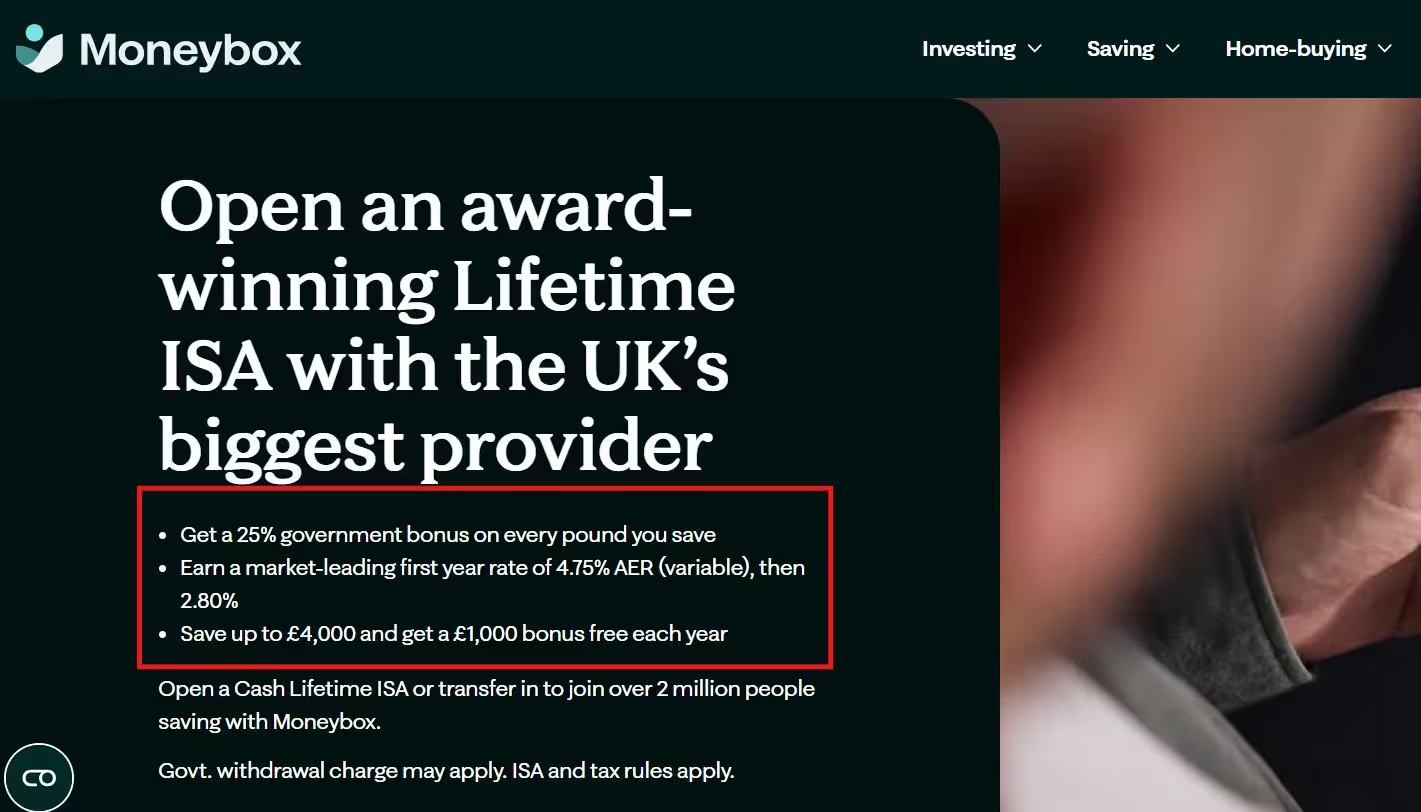
Official Moneybox Cash Lifetime ISA product page showing the 25% government bonus, introductory interest rate and first-time buyer benefits.
What Is the Moneybox Lifetime ISA Interest Rate in 2026?
As checked on 17 October 2026, Moneybox’s main Cash Lifetime ISA product page advertises a 4.75% AER variable introductory rate, followed by an underlying variable rate of 2.80% AER after the promotional period.
The headline introductory rate is intended for eligible new customers during the first year.
Current Interest Rate Breakdown
| Interest component | Advertised rate |
| First-year headline rate | 4.75% AER variable |
| Underlying variable rate | 2.80% AER |
| Advertised introductory bonus component | 1.85% |
| Rate after introductory period | 2.80% AER variable |
An important issue emerged during our review. Moneybox’s live product page displays a 4.75% AER headline alongside component rates of 2.80% and 1.85%, which add arithmetically to 4.65%.
Although AER calculations can involve compounding, the published figures deserve clarification. We recommend confirming the actual AER and introductory interest calculation with Moneybox before opening an account.
This is particularly relevant because historical product pages and search results can display earlier rates. The rate offered when a customer applies may differ from figures appearing in older comparisons.
How Is Interest Paid?
Moneybox’s Cash Lifetime ISA provides two forms of interest during the introductory period.
The underlying interest accrues daily and is credited monthly. The introductory bonus interest is calculated separately and is normally paid after the first 12 months, subject to the promotional conditions.
Once the introductory offer expires, the saver continues to receive the applicable underlying variable interest rate.
The 25% government bonus is separate from these interest payments.
Someone planning to retain their savings for several years should therefore compare both the first-year promotional rate and the longer-term underlying rate.
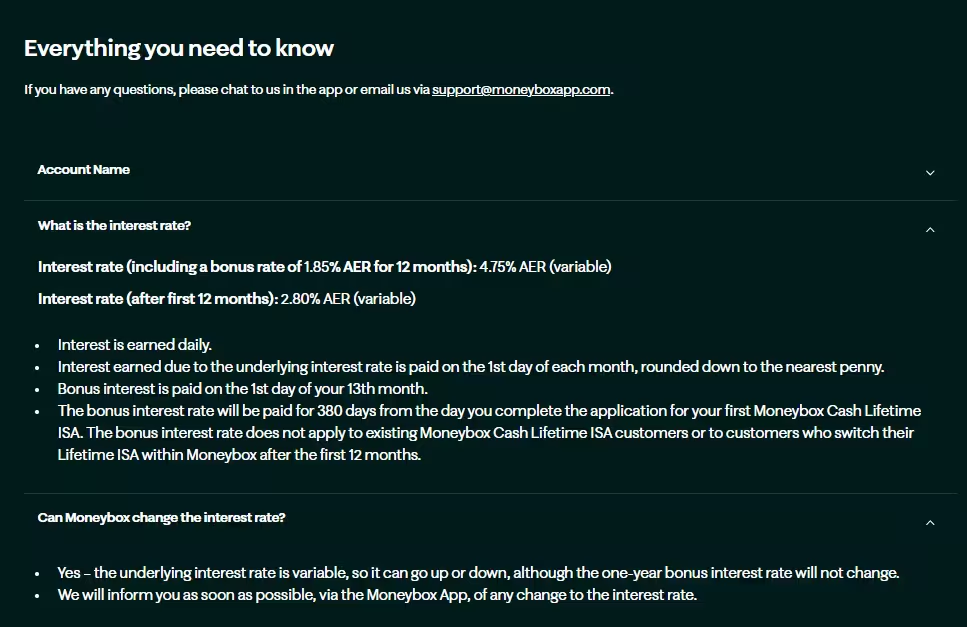
Moneybox’s official Cash Lifetime ISA interest information showing the first-year offer, underlying rate and timing of introductory bonus interest.
How Much Government Bonus Can You Get With Moneybox?
The most significant feature of the Moneybox Lifetime ISA is the government bonus.
For every £4 a saver contributes, the government adds £1, provided the contribution qualifies under the scheme rules.
The maximum annual bonus is £1,000.
The following calculations show how the bonus works before interest, investment returns or charges.
| Annual contribution | Government bonus (25%) | Total before interest |
| £500 | £125 | £625 |
| £1,000 | £250 | £1,250 |
| £2,000 | £500 | £2,500 |
| £3,000 | £750 | £3,750 |
| £4,000 | £1,000 | £5,000 |
For someone who saves the full £4,000 every tax year for five consecutive years, their contributions would total £20,000.
The government would add another £5,000, taking the combined amount to £25,000 before interest or investment performance.
This does not mean everyone receives a guaranteed 25% investment return. The bonus is attached to qualifying contributions, and withdrawal restrictions apply.
When Does Moneybox Pay the Government Bonus?
Moneybox explains that Lifetime ISA government bonuses are generally credited towards the end of each month, based on qualifying contributions made during the relevant previous bonus period.
The provider uses monthly bonus windows running from the sixth day of one month to the fifth day of the following month.
For example, a qualifying deposit made between 6 January and 5 February would normally generate a bonus payment towards the end of February.
The date is not absolutely fixed because HMRC processes the bonus payments.
For homebuyers approaching completion, this timing matters. A pending bonus may not be available when the solicitor needs the purchase funds.
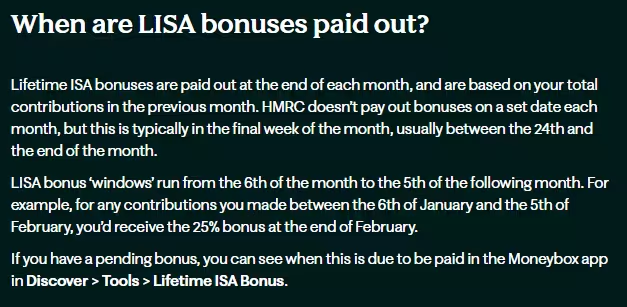
Official Moneybox explanation of when Lifetime ISA government bonuses are paid and how monthly contribution windows work.
Who Can Open a Moneybox Lifetime ISA?
A person must generally be between 18 and 39 years old to open their first Lifetime ISA.
They must also meet the UK residence requirements, with limited exceptions for qualifying Crown servants, armed forces personnel and their spouses or civil partners.
After opening an eligible account, contributions can continue until the account holder reaches 50.
From age 50, new contributions and government bonuses stop, although existing savings can remain invested or continue earning interest.
A Moneybox Lifetime ISA may therefore be suitable for university graduates, employees, freelancers, company directors and self-employed professionals who meet the eligibility requirements.
There is no general requirement to be employed by a company to qualify.
However, the account belongs to an individual. Business operating funds should not be confused with personal savings, and contributions do not create a business expense deduction.
People who already hold another ISA may still be eligible to open a Lifetime ISA, provided they follow the relevant contribution rules.
The distinction between holding accounts and contributing to them is explained in more detail when considering whether multiple ISAs can be held at the same time.
Can You Use a Moneybox Lifetime ISA to Buy Your First Home?
Yes. Buying a first home is one of the main intended purposes of a Lifetime ISA.
However, a withdrawal will only be charge-free when the property purchase satisfies the government requirements.
The principal conditions include:
- The property must cost £450,000 or less.
- The saver must qualify as a first-time buyer.
- At least 12 months must have passed since the first qualifying LISA contribution.
- The purchase must involve an eligible mortgage.
- A solicitor or conveyancer must handle the withdrawal.
- The property must be intended as the buyer’s main residence.
The property price limit applies across the UK.
For people looking for homes in London and other expensive property markets, the £450,000 ceiling is an important restriction.
A buyer who expects to purchase above that amount should assess whether locking money into a Lifetime ISA is financially appropriate.
Example: Buying a £300,000 Home
Consider a first-time buyer who contributes £4,000 annually for three years.
| Savings calculation | Amount |
| Personal contributions | £12,000 |
| Government bonuses | £3,000 |
| Combined savings before interest | £15,000 |
| Property purchase price | £300,000 |
| Savings as percentage of purchase price | 5% |
In this simplified example, the saver builds £15,000 before interest, potentially covering a 5% deposit.
However, mortgage availability, lending criteria, affordability assessments and other property costs still need to be considered.
A LISA bonus does not guarantee mortgage approval.
Can Two People Combine Their Lifetime ISAs?
Yes, two eligible first-time buyers can each use their own Lifetime ISA towards the same qualifying property.
For example, if both save £4,000 in one tax year, their combined savings would be £8,000.
Their government bonuses could add another £2,000, giving them £10,000 before interest or investment growth.
Both account holders must independently satisfy the relevant Lifetime ISA conditions.
A qualifying first-time buyer may also be able to use their LISA when purchasing with someone who has owned property previously, subject to the detailed rules.
How Do You Withdraw Money From Moneybox to Buy a House?
A qualifying house purchase does not involve withdrawing the LISA funds into an ordinary personal bank account.
Instead, Moneybox transfers the approved funds directly to the buyer’s conveyancer or solicitor.
The process generally works as follows.
Step 1: Check eligibility. Confirm the property price, first-time buyer status, mortgage requirements and 12-month account rule.
Step 2: Notify Moneybox. Start the withdrawal process in the app through Settings > Withdraw > LISA.
Step 3: Provide solicitor details. Moneybox contacts the conveyancer and requests the necessary documentation.
Step 4: Complete the declarations. The account holder and conveyancer provide the required information confirming that the purchase qualifies.
Step 5: Transfer the money. Once the request is approved, Moneybox arranges payment directly to the conveyancer.
Moneybox recommends starting the process approximately one month before the funds are needed.
For Cash LISAs, it aims to release the funds in time for the date specified by the conveyancer. Stocks & Shares LISA withdrawals may require additional time because investments must first be sold.
The funds must normally be used within 90 days of withdrawal, although extensions may be available under the relevant rules.
Moneybox also explains that LISA funds must go towards the property purchase price rather than ordinary legal fees, furnishing costs or stamp duty.
A buyer should therefore maintain additional accessible savings for other moving expenses.
What Happens If You Withdraw Money Early From a Moneybox Lifetime ISA?
One of the biggest disadvantages of the Lifetime ISA is the government withdrawal charge.
A withdrawal that does not meet the permitted conditions normally incurs a charge of 25% of the amount withdrawn.
This is not simply the repayment of the original government bonus.
The charge applies to the whole withdrawn balance, including bonuses and any interest or investment growth.
Example: The Real Cost of an Early Withdrawal
Suppose a saver contributes £4,000 and receives the full £1,000 government bonus.
| Calculation | Amount |
| Original savings | £4,000 |
| Government bonus | £1,000 |
| Account balance before interest | £5,000 |
| Withdrawal charge (25%) | £1,250 |
| Amount received | £3,750 |
| Loss against original savings | £250 |
In this example, the saver loses £250 of their original £4,000 contributions.
That represents a 6.25% loss of the original contribution, assuming no interest or investment movement.
This is why a Lifetime ISA should not ordinarily be used as an emergency savings account.
A business owner experiencing an unexpected cash-flow shortage could face a financial disadvantage if they are forced to withdraw personal LISA savings early.
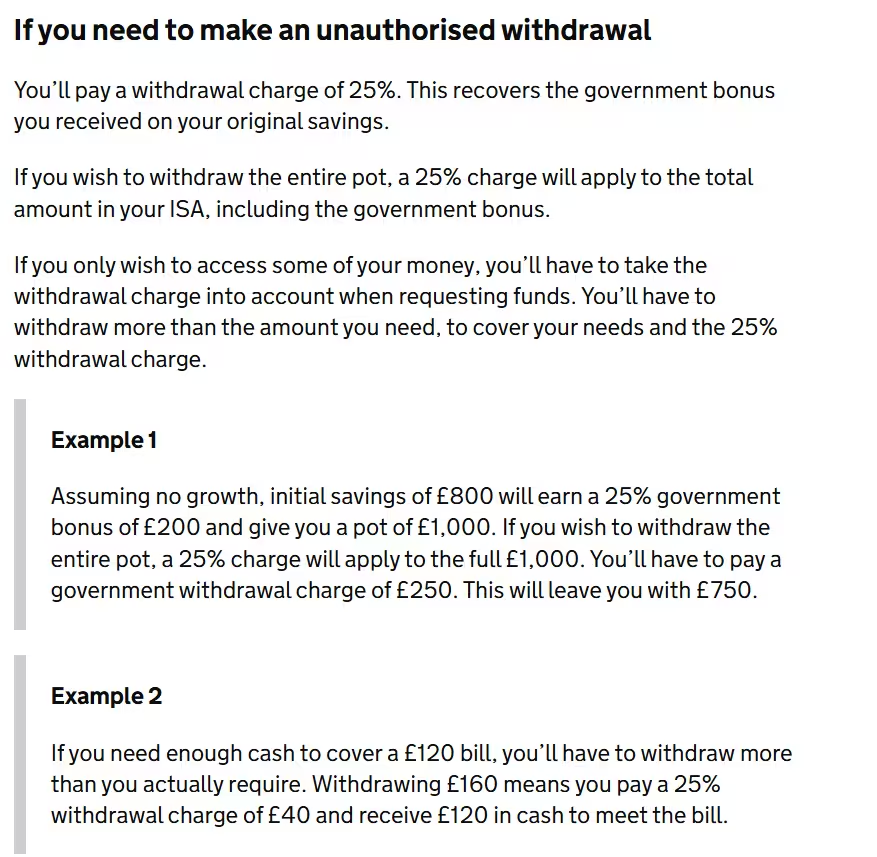
Official UK government guidance explaining the 25% Lifetime ISA withdrawal charge and showing how savers can receive less than their original contributions.
Moneybox Cash Lifetime ISA vs Stocks & Shares Lifetime ISA
Moneybox provides two Lifetime ISA products, and they are designed for different attitudes to risk.
The Cash Lifetime ISA earns interest, while the Stocks & Shares Lifetime ISA invests money in financial markets.
| Feature | Cash Lifetime ISA | Stocks & Shares Lifetime ISA |
| Main return | Interest | Investment performance |
| 25% government bonus | Yes | Yes |
| Market investment risk | No direct stock-market exposure | Yes |
| Capital value | Not affected by share-price movements | Can rise or fall |
| Ongoing investing fees | No investment platform charge for the Cash LISA | Platform, fund and possible subscription fees |
| Typical suitability | First-home savings over the next few years | Longer-term savings and investing |
| Withdrawal restrictions | Lifetime ISA rules | Lifetime ISA rules |
For someone expecting to buy a property within two or three years, protecting the deposit against stock-market volatility may be more important than seeking higher investment returns.
The Stocks & Shares Lifetime ISA may be more appropriate for someone with a substantially longer investment horizon, who understands the possibility of losses.
We would not regard the two accounts as financially interchangeable simply because they offer the same government bonus.
What Fees Does Moneybox Charge for Its Lifetime ISA?
Moneybox’s Cash Lifetime ISA does not charge a separate investment management fee.
Its Stocks & Shares Lifetime ISA has a different charging structure.
Moneybox currently advertises the following fees.
| Fee | Published arrangement |
| Monthly subscription | £1, subject to introductory and qualifying balance waivers |
| Subscription introductory period | First three months free |
| Service fee on Moneybox funds | 0.15% annually |
| Published Moneybox fund fee | 0.29% |
| Service fee on other providers’ funds | 0.45% annually |
| Other fund costs | Vary according to investment |
| US share currency conversion | 0.45%, where applicable |
Moneybox also publishes subscription fee waivers for customers meeting certain savings or investment balance conditions.
These fees matter because investment charges reduce net returns, particularly over longer periods.
For example, an investor holding £5,000 in a fund with combined annual percentage costs of 0.44% would incur approximately £22 in percentage-based costs over a year, assuming the value remained unchanged. Any applicable subscription charges would need to be considered separately.
This is only a simplified cost illustration, not a forecast or a quotation for a specific investment.
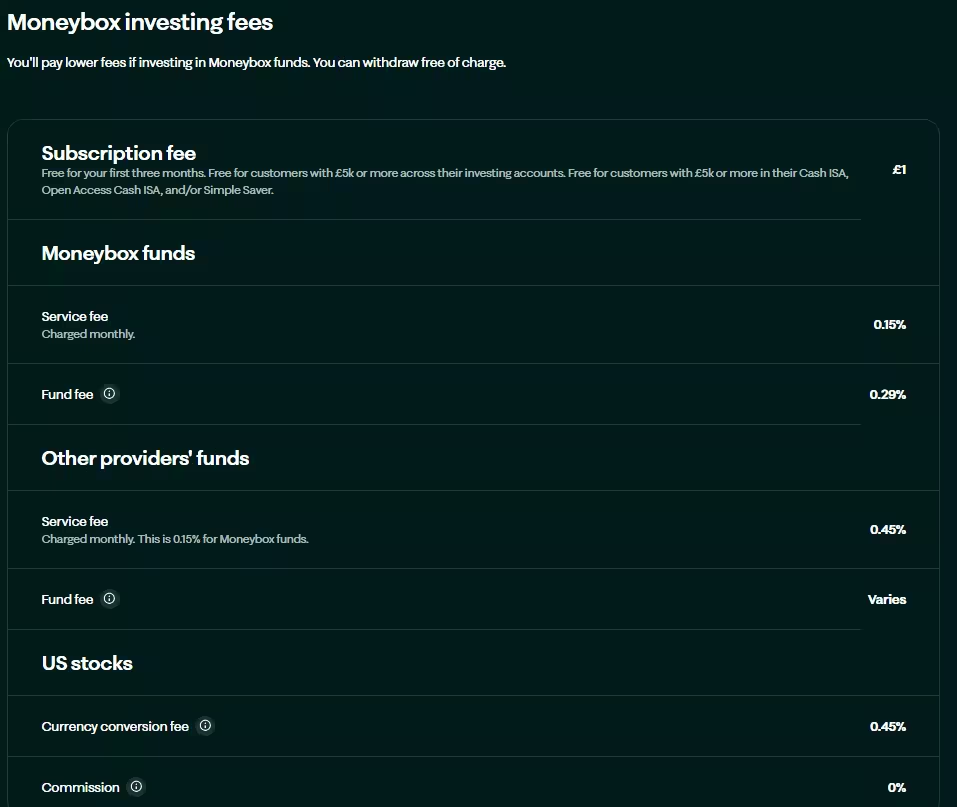
Official Moneybox Stocks & Shares Lifetime ISA fee schedule showing subscription, service and fund charges
Is Moneybox Lifetime ISA Safe?
Moneybox is a regulated financial services provider, but safety depends partly on the type of Lifetime ISA selected.
For the Cash Lifetime ISA, Moneybox explains that customer cash is held with third-party banking institutions.
Eligible deposits are covered under the Financial Services Compensation Scheme, subject to the relevant rules and limits.
The standard FSCS deposit protection limit is currently £120,000 per eligible person, per authorised institution.
Customers should check which underlying banks hold their cash, particularly if they have other deposits with the same banking institutions.
The position is different for investments.
A Stocks & Shares Lifetime ISA may benefit from applicable regulatory protections, but these do not guarantee that investments will maintain their market value.
If a chosen investment falls in value because of market performance, that loss is not normally reimbursed by FSCS.
Our assessment is that savers should distinguish between three separate risks: provider failure, market investment losses and the government withdrawal charge.
What Do Real Customers Say About Moneybox Lifetime ISA?
Independent consumer reviews provide useful evidence about how customers experience the product.
At the time of our review, Smart Money People’s Moneybox Lifetime ISA listing displayed the following results.
| Review measure | Published result |
| Average customer rating | 4.81 out of 5 |
| Number of published reviews | 9,303 |
| Five-star reviews | 95% |
| Four-star reviews | 4% |
| Equivalent rating as percentage of maximum stars | 96.2% |
| Latest review date shown | 4 September 2026 |
The 96.2% figure is simply 4.81 divided by five, multiplied by 100. It is not a separate satisfaction survey.
The ratings suggest a generally positive response among customers who submitted reviews. However, these figures should not be interpreted as representing every Moneybox customer.
What Customers Like?
Positive comments frequently discuss the convenience of app-based savings management, visibility of balances and the motivation created by government bonus payments.
One reviewer writing in September 2026 praised the application’s accessible presentation and straightforward account setup.
Another August reviewer particularly appreciated the ease of managing a Lifetime ISA.
Moneybox also features a customer testimonial from Adam, who explains that repeatedly contributing the annual maximum helped him towards buying his flat.
That testimonial is published in Moneybox’s own promotional material rather than being an independently conducted interview.
What Customers Dislike?
Some reviews highlight dissatisfaction with changes to interest rates.
A reviewer in April 2026 complained that the interest rate had been decreasing, an issue that can matter to savers who selected an account based on an attractive introductory offer.
Others have indicated that changes between account types or investment arrangements could be made more convenient.
Our assessment is that review ratings provide positive supporting evidence for Moneybox’s usability, but the interest terms and withdrawal restrictions are more important when determining whether the product fits an individual’s financial circumstances.
Is Moneybox Lifetime ISA Worth It for Business Owners and Entrepreneurs?
A Lifetime ISA can be useful for self-employed professionals, freelancers and company directors, provided it fits their personal financial plan.
However, self-employed income is not always predictable.
Business owners may face quarterly tax liabilities, delayed customer payments, unexpected equipment costs or variations in monthly revenue.
Locking too much personal cash into an account with a 25% non-qualifying withdrawal charge can become expensive.
Example: A Self-Employed Consultant Saving for a First Home
Consider a self-employed consultant earning variable monthly income.
They plan to save £2,400 a year towards their first property.
Rather than committing to a fixed amount regardless of circumstances, they could contribute £200 during months when sufficient personal cash is available.
Over 12 months, their contributions would total £2,400, generating a potential £600 government bonus.
Their total would be £3,000 before interest or investment movements.
This arrangement may suit someone with a clear house-purchase goal and sufficient accessible money for emergencies.
It would be less suitable if the same savings were needed to cover an upcoming Self Assessment bill or business expenses.
Our analysis suggests three financial priorities should be considered separately: operating liquidity, accessible personal emergency savings and restricted long-term savings.
For savers who need fewer withdrawal restrictions, comparing the best Cash ISA rates may reveal more suitable alternatives.
Is a Moneybox Lifetime ISA Better Than a Regular Cash ISA?
A regular Cash ISA and a Lifetime ISA serve different purposes.
A Cash ISA generally provides tax-free interest with withdrawal conditions determined by the individual account.
A Lifetime ISA offers the additional government bonus, but access to the money is more restricted.
| Consideration | Moneybox Cash LISA | Ordinary Cash ISA |
| Government contribution bonus | 25% on eligible contributions | None |
| Annual contribution limit | £4,000 | Subject to the applicable Cash ISA and overall ISA limits |
| Interest | Variable, with introductory offer | Fixed or variable depending on provider |
| Emergency withdrawals | Usually subject to government charge | Depends on account terms |
| First-home restrictions | Yes | No LISA-specific property price limit |
| Retirement access rule | Charge-free from age 60 | No LISA retirement-age restriction |
A first-time buyer who is confident about purchasing a qualifying property may find the government bonus particularly attractive.
Someone saving for uncertain expenses over the next year or two may benefit more from accessible cash.
People willing to lock money away for a fixed period can also compare fixed Cash ISA rates, although a fixed-rate product may impose its own early-access restrictions.
The strongest account is therefore not automatically the one displaying the highest introductory interest rate.
Can You Transfer an Existing ISA to Moneybox Lifetime ISA?
Moneybox permits eligible ISA transfers, but the rules depend on the account being transferred.
A direct transfer from one Lifetime ISA provider to another will generally preserve the Lifetime ISA status and does not constitute an ordinary withdrawal subject to the 25% government charge.
The original qualifying first-contribution date is also relevant to the 12-month first-home rule.
Transfers from an ordinary Cash ISA or Stocks & Shares ISA into a Lifetime ISA are different. They count towards the £4,000 annual Lifetime ISA contribution limit.
A saver considering such a transfer should check both providers’ procedures and their remaining annual allowance.
They should not simply withdraw money from an existing Lifetime ISA into a current account and redeposit it elsewhere.
That could trigger the government withdrawal charge.
Existing Moneybox customers should also check whether transferring or switching accounts affects any introductory interest eligibility.
Can You Use Moneybox Lifetime ISA for Retirement?
A Lifetime ISA can also be used to accumulate money for retirement.
Eligible contributions receive the 25% government bonus until the account holder turns 50.
The money can normally be withdrawn without the government charge once the account holder reaches age 60.
However, a Lifetime ISA is not necessarily a substitute for a workplace pension or personal pension.
For employees, workplace pensions may provide employer contributions that would not be available through personal LISA saving.
For self-employed people, pension contributions may qualify for tax relief, while a Lifetime ISA uses a different system of government bonuses and withdrawal rules.
The relative tax advantages depend on individual earnings, tax rates, retirement plans and circumstances.
A Lifetime ISA may also affect entitlement to certain means-tested benefits.
Our view is that the account can form part of a retirement savings strategy, but higher-rate taxpayers and entrepreneurs making substantial retirement contributions should compare the pension tax advantages carefully.
Is the Government Replacing the Lifetime ISA?
The government has proposed a new First Time Buyer ISA that would eventually be offered in place of the Lifetime ISA.
HM Treasury launched a consultation in June 2026, seeking feedback on a simpler savings product focused on first-time homebuyers.
The consultation closed in August 2026.
In a parliamentary response published on 4 September 2026, Treasury minister Lucy Rigby acknowledged the complexity of the existing Lifetime ISA’s combined homeownership and retirement purposes.
The proposed reform is intended to address some of the difficulties created by the current system, including withdrawal restrictions.
However, the detailed final design and introduction date of the replacement product had not been confirmed as of 17 October 2026.
The government has indicated that existing Lifetime ISA holders will be able to continue using their accounts under the applicable existing rules after the replacement product is introduced.
People considering opening a Lifetime ISA should therefore distinguish confirmed current regulations from future policy proposals.
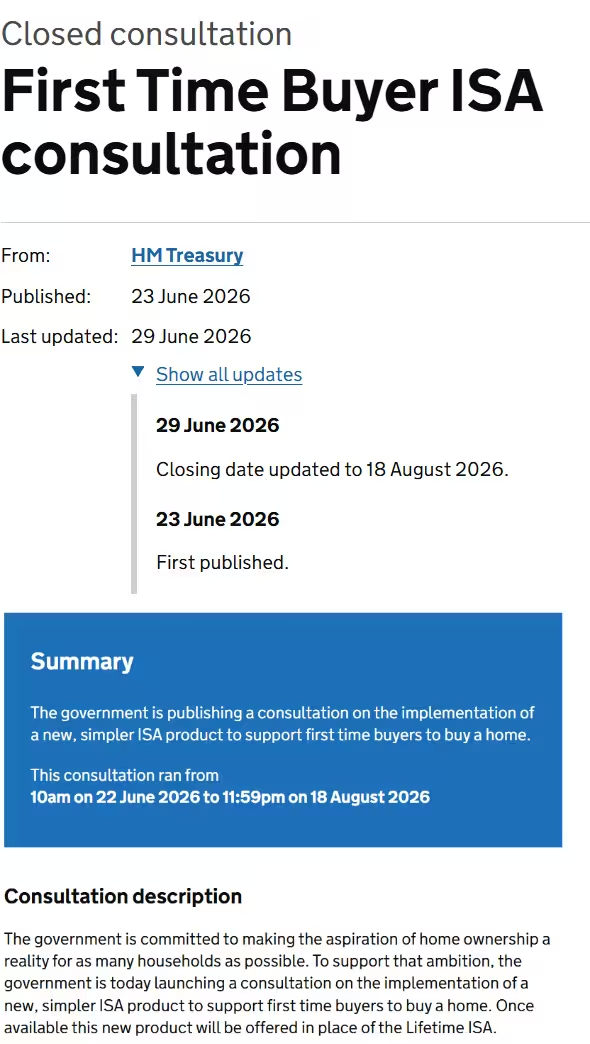
HM Treasury’s official First Time Buyer ISA consultation explaining the proposed replacement for the existing Lifetime ISA scheme.
What Are the Main Advantages and Disadvantages of Moneybox Lifetime ISA?
Our assessment of the product is based on government bonus eligibility, interest terms, fees, flexibility and customer experience.
| Advantages | Disadvantages |
| 25% government bonus | 25% charge on non-qualifying withdrawals |
| Up to £1,000 annual government contribution | £450,000 first-home property price limit |
| Cash and investment account choices | 12-month minimum period for a home purchase |
| Opening contributions from £1 | Introductory Cash LISA rate expires |
| App-based account management | Market risk for Stocks & Shares LISA |
| Tax-free qualifying interest and growth | Restricted contributions after age 50 |
The strongest advantage is the potential government bonus.
The greatest drawback is the lack of flexibility if personal circumstances change.
For savers who are uncertain about their purchase date, property budget or need for accessible funds, those restrictions deserve as much consideration as the headline interest rate.
What Is Our Final Assessment of Moneybox Lifetime ISA?
Based on the published product terms, government regulations and customer review data, we consider Moneybox a credible option for eligible UK savers with a clearly defined first-home or long-term savings objective.
Its 25% government bonus, low minimum opening deposit and app-based management are significant attractions.
The independent customer review average of 4.81 out of five also indicates strong approval among people who chose to submit feedback.
However, that customer rating is not a guarantee of suitability or future returns.
We would place greater emphasis on the intended use of the money, the likelihood of a qualifying property purchase, the withdrawal charge and the interest rate that applies after the introductory period.
For younger homebuyers, Moneybox may provide a useful structured method of building a deposit.
For entrepreneurs and freelancers, it is more appropriate as a separately funded personal savings goal than as a substitute for accessible cash reserves.
Ultimately, Moneybox Lifetime ISA is most valuable when the saver can use the government bonus without triggering the withdrawal charge.
Frequently Asked Questions
Is Moneybox Lifetime ISA free?
The Cash Lifetime ISA does not have a separate investment platform fee. The Stocks & Shares Lifetime ISA has subscription, platform and fund-related charges, depending on the investments and applicable waivers.
How much can I save in Moneybox Lifetime ISA?
Eligible savers can contribute up to £4,000 per tax year and receive a government bonus of up to £1,000 annually.
How long must a Moneybox Lifetime ISA be open before buying a house?
At least 12 months must pass from the first qualifying contribution before the money can be used for an eligible first-home purchase without the government withdrawal charge.
Can I lose money in Moneybox Lifetime ISA?
Yes. Unauthorised withdrawals can trigger a 25% charge, while Stocks & Shares Lifetime ISA investments can lose market value.
Can I open a Moneybox Lifetime ISA at 40?
A new Lifetime ISA normally must be opened before age 40. Someone who already has a valid Lifetime ISA may be able to transfer it to another provider after turning 40, subject to the provider’s conditions.
What happens to my Lifetime ISA when I turn 50?
You cannot make further contributions or receive new government bonuses, but existing money may remain in the account, earning interest or investment returns.
Can I use Moneybox Lifetime ISA for a £500,000 property?
Under the current first-home rules, the property price must not exceed £450,000 for a charge-free home-purchase withdrawal. A £500,000 purchase would not qualify.
Can I withdraw Moneybox Lifetime ISA savings at 60?
Yes. Once the account holder reaches age 60, withdrawals are normally permitted without the government’s 25% withdrawal charge.

More in Finance & Tax

Best 1 Year Fixed Rate ISA UK 2026: Top Cash ISA Rates Compared
The best 1 year fixed rate ISA in the UK currently pays up to 4.98% AER tax-free, with UBL UK offering the highest verified rate in our October 2026 comparison. Shawbrook Bank follows at 4.97%, while Vanquis Bank offers a competitive 4.96% alongside a lower minimum opening deposit. However, choosing the best one-year fixed Cash […]

Leeds Building Society ISA Rates 2026: Current Cash ISA Rates, Fixed Terms and Our Expert Review
Leeds Building Society ISA rates currently reach 4.90% AER tax-free, with fixed-rate Cash ISAs available over one, two, three and five years. Savers can also choose an Online Access Cash ISA paying 4.16% AER variable, alongside monthly-income and limited-access products. However, the highest interest rate does not automatically represent the best account. Withdrawal charges, maturity […]