
A person can put up to £20,000 into ISAs during the 2026/27 tax year, which runs from 6 April 2026 to 5 April 2027.
The £20,000 allowance is per person, not per household, and it can be divided between Cash ISAs, Stocks and Shares ISAs, Innovative Finance ISAs and a Lifetime ISA.
There is an important sub-limit for Lifetime ISAs: no more than £4,000 a year can be contributed to a Lifetime ISA, and that £4,000 forms part of the £20,000 overall ISA allowance rather than sitting on top of it.
A separate £9,000 Junior ISA allowance applies to eligible children. It belongs to the child and does not reduce a parent or guardian’s own £20,000 adult ISA allowance.
The rules change significantly from 6 April 2027. People below the relevant age-65 threshold will be limited to £12,000 a year in Cash ISAs, although the overall ISA allowance will remain £20,000. HMRC confirmed the detailed 2027 framework in its ISA reform policy material published on 17 September 2026.
How Much Can You Put in an ISA in 2026/27?
The maximum adult ISA subscription for the 2026/27 tax year is £20,000.
That is the total amount of new money a person can normally contribute across adult ISAs between 6 April 2026 and 5 April 2027.
| ISA type | Maximum contribution in 2026/27 | Part of the £20,000 adult allowance? |
| Cash ISA | Up to £20,000 | Yes |
| Stocks and Shares ISA | Up to £20,000 | Yes |
| Innovative Finance ISA | Up to £20,000 | Yes |
| Lifetime ISA | £4,000 | Yes |
| Junior ISA | £9,000 | No – separate allowance belonging to the child |
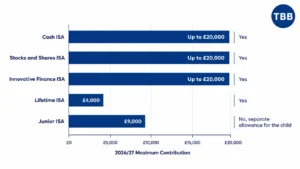
A saver therefore does not receive £20,000 for every adult ISA type.
For example, someone could contribute £10,000 to a Cash ISA, £6,000 to a Stocks and Shares ISA and £4,000 to a Lifetime ISA. The combined adult ISA subscriptions would equal £20,000.
Alternatively, a saver who does not use a Lifetime ISA could put the entire £20,000 into a Cash ISA during 2026/27.
GOV.UK confirms the £20,000 maximum for the current tax year.
Anyone deciding where to place the cash part of the allowance can compare current best Cash ISA rates in the UK rather than judging an account solely by the ISA allowance itself.
How Much Can You Put Into an ISA Per Month?
There is no official monthly ISA contribution limit. The restriction is based on the tax year.
Dividing the £20,000 annual allowance equally across 12 months gives roughly:
£20,000 ÷ 12 = £1,666.67 per month
There is a small rounding issue. Twelve payments of exactly £1,666.67 would total £20,000.04, which is four pence above the annual allowance.
A saver wanting an exact monthly schedule could therefore contribute £1,666.66 for 11 months and £1,666.74 in the final month, producing exactly £20,000.
There is no requirement to contribute monthly. Someone could instead contribute £20,000 as a lump sum, make irregular payments through the year or use any other contribution pattern allowed by the provider.
The important figure is the total qualifying subscriptions made during the tax year.
Is the £20,000 ISA Allowance Per Person or Per Household?
The ISA allowance belongs to each individual.
There is no shared ISA allowance for a married couple, civil partners or a household, and adult ISAs cannot normally be held jointly.
That means two eligible adults could potentially contribute:
| Person | Maximum adult ISA contribution in 2026/27 |
| Partner 1 | £20,000 |
| Partner 2 | £20,000 |
| Combined contributions | £40,000 |
The £40,000 is not a joint allowance. Each individual owns and controls their respective ISA and remains responsible for staying within their own limit.
If there are eligible children in the household, their Junior ISA allowances are separate again.
Does ISA Interest or Investment Growth Count Towards the £20,000 Limit?
No.
The annual ISA allowance applies to new subscriptions, not to interest, dividends or investment growth subsequently generated inside the ISA.
Someone could invest £20,000 into a Stocks and Shares ISA and see the portfolio rise to £24,000. The £4,000 investment gain would not use any additional ISA allowance.
Similarly, interest generated by money already held in a Cash ISA does not reduce the following year’s allowance.
This is why long-standing ISA balances can legitimately become much larger than £20,000.
Is There a Maximum Total Amount That Can Be Held in an ISA?
There is no general lifetime cap on the total value an individual can build inside ISAs.
The restriction applies to the amount of qualifying new money subscribed each tax year.
A saver who repeatedly uses annual allowances could therefore build an ISA balance of £100,000, £200,000 or substantially more.
That distinction creates another important issue once ISA balances become large: Financial Services Compensation Scheme protection.
Is There a Limit on FSCS Protection for ISA Savings?
Yes. The ISA tax rules and FSCS compensation limits are separate.
For eligible deposits held with a UK-authorised bank, building society or credit union, including qualifying Cash ISA deposits, the standard FSCS deposit protection limit increased from £85,000 to £120,000 per eligible person, per authorised firm from 1 December 2025.
It is the authorised institution, rather than simply the brand name or individual savings account, that matters.
For example, if two banking brands operate under the same banking licence, eligible savings held across those brands can be combined when the £120,000 protection limit is calculated.
Someone with a substantial Cash ISA balance may therefore want to check which institutions share an authorisation before assuming that using two different brand names provides two separate £120,000 protection limits.
Temporary high balances can receive additional protection in certain circumstances, such as following a house sale or inheritance. FSCS currently provides temporary high-balance protection of up to £1.4 million for qualifying circumstances, normally for up to six months.
Stocks and Shares ISAs work differently.
Investments are not covered by the £120,000 bank-deposit limit. FSCS investment compensation can provide up to £85,000 per eligible person, per firm in qualifying cases where an authorised investment firm has failed and cannot meet a valid claim. It does not protect an investor simply because shares, funds or other investments fall in value.
The ISA wrapper therefore protects eligible returns from tax, but it should not be confused with unlimited protection against the failure of a financial institution or against investment losses.
Cash ISA vs Personal Savings Allowance: Is a Cash ISA Always Necessary?
Not necessarily.
A normal savings account can already produce a certain amount of tax-free interest because of the Personal Savings Allowance, or PSA.
For 2026/27, the current allowances are:
| Tax position | Personal Savings Allowance |
| Basic-rate taxpayer | £1,000 |
| Higher-rate taxpayer | £500 |
| Additional-rate taxpayer | £0 |
HMRC confirms that interest received within an ISA does not use the Personal Savings Allowance.
This means a saver with a relatively small balance might be able to earn all of the interest from an ordinary savings account without paying tax anyway.
Suppose an ordinary account pays 4.5% interest.
At that illustrative rate, approximately £22,222 would generate £1,000 of annual interest, while approximately £11,111 would generate £500.
A basic-rate taxpayer with £10,000 earning 4.5%, for example, would receive about £450 interest. If there were no other taxable savings interest, that would remain below the £1,000 Personal Savings Allowance.
The comparison becomes more important as savings balances grow, interest rates rise or the saver moves into a tax band with a smaller PSA.
Additional-rate taxpayers receive no Personal Savings Allowance at all.
The Government has also announced higher tax rates on taxable savings income from 6 April 2027: 22% at the savings basic rate, 42% at the higher rate and 47% at the additional rate, while the existing PSA structure is due to remain.
A Cash ISA can consequently provide value even where an ordinary savings account temporarily pays a slightly higher headline rate, particularly where a saver expects their taxable interest to exceed the available PSA.
Anyone comparing actual products can also review the current Cash ISA rates highlighted by MoneySavingExpert and other major providers alongside ordinary savings rates.
Which Type of ISA Might Suit Different Savings Goals?
The annual allowance is only one part of choosing an ISA. Access, risk, time horizon and the purpose of the money also matter.
| ISA or account style | Access | Return structure | Typical use | Important restriction |
| Easy-access Cash ISA | Usually relatively flexible | Variable interest | Emergency savings or short-term cash | Rate can change |
| Fixed-rate Cash ISA | Usually restricted during fixed term | Fixed interest | Cash that can be left untouched | Early access may involve penalties |
| Stocks and Shares ISA | Investments can normally be sold, but values fluctuate | Investment returns | Longer-term investing | Capital is at risk |
| Lifetime ISA | Subject to LISA withdrawal rules | Cash interest or investment returns plus qualifying government bonus | First home or later-life savings | £4,000 annual LISA limit and withdrawal charge rules |
| Innovative Finance ISA | Depends on investment | Returns from qualifying peer-to-peer or similar investments | Specialist alternative investments | Higher risk and different protection arrangements |
No ISA type is automatically suitable for every saver.
Money required in the short term usually has very different risk and access requirements from money that can remain invested for many years.
How Much Can You Put in a Lifetime ISA?
The Lifetime ISA contribution limit is £4,000 per tax year.
The Government adds a 25% bonus to qualifying contributions, meaning a saver contributing the full £4,000 can potentially receive a £1,000 government bonus.
The £4,000 contribution still counts towards the person’s £20,000 overall ISA limit.
For example:
| Contribution | Amount |
| Lifetime ISA | £4,000 |
| Cash ISA | £8,000 |
| Stocks and Shares ISA | £8,000 |
| Total adult ISA subscriptions | £20,000 |
| Potential LISA government bonus | £1,000 |
The bonus itself does not cause the saver to exceed the £20,000 subscription limit.
A Lifetime ISA must normally be opened and receive its first payment before the account holder turns 40, while contributions can generally continue until age 50.
For a qualifying first-home purchase, the property must cost £450,000 or less. The Lifetime ISA must also generally have been open for at least 12 months before a qualifying first-home withdrawal.
For retirement purposes, money can normally be withdrawn without the standard Lifetime ISA withdrawal charge from age 60.
Withdrawals outside the qualifying circumstances can face the Lifetime ISA withdrawal charge, so a LISA should not be treated like an ordinary easy-access account.
How Much Can You Put in a Junior ISA?
The Junior ISA allowance is £9,000 for 2026/27.
The child can have a Cash Junior ISA, a Stocks and Shares Junior ISA or both, but total new subscriptions for the child must remain within the annual Junior ISA limit.
Contributions can be made by parents, grandparents and other people, but the money belongs legally to the child.
The child can generally take over management of the account at 16, although withdrawals normally cannot be made until age 18.
The £9,000 limit is separate from an adult’s own £20,000 ISA allowance.
Can 16 and 17-Year-Olds Have Both a Junior ISA and an Adult Cash ISA?
This requires particular care because older information on the internet can now be misleading.
Before the adult ISA minimum age changed, certain 16 and 17-year-olds could access an adult Cash ISA while also remaining eligible for a Junior ISA. Transitional arrangements were introduced when the standard adult ISA minimum age increased to 18.
However, HMRC’s current ISA manager guidance states that those transitional arrangements ended at 11:59pm on 5 April 2026.
That means this historic dual-access arrangement should not be described as a general 2026/27 entitlement for 16 and 17-year-olds.
For the current tax year, the standard minimum age for opening and subscribing to an adult ISA is 18, subject to the specific rules applying to an existing account or other exceptional circumstances.
This distinction is particularly important because some older Junior ISA guidance still describes the previous position.
Can You Pay Into More Than One ISA of the Same Type?
Yes.
Since the ISA reforms introduced from 6 April 2024, adults can generally subscribe to more than one ISA of the same type during the same tax year, provided all applicable subscription limits are respected.
For example, someone could pay money into two different Cash ISAs during 2026/27.
That can be useful where part of the allowance is kept in an easy-access account while another portion is placed into a fixed-rate Cash ISA.
Lifetime ISAs remain an exception: a person can subscribe to only one Lifetime ISA in the same tax year.
The saver remains responsible for keeping total qualifying adult ISA subscriptions within £20,000.
What Happens to Unused ISA Allowance?
Unused annual ISA allowance normally disappears when the tax year ends.
It cannot simply be carried forward.
If someone contributes £8,000 during 2026/27, the unused £12,000 does not increase the amount they can subscribe during 2027/28.
The remaining allowance expires after 5 April 2027.
This is one reason ISA activity often increases near the end of the tax year.
However, using an allowance should not override more fundamental considerations such as emergency savings, investment risk, debt costs and the time period for which money can realistically be left untouched.
Why Might Someone Use More of Their ISA Allowance?
There can be several reasons to shelter savings or investments inside an ISA where doing so is appropriate.
An ISA can protect qualifying future interest, dividends and capital gains from UK tax within the wrapper. Those tax advantages can become more significant as an account grows over many years.
Using an allowance also places money inside the wrapper before that year’s unused allowance expires.
A saver may additionally value certainty. Tax rates and allowances outside ISAs can change in future years, whereas eligible returns already generated inside a valid ISA retain the wrapper’s tax treatment under the applicable rules.
That does not mean everyone should automatically use the full £20,000. Someone should not take unsuitable investment risk or lock away emergency cash purely to maximise an ISA subscription.
What Happens If You Put More Than £20,000 Into ISAs?
An accidental oversubscription does not necessarily mean the entire ISA permanently loses its tax advantages.
HMRC has procedures for correcting certain invalid ISA subscriptions, commonly referred to as ISA repair.
Where an error is identified during the current tax year, the ISA manager may be able to remove excess subscriptions and the associated gains in accordance with HMRC rules.
Errors involving a previous tax year can require HMRC involvement before the provider makes the appropriate correction.
A saver who suspects an oversubscription should therefore contact the ISA provider rather than attempting to solve the problem by withdrawing money and moving it personally.
That is particularly important because an ordinary withdrawal is not the same thing as a formal ISA transfer.
How Do Flexible ISA Withdrawals Affect the Allowance?
Some ISAs are described as flexible.
A flexible ISA can allow money to be withdrawn and replaced within the same tax year without the replacement automatically using more annual ISA allowance.
Suppose a person contributes £10,000, withdraws £3,000 and later wants to replace it.
If the ISA is flexible and the relevant conditions are met, that £3,000 can normally be replaced during the same tax year without being treated as another £3,000 of ordinary subscription.
With a non-flexible ISA, replacing withdrawn money would normally count as a new subscription.
Not every ISA is flexible, so the provider’s terms need to be checked before making a withdrawal.
Can You Transfer an Old ISA Without Using This Year’s Allowance?
Generally, yes.
A formal transfer of existing ISA money is different from making a fresh subscription.
Someone with £50,000 accumulated from earlier tax years could potentially transfer that existing £50,000 to another eligible ISA without treating it as £50,000 of new contributions for the current year.
The transfer should be organised through the new ISA provider’s formal transfer process.
GOV.UK specifically warns against withdrawing ISA money personally and then depositing it into another provider, because doing so can result in the payment being treated differently from a protected ISA transfer.
Can You Make a Partial ISA Transfer?
Yes.
Under the current rules, an ISA does not necessarily have to be transferred on an all-or-nothing basis.
GOV.UK states that a saver can transfer all or part of an ISA to another provider. That can include investments made in the current year or in previous years, although Lifetime ISAs, Junior ISAs and individual provider terms can introduce additional restrictions.
This flexibility became particularly useful following the 2024 ISA reforms because savers can divide money between different providers without necessarily having to close the original ISA completely.
For example, someone with £30,000 in an existing Cash ISA might transfer £15,000 to a provider offering a different rate while leaving the other £15,000 where it is, provided both providers support the transaction.
The receiving provider’s ISA transfer procedure should still be used.
What Is Changing to ISA Limits From April 2027?
The biggest forthcoming change is the new Cash ISA limit.
From 6 April 2027, the annual Cash ISA subscription limit will be £12,000 for people under 65, while the overall adult ISA subscription limit remains £20,000. Savers aged 65 or over under the new rules retain a £20,000 Cash ISA limit.
The main figures will therefore be:
| ISA rule | 2026/27 | From 6 April 2027 |
| Overall adult ISA allowance | £20,000 | £20,000 |
| Cash ISA limit for affected under-65 savers | £20,000 | £12,000 |
| Cash ISA limit where age-65 rule applies | £20,000 | £20,000 |
| Lifetime ISA limit | £4,000 | £4,000 |
| Junior ISA limit | £9,000 | £9,000 |
The overall £20,000 adult ISA limit, £4,000 Lifetime ISA limit and £9,000 Junior ISA limit are scheduled to remain at those levels through the 2030/31 tax year, meaning until 5 April 2031.
This wording avoids a possible source of confusion. Some summaries describe the allowances as frozen “until 2030”, while the precise tax-year position is that the stated limits continue through 2030/31, ending on 5 April 2031.
For someone under the applicable age threshold who wants to use all £20,000 from 2027/28, no more than £12,000 could normally go into Cash ISAs.
For example, a person could use £12,000 of Cash ISA allowance and place a further £8,000 into eligible non-Cash ISAs.
There is no obligation to invest the remaining £8,000. Investments can fall as well as rise, so investment risk should not be taken merely because the Cash ISA limit has been reduced.
How Does the Age-65 Cash ISA Rule Work?
This part of the reform is easy to misunderstand.
The higher £20,000 Cash ISA limit applies from the start of the tax year in which the individual turns 65, rather than suddenly beginning on their 65th birthday.
Suppose a person turns 65 on 1 February 2028.
That birthday falls within the 2027/28 tax year, which started on 6 April 2027. Under the announced rules, the higher £20,000 Cash ISA limit applies from the beginning of that tax year.
HMRC’s anti-circumvention factsheet confirms this tax-year treatment.
The rule is therefore particularly relevant to people aged 64 around the beginning of 2027/28.
Are ISA Transfer Rules Also Changing From April 2027?
Yes.
The 2027 reforms do more than reduce the Cash ISA contribution limit.
For affected savers under 65, transfers from non-Cash ISAs into Cash ISAs will no longer be permitted.
That means money generally will not be transferable from a Stocks and Shares ISA or Innovative Finance ISA into a Cash ISA in the way allowed under the current rules.
Transfers in the other direction — from a Cash ISA into a non-Cash ISA — will remain possible.
The restriction is designed to prevent someone from contributing £20,000 through a non-Cash ISA and then moving the money into a Cash ISA to bypass the £12,000 annual Cash ISA subscription limit.
For people qualifying for the age-65 treatment, the transfer restriction is disapplied from the start of the tax year in which they turn 65.
What Happens to Cash Inside a Stocks and Shares ISA From 2027?
Another major 2027 measure affects cash deliberately held inside non-Cash ISAs.
Investors will still be able to hold some cash inside a Stocks and Shares ISA or Innovative Finance ISA, but from April 2027 the Government is introducing a 22% charge on interest or alternative-finance returns generated by that cash.
The ISA manager will account for the charge rather than leaving the individual investor to calculate it separately.
The Government is also introducing restrictions intended to prevent non-Cash ISAs from being used as substitute Cash ISAs.
Money market funds are specifically treated as cash-like assets for these rules, although diversified investment portfolios will still be able to contain some qualifying cash-like exposure.
These provisions are important because simply holding £20,000 as cash within a Stocks and Shares ISA will not provide an unrestricted workaround for the new £12,000 Cash ISA limit.
What Changed for Cryptoasset ETNs in ISAs in 2026?
A specialist ISA reform also took effect from 6 April 2026.
Qualifying cryptoasset exchange-traded notes, or cETNs, moved into the Innovative Finance ISA framework rather than being available for new purchases through a Stocks and Shares ISA.
Existing qualifying cETNs that were already held in a Stocks and Shares ISA immediately before the change can continue to receive the relevant transitional treatment while remaining there.
This will not affect most ordinary ISA savers, but it illustrates why ISA rules need to be checked against current HMRC guidance rather than older summaries.
Who Is Eligible to Open an ISA?
For most adult ISAs, an individual now needs to be 18 or over and satisfy the relevant UK residence requirements.
The standard Cash ISA minimum age used to be lower, which explains why some older guides still refer to 16-year-olds being eligible.
A Lifetime ISA has additional age rules. It generally needs to be opened and receive its first qualifying payment before age 40, with contributions possible until 50.
UK residents are the main eligible group, although specific provisions exist for qualifying Crown servants and certain spouses or civil partners living overseas.
What Happens to an ISA If Someone Moves Abroad?
A person who already has an ISA can generally keep it after leaving the UK.
Existing money and investments can remain within the ISA wrapper for UK tax purposes.
However, the individual normally cannot continue making new subscriptions while non-UK resident unless a specific exception applies.
The ISA provider should be informed of the change in residence.
The tax position in the new country of residence also needs separate consideration. A UK ISA’s tax exemption does not automatically require a foreign tax authority to treat the income or gains in the same way.
How Has the ISA Allowance Changed Over Time?
ISAs were introduced in 1999, replacing Personal Equity Plans and Tax-Exempt Special Savings Accounts.
The allowance has increased considerably since then.
| Tax year or period | Overall adult ISA limit | Cash ISA limit |
| 1999/00 | £7,000 | £3,000 |
| 2008/09 | £7,200 | £3,600 |
| 2010/11 | £10,200 | £5,100 |
| 2011/12 | £10,680 | £5,340 |
| 2012/13 | £11,280 | £5,640 |
| 2013/14 | £11,520 | £5,760 |
| From July 2014 | £15,000 | £15,000 |
| 2015/16 | £15,240 | £15,240 |
| 2016/17 | £15,240 | £15,240 |
| 2017/18 onwards | £20,000 | £20,000 |
| 2026/27 | £20,000 | £20,000 |
| From 2027/28 | £20,000 | £12,000 for affected under-65 savers |
The 2027 reform is therefore unusual because the overall adult ISA allowance remains unchanged while the amount most under-65 savers can place specifically into Cash ISAs falls.
ISA Allowance Worked Examples
Different types of saver can use the same allowance in very different ways.
| Example saver | Possible contributions | Total |
| Couple maximising adult ISAs | £20,000 in each partner’s own ISAs | £40,000 |
| First-time buyer | £4,000 LISA + £10,000 Cash ISA + £6,000 Stocks and Shares ISA | £20,000 |
| Cash-only saver in 2026/27 | £20,000 Cash ISA | £20,000 |
| Under-65 cash-focused saver from 2027/28 | £12,000 Cash ISA + up to £8,000 in eligible non-Cash ISAs | £20,000 |
| Saver turning 65 during 2027/28 | Up to £20,000 Cash ISA under the age-65 tax-year rule | £20,000 |
The first-time buyer example also shows why the Lifetime ISA should not be treated as an extra £4,000 allowance. Its £4,000 contribution forms part of the £20,000 adult ISA maximum.
Simple ISA Allowance Calculator
An on-page calculator can make the annual limit easier to understand.
A useful version would ask a reader to enter planned contributions to a Cash ISA, Lifetime ISA, Stocks and Shares ISA and Innovative Finance ISA.
It could then display:
| Result | Calculation |
| Total planned ISA subscriptions | Sum of all adult ISA contributions |
| Remaining overall allowance | £20,000 minus planned contributions |
| Remaining LISA allowance | £4,000 minus planned LISA contribution |
| 2027 Cash ISA warning | Triggered if an affected under-65 saver enters more than £12,000 |
| Over-limit warning | Triggered where total adult subscriptions exceed £20,000 |
Such a calculator should be presented as an allowance checker rather than personalised financial advice.
Final Thoughts
For the 2026/27 tax year, the straightforward answer to “how much can you put in an ISA?” is £20,000 per eligible adult.
The detail is more important than the headline figure.
The £20,000 allowance is shared across adult ISA types. A Lifetime ISA has a £4,000 contribution sub-limit. Junior ISAs have a separate £9,000 allowance. Interest and investment growth inside an ISA do not themselves use additional annual allowance, and unused annual allowance normally disappears at the end of the tax year.
Larger ISA balances also make FSCS protection important. Eligible Cash ISA deposits are now covered up to £120,000 per eligible person, per authorised institution, while qualifying investment claims remain subject to a different FSCS framework and an £85,000 investment compensation limit.
From 6 April 2027, the rules become more complex. Most people under 65 will have a £12,000 Cash ISA limit within the unchanged £20,000 overall allowance. Transfers from non-Cash ISAs into Cash ISAs will be restricted for affected savers, while interest generated by cash held inside non-Cash ISAs will be subject to the announced 22% charge.
The adult ISA, Lifetime ISA and Junior ISA limits are currently scheduled to remain at £20,000, £4,000 and £9,000 respectively through the 2030/31 tax year, ending 5 April 2031.
Frequently Asked Questions
How Much Can I Put in an ISA in 2026/27?
An eligible adult can contribute up to £20,000 in total across adult ISAs during the 2026/27 tax year.
How Much Can I Put Into an ISA Each Month?
There is no official monthly limit. £20,000 divided across 12 months is approximately £1,666.67 per month, although £1,666.67 paid exactly 12 times would exceed £20,000 by four pence because of rounding.
Can I Put £20,000 Into a Cash ISA and Another £20,000 Into a Stocks and Shares ISA ?
No. The £20,000 is one overall annual adult ISA allowance, not a separate £20,000 allowance for every ISA type.
Can I Put £20,000 Into a Cash ISA in 2026/27?
Yes. An eligible saver can use the full £20,000 adult allowance in a Cash ISA during 2026/27 if no part of the allowance has already been used elsewhere.
Can I Pay Into Two Cash ISAs in the Same Tax Year?
Generally, yes. The reforms introduced from April 2024 allow subscriptions to multiple ISAs of the same type, subject to the overall annual limits and provider terms.
Does Unused ISA Allowance Carry Forward?
No. Ordinary unused ISA allowance normally expires at the end of the tax year.
Does ISA Interest Count Towards the £20,000 Allowance?
No. Interest, dividends and investment growth generated inside the ISA do not count as new subscriptions.
What is the FSCS Limit for a Cash ISA?
Eligible Cash ISA deposits with a UK-authorised bank, building society or credit union are generally protected up to £120,000 per eligible person, per authorised institution under the standard FSCS deposit protection limit.
Is a Cash ISA Necessary if Savings Interest is Below the Personal Savings Allowance?
Not necessarily. Basic-rate taxpayers currently have a £1,000 Personal Savings Allowance and higher-rate taxpayers £500, while additional-rate taxpayers receive no PSA. Whether an ISA is beneficial depends on the interest rate, balance, tax position and longer-term circumstances.
How Much Can I Put Into a Lifetime ISA?
The annual Lifetime ISA contribution limit is £4,000, and this forms part of the overall £20,000 adult ISA allowance.
What is the Lifetime ISA Property Limit?
A qualifying first home must cost £450,000 or less for a charge-free first-home Lifetime ISA withdrawal under the current rules.
When Can a Lifetime ISA Be Withdrawn for Retirement?
Qualifying withdrawals can normally be made without the standard LISA withdrawal charge from age 60.
How Much Can I Put Into a Junior ISA?
The Junior ISA allowance is £9,000 for 2026/27.
Can a 16 or 17-year-old Open an Adult Cash ISA in 2026/27?
The old transitional arrangements for certain 16 and 17-year-olds ended on 5 April 2026. The standard minimum age for adult ISA subscriptions is now 18.
Can Part of an ISA Be Transferred?
Yes. Current rules allow all or part of an ISA to be transferred, subject to provider terms and special restrictions applying to products such as Lifetime and Junior ISAs.
Does Transferring an Old ISA Use the £20,000 Allowance?
A properly completed provider-to-provider ISA transfer of existing ISA funds does not normally count as a new subscription merely because the money is moved.
Can I Put £20,000 Into a Cash ISA From April 2027?
People covered by the under-65 rules will generally be limited to £12,000 in Cash ISAs from 6 April 2027. The overall adult ISA allowance remains £20,000.
What Happens if I Turn 65 During the 2027/28 Tax Year?
The announced higher £20,000 Cash ISA limit applies from the start of the tax year in which the individual turns 65, rather than beginning only on their birthday.
Can I Transfer a Stocks and Shares ISA Into a Cash Isa After April 2027?
For affected under-65 savers, transfers from non-Cash ISAs into Cash ISAs will be restricted from 6 April 2027. The restriction is disapplied under the announced age-65 rules from the beginning of the tax year in which the individual turns 65.

More in Finance & Tax

Leeds Building Society ISA Rates 2026: Current Cash ISA Rates, Fixed Terms and Our Expert Review
Leeds Building Society ISA rates currently reach 4.90% AER tax-free, with fixed-rate Cash ISAs available over one, two, three and five years. Savers can also choose an Online Access Cash ISA paying 4.16% AER variable, alongside monthly-income and limited-access products. However, the highest interest rate does not automatically represent the best account. Withdrawal charges, maturity […]

Company Cars and Payroll in 2027: What Every UK Business Owner Must Prepare For?
From 6 April 2027, the way UK employers handle company cars changes for good. Tax on cars, vans and fuel will no longer be settled once a year on a P11D form. It will run through payroll, every pay period, in real time. At the same time, company car tax rates keep climbing for electric […]