
The Martin Lewis best ISA rates currently highlighted by MoneySavingExpert (MSE) include a range of easy-access and fixed Cash ISA options.
MSE, the consumer finance website founded by Martin Lewis, regularly reviews savings products to identify competitive rates and important account conditions.
As of 2 September 2026, MSE highlighted easy-access Cash ISA rates of up to 4.61% AER, while some fixed Cash ISAs offered as much as 4.87% AER, depending on the term.
However, the highest headline rate is not necessarily the best choice for every saver.Martin Lewis’s wider approach to savings focuses on looking beyond the percentage alone.
Savers should consider whether they actually need the tax advantages of an ISA, compare ISA returns with ordinary savings accounts, preserve existing ISA status when transferring money, check how savings protection applies and understand any withdrawal or access restrictions.
A significant ISA rule change is also approaching. From 6 April 2027, the annual Cash ISA subscription limit for most people under 65 is due to fall to £12,000, while the overall ISA allowance will remain £20,000. Savers aged 65 and over will continue to have a £20,000 Cash ISA limit.
This article covers the latest Cash ISA rates highlighted by MSE, Martin Lewis’s broader savings principles, when a Cash ISA may be worthwhile, how ISA transfers work, differences between providers and what the 2027 rule changes could mean for savers.
Important: Cash ISA rates can change and individual products may be withdrawn at short notice. The rates shown below represent a dated market snapshot and should not be treated as a guarantee of the rate available when an application is made.
What Are the Martin Lewis Best ISA Rates Right Now?
MoneySavingExpert’s Cash ISA page was updated on 2 September 2026 and listed the following among its leading choices:
| ISA Type | Provider | Rate | Key Point |
| Easy access | Trading 212 | 4.61% AER variable | Leading rate for new money |
| Easy access | Chip | 4.60% AER variable | Strong option for ISA transfers |
| 1-year fixed | NatWest | 4.72% AER fixed | Leading one-year rate from a major bank |
| 2-year fixed | Vida Bank | 4.77% AER fixed | Higher rate for a longer commitment |
| 3-year fixed | Vida Bank | 4.80% AER fixed | Longer-term fixed option |
| 5-year fixed | Marsden Building Society | 4.87% AER fixed | One of the highest longer-term rates |
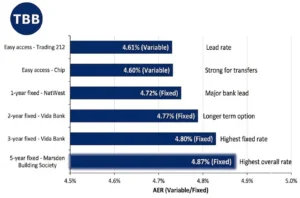
MSE’s current comparison therefore does not point to one universal “best ISA”. The account that works best depends on whether the saver needs easy access, wants to transfer an existing ISA, prefers a traditional bank or is prepared to fix for several years.
Anyone specifically considering a building society can also compare current Yorkshire Building Society ISA rates, including easy-access, limited-access and fixed options.
Why the Highest Rate Is Not Automatically the Best ISA?
A 4.80% account is not automatically better than one paying 4.60%.
A saver may reasonably prefer the lower rate if the higher-paying account:
- Locks money away for several years.
- Charges a significant early-access penalty.
- Requires a higher minimum deposit.
- Can only be managed through an app.
- Does not accept the type of ISA transfer required.
- Includes a temporary introductory bonus.
- Provides a level of customer support that does not suit the saver.
AER is therefore only the starting point.
What Does Martin Lewis Actually Say About Cash ISAs?
This is where searches for “Martin Lewis best ISA rates” can become misleading.
MSE maintains best-buy rate tables, but the underlying Martin Lewis approach is not simply:
Find ISA → choose highest rate → deposit money.
The broader strategy can be reduced to several important principles.
1. First Check Whether the Tax-Free ISA Wrapper Is Needed?
Cash ISAs protect interest from Income Tax, but many people can already receive a certain amount of savings interest tax-free through the Personal Savings Allowance.
For the 2026/27 tax year:
| Tax Position | Personal Savings Allowance |
| Basic-rate taxpayer | £1,000 |
| Higher-rate taxpayer | £500 |
| Additional-rate taxpayer | £0 |
Cash ISA interest does not use this allowance.
That means a basic-rate taxpayer earning only £300 or £400 a year from ordinary savings may currently pay no tax on that interest anyway.
The decision therefore needs to compare:
ISA interest rate
against
ordinary savings rate after any tax due.
MSE itself stresses that savers should not automatically assume an ISA is the best home for cash simply because the interest is tax-free.
2. Think About Future Tax, Not Only This Year’s Tax
The immediate tax calculation is not the only consideration.
Someone might currently have £8,000 in savings and remain well inside the Personal Savings Allowance. But if that person regularly saves £500 or £1,000 a month, the balance could become large enough for interest to exceed the allowance later.
An ISA can therefore act as a long-term tax shelter.
Once money has legitimately entered the ISA system, interest earned within the wrapper remains sheltered from Income Tax while it stays within the ISA rules.
This is particularly relevant for people building substantial cash reserves over several tax years.
3. Do Not Leave an Old ISA on a Poor Rate
Opening an ISA once does not mean the job is finished.
Rates change.
A competitive Cash ISA can eventually become mediocre, particularly after:
- An introductory bonus expires.
- A fixed term ends.
- A provider cuts a variable rate.
- The account automatically moves to a lower-paying product.
Existing ISA money can usually be transferred to another provider without using the current year’s ISA allowance.
The critical point is to use the formal ISA transfer process.
4. Never Withdraw an ISA Just to Transfer It Yourself
This is one of the most important ISA rules highlighted repeatedly by MSE.
If existing ISA money is simply withdrawn into a normal current account and then paid into another ISA, the original ISA protection can be lost and the new deposit may count against the current year’s allowance.
Instead, the new provider should be asked to arrange an official ISA transfer.
The provider then moves the money while preserving its ISA status.
5. Premium Bonds Are Not Automatically Better Because Prizes Are Tax-Free
Martin Lewis has frequently challenged the idea that the Premium Bonds headline prize-fund rate represents the return an individual saver can expect.
From the September 2026 draw, Premium Bonds have a 4.35% prize-fund rate and odds of 21,000 to one for each £1 bond.
But that 4.35% is not interest.
Individual returns vary.
MSE’s analysis shows that someone with typical luck can receive substantially less than the headline prize-fund rate. Its September comparison showed top easy-access Cash ISAs at 4.61%, compared with the 4.35% Premium Bond prize-fund rate.
Premium Bonds can become more interesting where a saver has:
- Used their ISA allowance.
- Exceeded their Personal Savings Allowance.
- A larger amount of cash.
- A preference for Government-backed capital security.
- An acceptance that returns are uncertain.
For most people purely chasing predictable interest, ordinary savings or a competitive Cash ISA can be easier to evaluate.
Does Someone Actually Need a Cash ISA?
Consider a simple calculation.
Suppose the best ordinary easy-access savings rate available is around 4.55%.
At that rate, a basic-rate taxpayer would need roughly:
£1,000 ÷ 4.55% = £21,978
in savings before one year’s interest reached the £1,000 Personal Savings Allowance, assuming there was no other taxable savings interest.
A higher-rate taxpayer with a £500 allowance would reach it at roughly:
£500 ÷ 4.55% = £10,989
This illustrates why the ISA decision can be quite different between two people with exactly the same savings balance.
A higher-rate taxpayer may obtain a useful tax benefit from an ISA much sooner.
Additional-rate taxpayers do not receive a Personal Savings Allowance, making the Cash ISA wrapper potentially valuable from the first pound of interest.
For people interested in how savings fit into a wider income strategy, interest on savings can be one of the simplest forms of passive income, although the tax treatment differs from dividends, rental income and trading profits.
Worked Example: Sarah Has £15,000 to Save
The difference becomes clearer with actual numbers.
Suppose Sarah has £15,000 and is comparing:
- A Cash ISA paying 4.61%.
- An ordinary savings account paying 4.55%.
- Premium Bonds with a 4.35% headline prize-fund rate.
After One Year
If the Cash ISA rate remained unchanged:
£15,000 × 4.61% = £691.50
Sarah would have approximately:
£15,691.50
The entire £691.50 would remain within the tax-free ISA wrapper.
An ordinary savings account at 4.55% would produce:
£15,000 × 4.55% = £682.50
For a basic-rate taxpayer with no other savings interest, that £682.50 remains below the £1,000 Personal Savings Allowance.
In that particular scenario, the ordinary account would also effectively be tax-free.
For a higher-rate taxpayer, however, only £500 would fall inside the Personal Savings Allowance.
The remaining £182.50 would currently be taxable.
At a 40% tax rate:
£182.50 × 40% = £73 tax
Net interest would therefore be approximately:
£609.50
The Cash ISA’s £691.50 would then be more attractive.
What Could Happen Over Longer Periods?
For illustration only, assume the respective rates remained unchanged and all returns were reinvested:
| Option | 1-Year Gain | 3-Year Gain | 5-Year Gain |
| Cash ISA at 4.61% | £691.50 | £2,171.60 | £3,791.32 |
| Savings at 4.55% before tax | £682.50 | £2,142.07 | £3,737.49 |
| 4.35% theoretical return | £652.50 | £2,043.89 | £3,558.96 |
This is not a forecast.
Easy-access rates can change substantially over five years.
The Premium Bonds figures are particularly important to interpret correctly. The 4.35% prize-fund rate cannot be treated like guaranteed savings interest. Individual Premium Bond winnings are random, so an actual saver could receive considerably more or considerably less.
The example instead demonstrates something more useful: apparently small differences in rates become more significant as balances and holding periods increase.
What Is Changing to Cash ISAs in April 2027?
This is one of the most important details for anyone reading ISA advice in 2026.
The rules for 2026/27 and 2027/28 are not the same.
Current Rules: 2026/27
For the tax year ending 5 April 2027:
- The overall ISA allowance is £20,000.
- Up to £20,000 can currently be placed into Cash ISAs.
- The allowance can be divided across eligible ISA types.
- Adults can contribute to more than one ISA, subject to the overall allowance and provider-specific conditions.
From 6 April 2027
For people under 65:
- Overall ISA allowance: £20,000
- Maximum Cash ISA subscriptions: £12,000
- Remaining allowance can potentially be used for other eligible ISA types.
For people 65 and over:
- Cash ISA limit remains £20,000.
- Overall ISA allowance remains £20,000.
The Government says entitlement to the higher £20,000 Cash ISA limit will apply from the beginning of the tax year in which a saver turns 65.
Example: Someone Under 65 Has £20,000 to Save in 2027/28
Under the new rules, they could not put all £20,000 of new subscriptions into a Cash ISA.
They could potentially use:
- £12,000 Cash ISA.
- £8,000 Stocks and Shares ISA.
But that does not mean the remaining £8,000 must be invested.
Investments can fall in value and should not be chosen simply to avoid losing unused ISA allowance.
The saver could instead keep some money outside an ISA if that better suited their risk tolerance and financial objectives.
Does the £12,000 Limit Affect Existing ISA Savings?
No.
The £12,000 figure is an annual limit on new Cash ISA subscriptions for under-65s from April 2027.
It does not mean someone who has already accumulated £50,000, £100,000 or more in legitimate Cash ISA savings must remove the excess.
Existing ISA pots can continue to sit inside the tax-free wrapper.
A Less-Discussed 2027 Change: ISA Transfers Become More Restrictive
The £12,000 limit has received most of the attention, but another significant change matters.
Under the planned reforms, people under 65 will no longer be permitted to transfer money from a non-Cash ISA, such as a Stocks and Shares ISA, into a Cash ISA.
Transfers in the opposite direction—from Cash ISAs into non-Cash ISAs—can continue.
The Government is introducing the restriction to stop people effectively bypassing the new £12,000 Cash ISA limit by first contributing £20,000 to an investment ISA and later converting it to cash.
This makes future ISA decisions more consequential.
Someone should not move long-established Cash ISA savings into investments without understanding that transferring back into a Cash ISA may be restricted after April 2027.
What Happens to Cash Held Inside a Stocks and Shares ISA From 2027?
Another rule is also changing.
From April 2027, interest earned on cash held inside a non-Cash ISA is due to face a 22% charge.
This is designed to prevent investment ISAs being used as substitute Cash ISAs.
Savers will still be able to temporarily hold cash within investment ISAs, but leaving large sums earning cash interest there long term becomes less attractive.
The Government has also proposed rules preventing non-Cash ISAs from being made up entirely of certain cash-like investments such as money market funds.
For someone regularly buying and selling investments, this is an important change to understand before April 2027.
Why Martin Lewis Criticised the New Cash ISA Limit?
Martin Lewis has not simply welcomed the £12,000 restriction.
MSE reported his view that encouraging more people to invest may be a reasonable objective, but argued that it should be achieved using a “carrot, not stick” approach.
His concern is that people should not be pushed into investments simply because the Government wants more household money flowing into markets.
Cash and investments serve different purposes.
Cash is generally appropriate for money that must remain stable and accessible.
Investments involve market risk and are normally more appropriate where money can remain invested for the longer term.
The distinction matters because an ISA is a tax wrapper—not an investment recommendation in itself.
How Trustworthy Are the Providers Paying the Highest ISA Rates?
Rate-comparison tables often overlook this question.
A provider does not need to be a household-name high-street bank to offer legitimate Cash ISA products, but savers should understand where their money is actually held.
Trading 212
Trading 212 is primarily known as an investment platform rather than a traditional bank.
Its Cash ISA keeps customers’ Cash ISA money in cash rather than automatically investing it.
Trading 212 says Cash ISA money is held through partner banks and eligible deposits can receive FSCS protection up to the applicable limit per partner bank.
The current 4.61% rate includes a promotional element for eligible new customers, so the underlying rate and expiry date need checking.
Its service is primarily digital, which may suit app-focused customers but may be less attractive to somebody who wants branch support.
Chip
Chip’s current Smart Cash ISA offer pays 4.60% AER for eligible new customers.
The rate combines a 3.75% standard variable rate with a 0.85 percentage-point boost for 12 months.
That means the bonus expiry date matters just as much as the headline rate.
Chip says money in the Smart Cash ISA is deposited with licensed UK banks. The service is app-based, so it suits savers comfortable managing finances digitally.
NatWest
NatWest provides a more traditional banking option.
Its latest Fixed Rate ISA offers:
- 4.72% for one year.
- 4.75% for two years.
- £1,000 minimum deposit.
The account can be accessed through a broader combination of digital, telephone and branch services than many app-only alternatives.
Early closure can trigger an interest charge, so the fixed rate should not be considered in isolation.
Vida Bank
Vida is a UK-licensed bank offering Cash ISAs including:
- 4.70% one-year fixed.
- 4.77% two-year fixed.
- 4.80% three-year fixed.
- 4.85% five-year fixed.
Its fixed products generally start from £1,000.
Vida states that eligible deposits receive FSCS protection.
What About Customer Reviews?
Public review scores can be useful, but they should be treated as secondary evidence.
Ratings can move quickly and often reflect customer-service experiences rather than the underlying financial strength or savings protection of an institution.
Before choosing an account, a saver should check:
- Who legally provides the account.
- Whether eligible deposits receive FSCS protection.
- Whether another account is already held with the same banking licence.
- How withdrawals work.
- Whether support is app-only, online, telephone or branch-based.
- Whether the advertised rate includes a temporary bonus.
How Much FSCS Protection Does a Cash ISA Have?
The standard Financial Services Compensation Scheme deposit protection limit is currently £120,000 per eligible person, per authorised financial institution.
It is not necessarily £120,000 per account.
That distinction matters.
Suppose someone has:
- £80,000 directly with Bank A.
- Another £60,000 held through a savings platform but ultimately deposited with the same Bank A.
The exposure to that banking licence could total £140,000.
The saver should not automatically assume each account separately receives £120,000 protection.
This becomes particularly important when using platforms that distribute cash among underlying partner banks.
How to Open a Cash ISA?
For many modern accounts, the application itself can be completed relatively quickly if identity checks pass immediately.
The process normally looks like this.
Step 1: Decide How Much Access Is Needed
Start by choosing between:
- Easy access.
- Limited access.
- One-year fixed.
- Two-year fixed.
- Longer fixed terms.
Emergency savings should generally not be locked away purely to gain a fractionally higher interest rate.
Step 2: Compare the Full Terms
Check:
- AER.
- Whether the rate is fixed or variable.
- Bonus rate.
- Bonus expiry date.
- Minimum deposit.
- Maximum deposit.
- Withdrawal limits.
- Early-access penalties.
- Whether transfers are accepted.
- Whether the ISA is flexible.
Step 3: Prepare Identification
Depending on the provider and electronic checks, applicants may need:
- Full legal name.
- Date of birth.
- UK address.
- National Insurance details where required.
-
Existing bank-account details.
- Photo identification.
- Proof of address.
- A selfie or digital identity check.
Not every provider requests the same documents.
Step 4: Open the Account
Most competitive providers now support online or app applications.
Traditional banks and building societies may additionally offer telephone, postal or branch applications.
Step 5: Choose New Money or an ISA Transfer
New savings can normally be deposited directly, subject to the annual ISA allowance.
Existing ISA savings should be moved using the provider’s official transfer process.
Do not simply withdraw the money and attempt to recreate the ISA manually.
Step 6: Set a Rate-Review Reminder
Immediately record:
- Bonus expiry date.
- Fixed-term maturity date.
- Any notice period.
- Date the provider can change a variable rate.
This small step can prevent money sitting for years in an account that is no longer competitive.
Cash ISA vs Stocks and Shares ISA
These accounts share the ISA name but serve very different purposes.
| Feature | Cash ISA | Stocks & Shares ISA |
| Capital value | Does not fluctuate with markets | Can rise or fall |
| Return | Interest | Investment growth, income or losses |
| Suitable horizon | Short/medium-term cash | Usually longer-term investing |
| Tax on return within ISA | No Income Tax on interest | No UK Income Tax or Capital Gains Tax within wrapper |
| Access | Depends on product | Investments generally need to be sold first |
| Risk | Mainly institution/inflation risk | Investment and market risk |
| Return guaranteed? | Fixed ISA rate may be | No |
Someone saving for a house purchase in two years may have completely different needs from someone investing for retirement in 20 years.
The higher expected long-term return of investments does not make them a substitute for emergency cash.
Cash ISA vs Pension
An ISA and pension should not be treated as interchangeable products either.
Cash ISA
A Cash ISA offers:
- Tax-free interest.
- Generally flexible access depending on the account.
- No tax when money is withdrawn.
- No investment-market risk to the cash itself.
Pension
A pension is specifically designed for retirement.
It can provide tax relief on qualifying contributions, while investments within the pension can grow in a tax-efficient environment.
But access is heavily restricted until later life and pension withdrawals have their own tax rules.
A pension can therefore be powerful for retirement planning, while an ISA provides far greater access to the money.
For many households the sensible question is not necessarily:
ISA or pension?
It may instead be:
How much should remain accessible, and how much can genuinely be committed to retirement?
Cash ISA vs Premium Bonds in September 2026
The current numbers make this comparison particularly interesting.
| Option | Headline Rate/Prize Rate | Return Certain? | Tax-Free? |
| Trading 212 Cash ISA | 4.61% AER variable | Rate variable, interest earned | Yes |
| Chip Smart Cash ISA | 4.60% AER variable | Rate variable, interest earned | Yes |
| Premium Bonds | 4.35% prize-fund rate | No | Prizes are tax-free |
Premium Bonds became more competitive in September 2026 after NS&I increased the prize-fund rate to 4.35%.
However, the crucial difference remains.
A savings account pays interest according to its stated terms.
Premium Bonds enter the saver into prize draws.
Someone could receive more than 4.35%.
Someone could receive less.
Someone with a small holding could receive nothing during a particular period.
MSE therefore argues that the headline prize-fund rate should not be interpreted in the same way as an AER savings rate.
What Does the 2027 Cash ISA Change Mean for People Over 60?
This requires some care because the relevant threshold is 65, not 60.
Someone aged 60, 61, 62, 63 or 64 does not automatically receive the £20,000 post-2027 Cash ISA limit.
From 6 April 2027, people below the relevant age threshold will generally face the £12,000 Cash ISA subscription limit.
Those aged 65 and over retain the £20,000 limit.
Government guidance says the age-65 entitlement applies from the beginning of the tax year in which the individual reaches 65.
That makes the exact date of birth relevant for somebody close to the threshold.
Is MoneySavingExpert a Bank?
No.
MoneySavingExpert is a consumer finance and journalism website, not a bank, building society or ISA provider.
It researches financial products and publishes comparison information and editorial recommendations.
The actual ISA is opened with the relevant provider.
This distinction matters because searches such as “Martin Lewis ISA” can make it sound as though Martin Lewis operates an ISA account himself.
He does not provide the Cash ISA.
MSE compares products offered by banks, building societies and financial platforms.
Is Martin Lewis Paid to Recommend Particular ISAs?
The more accurate question is how MoneySavingExpert makes money.
MSE states that companies cannot pay simply to obtain a position in its editorial best-buy tables.
Its published editorial code separates editorial decisions from commercial activity.
After products have been selected editorially, MSE may use affiliate links for some providers. Those links can generate revenue if readers click, apply or become customers.
MSE says that if a top product does not have a paying affiliate link, it can still remain in its rankings.
That distinction is important: an affiliate relationship can exist, but MSE says it does not determine which account receives the editorial recommendation.
How Often Should ISA Rates Be Checked?
Frequently.
The movement seen during summer 2026 demonstrates why.
Competitive accounts can change several times in a matter of weeks as providers respond to:
- Bank of England expectations.
- Competitor pricing.
- Deposit-funding requirements.
- New-customer campaigns.
- Changes in wider savings rates.
A practical routine is to review an easy-access Cash ISA periodically and always review:
- When a bonus ends.
- When a fixed ISA matures.
- After a significant savings-rate change.
- Before the end of the tax year.
- Before making a large new deposit.
Someone does not need to move money every time another provider offers an extra 0.05%, but neither should a long-established ISA be assumed to remain competitive indefinitely.
Final Thoughts: What Should Savers Take From Martin Lewis’s ISA Approach?
The most useful lesson from searches for Martin Lewis best ISA rates is not simply today’s highest percentage.
As of early September 2026, Cash ISA rates around 4.6% to 4.9% are available across different access and fixed-term structures.
But the better decision requires several questions:
- Does the saver actually need the ISA tax protection?
- Will the interest exceed the Personal Savings Allowance now or later?
- Is easy access important?
- Does the advertised rate contain a temporary bonus?
- Can existing ISA money be transferred in?
- What penalty applies for accessing a fixed ISA?
- Who actually holds the money?
- How does FSCS protection apply?
- Could the saver be affected by the April 2027 Cash ISA reforms?
For some people, an ordinary savings account can still be perfectly suitable.
For others—particularly higher-rate taxpayers, additional-rate taxpayers and those building large savings balances—the long-term value of protecting money inside an ISA can be more important than chasing a marginally higher taxable rate outside one.
And with the under-65 Cash ISA limit due to fall from £20,000 to £12,000 on 6 April 2027, the value of understanding the rules before moving existing ISA money is becoming even greater.
This article is for general information only and does not constitute personal financial, investment or tax advice. ISA rules, tax treatment and savings rates can change, and provider terms should be checked before applying.
Frequently Asked Questions
What is the best Cash ISA rate according to Martin Lewis in 2026?
MoneySavingExpert’s 2 September 2026 comparison highlighted up to 4.61% AER on easy-access Cash ISAs and up to 4.87% on longer fixed Cash ISAs. Rates can change quickly.
Is the Martin Lewis ISA a real ISA?
There is no Cash ISA provided by Martin Lewis personally. MoneySavingExpert compares ISA products offered by banks, building societies and financial platforms.
What Cash ISA does Martin Lewis recommend?
It is more accurate to refer to MSE’s current editorial top picks rather than treat every listed account as a personal Martin Lewis endorsement. The MSE Money Team continuously updates the site’s best-buy tables.
Is Trading 212’s Cash ISA safe?
Trading 212 says Cash ISA funds are held with partner banks and eligible deposits receive FSCS protection subject to the applicable limits. Savers should also account for money they already hold with any underlying banking group.
Is Chip’s 4.60% ISA rate permanent?
No. The current 4.60% Smart Cash ISA rate for eligible new customers includes a 0.85 percentage-point 12-month boost on top of the standard variable rate. The account should therefore be reviewed when the bonus expires.
How much can be paid into a Cash ISA in 2026?
For the 2026/27 tax year, the overall ISA allowance remains £20,000 and it can currently all be used for eligible Cash ISA subscriptions.
Is the Cash ISA allowance falling to £12,000?
Yes, but not until 6 April 2027, and the £12,000 Cash ISA limit applies to people under 65. The overall ISA allowance remains £20,000.
Can someone over 65 still put £20,000 into a Cash ISA after April 2027?
Yes. The planned reform preserves a £20,000 annual Cash ISA subscription limit for savers aged 65 and over.
Should someone withdraw an old ISA before opening a new one?
Generally not when the intention is to preserve its ISA status. The new ISA provider should normally be asked to complete a formal ISA transfer.
Can someone have more than one Cash ISA?
Under current rules, adults can subscribe to multiple ISAs of the same type during a tax year, provided total new subscriptions remain within the applicable ISA allowance. Individual providers can impose additional account-level restrictions.
Is a Cash ISA better than Premium Bonds?
Not automatically. A Cash ISA pays interest according to its account terms, whereas Premium Bond returns depend on prizes. Premium Bonds can become more attractive for some savers who have already used their ISA and Personal Savings Allowances.
Is a fixed Cash ISA completely inaccessible?
No. Cash ISA rules generally require access to be possible, but fixed providers can impose substantial interest penalties for early closure or withdrawal. The account terms should be checked carefully.
Is Cash ISA interest included in the Personal Savings Allowance?
No. Interest earned legitimately within a Cash ISA does not use the Personal Savings Allowance.

More in Finance & Tax

Best 1 Year Fixed Rate ISA UK 2026: Top Cash ISA Rates Compared
The best 1 year fixed rate ISA in the UK currently pays up to 4.98% AER tax-free, with UBL UK offering the highest verified rate in our October 2026 comparison. Shawbrook Bank follows at 4.97%, while Vanquis Bank offers a competitive 4.96% alongside a lower minimum opening deposit. However, choosing the best one-year fixed Cash […]

Moneybox Lifetime ISA Review 2026: Interest Rates, Bonuses, Fees and Is It Worth It?
The Moneybox Lifetime ISA is a UK savings and investment account designed to help eligible adults save for their first home or retirement. It offers a 25% government bonus on contributions of up to £4,000 each tax year, potentially adding £1,000 annually to a saver’s money. Moneybox offers both Cash and Stocks & Shares Lifetime […]