
The latest Armed Forces pay rise gives UK military personnel a 3.6% increase in base pay for 2026/27, effective from 1 April 2026.
The Government accepted the recommendations of the independent Armed Forces’ Pay Review Body in full, covering personnel across the Royal Navy, British Army and Royal Air Force.
The award means the average Armed Forces salary rises to approximately £45,710 a year, around £1,650 higher than the previous year. Starting salaries for the most junior non-commissioned personnel have increased to £27,282, while junior officer starting pay has risen to £35,926.
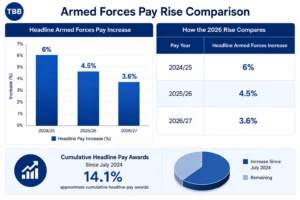
It is the third consecutive above-inflation military pay award, following increases of 6% in 2024 and 4.5% in 2025.
What Is the Armed Forces Pay Rise for 2026?
The confirmed Armed Forces pay rise for 2026 is 3.6%.
The Armed Forces’ Pay Review Body recommended that base pay should increase by 3.6% for everyone within its remit from 1 April 2026. The Government subsequently accepted the recommendation.
| Armed Forces Pay 2026/27 | Confirmed Position |
| Main base pay increase | 3.6% |
| Effective date | 1 April 2026 |
| Average Armed Forces salary | Around £45,710 |
| Average annual salary increase | Around £1,650 |
| Starting salary for other ranks | £27,282 |
| Junior officer starting salary | £35,926 |
| Volunteer Reserve Training Bounty | 3.6% increase |
| Many specialist payments | 3.6% increase |
The 2026 Armed Forces Pay Review Body report said recruitment and retention pressures, civilian pay comparisons, inflation, morale and the demands of military service were among the considerations behind the recommendation.
Anyone comparing the military settlement with other public-sector awards may also find Top Business Blog’s NHS pay rise 2026/27 guide useful.
When Does the Armed Forces Pay Rise Start?
The 3.6% Armed Forces pay rise applies from 1 April 2026.
Although the Government announced the settlement on 9 June 2026, the award was made effective from the beginning of the 2026/27 pay year. This means eligible personnel receive the increase based on their salary from 1 April rather than only from the date of the announcement.
Where the higher salary was not already included in earlier payroll payments, the relevant difference can therefore be paid as arrears.
Personnel should check their Joint Personnel Administration information and payslips to confirm how the revised rate and any arrears have been applied to their circumstances.
How Much More Will Armed Forces Personnel Get?
The exact cash increase depends on the person’s previous salary.
A 3.6% increase adds £360 for every £10,000 of eligible annual base pay. Therefore, somebody earning more receives a larger cash increase even though the percentage award is the same.
For illustration:
| Previous Annual Pay | Approx. 3.6% Increase | Approx. New Annual Pay |
| £27,000 | £972 | £27,972 |
| £30,000 | £1,080 | £31,080 |
| £35,000 | £1,260 | £36,260 |
| £40,000 | £1,440 | £41,440 |
| £45,000 | £1,620 | £46,620 |
| £50,000 | £1,800 | £51,800 |
| £60,000 | £2,160 | £62,160 |
| £75,000 | £2,700 | £77,700 |
These examples simply demonstrate what a 3.6% uplift looks like mathematically. A service person’s actual salary depends on rank, pay level, trade, specialist payments and other elements of military remuneration.
People trying to understand what an annual salary represents on an hourly basis can use Top Business Blog’s salary to hourly rate calculator.
What Is the New Starting Salary for UK Armed Forces Personnel?
One of the most significant parts of the settlement concerns junior personnel.
The Government confirmed that the starting salary for non-commissioned ranks would rise by £948 a year to £27,282. Approximately 14,250 junior personnel were expected to benefit from this change.
Starting pay for junior officers increases by approximately £1,250 to £35,926.
These starting salaries are particularly important for military recruitment because the Armed Forces compete with private businesses and other public-sector employers for younger workers and people with specialist technical skills.
Pay is not the only factor affecting recruitment, but competitive entry-level salaries can influence whether people view the military as an attractive long-term career.
Does the Armed Forces Pay Rise Apply to the Army, RAF and Royal Navy?
Yes. The main 3.6% pay recommendation covers personnel within the Armed Forces Pay Review Body’s remit rather than being an Army-only pay rise.
That means the settlement affects eligible members of the:
- British Army
- Royal Air Force
- Royal Navy
- Royal Marines
The exact salary received will still differ according to rank, seniority and role.
A soldier, RAF technician and Royal Navy engineer could therefore all receive the headline percentage increase while ending up with different annual salaries because they occupy different positions on the military pay structure.
Are Specialist Armed Forces Payments Increasing Too?
The settlement extends beyond standard base pay.
The Armed Forces Pay Review Body recommended a 3.6% increase to several specialist and compensatory payments from 1 April 2026.
These include payments connected with areas such as:
- Cyber skills
- Engineering
- Defence human intelligence
- Aircrew professional skills
- Recruitment and retention
- Compensatory allowances
- Volunteer Reserve training
The Government also accepted measures intended to address recruitment and retention pressures in specialist military occupations.
This matters because the total reward received by military personnel can be more complicated than the headline annual salary alone.
What Is Changing for Armed Forces Nurses?
Military nurses receive additional attention in the 2026 settlement.
The Armed Forces Pay Review Body supported the introduction of a new Nursing Professional Pay Spine from 1 October 2026 for nursing ranks up to and including OF3, alongside a Senior Nursing Officer Pay Spine covering OF4 to OF6 personnel.
The nurses’ Golden Hello was also recommended to rise to £50,000 from 1 April 2026, with the objective of improving recruitment into specialisms where the Armed Forces face capability gaps.
This is separate from the standard NHS pay system, despite military and NHS personnel sometimes working in closely related medical professions.
Are Armed Forces Accommodation Charges Increasing?
Higher pay does not necessarily mean every service person will see the entire increase in disposable income.
The 2026 recommendations also covered accommodation charges.
For Service Family Accommodation, rental charges for CAAS Bands A to F were recommended to rise by 3.8%, while no increase was recommended for Bands G and below.
For Single Living Accommodation, the recommendations included:
| Accommodation Grade | Recommended Increase |
| Grade 1 | 3.8% |
| Grade 2 | 2.5% |
| Grade 3 | 1.3% |
| Grade 4 | No increase |
Unlike the main pay award, these accommodation increases were not recommended to be backdated.
Personnel should therefore consider salary, accommodation, allowances and deductions together when assessing whether their household finances have improved.
Will Take-Home Pay Increase by the Full 3.6%?
Not necessarily.
The 3.6% Armed Forces pay rise applies to gross base pay. It does not mean every service person will have exactly 3.6% more money available to spend each month.
Net income can be affected by factors including:
- Income Tax
- National Insurance
- Accommodation charges
- Student loan repayments
- Salary-related deductions
- Changes to allowances
- Individual tax codes
For example, someone receiving an additional £1,500 of gross annual salary will not normally receive the full £1,500 as additional take-home income because Income Tax and potentially other deductions may apply.
Personnel should therefore compare their new payslip with an earlier payslip rather than simply multiplying their previous monthly net pay by 3.6%.
National Insurance can also affect long-term State Pension entitlement. Top Business Blog explains the wider qualifying-year rules in its guide for people asking whether they can get a pension without paying National Insurance.
Why Did the Armed Forces Receive a 3.6% Pay Rise?
Recruitment and retention remain important issues for Defence.
The Armed Forces Pay Review Body said its recommendation considered several competing factors, including pay in the wider economy, inflation, recruitment difficulties, retention and the effect of Service life on personnel and their families.
Its 2026 report noted that the trained strength of all three Services remained below requirement and described the workforce position as fragile.
It also considered a 3.2% median level of pay awards elsewhere in the economy but concluded that such an award could risk weakening the recovery in Armed Forces recruitment and retention.
At the time the report was completed, it cited CPI inflation of 3.0% and CPIH of 3.2%, meaning the recommended 3.6% settlement was above those measures.
How Does the 2026 Rise Compare With Previous Armed Forces Pay Rises?
Military personnel have now received three consecutive substantial annual increases.
| Pay Year | Headline Armed Forces Increase |
| 2024/25 | 6% |
| 2025/26 | 4.5% |
| 2026/27 | 3.6% |
The Government says most personnel have therefore received cumulative headline pay awards of approximately 14.1% since July 2024.
However, cumulative percentage changes should not be confused with a guarantee that every individual’s actual salary has risen by exactly 14.1%. Promotions, increments, changes in role and specialist payments can all alter an individual’s position.
Has an Armed Forces Pay Rise for 2027 Been Confirmed?
No 2027/28 Armed Forces pay percentage has yet been confirmed as of August 2026.
The Ministry of Defence formally started the 2027 pay round on 15 July 2026, asking the Armed Forces Pay Review Body to begin considering its recommendations for the 2027/28 year.
That is an important distinction for anyone searching for the latest Armed Forces pay rise.
The position is currently:
2026/27: Confirmed 3.6% increase.
2027/28: Review process underway, but no final percentage confirmed.
Claims suggesting that a specific 2027 military pay rise has already been guaranteed should therefore be treated cautiously unless supported by a subsequent official Government announcement.
What Does the Armed Forces Pay Rise Mean for Recruitment?
Pay is becoming increasingly important to the Government’s wider Defence workforce strategy.
Official figures released alongside the 2026 announcement put total UK Armed Forces strength at 183,410, around 1,510 higher than a year earlier.
The Government also said more personnel were joining than leaving, signalling an improvement after several years of recruitment and retention difficulties.
A higher starting salary may help the Armed Forces compete for candidates, particularly in areas such as engineering, cyber security, healthcare and other technical professions where civilian employers are also competing for skilled workers.
The specialist payments included in the settlement indicate that Defence is not relying exclusively on across-the-board pay increases. Targeted remuneration is also being used where recruitment or retention pressures are particularly acute.
Armed Forces Pay Rise 2026: Key Takeaway
The Armed Forces pay rise for 2026/27 is 3.6%, effective from 1 April 2026 and covering eligible personnel across the UK Armed Forces.
The settlement raises the average Armed Forces salary to approximately £45,710, increases starting pay for junior non-commissioned personnel to £27,282, and lifts junior officer starting pay to £35,926.
Several specialist payments and allowances also receive increases, while new arrangements are being introduced for groups including military nurses and submariners.
The next Armed Forces pay review for 2027/28 has already started, but no confirmed 2027 pay-rise percentage has yet been announced.
Frequently Asked Questions
What is the Armed Forces pay rise in 2026?
UK Armed Forces personnel have received a 3.6% base pay increase for 2026/27, effective from 1 April 2026.
Is the Armed Forces pay rise backdated?
Yes. The 2026 award applies from 1 April 2026, meaning eligible salary increases are effective from that date even though the Government announced the settlement in June.
What is the new starting salary for Armed Forces personnel?
The starting salary for junior non-commissioned personnel has increased to £27,282 a year.
How much do junior Armed Forces officers earn in 2026?
The Government says junior officer starting salary has risen by approximately £1,250 to £35,926 a year.
Does the 3.6% increase apply to the Royal Navy and RAF?
Yes. The Armed Forces pay award covers eligible personnel across the Royal Navy, British Army and Royal Air Force rather than applying to one individual Service.
Are military allowances also increasing?
Several recruitment, retention, specialist skills and compensatory payments have been increased by 3.6%, although individual arrangements vary depending on role.
Will Armed Forces personnel get another pay rise in 2027?
The 2027/28 Armed Forces pay review has started, but a final pay-rise percentage had not yet been confirmed as of August 2026.

More in Finance & Tax

Best 1 Year Fixed Rate ISA UK 2026: Top Cash ISA Rates Compared
The best 1 year fixed rate ISA in the UK currently pays up to 4.98% AER tax-free, with UBL UK offering the highest verified rate in our October 2026 comparison. Shawbrook Bank follows at 4.97%, while Vanquis Bank offers a competitive 4.96% alongside a lower minimum opening deposit. However, choosing the best one-year fixed Cash […]

Moneybox Lifetime ISA Review 2026: Interest Rates, Bonuses, Fees and Is It Worth It?
The Moneybox Lifetime ISA is a UK savings and investment account designed to help eligible adults save for their first home or retirement. It offers a 25% government bonus on contributions of up to £4,000 each tax year, potentially adding £1,000 annually to a saver’s money. Moneybox offers both Cash and Stocks & Shares Lifetime […]