
Redundancy pay is not usually taxable up to the first £30,000 of qualifying redundancy and termination compensation in the UK.
Any qualifying amount above £30,000 is normally subject to Income Tax. However, notice pay, unpaid wages, holiday pay and bonuses are treated as normal earnings and can be taxed from the first pound.
For employers, qualifying termination payments above £30,000 can also create a Class 1A National Insurance liability.
Understanding that distinction is important because a redundancy package may contain several different payments, and they do not all receive the same tax treatment.
For businesses planning redundancies, getting the calculation wrong can also lead to payroll errors, unexpected employment costs and disputes with departing employees.
Is Redundancy Pay Taxable in the UK?
Redundancy pay can be partly tax-free and partly taxable.
The first £30,000 of qualifying termination payments can normally be received without Income Tax being charged.
This can include:
- Statutory redundancy pay
- Enhanced redundancy compensation
- Certain additional severance payments
- Some non-cash benefits provided because employment is ending
Only qualifying termination compensation receives the £30,000 exemption.
Payments representing normal earnings do not become tax-free simply because they appear inside a redundancy package.
This distinction becomes particularly important for employees with larger salaries. Someone moving from one of the UK’s higher-paid career paths could have substantial notice pay, bonuses or contractual benefits alongside their redundancy compensation, resulting in a significant portion of their final payment remaining taxable.
How Does the £30,000 Redundancy Tax-Free Rule Work?
The £30,000 threshold applies to qualifying compensation connected with the termination of employment.
For example, suppose an employee receives:
| Payment | Amount | Typical Tax Treatment |
| Statutory redundancy pay | £12,000 | Qualifying termination payment |
| Enhanced redundancy payment | £15,000 | Qualifying termination payment |
| Total qualifying compensation | £27,000 | Normally tax-free |
| PILON | £5,000 | Taxed as earnings |
| Holiday pay | £1,500 | Taxed as earnings |
The employee’s overall leaving package is £33,500, but this does not mean £3,500 is automatically taxable under the £30,000 rule.
The qualifying redundancy compensation is only £27,000, which falls below the threshold.
The £5,000 notice payment and £1,500 holiday payment are instead taxed separately as earnings.
This is one of the most important distinctions for both employers and employees to understand.
Is Statutory Redundancy Pay Taxable?
Statutory redundancy pay normally falls within the tax-free termination payment rules.
In England, Scotland and Wales, the statutory calculation is based on age, length of service and weekly earnings.
For redundancies taking effect from 6 April 2026, weekly pay used for the statutory calculation is capped at £751, while no more than 20 years of service can be counted.
This means the maximum statutory redundancy payment is currently £22,530.
Because that maximum is below £30,000, statutory redundancy pay on its own will ordinarily fall within the tax-free threshold.
Enhanced redundancy arrangements can push the overall qualifying termination compensation above £30,000.
Is Enhanced Redundancy Pay Taxable?
Enhanced redundancy pay is additional compensation offered by an employer above the statutory minimum.
It may arise because:
- The employment contract provides enhanced terms
- A company redundancy policy offers additional compensation
- The employer negotiates an exit package
- A settlement agreement includes additional compensation
Genuine enhanced redundancy compensation can normally form part of the £30,000 tax-free amount.
For example:
| Qualifying Payment | Amount |
| Statutory redundancy | £14,000 |
| Enhanced redundancy | £26,000 |
| Total | £40,000 |
| Potentially tax-free | £30,000 |
| Potentially taxable | £10,000 |
The £10,000 excess is normally subject to Income Tax.
However, labelling a payment as “redundancy” does not automatically make it qualifying compensation. HMRC looks at what the payment is actually for.
Is Redundancy Pay Over £30,000 Taxable?
Yes. The part of a qualifying termination payment above £30,000 will normally be subject to Income Tax.
Suppose genuine redundancy compensation totals £45,000.
The basic calculation is:
£45,000 – £30,000 = £15,000 taxable termination payment
The tax actually charged on that £15,000 depends on the employee’s wider taxable income and applicable tax bands.
For England, Wales and Northern Ireland, the main 2026/27 rates remain 20%, 40% and 45%, subject to the relevant bands and Personal Allowance. Scotland operates different Income Tax bands for employment income.
So an employee should not assume that every taxable redundancy payment is automatically charged at 20%.
Do You Pay National Insurance on Redundancy Pay?
The National Insurance position is different from the Income Tax position.
For an employee, genuine qualifying termination compensation is normally not subject to employee National Insurance, including qualifying amounts exceeding £30,000.
However, normal employment earnings included in the termination package can still attract employee National Insurance.
This includes payments such as:
- Wages
- Holiday pay
- Bonuses
- Notice pay
- Post-Employment Notice Pay
The employer has an additional responsibility where qualifying termination compensation exceeds £30,000.
Do Employers Pay National Insurance on Redundancy Pay?
This is particularly important for businesses budgeting for workforce restructuring.
For 2026/27, employers generally pay Class 1A National Insurance at 15% on the portion of qualifying termination awards exceeding £30,000.
Consider an employee receiving £50,000 of genuine qualifying termination compensation.
| Calculation | Amount |
| Termination award | £50,000 |
| Tax-free threshold | £30,000 |
| Amount subject to employer Class 1A NIC | £20,000 |
| Class 1A NIC at 15% | £3,000 |
The employer’s actual cost is therefore higher than simply the £50,000 paid to the employee.
This can become a substantial additional expense where several senior employees receive enhanced packages.
Businesses preparing redundancy budgets should therefore model employment taxes as well as the headline settlement payments.
Is Payment in Lieu of Notice Taxable?
Yes.
A payment in lieu of notice, commonly known as PILON, is normally treated as employment earnings and subject to Income Tax and National Insurance.
It does not simply fall within the £30,000 redundancy exemption.
This is an area that frequently causes confusion because employers may present redundancy, notice pay and other payments together as one overall settlement figure.
For example, an employee might be told they are receiving a £28,000 “leaving package”, but the package could actually consist of:
- £18,000 redundancy compensation
- £7,000 PILON
- £3,000 holiday pay
In that situation, the £18,000 qualifying redundancy element may be tax-free, while the remaining £10,000 can be taxed as normal employment income.
What Is Post-Employment Notice Pay?
Post-Employment Notice Pay, usually shortened to PENP, is designed to ensure that notice-related earnings cannot simply be converted into tax-free termination compensation.
Where an employee does not work all of their notice period, employers may have to calculate the amount that effectively represents earnings for that notice period.
That portion can be treated as taxable earnings even where it forms part of a wider severance payment.
HMRC specifically states that PENP does not receive the normal £30,000 termination payment exemption.
Employers dealing with substantial settlement agreements should therefore calculate PENP before deciding how much of an award qualifies for the termination payment exemption.
Is Holiday Pay Taxable When Made Redundant?
Yes.
Payment for accrued but unused holiday is normal employment income.
It is therefore normally subject to:
- PAYE Income Tax
- Employee National Insurance
- Employer National Insurance where applicable
The £30,000 termination payment exemption does not convert earned holiday entitlement into tax-free redundancy compensation.
The same principle generally applies to unpaid salary.
Are Bonuses Taxable in a Redundancy Package?
Yes.
A bonus earned because of the employee’s performance or work is normally taxable employment income.
It does not become tax-free simply because it is paid at the same time as redundancy compensation.
For example:
| Final Payment | Amount | Tax Position |
| Genuine redundancy compensation | £25,000 | Normally tax-free |
| Performance bonus | £6,000 | Taxable |
| Unused holiday | £2,000 | Taxable |
| Notice pay | £5,000 | Taxable |
| Total received | £38,000 | Mixed treatment |
In this example, it would be incorrect to deduct £30,000 from £38,000 and tax only £8,000.
The individual components need to be classified first.
Can Redundancy Pay Push Someone Into a Higher Tax Band?
Potentially, yes.
Only the taxable portion is relevant, but taxable redundancy compensation above £30,000 is added to the individual’s taxable employment income.
A sufficiently large termination payment could therefore cause some of the employee’s income to fall into a higher Income Tax band.
For example, someone who already has substantial salary income during the tax year could find that a taxable termination payment pushes additional income into the higher-rate band.
The tax effect consequently depends on:
- Salary earned before redundancy
- Other taxable employment income
- Bonuses and benefits
- Taxable termination compensation
- Pension contributions
- Other taxable income
- The individual’s UK tax residence position
It is therefore misleading to calculate redundancy tax simply by multiplying the taxable portion by 20%.
Does Redundancy Pay Affect the Personal Allowance?
It can if taxable income becomes sufficiently high.
For 2026/27, the standard Personal Allowance remains £12,570.
The allowance begins reducing by £1 for every £2 of adjusted net income above £100,000, and can disappear completely at sufficiently high income levels.
A large taxable termination payment could therefore have a secondary tax consequence for a high earner by contributing to income levels at which the Personal Allowance is withdrawn.
This is particularly relevant to directors, executives and other senior employees receiving substantial exit packages.
Can an Employer Pay Part of a Redundancy Package Into a Pension?
Employer pension contributions can sometimes form part of a termination arrangement.
HMRC states that employer contributions made into a registered pension scheme as part of a termination payment are not normally subject to Income Tax and National Insurance in the same way as a cash payment, although pension Annual Allowance rules remain relevant.
For higher-value redundancy packages, pension contributions may therefore form part of the financial discussions between employer and employee.
However, the pension tax rules can become complicated, particularly where the employee:
- Already makes significant pension contributions
- Has high income
- Has unused allowance from earlier years
- Has pension protections
- Has flexibly accessed pension savings
Professional tax or regulated financial advice may therefore be appropriate before restructuring a large cash termination award.
Are Legal Fees for a Settlement Agreement Taxable?
Certain legal costs relating directly to termination can receive favourable treatment where the employer pays them directly to the employee’s solicitor.
HMRC lists legal costs connected with the settlement and paid directly by the employer to the solicitor among amounts on which the employee does not pay tax or National Insurance.
This matters because employers frequently contribute towards an employee’s independent legal advice when a settlement agreement is used.
The agreement should clearly explain how the contribution is being handled.
Can Splitting Redundancy Pay Into Different Payments Avoid Tax?
Generally, an employer should not assume that dividing a termination award into several payments creates several £30,000 exemptions.
Relevant termination payments can have to be aggregated before the threshold is applied. HMRC’s termination payment rules specifically address circumstances where payments and benefits must be added together before applying the £30,000 limit.
Changing the payment date or labelling parts differently does not necessarily change the underlying tax treatment.
Businesses should structure termination arrangements according to the actual nature of each payment rather than attempting to create an artificial tax advantage.
How Should Employers Tax a Redundancy Package?
From a payroll perspective, businesses should identify each component separately before processing the employee’s final payment.
A useful breakdown is:
| Payment Type | Income Tax | Employee NIC | Employer NIC |
| Qualifying termination compensation up to £30,000 | Normally No | Normally No | Normally No |
| Qualifying termination compensation above £30,000 | Yes | Normally No | Class 1A normally applies |
| PILON/PENP | Yes | Yes | Normal employer NIC |
| Unpaid wages | Yes | Yes | Normal employer NIC |
| Holiday pay | Yes | Yes | Normal employer NIC |
| Performance bonus | Yes | Yes | Normal employer NIC |
| Qualifying employer pension contribution | Special rules | Special rules | Special rules |
For 2026/27, Class 1A National Insurance on qualifying termination awards above £30,000 is charged at 15%.
Keeping the components separate also makes the employee’s settlement documentation easier to understand and reduces the likelihood of disagreement over deductions.
Businesses dealing regularly with PAYE should treat redundancy taxation as part of their wider payroll compliance rather than simply treating the entire settlement as one lump sum.
Worked Example: How Much of a £48,000 Package Is Taxable?
Consider an employee who receives the following final package:
| Payment | Amount |
| Statutory redundancy | £12,000 |
| Enhanced redundancy | £23,000 |
| PILON | £8,000 |
| Holiday pay | £3,000 |
| Bonus | £2,000 |
| Total | £48,000 |
The statutory and enhanced redundancy payments total £35,000.
Of this:
- First £30,000: normally tax-free
- Remaining £5,000: subject to Income Tax
- £8,000 PILON: taxable earnings
- £3,000 holiday pay: taxable earnings
- £2,000 bonus: taxable earnings
The amount potentially subject to Income Tax is therefore £18,000, not simply £18,000 because the package exceeds £30,000 by that amount.
It arrives at the same figure here only because of the particular composition of the example, to understand easily see the below image.
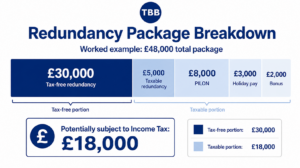
Employers should always classify the components first.
Could Someone Receive a Tax Refund After Redundancy?
Yes.
PAYE normally deducts tax based partly on assumptions about earnings across the tax year. After redundancy, actual annual earnings may be lower than originally expected if the individual remains unemployed or earns less in a new role.
This can sometimes result in too much Income Tax having been deducted.
Someone starting another PAYE job may have their tax position adjusted through their new employer. In other circumstances, a refund may need to be claimed from HMRC.
People who move into freelance or independent work after redundancy should also understand the difference between PAYE employment and self-employment. The tax position is explained further in the comparison of a side hustle and second job.
What Happens if Someone Starts a Business After Being Made Redundant?
Redundancy often becomes the point at which an employee decides to become self-employed, freelance or build a business.
The redundancy payment itself and income from the new business are separate for tax purposes.
If someone begins trading personally, they may subsequently have to register with HMRC. The process for registering as a sole trader depends on whether the person’s trading income creates a Self Assessment reporting obligation.
Redundancy compensation should therefore not be confused with later business turnover or profits.
For a business owner leaving employment, it can be useful to separate finances into three categories:
- Redundancy and termination compensation
- Taxable final employment earnings
- Income generated after starting the new business
This makes budgeting and tax record-keeping substantially easier.
What Should Employers Check Before Making Redundancy Payments?
Businesses should avoid treating redundancy taxation as an afterthought.
Before payroll is processed, the employer should check:
- Whether statutory redundancy is due
- Whether an enhanced redundancy scheme applies
- How much notice is owed
- Whether PILON or PENP applies
- Outstanding holiday entitlement
- Unpaid salary and commission
- Bonuses already earned
- Non-cash benefits transferred to the employee
- Pension contributions included in the settlement
- Whether qualifying compensation exceeds £30,000
- The resulting Class 1A National Insurance cost
For redundancies occurring from 6 April 2026, employers should also remember that the statutory weekly pay cap in England, Scotland and Wales is currently £751, giving a maximum statutory redundancy payment of £22,530.
Accurate calculations should be documented so the employee can see why particular amounts have or have not been taxed.
What Are the Most Common Redundancy Tax Mistakes?
One of the biggest mistakes is assuming that the first £30,000 of the entire final payslip is tax-free.
It is not.
The £30,000 exemption relates to qualifying termination compensation.
Other common mistakes include:
- Treating PILON as tax-free redundancy
- Including holiday pay within the exemption
- Assuming bonuses qualify for tax-free treatment
- Forgetting the employer Class 1A NIC charge above £30,000
- Ignoring PENP calculations
- Assuming every enhanced payment automatically qualifies
- Looking only at Income Tax and ignoring the employee’s total annual income
- Failing to separate payments clearly in settlement documentation
The safest approach is to identify why every payment is being made before deciding how it should be taxed.
Is Redundancy Pay Taxable if an Employer Is Insolvent?
The underlying tax treatment still depends on the type of payment received.
Where an employer becomes insolvent, eligible employees may be able to claim certain amounts through the government’s Redundancy Payments Service.
For redundancies from 6 April 2026, statutory redundancy calculations remain subject to the £751 weekly cap. Other payments such as unpaid wages and holiday pay are treated differently and can be subject to tax and National Insurance.
Employees should therefore look at the breakdown of any Insolvency Service payment rather than treating every amount received as tax-free redundancy pay.
Final Thoughts
So, is redundancy pay taxable? In many cases, only partly.
The first £30,000 of qualifying redundancy and termination compensation is normally free from Income Tax, while qualifying compensation above that amount is taxable. Notice pay, wages, bonuses and holiday pay remain taxable earnings regardless of the £30,000 threshold.
For employers, there is an additional consideration: qualifying termination awards above £30,000 can attract 15% Class 1A National Insurance in 2026/27.
The most important step is therefore not simply looking at the size of the final payment. Businesses and employees should break the package into its individual components and apply the correct tax treatment to each one.
Frequently Asked Questions
Is the first £30,000 of redundancy pay always tax-free?
The first £30,000 of qualifying termination compensation can normally be tax-free. However, normal earnings such as wages, holiday pay, bonuses and notice pay do not become tax-free because they are included in the same redundancy package.
How much redundancy pay can someone receive tax-free?
Up to £30,000 of qualifying termination payments can normally fall within the Income Tax exemption. Payments representing ordinary earnings are taxed separately.
Is statutory redundancy pay taxed?
Statutory redundancy pay normally qualifies for the termination payment exemption. The maximum statutory redundancy payment in England, Scotland and Wales for redundancies from 6 April 2026 is £22,530.
Do employees pay National Insurance on redundancy pay over £30,000?
Qualifying termination compensation above £30,000 is generally subject to Income Tax but not employee National Insurance. Employers can, however, have to pay Class 1A National Insurance on the excess.
What is the employer National Insurance rate on redundancy payments in 2026/27?
The Class 1A National Insurance rate applying to qualifying termination awards above £30,000 is 15% for 2026/27.
Is PILON included in the £30,000 tax-free allowance?
Generally no. PILON and amounts treated as Post-Employment Notice Pay are treated as employment earnings and can be subject to Income Tax and National Insurance.
Is unused holiday pay tax-free after redundancy?
No. Accrued holiday pay is normally treated as employment income and taxed through PAYE.
Can an enhanced redundancy payment be tax-free?
Yes, genuine enhanced redundancy compensation may fall within the £30,000 termination payment exemption. The exact treatment depends on why the payment is being made.
Can redundancy pay push someone into the 40% tax band?
Yes. Taxable termination compensation above the exempt amount is added to taxable income and may push some income into a higher tax band depending on the person’s overall earnings.
Does the £30,000 redundancy allowance reset every tax year?
The rules require relevant termination payments to be aggregated in applicable circumstances. Splitting one termination arrangement across payments or tax years should therefore not be assumed to create additional £30,000 exemptions.

More in Finance & Tax

Best 1 Year Fixed Rate ISA UK 2026: Top Cash ISA Rates Compared
The best 1 year fixed rate ISA in the UK currently pays up to 4.98% AER tax-free, with UBL UK offering the highest verified rate in our October 2026 comparison. Shawbrook Bank follows at 4.97%, while Vanquis Bank offers a competitive 4.96% alongside a lower minimum opening deposit. However, choosing the best one-year fixed Cash […]

Moneybox Lifetime ISA Review 2026: Interest Rates, Bonuses, Fees and Is It Worth It?
The Moneybox Lifetime ISA is a UK savings and investment account designed to help eligible adults save for their first home or retirement. It offers a 25% government bonus on contributions of up to £4,000 each tax year, potentially adding £1,000 annually to a saver’s money. Moneybox offers both Cash and Stocks & Shares Lifetime […]