Someone who has never personally paid National Insurance may still receive a UK State Pension. The key question is not simply whether National Insurance has ever been deducted from their wages, but how many qualifying years appear on their National Insurance record.
For someone covered by the new State Pension, at least 10 qualifying years are normally required before any State Pension becomes payable. Those years do not have to be consecutive.
Qualifying years can be built through paid National Insurance contributions, National Insurance credits, contributions treated as paid, voluntary contributions and, in some circumstances, periods of work or insurance overseas.
This distinction is particularly important because a person can legitimately say, “I have never paid National Insurance”, while still having qualifying years towards their pension.
For example, someone may have received credits while raising children, caring for another person or claiming certain benefits. A lower-paid employee may also build a qualifying record despite having no employee National Insurance deducted from their wages.
The official new State Pension eligibility rules explain that at least 10 qualifying years are normally required and that contributions, credits and certain overseas periods can all affect entitlement.
Can You Get a State Pension Without Ever Paying National Insurance?
Yes, in some circumstances.
There are two very different situations that are often described as “never paying National Insurance”.
| Situation | Likely State Pension position |
| No NI has personally been paid, but qualifying credits exist | State Pension entitlement may still have been built |
| No NI was deducted because earnings were relatively low | The year may still qualify because contributions can be treated as paid |
| Self-employed but no Class 2 payment was physically made | The year may still qualify if Class 2 is treated as paid |
| Some qualifying years exist, but fewer than 10 | Normally no new State Pension yet |
| 10 or more qualifying years exist | Some new State Pension may normally be payable |
| No contributions, credits or other qualifying years exist | Normally no new State Pension under the standard rules |
Simply living in the UK for many years does not normally create new State Pension qualifying years by itself. The National Insurance record is what matters.
Can A Year Count Even If No National Insurance Was Deducted?
Yes. This is one of the most important points for anyone who believes they have “never paid NI”.
For the 2026/27 tax year, an employee earning between £129 and £242 a week from one employer can generally be treated as having paid National Insurance for benefit purposes even though no employee NI contribution is actually deducted.
Someone earning above £242 a week will normally start paying employee National Insurance, subject to the usual rules.
That means looking through old payslips and seeing £0 beside National Insurance does not necessarily prove that those years are missing from the State Pension record.
GOV.UK confirms that qualifying years can be created where an employee earns between £129 and £242 a week in 2026/27 and is treated as having paid contributions.
The safest approach is therefore to check the official National Insurance record rather than attempting to reconstruct pension entitlement from payslips.
What If Someone Was Self-Employed But Never Paid National Insurance?
The same principle can apply to self-employed people.
For 2026/27, a self-employed person with annual profits of £7,105 or more normally has Class 2 National Insurance treated as paid. They do not need to physically pay the normal weekly Class 2 amount for those years simply to receive that treatment.
Where profits are below £7,105, no compulsory payment is normally required, although an eligible person may be able to pay voluntary Class 2 contributions.
Anyone with a self-employed history can read more about the 2026/27 National Insurance rules for self-employed people on Top Business Blog. Self-employed National Insurance rules for 2026/27
GOV.UK confirms that Class 2 is treated as paid where qualifying self-employed profits reach at least £7,105 during 2026/27.
This can therefore produce another situation where someone has paid £0 of Class 2 National Insurance but has still protected their National Insurance record.
How Many Years Of National Insurance Are Needed For A State Pension?
For people covered by the new State Pension, 10 qualifying years are normally required before any State Pension becomes payable.
Those years can come from before or after April 2016 and do not normally need to be consecutive.
For someone whose National Insurance record began after April 2016, 35 qualifying years will normally be required to receive the full new State Pension.
However, the widely repeated statement that “everyone needs exactly 35 years” is misleading.
Someone with National Insurance history from before 6 April 2016 can be subject to transitional calculations based on their record when the new State Pension was introduced.
Previous periods of contracting out can also affect the amount.
As a result, two people with the same number of qualifying years can potentially receive different State Pension amounts.
How Much Is The State Pension In 2026/27?
The full new State Pension is £241.30 a week for 2026/27.
That is:
£241.30 × 52 = £12,547.60 a year
before considering any Income Tax that may be due because of the person’s total taxable income.
The £241.30 figure is the full standard rate. It is not automatically paid to everybody reaching State Pension age.
The actual amount depends on the individual’s National Insurance history, including qualifying years and, where relevant, their pre-April-2016 record.
What Could 10 Qualifying Years Be Worth?
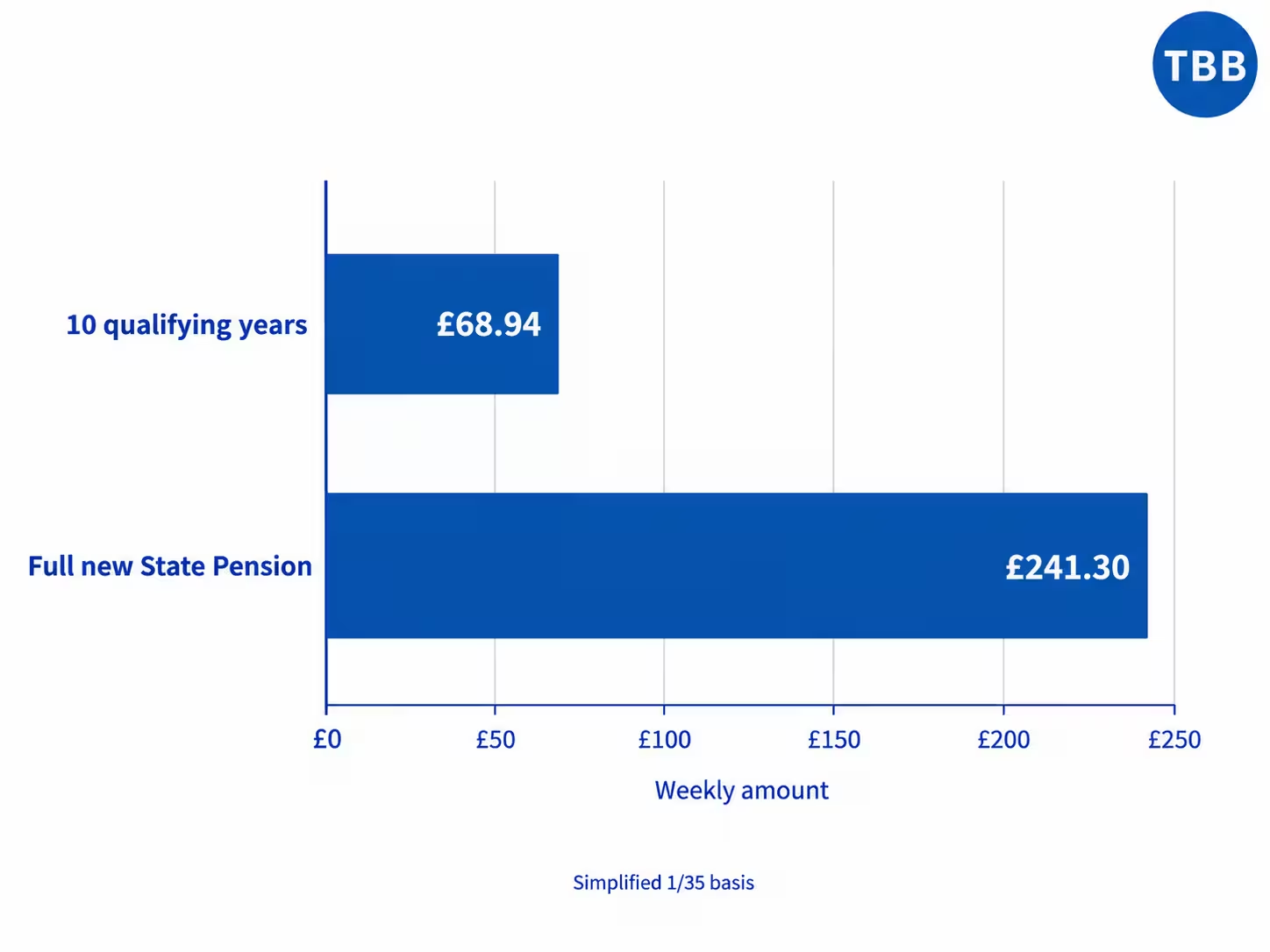
Someone whose entire National Insurance record started after April 2016 can broadly think of each qualifying year as contributing 1/35 of the full new State Pension until the maximum is reached.
On that simplified basis:
£241.30 × 10 ÷ 35 = approximately £68.94 a week
However, this should not be treated as a universal minimum State Pension.
People with National Insurance history before April 2016, overseas periods, contracting-out histories or special transitional rights can have different calculations.
A personal State Pension forecast is therefore considerably more reliable than multiplying qualifying years by £241.30 ÷ 35.
Can Someone Who Has Never Worked Get A State Pension?
Potentially, yes.
Paid employment is not the only way to build a National Insurance record.
Someone who spent many years outside employment because they were looking after children, caring for another person, unable to work because of illness or receiving certain benefits may have accumulated National Insurance credits.
They could consequently have a significant State Pension record despite having very little conventional employment history.
Someone who has never worked should therefore check for credits before assuming that they have no pension entitlement.
Which National Insurance Credits Can Build A State Pension?
Several situations can protect a person’s National Insurance record.
Child Benefit Credits
A parent or guardian registered for Child Benefit for a child under 12 can normally receive Class 3 National Insurance credits.
Importantly, someone can still receive the NI credit even if they choose not to receive the Child Benefit payment itself. They still need to have made the relevant Child Benefit claim or registration.
This can be particularly valuable where a parent stopped working or substantially reduced their earnings to look after children.
Carer’s Credits
Someone receiving Carer’s Allowance generally receives National Insurance credits automatically.
People who care for one or more sick or disabled people for at least 20 hours a week may also be able to claim Carer’s Credit where the relevant eligibility conditions are met.
Universal Credit And Other Benefits
Universal Credit normally provides Class 3 National Insurance credits automatically.
Credits can also arise in other circumstances involving unemployment, sickness, maternity and certain other benefits.
Specified Adult Childcare Credits
Eligible grandparents and certain other family members who provide childcare may be able to receive Specified Adult Childcare credits.
This can matter where an adult under State Pension age reduced or stopped work to care for a family member’s child under 12.
GOV.UK provides a detailed list of circumstances in which National Insurance credits may be available.
What Changed For Parents And Carers In 2026?
A separate replacement-credit scheme is planned for some parents and carers who were eligible for Child Benefit but did not claim it and consequently missed National Insurance credits.
HMRC announced on 30 March 2026 that the National Insurance replacement credits service had been delayed until April 2027.
It is intended to cover qualifying parents and carers who were eligible for Child Benefit for a child under 12 from 7 January 2013 but did not claim it.
Most eligible people will be able to apply once the service opens.
HMRC has also established arrangements for people whose State Pension payments could already be affected by the delay.
Anyone who stayed out of work to raise children but sees unexplained gaps in their National Insurance record should therefore avoid assuming that those years are permanently lost.
What If Someone Really Has Zero Qualifying Years?
Someone covered by the new State Pension rules who genuinely has zero qualifying years would normally receive no new State Pension based on that record.
Before reaching that conclusion, it is worth checking whether the apparent zero record is accurate.
Potentially missing years could relate to employment, low-paid work, Child Benefit, caring responsibilities, Universal Credit, sickness, maternity, unemployment, self-employment or overseas work.
The official National Insurance record service shows contributions and credits recorded up to the start of the current tax year, whether there are gaps and whether paying voluntary contributions could improve the State Pension forecast.
Can Missing National Insurance Years Be Bought?
Eligible gaps can sometimes be filled through voluntary National Insurance contributions.
For 2026/27, the standard voluntary Class 3 rate is £18.40 a week.
A full year at that rate is approximately:
£18.40 × 52 = £956.80
The actual amount required to complete a particular tax year may be different where part of the year has already been credited.
Under the normal rules, voluntary Class 3 contributions can generally be paid for gaps in the previous six tax years. The deadline is normally 5 April each year.
For example, a gap for the 2025/26 tax year can normally be filled until 5 April 2032.
The temporary arrangement that previously allowed many people to fill much older National Insurance gaps has ended, so pension articles referring to the former extended deadline may now be out of date.
Should Every Missing Year Be Bought?
No.
Paying voluntary National Insurance does not always increase the State Pension.
A person could pay to fill a historical gap and discover that the payment does not change their eventual pension because of their existing record, pre-2016 calculation, contracting-out history or the number of future qualifying years they can still accumulate.
The recommended order is therefore:
- Check the National Insurance record.
- Check the State Pension forecast.
- Look for missing credits.
- Identify which gaps would actually increase the pension.
- Only then consider paying voluntary contributions.
GOV.UK specifically warns that voluntary contributions do not always increase State Pension entitlement.
What If Someone Lived Or Worked Abroad?
A short UK contribution history does not always mean that someone fails the 10-year test.
Periods of work or social insurance in the European Economic Area, Switzerland and countries covered by relevant UK social security agreements can sometimes be taken into account when determining whether the minimum qualifying conditions have been met.
For example, someone with seven UK qualifying years and recognised contribution periods in another eligible country may still need an international pension calculation.
The amount of UK State Pension ultimately paid will depend on the applicable rules and the person’s UK record.
Voluntary NI From Abroad Changed From April 2026
The voluntary contribution rules for people living or working abroad changed on 6 April 2026.
For periods from 2026/27 onwards, the previous ability to pay voluntary Class 2 National Insurance while abroad has ended.
New applications to pay Class 3 contributions for periods abroad generally require a stronger connection to the UK, such as at least 10 continuous years of UK residence or 10 years of qualifying National Insurance contributions, subject to the detailed rules and transitional arrangements.
Anyone living overseas should check the current HMRC rules rather than relying on older pension articles written under the previous system.
Can A Husband, Wife Or Civil Partner’s NI Record Be Used?
Under the new State Pension, entitlement is normally based on the individual’s own National Insurance record.
Marriage does not usually mean that one spouse can simply use the other’s 35 qualifying years.
However, there are exceptions involving inherited State Pension rights, older pension rules and historic arrangements for some married women and widows.
One particularly important exception concerns some women who elected to pay the former reduced-rate National Insurance contributions, sometimes called the Married Woman’s Stamp.
Certain people covered by these historic arrangements can be subject to special State Pension rules and may not need the ordinary 10 qualifying years of their own record.
The position is highly dependent on dates and individual circumstances, so older married or widowed claimants should not assume that the standard new State Pension rules give the complete answer.
Is There An Exception For People Over 80?
There is a narrow exception for some older pensioners.
The Over 80 Pension is not based on National Insurance contributions.
For 2026/27 it can provide up to £110.75 a week to eligible people aged 80 or over who receive no basic State Pension or less than that amount.
However, it is an old-system provision. Someone cannot qualify if they reached State Pension age on or after 6 April 2016.
Residence and ordinary-residence conditions also apply.
For most people currently approaching retirement, the Over 80 Pension will therefore not apply, but it is important when answering the broad question of whether absolutely everyone with no National Insurance history receives nothing.
State Pension Age Is Also Changing In 2026
The age at which someone can claim the State Pension is separate from the number of qualifying years they have.
State Pension age is currently being phased from 66 to 67 between 2026 and 2028.
People born between 6 April 1960 and 5 March 1961 reach State Pension age at 66 plus a specified number of months. People born from 6 March 1961 through most of the following age group are scheduled to reach it at 67 under the current timetable.
Someone approaching retirement should therefore check their individual State Pension date rather than automatically assuming that they can claim from their 66th birthday.
What If Someone Has No State Pension At All?
Someone with little or no State Pension may still qualify for means-tested retirement support.
Pension Credit
Pension Credit is separate from the contributory State Pension.
For 2026/27, its Standard Minimum Guarantee can top qualifying income up to:
| Household | 2026/27 weekly amount |
| Single person | £238.00 |
| Couple | £363.25 |
Additional amounts may be available for circumstances such as severe disability, caring responsibilities, children and certain housing costs.
Savings, other pension income and household circumstances can affect entitlement, so receiving no State Pension does not automatically guarantee Pension Credit.
A person with little retirement income should nevertheless check eligibility because Pension Credit can also act as a gateway to other support.
Is A State Pension The Same As A Workplace Or Private Pension?
No.
National Insurance history mainly determines entitlement to the State Pension and certain contributory benefits.
A workplace or personal pension is separate.
Someone could therefore have no State Pension but substantial private retirement savings. Equally, another person could qualify for the full State Pension while having little or no workplace or personal pension provision.
Potential retirement income can include:
- State Pension
- workplace defined contribution pensions
- defined benefit or final salary pensions
- personal pensions
- SIPPs
- annuity income
- other investments or savings
A short National Insurance history does not make privately accumulated pension savings disappear.
Four Examples Of People Who Say They Have Never Paid National Insurance
| Example | National Insurance position | Possible outcome |
| Stay-at-home parent | 18 years of Child Benefit credits | Could have substantial State Pension entitlement despite little employment |
| Part-time worker | Earned within the 2026/27 treated-as-paid earnings range | May build qualifying years despite £0 employee NI deduction |
| Low-profit self-employed person | Profits above £7,105 | Class 2 can be treated as paid without an actual Class 2 charge |
| Person with zero contributions and zero credits | No qualifying years | Normally no new State Pension unless entitlement can still be built or a special rule applies |
These examples demonstrate why the phrase “I have never paid National Insurance” cannot, by itself, determine the answer.
How Can Someone Check Exactly What Pension They Will Get?
Two government services should normally be checked together.
The National Insurance record shows which years count, where gaps exist and which credits or contributions have been recorded.
The State Pension forecast estimates the pension a person could receive, when they can receive it and whether it could potentially be increased.
The official State Pension forecast service can also indicate whether filling particular gaps may increase future entitlement.
This is especially important for anyone with a pre-2016 National Insurance history because simply counting qualifying years may not reproduce the government’s actual pension calculation.
What Should Someone Do If They Have Never Paid National Insurance?
The most sensible process is to establish the facts before spending money.
First, the individual should check their National Insurance record and State Pension forecast. They should then investigate apparent gaps involving employment, Child Benefit, caring, benefits, self-employment or overseas periods.
If credits are missing, these should be investigated before voluntary contributions are purchased.
Only after establishing what each additional qualifying year would do to the personalised State Pension forecast should someone consider paying to fill a gap.
This avoids the two biggest mistakes: assuming that £0 of National Insurance paid means £0 of pension entitlement, and paying hundreds or thousands of pounds for gaps that do not actually improve the eventual pension.
Conclusion: I Have Never Paid National Insurance – Will I Get A Pension?
Someone who has never personally paid National Insurance may still receive a UK State Pension.
The decisive issue is the person’s qualifying National Insurance record rather than the amount of NI they remember paying.
A parent or carer may have accumulated National Insurance credits. A lower-paid employee may have qualifying contributions treated as paid despite having no NI deducted. A self-employed person can also have Class 2 treated as paid without physically paying it where the relevant profit conditions are met.
For the new State Pension, at least 10 qualifying years are normally required before anything is payable. Someone whose National Insurance record started after April 2016 will normally need 35 qualifying years for the full rate, currently £241.30 a week in 2026/27.
People with pre-2016 records, historic married-woman arrangements, overseas contributions or other special circumstances can have different calculations.
The best starting point is therefore simple: check the National Insurance record and State Pension forecast before assuming there is no entitlement or paying to fill a gap.
Frequently Asked Questions
Can A Woman Who Has Never Worked Get A State Pension?
Yes, potentially. A woman who spent years raising children or caring for another person may have National Insurance credits even if she had little or no paid employment. Historic married-woman and widow rules can also affect some older claimants.
Can I Get A State Pension If I Have Never Worked?
Potentially. National Insurance credits from parenting, caring and certain benefits can create qualifying years without employment.
What Happens If I Have Never Paid National Insurance?
Nothing can be concluded from that fact alone. The National Insurance record should be checked because credits, low-paid employment or self-employment may have created qualifying years without an actual NI payment.
Can A Year Count If I Paid £0 National Insurance?
Yes. In 2026/27, an employee earning between £129 and £242 a week from one employer can generally be treated as having paid NI. Some self-employed people can also have Class 2 treated as paid.
What Happens If I Have Fewer Than 10 Qualifying Years?
Someone covered by the new State Pension will normally receive no new State Pension until they have at least 10 qualifying years, although overseas periods and certain special rules can affect the position.
Do I Automatically Get A Pension After Living In The UK For 10 Years?
No. Simply residing in the UK does not normally create 10 qualifying years for the new State Pension. Contributions, credits or another recognised route are normally needed.
Can I Buy Missing National Insurance Years?
Eligible gaps can potentially be filled through voluntary contributions, but paying does not always increase the State Pension. The National Insurance record and State Pension forecast should be checked first.
How Much Is Voluntary National Insurance In 2026/27?
The standard voluntary Class 3 rate is £18.40 a week in 2026/27, equivalent to approximately £956.80 for 52 weeks.
Can Someone With No State Pension Claim Pension Credit?
Potentially. Pension Credit is means-tested rather than based purely on National Insurance contributions. For 2026/27, the Standard Minimum Guarantee is £238 a week for a single claimant and £363.25 for a couple, subject to the full eligibility rules.
Does My Husband Or Wife’s National Insurance Give Me A State Pension?
The new State Pension is normally based on each person’s own National Insurance record. Limited inherited and historic spouse-related rules can apply, particularly for older records.
Does A Private Pension Depend On National Insurance?
No. Workplace and private pensions are separate from State Pension entitlement. Someone can have private pension savings even where their National Insurance record does not qualify them for a State Pension.

More in Finance & Tax

Best 1 Year Fixed Rate ISA UK 2026: Top Cash ISA Rates Compared
The best 1 year fixed rate ISA in the UK currently pays up to 4.98% AER tax-free, with UBL UK offering the highest verified rate in our October 2026 comparison. Shawbrook Bank follows at 4.97%, while Vanquis Bank offers a competitive 4.96% alongside a lower minimum opening deposit. However, choosing the best one-year fixed Cash […]

Moneybox Lifetime ISA Review 2026: Interest Rates, Bonuses, Fees and Is It Worth It?
The Moneybox Lifetime ISA is a UK savings and investment account designed to help eligible adults save for their first home or retirement. It offers a 25% government bonus on contributions of up to £4,000 each tax year, potentially adding £1,000 annually to a saver’s money. Moneybox offers both Cash and Stocks & Shares Lifetime […]