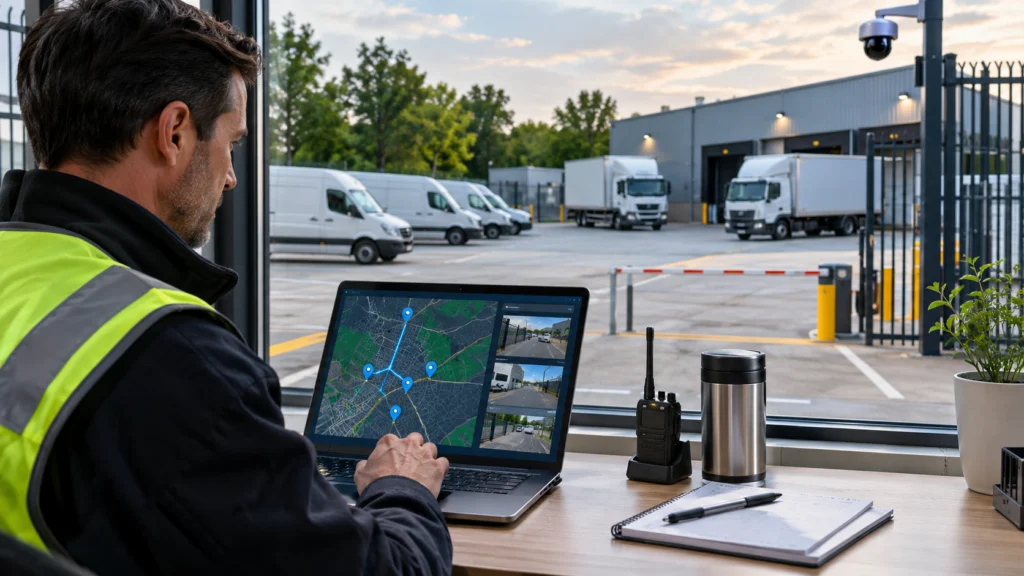
For a large number of businesses, the effective management of a fleet of vehicles will be central to ongoing operational success.
Whether that fleet is used to distribute goods or move workers to various locations, it’s critically important that those vehicles are kept safe and in good condition.
In 2026, fleet management security in particular requires adopting a combination of physical and digital technologies.
Below, we outline some of the main things to keep in mind, from advanced tracking systems to employee training.
Key Technologies for Improving Fleet Security
Advanced Tracking
There are now more ways than ever before to track vehicles using advanced telematics systems. You should always know where the vehicles in your fleet are located, but that’s the bare minimum.
Modern telematics solutions can also provide all sorts of insights into everything from driver behaviour to operational performance. Based on these insights, you should be able to spot patterns that help you to prevent incidents before they occur.
These systems need to be kept up to date, and you shouldn’t take the data they provide you with for granted. Make sure that you’re using the best analytic tools available, which, thanks to AI, can provide increasingly impressive insights.
Physical Security
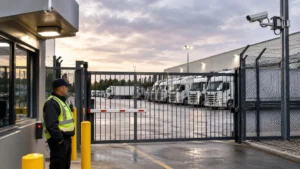
The basic requirements of fleet security remain relatively unchanged in 2026. One of the most obvious things is to create a physically secure space to keep the fleet in.
That could be a secure parking facility with a strong perimeter, using fences, gates, and retractable bollards to physically prevent vehicles from leaving the lot without prior authorisation.
It could also include using advanced alarm systems and CCTV, to provide a further layer of deterrence and allow you to respond to incidents as quickly as reasonably possible.
Key Management
Keys are the weak link in fleet management. If someone can get their hands on the key to a vehicle, there will be relatively little that prevents them from taking it in many cases, making key management of paramount importance.
Thankfully, smart key lockers from providers like KEYper Systems have made key management a lot more achievable in recent years.
These kinds of lockers allow you to place individualised access controls on each key, preventing unnecessarily broad access provisions while also automatically updating digital access logs.
Employee Training
It’s important to note that you can’t just implement a bunch of technologically advanced systems and hope for the best. Security systems always need to be used properly in order to be effective, and this is especially the case in the context of fleet management.
Train everyone who will need to engage with these systems on how they need to be operated. This training will need to be regularly updated, as systems or the threats they need to mitigate change.
Understanding fleet security in 2026 requires taking a step back and putting your existing systems and vulnerabilities into perspective. Based on that picture, you can then choose a select range of solutions that are able to cater to those specific issues as effectively as possible.

More in Business Tools & Software
What Do Retail Security Requirements Look Like Ready for 2027?
Retail security has been an absolute whirlwind in recent years. A range of factors, including increasing economic precarity and increasingly organised criminal syndicates, have contributed towards a substantial rise in shoplifting, along with cybersecurity and other digital threats. Retail security requirements have to be considered in this broader context, with solutions being sought to cater […]

Top 10 Print on Demand Companies in the UK
The UK print-on-demand industry is thriving, offering creators and entrepreneurs an efficient way to launch product lines without holding inventory. Choosing the right partner is essential for success, as providers vary in pricing, product selection, and customer service. This list ranks the top 10 UK print-on-demand companies, with a clear focus on the features that […]