Newcastle Building Society ISA rates are attracting attention from UK savers preparing their finances for 2027. With fixed-rate Cash ISAs offering up to 4.90% AER, a one-year fixed ISA paying 4.70%, and limited-access savings options available, Newcastle provides several ways to earn tax-free interest.
The October 2026 Autumn Budget also brought an important change. The government abandoned its earlier plan to reduce the annual Cash ISA allowance to £12,000 for savers under 65. Instead, the £20,000 limit will continue from April 2027.
We analysed Newcastle Building Society’s published ISA products, withdrawal restrictions, market interest rates and tax rules to understand how competitive its savings options are.
Our assessment focuses on interest returns, accessibility, financial protection and suitability for households, business owners, self-employed professionals and retirement savers.
Importantly, the figures below are rates advertised in November 2026, not a prediction of what new ISA products will pay during 2027.
What Are the Latest Newcastle Building Society ISA Rates for 2027?
Newcastle Building Society currently offers fixed-rate, variable-rate, limited-access, Lifetime and Junior Cash ISAs. The right account depends on whether your priority is a guaranteed interest rate, access to savings or a specific financial goal.
Newcastle Building Society ISA Rates Comparison
| ISA account | Interest rate (AER) | Access or maturity | Minimum deposit |
| 1 Year Fixed Rate ISA (Issue 130) | 4.70% fixed | 19 November 2027 | £1 |
| 18 Month Fixed Rate ISA (Issue 42) | 4.75% fixed | 17 May 2028 | £1 |
| 2 Year Fixed Rate ISA (Issue 127) | 4.85% fixed | 15 November 2028 | £1 |
| 5 Year Fixed Rate ISA (Issue 89) | 4.90% fixed | 17 November 2031 | £1 |
| Newcastle Single Access ISA (Issue 2) | 3.65% variable | One withdrawal at higher rate | £1 |
| Newcastle Double Access ISA (Issue 6) | 3.45% variable | Two withdrawals at higher rate | £1 |
| Newcastle Easy Saver ISA (Issue 5) | 1.80% variable | Easy access | £1 |
| Newcastle Cash Lifetime ISA (Issue 3) | 1.95% variable | LISA withdrawal rules | £1 |
| Newcastle Junior ISA | 3.00% variable | Normally until age 18 | £1 |
Rates checked against Newcastle Building Society’s published ISA range on 5 November 2026. Fixed-rate issues may be withdrawn or replaced, while variable rates can change.
The highest advertised rate is 4.90% on the five-year ISA. However, savers should not automatically choose the highest interest rate without examining the account’s restrictions.
For example, a five-year product requires a much longer commitment, and its early withdrawal charge is considerably greater than that of a one-year ISA.
We also found that Newcastle’s £1 minimum opening deposit is a notable advantage. It allows savers to start with a small amount rather than having to meet the £1,000 or £10,000 initial deposits required by some competing accounts.

Newcastle Building Society’s official Cash ISA comparison showing fixed-rate, limited-access, Lifetime and Junior ISA rates.
How Does Newcastle Building Society’s One-Year Fixed ISA Work?
Newcastle Building Society’s One Year Fixed Rate ISA (Issue 130) currently pays 4.70% tax-free AER, with the rate fixed until 19 November 2027.
This makes the product relevant to savers who want a known interest rate through much of 2027 without committing their money for several years.
The main features include:
- Annual interest: 4.70% tax-free pa/AER.
- Monthly interest option: 4.60% tax-free per annum, equivalent to 4.70% AER.
- Minimum opening deposit: £1.
- Maturity date: 19 November 2027.
- Early withdrawal charge: 90 days’ loss of interest.
- Application: Online or in branch.
- ISA transfers: Transfers from other ISA providers are permitted, subject to the terms.
Unlike a normal easy-access savings account, the fixed-rate arrangement guarantees the stated interest rate until maturity.
That protection can be valuable if other savings providers reduce their interest rates during 2027.
However, a withdrawal before maturity incurs a charge. If insufficient interest has accumulated, Newcastle states that the charge can be deducted from the original capital.
How Much Interest Could You Earn?
The table below shows illustrative interest over one full year at 4.70% AER.
| Opening balance | Annual interest at 4.70% | Illustrative balance after one year |
| £1,000 | £47 | £1,047 |
| £5,000 | £235 | £5,235 |
| £10,000 | £470 | £10,470 |
| £15,000 | £705 | £15,705 |
| £20,000 | £940 | £20,940 |
These calculations assume the full amount remains invested for one year, with no withdrawals and interest retained in the account. Actual interest depends on the deposit date, payment option and product terms.
For savers researching the wider market, comparing Newcastle with the best one-year fixed-rate ISA accounts can reveal whether the convenience of a particular provider compensates for a lower interest rate.
Our assessment: The 4.70% rate is competitive enough to consider, especially with the £1 opening requirement and the choice of online or branch applications. However, higher rates are available elsewhere, so it should not be treated as the automatic best choice.

Newcastle Building Society One Year Fixed Rate ISA (Issue 130), showing 4.70% AER, the November 2027 maturity date and the 90-day early withdrawal charge.
Are Newcastle Building Society’s Two-Year and Five-Year ISAs Better?
Longer fixed-rate ISAs may suit savers who can leave their money untouched for an extended period.
Newcastle currently offers a two-year ISA paying 4.85% AER and a five-year ISA paying 4.90% AER.
The difference in interest rates is relatively small, but the commitment period is substantially different.
| Feature | Two-year fixed ISA | Five-year fixed ISA |
| Advertised interest | 4.85% AER | 4.90% AER |
| Interest type | Fixed | Fixed |
| Maturity | November 2028 | November 2031 |
| Minimum deposit | £1 | £1 |
| Early withdrawal charge | 120 days’ interest | 365 days’ interest |
| Suitable for | Medium-term savings | Longer-term savings |
The Cost of Choosing a Longer Fixed Term
Suppose a saver deposits £10,000 into the two-year ISA at 4.85% AER.
Assuming annual compounding, no withdrawals and interest retained:
| Period | Estimated balance |
| Initial deposit | £10,000.00 |
| After year one | £10,485.00 |
| After year two | £10,993.52 |
| Total estimated interest | £993.52 |
Over approximately two years, the account could therefore generate nearly £1,000 in tax-free interest.
A five-year account at 4.90% could generate approximately £2,702 on the same £10,000 deposit over five full years, assuming that the annual equivalent return is compounded and retained.
However, this higher total is largely the result of the longer saving period rather than a substantially higher annual interest rate.
The five-year ISA also charges 365 days’ interest for an early withdrawal. That is an important consideration for anyone expecting property expenses, business investments or large household bills before 2031.
Our analysis suggests that a shorter fixed term can offer a more balanced arrangement for savers who value predictable returns but do not want a five-year commitment.
A broader comparison of two-year fixed-rate ISA returns can help establish whether Newcastle’s rate is competitive at the point of application.
How Do Newcastle’s Easy Access and Limited Access ISA Rates Compare?
Newcastle offers several variable-rate Cash ISAs, but their withdrawal rules differ significantly.
The three principal choices are the Easy Saver ISA, Single Access ISA and Double Access ISA.
Easy Saver ISA
The Newcastle Easy Saver ISA (Issue 5) currently pays 1.80% AER variable.
It allows withdrawals without the withdrawal-frequency restrictions associated with Newcastle’s Single and Double Access products.
This makes it a straightforward option for emergency savings or funds that may be needed at short notice.
However, the interest rate is substantially lower than the Society’s fixed-rate accounts.
At 1.80%, a balance of £10,000 would produce approximately £180 interest over one year if the rate remained unchanged.
Single Access ISA
The Newcastle Single Access ISA (Issue 2) offers:
- 3.65% AER variable with no more than one withdrawal during an account anniversary year.
- 1.70% AER variable once two or more withdrawals are made during that anniversary period.
This account may be suitable for savers who expect to make one planned withdrawal rather than frequent transactions.
For example, someone saving towards an annual tax payment or home improvement project might prefer the higher initial rate.
Double Access ISA
The Newcastle Double Access ISA (Issue 6) offers 3.45% AER variable when no more than two withdrawals are made during an account anniversary year.
After the third withdrawal, the applicable rate falls to 1.70% under the published terms.
| Account | Higher rate | Withdrawals before rate reduction | Reduced rate |
| Easy Saver ISA | 1.80% | Unrestricted access | Not applicable |
| Single Access ISA | 3.65% | One | 1.70% |
| Double Access ISA | 3.45% | Two | 1.70% |
The difference between 3.65% and 1.70% is 1.95 percentage points.
For a £10,000 balance maintained for a full year, that represents an illustrative £195 difference in annual interest, assuming each rate applied for the entire year.
In practice, the amount lost depends on when the withdrawal occurs, the remaining balance and Newcastle’s interest-calculation rules.
We consider the anniversary-year restriction especially important. It is not necessarily the same as a calendar year or a UK tax year.
Before selecting a limited-access ISA, savers should confirm when their withdrawal allowance resets.
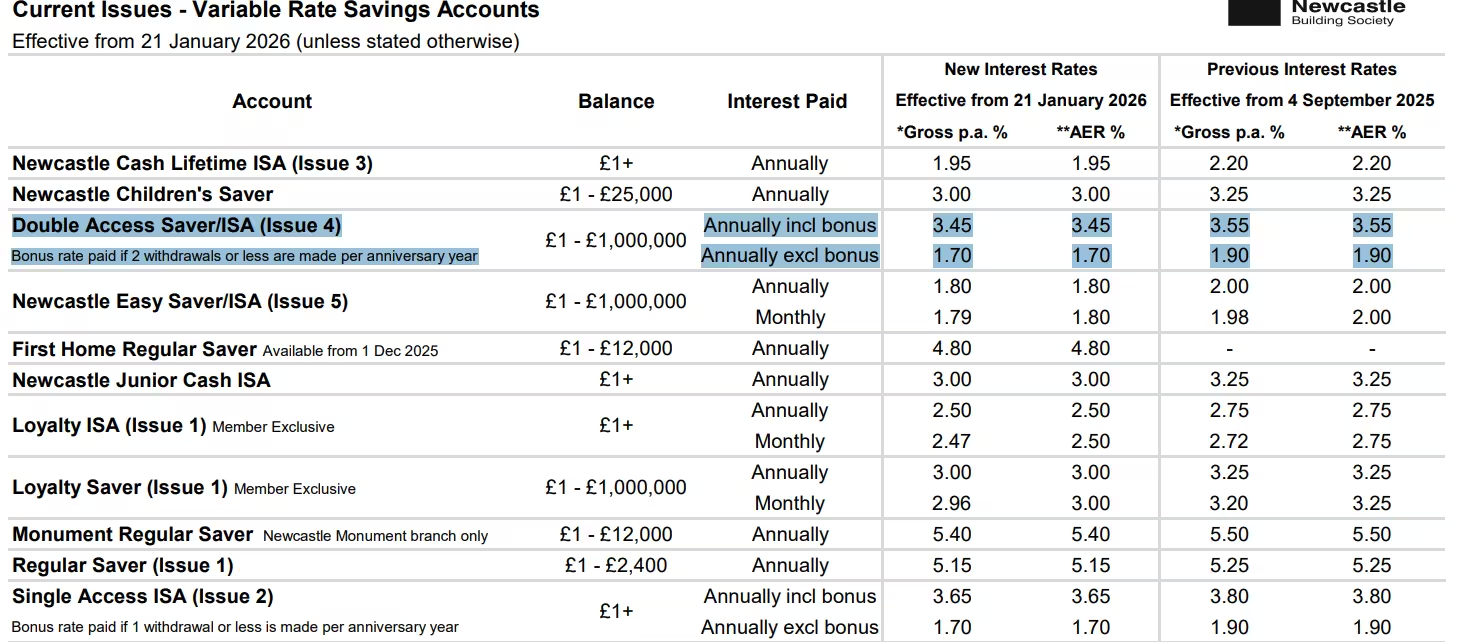
Newcastle’s Single Access and Double Access Cash ISAs, showing their higher variable interest rates and reduced rates after additional withdrawals.
What Will Change for Newcastle Building Society ISA Savers in 2027?
The most important regulatory development for ISA savers is the government’s decision to retain the annual Cash ISA limit at £20,000.
During 2025 and much of 2026, the government intended to introduce a lower £12,000 Cash ISA limit for people under 65 from April 2027.
However, the Autumn Budget published on 28 October 2026 reversed that policy.
The associated anti-circumvention rules will also not take effect.
Cash ISA Allowances for 2026/27 and 2027/28
| ISA allowance | 2026/27 | 2027/28 |
| Overall adult ISA allowance | £20,000 | £20,000 |
| Cash ISA allowance, under 65 | £20,000 | £20,000 |
| Cash ISA allowance, 65 and over | £20,000 | £20,000 |
| Lifetime ISA contribution limit | £4,000 | £4,000 |
| Junior ISA allowance | £9,000 | £9,000 |
The Lifetime ISA allowance forms part of the adult’s £20,000 overall ISA allowance, while the Junior ISA has its own separate limit.
The government has also announced plans to develop a new incentive for people investing in a Stocks and Shares ISA for the first time. Its final design has not yet been confirmed.
Our assessment is that preserving the £20,000 Cash ISA limit provides useful certainty for risk-conscious savers.
Those who prefer guaranteed cash returns can continue using their entire adult ISA subscription allowance for cash savings without being required to place the remainder into investments.
We have examined the emerging UK Budget Starter Investment ISA proposals in the context of the government’s wider efforts to encourage participation in financial markets. Savers should distinguish those proposed investment incentives from the existing Cash ISA allowance.
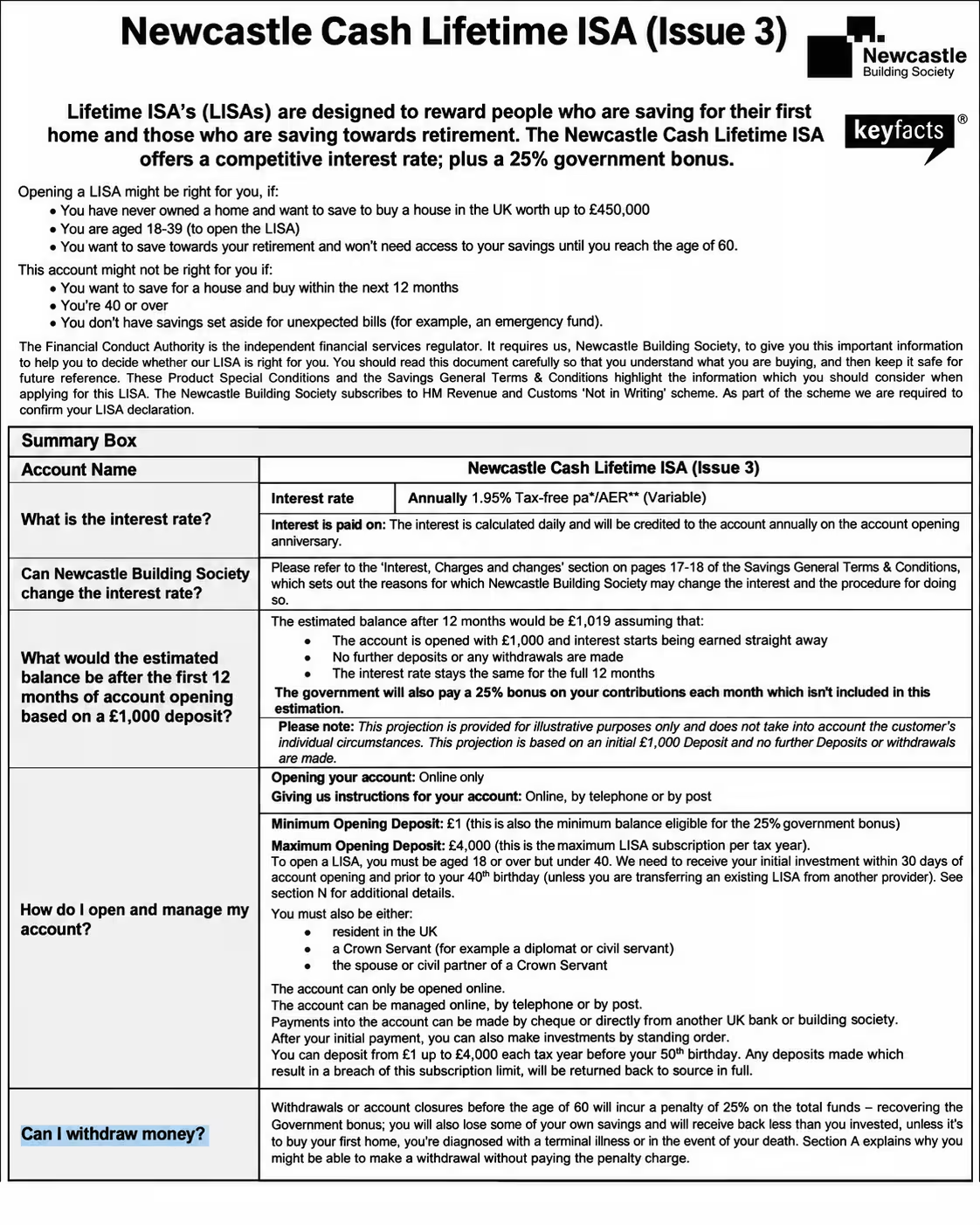
HMRC confirms that the £20,000 annual Cash ISA allowance will remain in place from 6 April 2027.
Will ISA Savings Become More Valuable After the 2027 Tax Changes?
Cash ISAs could become particularly relevant for savers affected by higher Income Tax rates on non-ISA savings interest.
The Autumn Budget 2026 announced a two-percentage-point increase in the rates of tax applicable to savings income from 6 April 2027.
The announced rates for 2027/28 are:
| Savings Income Tax band | Rate from April 2027 |
| Basic rate | 24% |
| Higher rate | 44% |
| Additional rate | 49% |
The Personal Savings Allowance remains relevant when determining whether non-ISA savings interest is actually taxable.
Under current rules, basic-rate taxpayers generally receive a £1,000 Personal Savings Allowance, higher-rate taxpayers receive £500, and additional-rate taxpayers receive no Personal Savings Allowance.
Example: Higher-Rate Taxpayer Saving £20,000
Consider a higher-rate taxpayer earning £940 interest on £20,000 held outside an ISA.
Assume the individual has no other taxable savings interest and the £500 Personal Savings Allowance is fully available.
| Calculation | Amount |
| Total annual savings interest | £940 |
| Personal Savings Allowance | £500 |
| Taxable interest | £440 |
| 2027 higher savings tax rate | 44% |
| Illustrative savings tax | £193.60 |
| Net interest after tax | £746.40 |
If the same £940 interest were earned within a qualifying Cash ISA, the interest would remain free from UK Income Tax.
That produces an illustrative tax saving of £193.60 in this scenario.
However, a basic-rate taxpayer with £940 of total annual savings interest and an unused £1,000 Personal Savings Allowance would not normally owe savings tax outside an ISA either.
This distinction matters because a Cash ISA is not automatically more profitable than a normal savings account offering a materially higher interest rate.
For company directors, sole traders, landlords and other individuals receiving income from several sources, comparing their overall tax position can be particularly important.
Is Newcastle Building Society’s Lifetime ISA Worth Considering in 2027?
Newcastle Building Society’s Cash Lifetime ISA (Issue 3) currently pays 1.95% AER variable.
A Lifetime ISA is designed primarily for eligible first-time buyers and retirement savings.
It operates differently from a standard Cash ISA because the government adds a 25% bonus to eligible contributions.
For example:
| Annual contribution | Government bonus | Total before interest |
| £1,000 | £250 | £1,250 |
| £2,000 | £500 | £2,500 |
| £3,000 | £750 | £3,750 |
| £4,000 | £1,000 | £5,000 |
Eligible individuals can open a Lifetime ISA between ages 18 and 39. Contributions can generally continue until age 50, subject to the rules.
The government bonus is attractive, but withdrawal restrictions are essential.
A standard 25% withdrawal charge generally applies when money is withdrawn for a non-qualifying purpose.
October 2026 Lifetime ISA Withdrawal Update
The Autumn Budget 2026 introduced an important exception.
From 29 October 2026, eligible first-home purchases above the £450,000 Lifetime ISA property price cap became subject to a reduced 20% withdrawal charge rather than the previous 25% charge, provided the other qualifying conditions are satisfied.
For other unauthorised withdrawals, the 25% charge remains.
This means the reduced charge does not apply to every early withdrawal.
Another significant announcement is that a new First Time Buyer ISA is planned for April 2029. It is intended to replace the Lifetime ISA for new savers, while existing Lifetime ISA holders will be able to continue using their accounts under the applicable rules.
For someone planning to purchase their first home during 2027, the current Lifetime ISA rules remain directly relevant.
However, Newcastle’s 1.95% interest rate should be compared with competing Lifetime ISA providers because a government bonus does not eliminate differences in savings returns.
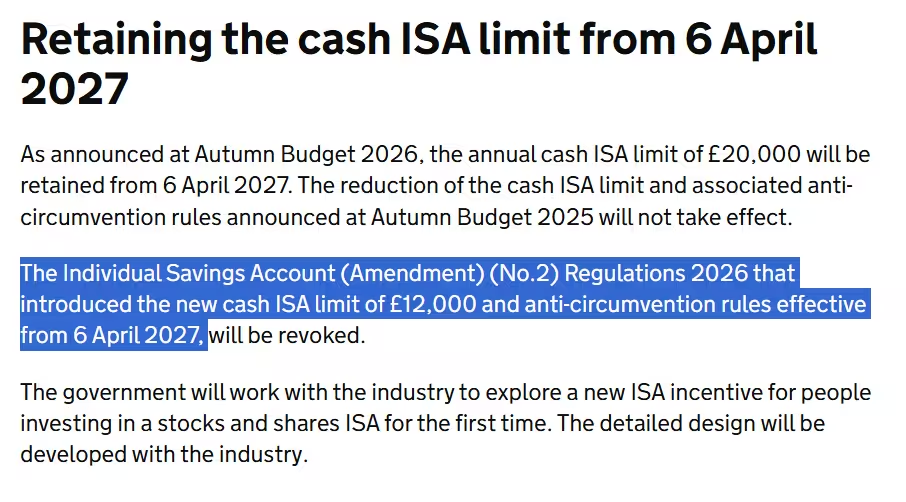
Newcastle Building Society Cash Lifetime ISA (Issue 3), showing the interest rate, opening age and withdrawal restrictions.
Is Newcastle Building Society Safe for Cash ISA Savings?
Newcastle Building Society is authorised by the Prudential Regulation Authority and regulated by the Financial Conduct Authority and the Prudential Regulation Authority.
It also participates in the Financial Services Compensation Scheme (FSCS).
Under the current scheme, eligible deposits are protected up to £120,000 per person, per authorised firm.
This protection applies to eligible savings held with Newcastle Building Society, subject to the relevant rules.
Importantly, Newcastle states that deposits held with Manchester Building Society, operating as a trading name of Newcastle Building Society, count towards the same protection limit.
Therefore, savers holding money with both brands should not assume they receive separate £120,000 allowances.
| Protection feature | Newcastle Building Society |
| UK-regulated institution | Yes |
| FSCS deposit protection | Yes |
| Standard eligible deposit limit | £120,000 |
| Shared protection with Manchester Building Society | Yes |
| Cash ISA interest protected from UK Income Tax | Yes |
| Fixed-rate products exposed to stock market fluctuations | No |
A fixed-rate Cash ISA does not expose the deposited money to stock-market movements.
However, account restrictions still apply, and inflation can reduce the purchasing power of savings even where the nominal balance grows.
How Competitive Are Newcastle Building Society ISA Rates Against Other Providers?
A central part of our review was comparing Newcastle’s advertised returns against the wider UK ISA market.
Comparison data published on 3–4 November 2026 showed that some competing fixed-rate accounts offered higher returns.
| ISA term | Newcastle rate | Example leading market rate | Difference |
| One year | 4.70% | 5.02% | 0.32 percentage points |
| Two years | 4.85% | 5.15% | 0.30 percentage points |
| Five years | 4.90% | 5.25% | 0.35 percentage points |
Market benchmark figures are snapshots from early November 2026, not guaranteed offers or predictions for 2027. Competing accounts may have different minimum deposits, opening requirements and withdrawal conditions.
For a £10,000 deposit over one full year, an account paying 5.02% would generate approximately £502, compared with £470 at 4.70%.
That represents an additional £32 a year, assuming the balance and interest rates remain unchanged.
On £20,000, the difference becomes £64.
For some savers, that gap may justify changing provider. Others may prefer Newcastle because they value branch access, a low minimum deposit or existing account arrangements.
The important lesson is that a higher AER does not always produce the best overall outcome when restrictions, access and administrative convenience are considered.
Digital providers also compete strongly in the Cash ISA market. We have separately examined Trading 212 Cash ISA safety, particularly how deposit protection and account arrangements should be assessed alongside headline interest rates.
What Is Our Expert Rating of Newcastle Building Society ISAs?
Based on our review of published account terms and current rate comparisons, we give Newcastle Building Society’s Cash ISA range an overall editorial score of 81% out of 100.
This is our assessment of the product range, not a customer satisfaction survey, an independently audited provider rating or a measure of the probability of losing deposits.
We used five weighted factors:
| Review criterion | Editorial score | Weight |
| Interest-rate competitiveness | 80% | 40% |
| Withdrawal flexibility | 65% | 25% |
| Minimum deposit accessibility | 100% | 15% |
| ISA product variety | 92% | 10% |
| Clarity of published product terms | 90% | 10% |
| Weighted overall score | 81% | 100% |
What We Liked?
- Low opening deposit: The £1 minimum across the advertised range makes Newcastle accessible to new savers and people who prefer building balances gradually.
- Choice of account terms: One-year, 18-month, two-year and five-year fixed-rate products provide different levels of commitment.
- Branch access: Customers who prefer discussing their accounts in person may benefit from Newcastle’s physical branch network.
- Clear interest-rate information: The published product summaries distinguish AER, annual interest, monthly interest and early withdrawal charges.
- What Could Be Better?
- Higher rates are available elsewhere: Some competitors offered approximately 0.30 percentage points or more above Newcastle’s comparable fixed-rate accounts in early November 2026.
- Limited-access rate reductions: A second or third withdrawal can materially reduce the interest payable on certain variable-rate ISAs.
- Long-term withdrawal charges: The five-year fixed ISA’s 365-day interest penalty is substantial.
- Lower easy-access interest: The Easy Saver ISA pays considerably less than some higher-paying accounts elsewhere in the market.
What Do Financial Industry Experts Say?
The Autumn Budget’s decision to preserve the £20,000 Cash ISA allowance was welcomed by parts of the building society sector.
Annette Barnes, Chief Executive Officer of Leeds Building Society, commented on the policy reversal:
“Cash ISAs are simple, trusted products that give people choice over how they manage their money”
Her comments underline an important distinction between cash savings and long-term investing.
A Cash ISA is not necessarily designed to produce the highest possible long-term return. Its value may also lie in tax efficiency, capital protection and the ability to plan future expenditure.
That is particularly relevant for individuals who need to preserve emergency funds, property deposits or money for planned expenditure.
Our view is that Newcastle remains a reasonable option for savers who prioritise predictable returns, straightforward opening requirements and access to traditional building society services.
However, those focused exclusively on maximising interest should compare the full market before committing.
How Can You Open or Transfer to a Newcastle Building Society ISA?
Opening an account typically involves selecting a product, reviewing eligibility and completing the provider’s application process.
The general process is:
- Choose an ISA: Compare the current interest rate, product term, minimum deposit and withdrawal restrictions.
- Review the official summary: Confirm the issue number, maturity date and interest-payment options.
- Apply through an accepted channel: Depending on the account, applications may be available online, in branch or through another stated method.
- Complete identity checks: Provide the information required for account verification and ISA eligibility.
- Fund the account: Make an eligible payment within the applicable ISA allowance and product funding rules.
- Arrange an ISA transfer where appropriate: Ask Newcastle to transfer money directly from an existing ISA provider.
Transferring Previous Years’ ISA Savings
An important feature of ISA rules is that qualifying transfers of savings contributed in previous tax years do not normally use up the current year’s ISA subscription allowance.
For example, someone with £35,000 saved in Cash ISAs during earlier tax years may be able to transfer that amount to a new provider, subject to the receiving product’s rules.
This is separate from the individual’s annual £20,000 allowance for new subscriptions.
The correct procedure is to request an official ISA transfer rather than withdrawing the money into an ordinary bank account and redepositing it.
Taking the money outside the ISA wrapper can affect its tax-protected status or use up contribution allowance when redeposited, depending on the circumstances.
Newcastle accepts ISA transfers into certain fixed-rate products, but applicants should verify the specific issue’s funding window and transfer conditions.
Are Newcastle ISAs Flexible?
Newcastle states that it offers flexible Cash ISAs, but individual product restrictions can affect how the flexibility works.
A flexible ISA can allow eligible withdrawals to be replaced within the same tax year without using additional annual allowance.
However, flexibility should not be confused with penalty-free access.
A fixed-rate product may still impose an early withdrawal charge, while a product with a closed funding window may restrict replacement deposits.
Always confirm the rules for the specific account before withdrawing funds.
Which Newcastle Building Society ISA Is Best for Business Owners and Self-Employed Savers?
Self-employed individuals, contractors and company directors often face savings decisions that differ from those of salaried employees.
Their income can fluctuate, while tax payments and business expenses may arise at predictable intervals.
We considered three common financial situations.
Saving for a Known Future Expense
A business owner who has personal savings that will not be needed for approximately 12 months may prefer the one-year fixed ISA.
The guaranteed rate can make interest projections easier, provided the account maturity date matches the planned expense.
Maintaining Emergency Savings
Someone whose income varies substantially from month to month may prioritise access rather than the highest fixed interest rate.
A limited-access ISA could suit a person who expects only occasional withdrawals, while an unrestricted easy-access product may be more appropriate for an emergency reserve.
It is important to keep actual business cash reserves and future business tax liabilities separate from personal savings. A personal Cash ISA is not a substitute for a business banking arrangement.
Planning Retirement Income
Older savers may benefit from considering Cash ISAs alongside pensions when planning withdrawals.
ISA income can generally be withdrawn without an additional Income Tax charge, while taxable pension withdrawals may affect the individual’s tax position.
We have examined the wider tax implications of spending a pension before an ISA, including how retirement withdrawals and inheritance planning may interact from 2027.
Our assessment is that ISA selection should be based on the intended use of the money rather than simply choosing the product with the highest advertised interest rate.
What Should Savers Expect From Newcastle Building Society ISA Rates During 2027?
No single interest-rate forecast can reliably establish what Newcastle Building Society will offer on new ISA issues throughout 2027.
The Society’s fixed-rate products already opened by savers are governed by their contractual terms. A qualifying fixed-rate account paying 4.70% until November 2027 would not ordinarily change its interest rate before maturity.
New products released later in 2027 could offer different rates.
Several factors may affect future pricing.
- Bank of England monetary policy: Changes in Bank Rate and market interest-rate expectations can influence the rates offered on savings products.
- Competition for deposits: Providers may introduce attractive new ISA issues to attract customer funds, particularly around the tax-year deadline.
- Funding requirements: Building societies can adjust savings rates according to their lending requirements, deposit targets and broader financial conditions.
- The 2027 tax environment: Retaining the £20,000 Cash ISA allowance and increasing tax rates on non-ISA savings interest may influence demand for tax-free savings.
For savers choosing between fixing now and waiting, three broad scenarios are worth considering.
| 2027 market scenario | Potential implication |
| Savings rates fall | Existing fixed-rate ISAs may become relatively more attractive |
| Savings rates remain stable | Account restrictions and convenience become important differentiators |
| Savings rates rise | New accounts may offer better rates, while existing fixed products remain at their contracted rates |
These are planning scenarios, not predictions of specific Newcastle ISA rates.
We would prioritise the saver’s expected withdrawal date, emergency cash requirements and tax position before making a decision based on an uncertain rate forecast.
Conclusion: Is Newcastle Building Society a Good ISA Choice for 2027?
Newcastle Building Society offers a broad selection of Cash ISAs, with November 2026 fixed rates ranging from 4.70% to 4.90% AER. Its £1 minimum opening deposit, branch services and FSCS protection make it worth considering.
However, other providers offer higher rates, and Newcastle’s withdrawal charges deserve careful attention.
The government’s decision to retain the £20,000 annual Cash ISA allowance from April 2027 also strengthens the case for comparing tax-free savings options.
Our overall editorial rating is 81%, reflecting good accessibility and product choice, but room for improvement in interest-rate competitiveness and flexibility.
Frequently Asked Questions
What is Newcastle Building Society’s highest Cash ISA rate?
As checked on 5 November 2026, Newcastle’s highest advertised fixed Cash ISA rate is 4.90% AER on its five-year product. Rates and issue availability can change.
What is the Newcastle Building Society one-year ISA rate for 2027?
The one-year fixed ISA (Issue 130) pays 4.70% AER and matures on 19 November 2027. This is a rate available in 2026 with a 2027 maturity, not a forecast for future ISA launches.
Can I open a Newcastle Building Society ISA with £1?
Yes. Newcastle currently advertises a £1 minimum opening deposit across its main Cash ISA range, although individual eligibility and product terms still apply.
Will the Cash ISA allowance fall to £12,000 in April 2027?
No. The government reversed the planned reduction in the October 2026 Autumn Budget. The annual Cash ISA allowance is being retained at £20,000 for eligible adult savers.
Can I withdraw money from a Newcastle fixed-rate ISA early?
Yes, the current fixed-rate products permit withdrawals subject to interest penalties. Depending on the account, these range from 90 days to 365 days of interest.
Is Newcastle Building Society protected by the FSCS?
Yes. Eligible deposits are protected up to £120,000 per person, per authorised firm under the current FSCS rules. Deposits held with Manchester Building Society under Newcastle’s authorisation share the applicable limit.
Can I transfer an existing ISA to Newcastle Building Society?
Yes, certain Newcastle ISA products accept transfers from other providers. The transfer should be arranged through the official ISA transfer process to preserve qualifying tax benefits.
Are Newcastle Building Society ISA rates likely to rise in 2027?
Future rates remain uncertain. New product pricing may respond to monetary policy, market competition and provider funding needs. Existing fixed-rate accounts continue under their contractual terms.
Does Newcastle Building Society offer a Junior ISA?
Yes. Newcastle currently advertises a Junior ISA paying 3.00% AER variable. The annual Junior ISA allowance remains £9,000 for 2027/28.
Is Newcastle Building Society better than a digital Cash ISA provider?
It depends on your priorities. Newcastle offers physical branches and low opening deposits, while some digital providers may offer higher interest rates. Compare FSCS arrangements, withdrawal rules and tax treatment as well as the headline AER

More in Finance & Tax
Skipton Building Society ISA Rates 2027: Latest Cash ISA Rates and 2026 Updates
Skipton Building Society ISA rates currently reach 5.05% AER tax-free on its five-year fixed-rate Cash ISA, while its 15-month fixed account offers 4.90% and its Bonus Cash ISA Saver pays 4.21% variable, including a temporary introductory bonus. For savers preparing their finances for 2027, these rates create different opportunities depending on how long they can […]
Coventry Building Society ISA Rates 2027: Latest Cash ISA Rates, 2026 Updates and Our Expert Review
Coventry Building Society ISA rates are an important consideration for UK savers looking to earn tax-free interest in 2027. Whether you want to lock away money for a guaranteed return, maintain access to emergency savings or transfer an existing ISA, choosing the right account can make a significant difference to your annual interest. Our analysis […]