Skipton Building Society ISA rates currently reach 5.05% AER tax-free on its five-year fixed-rate Cash ISA, while its 15-month fixed account offers 4.90% and its Bonus Cash ISA Saver pays 4.21% variable, including a temporary introductory bonus.
For savers preparing their finances for 2027, these rates create different opportunities depending on how long they can leave their money untouched, whether they need withdrawals and how much interest they want to protect from tax.
We analysed Skipton’s published ISA range, interest calculations, withdrawal restrictions and the latest UK tax changes to identify the financial considerations that matter beyond the advertised percentage.
The rates below were checked on 13 November 2026. They are existing offers, not confirmed rates for new accounts opening during 2027.
What Are Skipton Building Society ISA Rates for 2026 and 2027?
Skipton offers fixed-rate, easy-access, limited-access, Lifetime and Junior Cash ISAs. Its main products have a minimum opening deposit of £1, making them accessible to savers who cannot immediately deposit a large lump sum.
| Skipton ISA account | Interest rate (AER) | Access conditions |
| 1 Year Fixed Rate Cash ISA | 4.45% fixed | 60 days’ interest penalty for early closure |
| 15 Month Fixed Rate Cash ISA | 4.90% fixed | 90 days’ interest penalty |
| 19 Month Fixed Rate Cash ISA | 4.81% fixed | 90 days’ interest penalty |
| 2 Year Fixed Rate Cash ISA | 4.60% fixed | 180 days’ interest penalty |
| 3 Year Fixed Rate Cash ISA | 4.95% fixed | 240 days’ interest penalty |
| 5 Year Fixed Rate Cash ISA | 5.05% fixed | 365 days’ interest penalty |
| Bonus Cash ISA Saver | 4.21% variable | Flexible withdrawals; 12-month bonus |
| Two Access Cash ISA Saver | 4.15% variable | Two withdrawals per year, plus closure |
| Four Access Cash ISA Saver | 3.90% variable | Four withdrawals per year, plus closure |
| Six Access Cash ISA Saver | 3.55% variable | Six withdrawals per year, plus closure |
| Cash ISA Saver | 2.15% variable | Flexible withdrawals |
| Cash Lifetime ISA | 2.15% variable | Government withdrawal rules apply |
| Junior Cash ISA | 4.00% variable | Normally inaccessible until age 18 |
All percentages are tax-free per annum/AER. Fixed-rate products generally require full account closure for early access rather than permitting partial withdrawals.
The difference between Skipton’s highest fixed rate of 5.05% and its standard Cash ISA Saver rate of 2.15% is 2.90 percentage points.
On £10,000, that represents approximately £290 of additional interest over one year at the quoted rates, assuming no balance changes or rate movements.
However, the five-year account requires a substantially longer commitment. Savers comparing the wider market can examine the best fixed ISA rates before committing their savings.
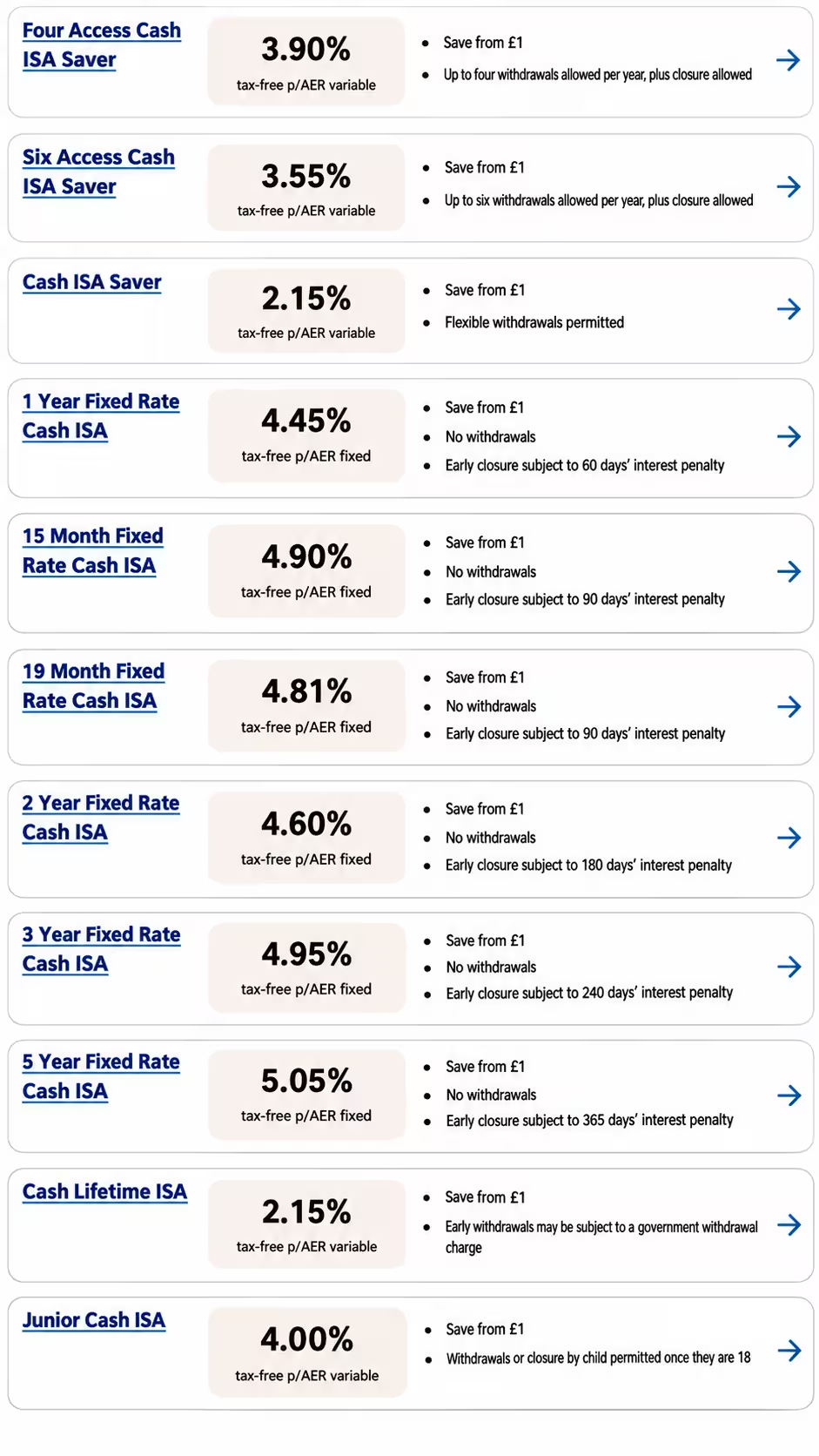
Skipton Building Society’s official Cash ISA comparison showing fixed, variable, Lifetime and Junior ISA rates in November 2026.
Which Skipton Cash ISA Could Make More Financial Sense in 2027?
The most significant difference within Skipton’s current range is not simply the interest rate. It is how much flexibility a saver gives up to earn that interest.
For Short-Term Savings: 15-Month Fixed Isa
At 4.90% AER, the 15-month account offers only 0.15 percentage points less than the five-year fixed ISA.
For every £10,000 saved, that difference represents approximately £15 of annual interest at the quoted rates.
Someone who expects to use their savings for a house deposit, family expense or planned investment may therefore find the shorter commitment more practical, provided the maturity date fits their requirements.
Our examination of one-year ISAs also shows why comparing actual maturity dates and funding windows matters alongside the headline rate.
For Accessible Savings: Bonus Cash Isa Saver
Skipton’s Bonus Cash ISA Saver currently pays 4.21% AER variable, comprising:
- A 2.15% underlying variable rate.
- A fixed 2.06% bonus for the first 12 months.
Once the bonus expires, the account reverts to the underlying variable rate, currently 2.15%.
This creates a potentially significant reduction in interest income.
For example, £10,000 earning 4.21% produces approximately £421 annually, compared with £215 at 2.15%, assuming unchanged rates and balances.
That is a difference of £206 per year.
The account is flexible, allowing withdrawals and replacement deposits within the same tax year without using additional ISA allowance, provided the account remains open and the relevant conditions are met.
Our analysis suggests that monitoring the bonus expiry date is just as important as securing the initial interest rate.
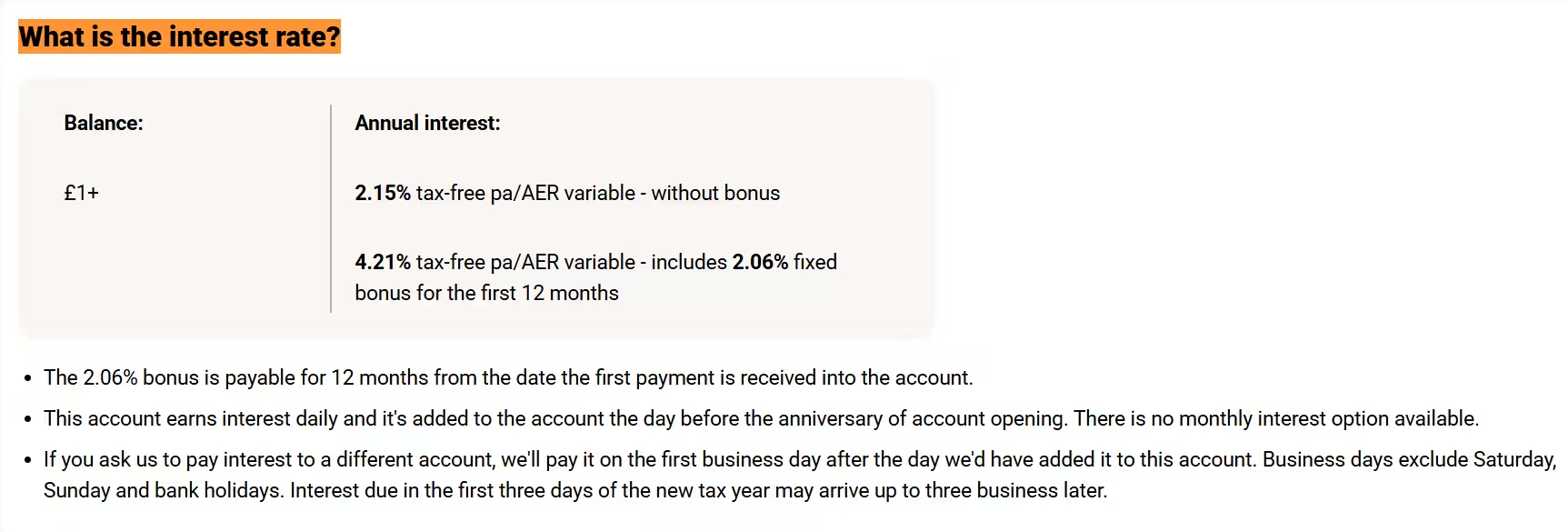
Skipton Bonus Cash ISA Saver showing its 4.21% introductory variable rate, 2.06% fixed bonus and underlying 2.15% rate.
How Much Interest Could You Earn With Skipton in 2027?
To understand the financial difference between accounts, we calculated illustrative annual interest on £5,000, £10,000 and £20,000.
| ISA interest rate | £5,000 savings | £10,000 savings | £20,000 savings |
| 2.15% | £107.50 | £215 | £430 |
| 4.21% | £210.50 | £421 | £842 |
| 4.45% | £222.50 | £445 | £890 |
| 4.90% | £245 | £490 | £980 |
| 5.05% | £252.50 | £505 | £1,010 |
These figures illustrate one year’s return at a constant AER, without additional deposits or withdrawals. They do not represent the total maturity return on fixed accounts lasting longer than 12 months, and variable rates are not guaranteed.
One finding stands out: selecting a competitive ISA can matter more than making small changes to the original deposit.
For example, moving £20,000 from an account paying 2.15% to one earning 4.90% represents £550 more annual interest at those rates.
Nevertheless, money that might be required unexpectedly should not automatically be placed into a fixed ISA.
Savers prioritising longer-term returns can compare two-year ISAs alongside Skipton’s shorter and longer fixed products.
What Changed for Cash ISAs Ahead of April 2027?
One of the most important developments for UK savers occurred during the Autumn Budget 2026.
The government had originally planned to reduce the annual Cash ISA subscription limit to £12,000 for individuals under 65 from April 2027.
However, that reduction was subsequently cancelled.
According to HMRC’s October 2026 update, the £20,000 Cash ISA subscription allowance will remain in place from 6 April 2027.
| ISA rule | 2026/27 | 2027/28 |
| Overall adult ISA subscription allowance | £20,000 | £20,000 |
| Cash ISA subscription allowance | £20,000 | £20,000 |
| Lifetime ISA annual contribution limit | £4,000 | £4,000 |
| Junior ISA annual contribution limit | £9,000 | £9,000 |
| Tax on qualifying Cash ISA interest | 0% | 0% |
The £20,000 allowance applies to new subscriptions during each tax year, not to the total value accumulated across previous years.
This means someone holding £70,000 in existing Cash ISAs does not have to reduce their balance simply because the annual subscription allowance is £20,000.
There is another important development: from April 2027, UK savings-income tax rates are scheduled to increase to 24% for basic-rate taxpayers, 44% for higher-rate taxpayers and 49% for additional-rate taxpayers.
This makes tax-free interest especially relevant for savers who would otherwise exceed their Personal Savings Allowance.
For example, a higher-rate taxpayer earning £1,000 of interest outside an ISA, with a fully available £500 Personal Savings Allowance, could face £220 of tax at the 2027 higher savings-income rate.
The same £1,000 earned within a qualifying Cash ISA would remain free from Income Tax.
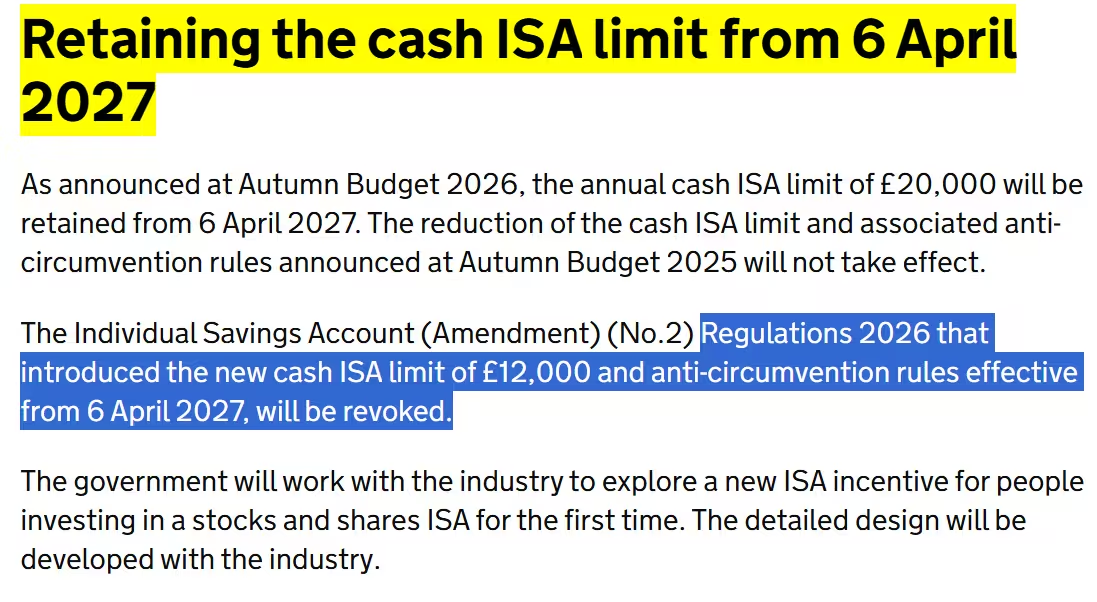
HMRC’s October 2026 confirmation that the £20,000 Cash ISA allowance will remain in place from April 2027.
What Should Business Owners and Self-Employed Savers Consider?
For sole traders, company directors and self-employed professionals, a Cash ISA can form part of a wider personal savings strategy.
However, we would distinguish between money available for long-term personal savings and funds needed for tax bills, payroll, supplier payments or business emergencies.
A company cannot simply place its corporate cash into a director’s personal ISA. Money must first belong to the individual, with any relevant salary, dividend or other tax consequences addressed.
A practical allocation might involve maintaining accessible cash for anticipated liabilities while using a fixed-rate ISA for personal savings that will not be needed during the fixed term.
Those approaching retirement should also consider how their pension withdrawals interact with tax-free ISA savings.
Comparing providers remains worthwhile. Coventry, Newcastle and Nationwide offer alternative Cash ISA structures, with differences in maturity dates, withdrawal allowances and interest rates.
Our analysis also identified an important consideration for fixed accounts: Skipton’s products generally require account closure for early access, and the associated interest charge can reduce the amount returned.
Eligible Skipton deposits are protected by the Financial Services Compensation Scheme up to £120,000 per person, subject to the scheme’s rules and any other deposits held under the same banking authorisation.
How Can You Transfer an Existing ISA to Skipton?
Existing ISA funds can generally be transferred to an eligible Skipton Cash ISA without counting the transferred money as a new annual subscription.
The correct process is to request an ISA transfer through Skipton rather than withdrawing the savings into an ordinary bank account and redepositing them.
Skipton supports transfer requests through its app and other available application channels.
Before transferring, check whether the receiving account accepts transfers, whether the current provider charges an exit penalty and whether the new fixed-rate product has a limited funding window.
There is also a maturity consideration that savers sometimes overlook.
Skipton states that its fixed-rate Cash ISAs normally move into a new one-year fixed-rate Cash ISA at maturity unless the customer provides different instructions.
This means customers should check their maturity communications carefully rather than assuming their money will automatically become fully accessible.
People comparing provider arrangements can also examine the broader Cash ISA rates available across the UK market.
Frequently Asked Questions
What is Skipton Building Society’s highest ISA rate?
As checked on 13 November 2026, Skipton’s highest listed Cash ISA interest rate is 5.05% AER fixed on its five-year fixed-rate account. This is not a guaranteed offer for new applicants in 2027.
What is Skipton’s one-year fixed Cash ISA rate?
Its one-year fixed-rate Cash ISA currently pays 4.45% AER tax-free. Early closure normally results in a charge equivalent to 60 days’ interest.
Does Skipton offer a Lifetime ISA?
Yes. Skipton’s Cash Lifetime ISA currently pays 2.15% AER variable. Eligible savers can receive a 25% government bonus on qualifying contributions, subject to the Lifetime ISA rules. Withdrawal charges can apply if funds are used for non-qualifying purposes.
Can I open a Skipton Cash ISA with £1?
Yes. Skipton advertises a £1 minimum opening deposit across its main Cash ISA products, although eligibility and individual account conditions must still be satisfied.
Will Skipton ISA rates increase in 2027?
There is no confirmed general increase for Skipton’s new ISA offers in 2027. Future rates will depend on funding conditions, market competition and Skipton’s pricing decisions. Existing fixed-rate agreements continue under their contractual terms.
Is Skipton suitable for tax-free savings in 2027?
Skipton offers several ways to earn tax-free interest, including fixed, limited-access and flexible accounts. The most appropriate choice depends on the rate available when applying, how long the money can remain deposited and whether early withdrawals may be necessary.
For savers making decisions ahead of the 2027/28 tax year, comparing the actual interest earned, access restrictions and tax position is more useful than choosing an account based solely on its highest advertised AER.

More in Finance & Tax
Coventry Building Society ISA Rates 2027: Latest Cash ISA Rates, 2026 Updates and Our Expert Review
Coventry Building Society ISA rates are an important consideration for UK savers looking to earn tax-free interest in 2027. Whether you want to lock away money for a guaranteed return, maintain access to emergency savings or transfer an existing ISA, choosing the right account can make a significant difference to your annual interest. Our analysis […]
Newcastle Building Society ISA Rates 2027: Latest Cash ISA Rates, 2026 Updates and Expert Review
Newcastle Building Society ISA rates are attracting attention from UK savers preparing their finances for 2027. With fixed-rate Cash ISAs offering up to 4.90% AER, a one-year fixed ISA paying 4.70%, and limited-access savings options available, Newcastle provides several ways to earn tax-free interest. The October 2026 Autumn Budget also brought an important change. The […]