
Nationwide ISA rates currently range from 3.30% AER on its Triple Access Cash ISA to 4.70% AER on its five-year Fixed Rate Cash ISA.
The building society offers several tax-free savings options, although the interest rate, withdrawal conditions and length of commitment differ considerably between accounts.
As of 21 October 2026, Nationwide offers fixed Cash ISA rates of 4.50% for one year, 4.55% for two years, 4.65% for three years and 4.70% for five years. Its 1 Year Triple Access ISA pays 3.30% AER variable, reducing to 1.05% after a fourth withdrawal.
For savers, the important question is not simply which account offers the highest percentage. It is how much interest the account could generate, how easily money can be accessed and whether the rate compares favourably with alternatives.
Our analysis of Nationwide’s published savings products, interest calculations and account restrictions indicates that the building society’s fixed-rate accounts may appeal to people who prioritise rate certainty and branch banking.
However, longer fixed terms create additional commitments, and several competing UK providers currently advertise higher rates.
The following breakdown examines the Nationwide ISA rates available in October 2026, how the different accounts work and what savers should understand before making a financial commitment.
What Are the Current Nationwide ISA Rates in 2026?
Nationwide currently offers five main Cash ISA options, including four fixed-rate products and one variable-rate limited-access account.
The interest rates advertised for new applications are:
| Nationwide Cash ISA | Interest rate (AER) | Minimum deposit | Withdrawal conditions |
| 1 Year Fixed Rate Cash ISA | 4.50% fixed | £1 | Early closure charge applies |
| 2 Year Fixed Rate Cash ISA | 4.55% fixed | £1 | Early closure charge applies |
| 3 Year Fixed Rate Cash ISA | 4.65% fixed | £1 | Early closure charge applies |
| 5 Year Fixed Rate Cash ISA | 4.70% fixed | £1 | Early closure charge applies |
| 1 Year Triple Access ISA | 3.30% variable | £1 | Three withdrawals without rate reduction |
| Triple Access ISA after four withdrawals | 1.05% variable | — | Lower rate applies for the remainder of the term |
All the rates shown are AER/tax-free. The fixed rates are those introduced for new accounts on 26 August 2026, while the current Triple Access ISA rates took effect on 6 May 2026.
These are rates for the advertised products, not necessarily the rates paid on older Nationwide ISAs. Existing fixed-rate accounts ordinarily retain the interest rate agreed when they were opened.
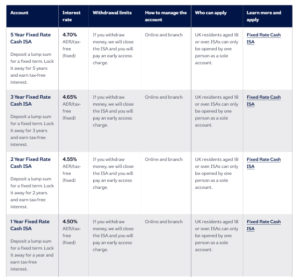
Nationwide’s official Cash ISA comparison showing the current one-year, two-year, three-year and five-year fixed interest rates, alongside the Triple Access ISA.
What Does AER Mean on a Nationwide ISA?
AER stands for Annual Equivalent Rate. It expresses the interest rate on a comparable annual basis, taking compounding into account.
For example, a £10,000 balance earning 4.50% AER would generate approximately £450 over a full year, provided the money remained in the account and the rate stayed unchanged.
The term tax-free means that qualifying interest earned inside the Cash ISA is exempt from UK income tax.
However, interest rates and account rules serve different purposes. A 4.70% fixed ISA guarantees its interest rate for the agreed term, while a variable 3.30% ISA can change its rate according to the provider’s terms.
This distinction becomes particularly important when comparing accounts for emergency savings, future property purchases and long-term personal financial planning.
How Do Nationwide Fixed Rate Cash ISAs Work?
Nationwide’s Fixed Rate Cash ISAs allow eligible savers to deposit or transfer a lump sum and receive a guaranteed interest rate over a selected period.
Four fixed terms are currently available:
- Nationwide 1 Year Fixed Rate Cash ISA – 4.50%
- Nationwide’s one-year fixed Cash ISA offers 4.50% AER tax-free.
- A £10,000 deposit would generate approximately £450 over a full year, producing a closing balance of £10,450.
The main advantage is that savers know their rate will not change during the term.
However, the money is committed for one year. Withdrawing before maturity requires closing the account and paying the applicable early-access charge, except where the cancellation rules provide otherwise.
The one-year term may be relevant for people with a defined savings objective approximately 12 months away, provided they do not need the money earlier.
Nationwide 2 Year Fixed Rate Cash ISA – 4.55%
The two-year Fixed Rate Cash ISA pays 4.55% AER tax-free.
The rate is 0.05 percentage points higher than Nationwide’s one-year option.
On a £10,000 balance, that difference represents approximately £5 of additional interest over a single year.
Our assessment is that this relatively small annual rate advantage should be considered alongside the extra year of restricted access.
A saver who expects to need the money within the next 12 to 18 months may find the longer commitment inconvenient, despite the slightly higher rate.
Nationwide 3 Year Fixed Rate Cash ISA – 4.65%
Nationwide’s three-year fixed Cash ISA currently offers 4.65% AER tax-free.
The rate is 0.15 percentage points higher than the one-year fixed product.
On a £20,000 balance, that represents approximately £30 of additional interest per year at the respective rates, before considering compounding.
The three-year term provides greater certainty over future interest earnings. It may also prove useful if market savings rates decline during the period.
However, an important risk remains: if competing rates rise, money committed to the Nationwide fixed account cannot simply be moved elsewhere without considering the early-access conditions.
Nationwide 5 Year Fixed Rate Cash ISA – 4.70%
The five-year fixed Cash ISA currently offers Nationwide’s highest advertised ISA interest rate at 4.70% AER tax-free.
A £20,000 balance would generate approximately £940 in first-year interest.
Over five years, interest retained and compounded within the ISA could increase the balance substantially.
The additional return over Nationwide’s shorter fixed products is relatively modest in annual percentage terms, despite the longer commitment.
For example, the difference between 4.50% and 4.70% AER is only 0.20 percentage points. On £10,000, that represents £20 per year at the respective rates.
This does not mean the five-year ISA is unsuitable. It means savers should understand that the commitment increases considerably faster than the interest rate.
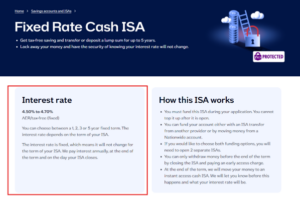
Nationwide Fixed Rate Cash ISA account information confirming the available fixed terms, interest rates and funding requirements.
How Much Interest Can You Earn With Nationwide ISA Rates?
Interest calculations make it easier to understand the practical differences between Nationwide’s advertised percentages.
The following table illustrates the interest that could be earned over one full year at each current rate.
| Nationwide ISA rate | £1,000 balance | £5,000 balance | £10,000 balance | £20,000 balance |
| 4.50% | £45 | £225 | £450 | £900 |
| 4.55% | £45.50 | £227.50 | £455 | £910 |
| 4.65% | £46.50 | £232.50 | £465 | £930 |
| 4.70% | £47 | £235 | £470 | £940 |
| 3.30% | £33 | £165 | £330 | £660 |
Calculation assumptions: The table illustrates a full year’s interest on a constant balance at the stated annual rate. Fixed-rate accounts have different total terms. The Triple Access ISA is variable, so its actual interest can change, and withdrawals may affect the amount earned.
What Happens to Interest Over Several Years?
Nationwide calculates interest daily on its fixed Cash ISAs and pays it annually, at maturity and when an account closes.
Where interest remains in the account, it can contribute to further interest earnings.
For example, using Nationwide’s published £1,000 maturity illustrations as the basis, the approximate outcomes for a £10,000 balance would be:
| Fixed ISA term | Interest rate | Approximate balance at maturity | Approximate total interest |
| 1 year | 4.50% | £10,450.00 | £450.00 |
| 2 years | 4.55% | £10,930.70 | £930.70 |
| 3 years | 4.65% | £11,460.90 | £1,460.90 |
| 5 years | 4.70% | £12,581.50 | £2,581.50 |
These are illustrations rather than guaranteed account-specific quotations. Exact amounts may vary with the opening date, daily interest calculations and rounding.
The five-year account produces more total interest partly because the money remains deposited for a longer period. Comparing its total five-year earnings directly with the one-year account’s earnings would therefore be misleading.
For anyone comparing fixed ISA accounts, annualised rates are the more appropriate starting point.
Does a Higher ISA Rate Always Mean More Money?
A higher annual interest rate generally produces more interest on an equivalent balance over an equivalent period, assuming other conditions are the same.
However, the ability to access money also has a financial value.
Suppose someone locks £15,000 into a five-year fixed ISA, but subsequently needs it for a property deposit or an unexpected expense.
Although the account may have accumulated interest, closing it early could result in a substantial charge.
Our calculations suggest that savers should distinguish between money genuinely available for medium-term saving and money that might be required at short notice.
Can You Withdraw Money Early From a Nationwide Fixed ISA?
Yes, but Nationwide’s fixed Cash ISAs have important early-access restrictions.
The account must be closed to make an early withdrawal, and an early-access charge normally applies.
| Fixed ISA term | Early-access charge |
| 1 year | 60 days’ interest |
| 2 years | 120 days’ interest |
| 3 years | 180 days’ interest |
| 5 years | 300 days’ interest |
The charge depends on the account’s fixed term and the interest calculation specified in its conditions.
How Much Could Early Withdrawal Cost?
To illustrate the scale, consider £10,000 held at Nationwide’s current fixed ISA rates.
| Fixed ISA | Illustrative early-access charge on £10,000 |
| 1 year at 4.50% | Approximately £74 |
| 2 years at 4.55% | Approximately £150 |
| 3 years at 4.65% | Approximately £229 |
| 5 years at 4.70% | Approximately £386 |
These illustrative charges use the stated annual rate and a 365-day year. The actual charge is calculated under Nationwide’s terms and can differ depending on the balance and timing.
Importantly, these are not necessarily the amounts of interest a saver would lose in every scenario.
If an account is closed early enough, the charge could exceed the interest already accumulated. Nationwide explicitly warns that an early withdrawal may result in receiving less than the original amount deposited.
There is no early-access charge if the account is cancelled within the applicable 14-day cancellation period.
For individuals who may require the money unexpectedly, this can be a more significant consideration than a difference of 0.10 or 0.20 percentage points between savings rates.
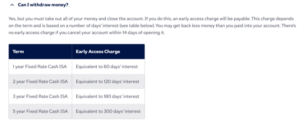
Nationwide’s official fixed ISA early-access charges, ranging from 60 days’ interest on the one-year account to 300 days’ interest on the five-year account.
What Is the Nationwide Triple Access ISA Rate?
Nationwide’s 1 Year Triple Access ISA currently pays 3.30% AER tax-free variable.
This account provides greater access to savings than Nationwide’s fixed-rate ISAs, but it does not offer unlimited withdrawals without consequences.
The account permits up to three withdrawals during its 12-month term without triggering the lower interest rate.
After a fourth withdrawal, the rate reduces to 1.05% AER tax-free variable for the remainder of the term.
The reduced rate is not necessarily applied retrospectively to the entire term. The interest calculation depends on when the withdrawals take place and the rates applicable during the relevant periods.
| Number of withdrawals | Applicable advertised rate |
| 0 | 3.30% variable |
| 1 | 3.30% variable |
| 2 | 3.30% variable |
| 3 | 3.30% variable |
| 4 or more | 1.05% variable for the rest of the term |
A £10,000 balance held for a complete year at an unchanged 3.30% rate would generate approximately £330 in interest.
However, the actual return changes if money is withdrawn, the variable rate moves or the fourth-withdrawal rule takes effect.
Richard Stocker, Nationwide’s Head of Savings, explained the purpose of the product in a May 2026 announcement:
“For those who require more flexibility we also have our Triple Access offering.”
The statement highlights the intended difference between the fixed-rate and limited-access ranges.
From a practical financial perspective, the Triple Access ISA provides some flexibility, but its lower headline interest rate represents a meaningful trade-off.
Is the Nationwide Triple Access ISA Flexible?
Yes. Nationwide’s current Triple Access ISA includes flexible ISA functionality.
This means qualifying money withdrawn during a tax year can be replaced within the same tax year without using additional ISA subscription allowance, provided the account conditions are met.
For example, someone could deposit £10,000, withdraw £2,000 and subsequently replace that £2,000 during the same tax year.
The replacement would not normally use a further £2,000 of the annual ISA allowance.
However, the original withdrawal still counts towards the Triple Access ISA’s withdrawal limit.
This is an important distinction: flexible ISA treatment does not remove the product’s three-withdrawal interest-rate rule.
The product also accepts additional deposits during its term, subject to the applicable ISA limits.
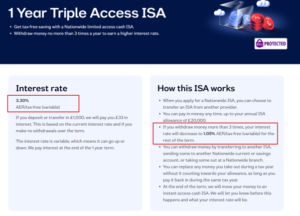
Nationwide Triple Access ISA interest-rate table showing the 3.30% variable rate for up to three withdrawals and the reduction to 1.05% after four withdrawals.
Can You Add More Money to a Nationwide ISA After Opening It?
The answer depends on the type of Nationwide ISA.
For the current Fixed Rate Cash ISA, the money must be provided during the application. Additional deposits cannot be added to that same fixed-rate product after it has opened.
Nationwide allows an eligible fixed ISA to be funded using an ISA transfer or by moving funds from a Nationwide account.
Its published rules state that customers wishing to use both funding methods need to open two separate ISAs.
This is particularly important for people expecting to save additional money throughout the year.
For example, someone might have £8,000 ready to deposit now and expect to save another £4,000 over the following six months.
They could not simply add the additional £4,000 to the existing Nationwide fixed-rate account after it has opened.
A different eligible ISA product or account arrangement would be needed.
Nationwide’s Triple Access ISA, in contrast, allows additional payments during its term, subject to the annual ISA allowance.
Can You Have More Than One Nationwide Cash ISA?
Nationwide operates a portfolio Cash ISA structure that allows eligible products to be held within a single overall Cash ISA portfolio.
This makes it possible to distribute savings between different Nationwide Cash ISA products.
For instance, someone could allocate one portion to a fixed-rate account and another portion to a limited-access account, subject to the provider’s rules and the remaining ISA allowance.
More broadly, UK tax rules generally permit adults to contribute to multiple ISAs of the same type within one tax year.
Our explanation of whether you can have more than one ISA covers how those rules apply when accounts are held with different providers.
How Do You Transfer an Existing ISA to Nationwide?
Nationwide accepts eligible ISA transfers from other providers.
An ISA transfer allows money already held within an ISA to move to another qualifying ISA without automatically losing its tax-protected status.
A formal transfer is different from withdrawing money into an ordinary bank account and then making a new deposit.
For example, consider someone with £35,000 accumulated in Cash ISAs over previous tax years.
They may be able to transfer that balance to a new Nationwide Cash ISA without the transferred amount using their current year’s £20,000 subscription allowance.
The receiving provider should normally arrange the formal transfer.
How Long Does an ISA Transfer Take?
The general transfer timeframes are:
- Cash ISA to Cash ISA: up to 15 working days.
- Other ISA transfers: normally up to 30 calendar days.
Transfers may take longer where existing product notice periods or other conditions apply.
Nationwide allows transfers into eligible new ISA products during the application process. It does not generally allow a transfer into an already-opened Nationwide ISA product.
Before transferring a fixed-rate ISA from another provider, savers should check whether the existing account will impose an early-exit charge.
It is also important to understand that the transfer rules will change for certain ISA types from April 2027.
Are Nationwide ISA Rates Competitive Compared With Other UK Banks?
Nationwide’s current Cash ISA rates are competitive in some parts of the high-street savings market, but they are not consistently the highest rates available.
For perspective, Moneyfacts comparison information dated 16 October 2026 included a one-year fixed Cash ISA from Shawbrook Bank paying 4.97% AER and a two-year fixed Cash ISA from Tandem Bank paying 5.08% AER.
During the same period, Nationwide advertised 4.50% for one year and 4.55% for two years.
The difference is financially measurable.
| Comparable term | Nationwide rate | Higher market example | Rate difference |
| 1 year | 4.50% | 4.97% | 0.47 percentage points |
| 2 years | 4.55% | 5.08% | 0.53 percentage points |
The comparison is a dated October 2026 snapshot. Market-leading accounts can change or become unavailable, and competing products may have different deposit minimums, application methods and withdrawal rules.
For example, Shawbrook’s one-year product in that comparison required a minimum deposit of £10,000, compared with Nationwide’s £1 minimum.
On a £10,000 balance, the difference between annual rates of 4.50% and 4.97% is £47 in a full year.
For a saver with a relatively small balance, the choice may depend more on eligibility and ease of opening the account. For someone with a much larger balance, even a modest percentage-point difference can become significant.
Our broader comparison of the best fixed ISA rates examines other available terms and providers.
Savers comparing building societies may also consider Leeds Building Society ISA rates, particularly when branch access and fixed-term options are priorities.
Nationwide ISA Rates Compared With Virgin Money
Virgin Money provides a useful alternative comparison because it now forms part of Nationwide.
Although the two brands operate different savings products, savers should not assume that their rates or withdrawal conditions are identical.
A Virgin Money fixed-rate Cash ISA may offer a different return, minimum balance or funding arrangement from a Nationwide product.
The current Virgin Money ISA rates provide a comparison of the available fixed and accessible options.
However, there is an important deposit-protection consideration: eligible savings held across Nationwide and Virgin Money share the same relevant FSCS protection limit.
This becomes particularly significant for people holding substantial balances with both brands.
Are Nationwide Cash ISAs Better Than Ordinary Savings Accounts?
The main financial advantage of a Cash ISA is the tax treatment of interest.
Qualifying Cash ISA interest is exempt from UK income tax.
Interest earned in a normal savings account may also be tax-free up to certain limits, depending on the individual’s circumstances.
For the 2026/27 tax year, the Personal Savings Allowance is generally:
| Income tax position | Personal Savings Allowance |
| Basic-rate taxpayer | £1,000 |
| Higher-rate taxpayer | £500 |
| Additional-rate taxpayer | £0 |
Some people may also qualify for the starting rate for savings, depending on their other income.
Example: A Higher-Rate Taxpayer With £20,000 in Savings
Suppose an individual earns £910 annual interest on £20,000 held in a taxable savings account paying 4.55%.
If they are a higher-rate taxpayer with a £500 Personal Savings Allowance and no other taxable savings interest, £410 would exceed that allowance.
At the 2026/27 higher savings-income tax rate of 40%, the tax on that excess would be £164.
By comparison, £910 of qualifying interest earned within a Cash ISA would be free of income tax.
This is a simplified illustration. The actual advantage depends on the interest rates available, the individual’s tax position and any other taxable savings income.
Someone whose ordinary savings interest remains within their available allowances might obtain no immediate tax saving from using an ISA.
Nevertheless, Cash ISAs can provide lasting tax protection as balances grow over multiple tax years.
For anyone prioritising the interest rate rather than a particular banking provider, it may be useful to compare the best Cash ISA rates in the UK before opening an account.
Are Nationwide ISAs Suitable for Business Owners and Self-Employed People?
Nationwide’s personal Cash ISAs are designed for eligible individuals, not limited companies.
This distinction matters for entrepreneurs, company directors and self-employed professionals managing personal savings alongside business finances.
Sole Traders and Freelancers
A sole trader may use an eligible personal Cash ISA for their own savings.
However, money needed for business expenses, VAT liabilities or Self Assessment payments may not be suitable for a fixed account with early-access restrictions.
For example, a freelancer expecting a substantial tax payment within six months should consider whether a one-year or longer fixed term matches that obligation.
It may be more practical to keep short-term business-related reserves accessible, even where another account offers a lower interest rate.
Limited Company Directors
A limited company cannot simply place its corporate cash into a director’s personal ISA.
Company funds and personal funds are legally distinct.
Where a director wishes to use company-generated profits for personal savings, the money generally needs to be extracted legitimately, such as through salary or dividends, with the relevant tax implications considered.
Moving funds from a company to an individual can therefore create tax consequences that outweigh a small difference in ISA interest rates.
Our analysis suggests that entrepreneurs should assess their personal cash requirements, upcoming liabilities and tax position before deciding how much money to commit to fixed-term savings.
A Cash ISA can be part of a personal savings strategy, but it is not a substitute for a business treasury account or suitable working-capital arrangements.
How Much Can You Put Into a Nationwide ISA in 2026/27?
For the tax year running from 6 April 2026 to 5 April 2027, the overall adult ISA allowance is £20,000.
That limit applies to new subscriptions across the eligible adult ISAs held by one person.
It is not a separate £20,000 allowance for every provider or account.
For example, someone could contribute £12,000 to a Nationwide Cash ISA and £8,000 to a Stocks and Shares ISA.
Their total subscriptions would be £20,000, using the full allowance for the year.
Interest accumulated inside an ISA does not itself count as an additional subscription.
Similarly, balances saved in previous tax years can continue to grow without consuming the new tax year’s contribution allowance.
Anyone planning regular contributions or dividing savings between products can explore how much can be put into an ISA for a fuller explanation of the contribution limits.
What Happens to Cash ISA Limits From April 2027?
A significant change to UK Cash ISA rules takes effect from 6 April 2027.
The annual Cash ISA subscription limit will generally fall from £20,000 to £12,000 for people under the age of 65.
The overall adult ISA allowance will remain £20,000.
Those entitled to the age-65 treatment will retain an annual Cash ISA subscription limit of £20,000. Eligibility applies from the beginning of the tax year in which the individual turns 65.
| ISA allowance | 2026/27 | From 6 April 2027 |
| Overall adult ISA allowance | £20,000 | £20,000 |
| Cash ISA limit for under-65s | £20,000 | £12,000 |
| Cash ISA limit under age-65 rules | £20,000 | £20,000 |
| Overall Stocks and Shares ISA subscription capacity | Within £20,000 overall limit | Within £20,000 overall limit |
For example, someone aged 40 will generally be limited to £12,000 of new Cash ISA subscriptions in the 2027/28 tax year.
They could potentially use the remaining £8,000 of their overall allowance for another eligible ISA type, subject to its rules.
The reform does not mean that existing Cash ISA balances above £12,000 must be withdrawn. It primarily changes how much new money qualifying individuals can subscribe each tax year.
Will ISA Transfers Also Change in April 2027?
Yes. The reforms also introduce restrictions on transfers from non-Cash ISAs into Cash ISAs.
For individuals under 65, transfers from Stocks and Shares ISAs or Innovative Finance ISAs into Cash ISAs will no longer be permitted under the new rules.
Transfers from Cash ISAs into eligible non-Cash ISAs can continue, subject to the applicable requirements.
The reforms also introduce a 22% charge on interest earned on uninvested cash held in certain non-Cash ISAs.
These changes may affect how people plan transfers between savings and investment products, particularly where they expect to move from investments into cash at a later date.
However, ISA decisions should not be rushed solely because a regulatory deadline is approaching. Investment risk, access requirements and long-term financial objectives remain important.
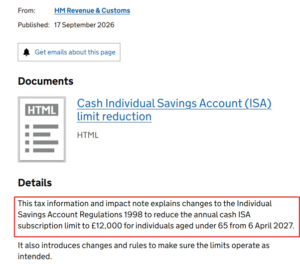
HMRC’s official confirmation that the annual Cash ISA subscription limit will fall to £12,000 for individuals under 65 from 6 April 2027.
When Does the ISA Allowance Reset?
The ISA allowance resets at the start of each new tax year on 6 April.
The current allowance therefore runs until 5 April 2027, with the new rules applying from the following day.
Unused annual ISA allowance cannot ordinarily be carried into the next tax year.
The dates and implications are explained further in our breakdown of when the ISA allowance resets.
Are Nationwide Cash ISAs Protected by the FSCS?
Eligible deposits held with Nationwide are protected under the Financial Services Compensation Scheme.
As of October 2026, the standard FSCS deposit-protection limit is £120,000 per eligible person per authorised institution.
This protection can be important for individuals who have accumulated large ISA balances over several tax years.
For example, someone holding £80,000 in a Nationwide Cash ISA and £50,000 in a Virgin Money savings account should recognise that the eligible balances are combined for the relevant protection limit.
That gives a combined balance of £130,000, which is £10,000 above the standard £120,000 limit, assuming the balances are fully eligible and no special protection applies.
Certain temporary high balances may qualify for additional protection under separate rules.
The key distinction is that ISA tax benefits and FSCS deposit protection are not the same thing.
An ISA provides tax advantages. FSCS protection concerns eligible compensation if an authorised financial institution fails.
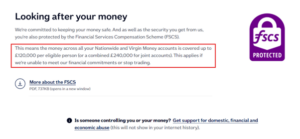
Nationwide’s confirmation that eligible deposits across Nationwide and Virgin Money share the relevant £120,000 FSCS protection limit.
Can New Customers Open a Nationwide ISA?
Yes. Eligible UK residents aged 18 or over can generally apply for Nationwide’s adult Cash ISAs, subject to account requirements.
Nationwide also recognises certain eligible Crown employees serving overseas and qualifying partners under ISA residence rules.
Application methods vary depending on the product and the customer’s existing relationship with Nationwide.
New customers wishing to open the current Fixed Rate Cash ISA must apply in a Nationwide branch.
Existing Nationwide customers may be able to open and manage the account through the mobile banking app, internet bank or branch.
The Triple Access ISA is available through Nationwide’s online application process, banking app, internet banking or branches, subject to eligibility.
Before beginning an application, savers should check:
- The current interest rate and whether it is fixed or variable.
- The minimum initial deposit and funding requirements.
- Whether the account accepts transfers from their existing provider.
- The withdrawal and early-access conditions.
- Their remaining ISA subscription allowance.
- What happens when the account matures.
These checks are especially relevant when transferring sizeable balances or committing funds for several years.
What Happens When a Nationwide ISA Matures?
When a Nationwide Fixed Rate Cash ISA reaches the end of its agreed term, the building society moves the balance into an instant-access Cash ISA under its maturity arrangements.
Nationwide contacts savers before maturity and explains the available options.
The interest rate on the destination account may differ from the original fixed rate.
This means an account paying 4.70% for five years will not automatically continue paying 4.70% after maturity.
Nationwide also operates a maturity rate promise for qualifying reinvestments into another fixed-rate ISA.
Under that arrangement, customers who provide the necessary reinvestment instructions by maturity may benefit from the better of the relevant rates where the advertised rate changes during the qualifying period.
The applicable terms need to be checked before relying on that promise.
From a financial planning perspective, the maturity date is an important opportunity to reassess interest rates, accessibility and the wider savings market.
What Should Savers Consider Before Choosing a Nationwide ISA?
A Nationwide Cash ISA can offer tax-free interest and, with its fixed-rate products, certainty about the annual rate of return.
However, the right account depends on more than its advertised AER.
Someone primarily interested in keeping savings accessible may place greater importance on withdrawal conditions than achieving the highest fixed rate.
Conversely, a saver who can genuinely leave a lump sum untouched for several years may place more value on locking in an interest rate.
Our comparison suggests that the following questions are particularly relevant:
- How soon could the money be needed? Longer fixed terms increase the potential cost of changing plans.
- Is the rate competitive? Compare the same savings term and similar account conditions across providers.
- Will additional deposits be required? Nationwide’s current fixed-rate ISA cannot be topped up after opening.
- How important is branch access? Nationwide’s physical branches may be useful for savers who prefer in-person banking.
- Will future tax rules affect the strategy? The April 2027 ISA reforms may influence new subscriptions and certain transfers.
- Does the account fit the individual’s financial circumstances? An attractive rate is less valuable if it creates liquidity problems.
The balance between financial certainty, accessible savings and the amount of interest earned should determine the decision.
Final Thoughts
Nationwide ISA rates in October 2026 offer a range of choices for savers seeking tax-free interest, with fixed returns from 4.50% to 4.70% AER and a variable Triple Access account currently paying 3.30%.
The fixed products provide rate certainty, but early access requires account closure and can involve substantial charges. The Triple Access ISA offers greater withdrawal flexibility, although a fourth withdrawal reduces its interest rate to 1.05% for the remainder of the term.
Our financial analysis indicates that Nationwide’s accounts should be compared on their complete conditions, not simply their advertised percentages. Funding restrictions, access requirements, tax treatment and the potential return available elsewhere can all influence the final outcome.
With the Cash ISA subscription limit changing for many savers from April 2027, understanding how existing balances, new deposits and transfers are treated is also increasingly important.
For anyone considering a Nationwide Cash ISA, checking the latest published rates and account terms immediately before applying remains essential, particularly as savings products and market conditions continue to change.
Frequently Asked Questions About Nationwide ISA Rates
What is the highest Nationwide ISA rate in October 2026?
The highest currently advertised Nationwide Cash ISA rate is 4.70% AER tax-free, available on the five-year Fixed Rate Cash ISA.
What is Nationwide’s one-year ISA rate?
Nationwide’s one-year Fixed Rate Cash ISA currently pays 4.50% AER tax-free fixed. Its separate one-year Triple Access ISA offers 3.30% AER variable.
What is Nationwide’s two-year ISA rate?
The two-year Fixed Rate Cash ISA currently offers 4.55% AER tax-free fixed, with an early-access charge if the account is closed before maturity.
What is Nationwide’s three-year ISA rate?
Nationwide currently pays 4.65% AER tax-free fixed on its three-year Cash ISA, with the interest rate remaining unchanged for the agreed term.
What is Nationwide’s five-year ISA rate?
The five-year Fixed Rate Cash ISA pays 4.70% AER tax-free fixed. Early access requires closing the account and paying the applicable charge.
How much interest would £20,000 earn in a Nationwide ISA?
At 4.50% AER, £20,000 would earn approximately £900 over one year. At 4.70% AER, the equivalent annual interest would be approximately £940, assuming a full year at that rate.
Can I withdraw money from my Nationwide ISA at any time?
Money can be withdrawn from eligible Nationwide Cash ISAs, but the consequences depend on the product. Fixed-rate ISAs require closure and normally impose an early-access charge, while the Triple Access ISA allows withdrawals subject to its rate-reduction rule.
Is the Nationwide Triple Access ISA flexible?
Yes. Qualifying withdrawals can be replaced within the same tax year without using additional ISA allowance, although withdrawals still count towards the product’s interest-rate threshold.
Can I transfer my existing Cash ISA to Nationwide?
Yes. Nationwide accepts eligible ISA transfers into new qualifying products. The transfer should use the official ISA transfer process to preserve the relevant tax benefits.
Can I open more than one Nationwide Cash ISA?
Nationwide offers a portfolio Cash ISA structure that allows eligible Cash ISA products to be combined, giving savers the option to distribute their allowance between different products.
Can I put £20,000 into a Nationwide Cash ISA in 2026?
Yes, provided the saver is eligible and has sufficient unused ISA allowance. The overall adult ISA subscription limit for 2026/27 is £20,000 across all eligible adult ISAs.
Will Nationwide ISA rates change in 2027?
Nationwide may change rates offered to new applicants and variable-rate accounts. Existing fixed-rate accounts ordinarily retain their agreed rate during the fixed term. Separately, UK Cash ISA subscription rules change from 6 April 2027.

More in Finance & Tax

HSBC ISA Rates 2026/2027: Current Cash ISA Rates, Eligibility and Comparison
HSBC ISA rates currently range from 2.50% to 4.40% AER, depending on the Cash ISA and the customer’s account type. The HSBC Fixed Rate Cash ISA pays 4.40% AER tax-free, while the Loyalty Cash ISA pays 3.00% AER for HSBC Premier customers and 2.50% AER for customers with other eligible HSBC current accounts. The main […]

How to Open a Lifetime ISA in 2027?: Step-by-Step Guide, Eligibility and 2026 Rule Changes
Opening a Lifetime ISA in 2027 could help UK residents build a first-home deposit or create a tax-efficient savings fund for later life. The government provides a 25% bonus on eligible contributions, meaning someone who saves £4,000 in a tax year can receive an additional £1,000. However, choosing the right account involves more than finding […]