
Opening a Lifetime ISA in 2027 could help UK residents build a first-home deposit or create a tax-efficient savings fund for later life. The government provides a 25% bonus on eligible contributions, meaning someone who saves £4,000 in a tax year can receive an additional £1,000.
However, choosing the right account involves more than finding an attractive interest rate. Age restrictions, property purchase rules, withdrawal charges and the timing of the first deposit can all influence whether a Lifetime ISA delivers the expected financial benefit.
The Autumn Budget 2026 also introduced an important change: the withdrawal charge for qualifying first-home purchases above the £450,000 property price ceiling was reduced to 20% from 29 October 2026. Meanwhile, the government has confirmed plans to introduce a replacement First Time Buyer ISA in April 2029.
We examined the latest rules, provider application requirements and savings considerations relevant to employees, self-employed professionals, entrepreneurs and first-time buyers preparing their finances for 2027.
This article explains how to open a Lifetime ISA, what documents are needed, how much money to deposit and which financial decisions matter before making the first contribution.
What Should You Know Before Opening a Lifetime ISA in 2027?
A Lifetime ISA, commonly called a LISA, is a government-supported savings and investment account designed primarily for purchasing a first home or providing money from age 60.
The account can hold cash or investments, depending on the provider and product selected.
| Lifetime ISA feature | Rules for 2027 |
| Minimum opening age | 18 |
| Maximum opening age | 39 |
| Maximum annual contribution | £4,000 |
| Government bonus | 25% |
| Maximum annual bonus | £1,000 |
| Overall annual ISA allowance | £20,000 |
| Final contribution age | Before 50 |
| Penalty-free retirement access | From age 60 |
| First-home price ceiling for charge-free withdrawal | £450,000 |
| Minimum period before first-home withdrawal | 12 months from first payment |
| Withdrawal charge for qualifying purchases above £450,000 | 20% |
| Other unauthorised withdrawals | 25% |
The annual £4,000 Lifetime ISA limit forms part of the overall £20,000 ISA allowance, rather than providing an additional allowance.
For example, somebody contributing £4,000 to a Lifetime ISA would have £16,000 of their annual ISA subscription allowance remaining for other eligible ISA contributions.
An important distinction is that a Lifetime ISA does not have to be opened through a government website. Applications are made directly through authorised banks, building societies or investment platforms offering the product.
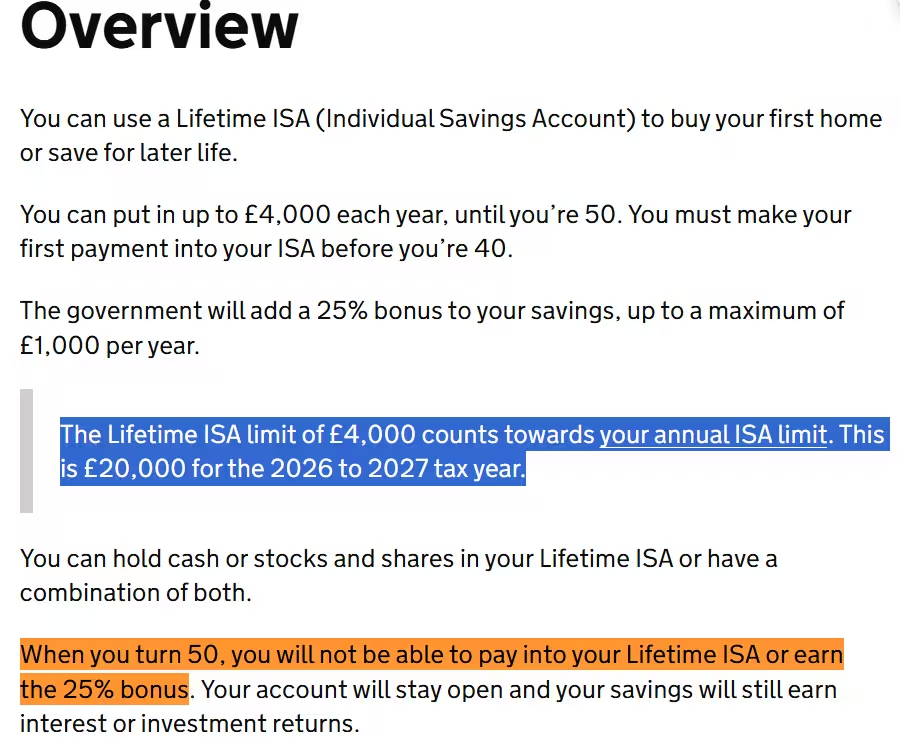
Official GOV.UK Lifetime ISA overview showing the £4,000 annual contribution limit, 25% government bonus and age restrictions.
Who Can Open a Lifetime ISA in the UK?
Before comparing providers, applicants should establish whether they satisfy the account’s eligibility requirements.
The principal rule is that an individual must be aged between 18 and 39 when opening and making their first payment into a Lifetime ISA.
UK residence is also normally required, although qualifying Crown servants and their spouses or civil partners may be eligible while living overseas.
| Applicant | Can they open a new LISA? | Important condition |
| UK resident aged 18–39 | Yes | Must meet provider requirements |
| UK resident aged 39 | Yes | First payment must be made before 40 |
| Person aged 40 or older | Normally no | Existing LISAs may be transferred |
| Self-employed individual aged 18–39 | Yes | Personal account, not business account |
| University student aged 18–39 | Yes | No minimum earnings requirement |
| Unemployed adult aged 18–39 | Yes | Must satisfy residence requirements |
| UK resident who previously owned a home | Yes | Generally cannot use first-home withdrawal benefits |
| Qualifying Crown servant overseas | Yes | Special residence exemption applies |
Applicants do not have to own a business, earn a particular salary or hold an existing ISA.
Importantly, UK citizenship is not the same as UK residence. Someone who is legally resident in the UK but does not hold British citizenship may still qualify.
For entrepreneurs, there is another distinction: a Lifetime ISA is a personal savings account. A limited company cannot open one in its own name or directly treat the director’s personal savings contribution as an ordinary company expense.
Anyone planning to fund an account from self-employment income should first separate personal funds from money required for business expenses and tax liabilities.
How Do You Open a Lifetime ISA in 2027?
Opening a Lifetime ISA generally involves selecting an authorised provider, confirming eligibility, completing identity checks and making an initial contribution.
The application itself is relatively straightforward. The financial decisions surrounding it deserve more attention.
Step 1: Decide Whether You Are Saving for a Home or Retirement
The first decision should be the purpose of the account.
Someone saving for a house deposit within the next two or three years will usually prioritise capital preservation and predictable access when purchasing.
Someone investing towards retirement several decades away might instead consider whether a Stocks and Shares Lifetime ISA fits their investment horizon and risk tolerance.
These are different financial objectives and should not automatically lead to the same product.
A person saving for retirement should also compare the tax treatment of pensions and Lifetime ISAs before committing long-term contributions.
Step 2: Choose a Lifetime ISA Provider
Lifetime ISAs are available from selected building societies and digital investment platforms.
For example, Moneybox offers Cash and Stocks and Shares Lifetime ISAs through its app. Its application process and account features are explored in our detailed Moneybox Lifetime ISA article.
Skipton Building Society and Newcastle Building Society also offer Cash Lifetime ISA products.
Our analysis of Skipton savings products examines the distinction between traditional Cash ISAs and its Lifetime ISA, while the Newcastle Building Society ISA rates comparison includes the provider’s Lifetime ISA alongside its other savings accounts.
When comparing providers, consider the following:
| Comparison factor | Why it matters |
| Minimum deposit | Determines how little money is required to start |
| Cash interest rate | Influences earnings beyond the government bonus |
| Introductory rate | May expire after a promotional period |
| Investment charges | Can reduce long-term investment returns |
| Account management | Some providers operate mainly through apps |
| ISA transfer acceptance | Important if switching providers later |
| Withdrawal administration | Relevant when approaching a property purchase |
| FSCS protection | Determines how eligible money or investments are protected |
An ordinary Cash ISA and a Cash Lifetime ISA are separate products. A building society advertising a high fixed Cash ISA rate does not mean its Lifetime ISA offers the same rate.
This distinction is especially important when comparing providers for 2027. Published rates available in late 2026 are not guaranteed to remain available during the following year.
Step 3: Prepare the Documents and Information
Most providers request personal and financial information before completing an application.
Common requirements include:
- Full legal name and date of birth.
- Current UK residential address and postcode.
- National Insurance number.
- Email address and contact details.
- Bank account details for contributions.
- Photo identification or proof of address where additional verification is required.
A National Insurance number helps providers satisfy ISA reporting requirements. Applicants should ensure that their personal information matches official records to avoid delays.
Self-employed applicants are not normally required to demonstrate business profits merely to open the account, although normal identity, eligibility and anti-money-laundering checks still apply.
Step 4: Complete the Provider’s Application
Applications can normally be submitted online or through a mobile application, depending on the provider.
For example, Moneybox allows applicants to open a Lifetime ISA using its mobile app, while Skipton provides online account opening for its Cash Lifetime ISA.
The application ordinarily involves choosing the appropriate account, entering personal details, accepting the Lifetime ISA declaration and confirming the payment arrangements.
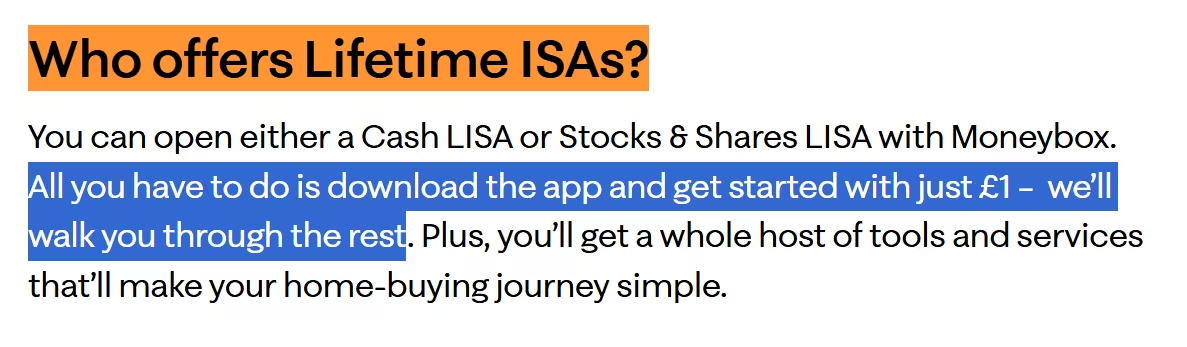
Official Lifetime ISA application information showing how eligible applicants can open an account through a recognised savings provider.
Step 5: Make Your First Deposit
This is one of the most financially important parts of the process.
The 12-month qualifying period for a first-home withdrawal starts from the date of the first payment, not simply the date an application is submitted.
Some providers allow applicants to begin with just £1.
For instance, Moneybox and Skipton have offered £1 minimum opening deposits for their Lifetime ISA products.
A saver who makes their first qualifying deposit on 15 January 2027 would ordinarily satisfy the 12-month timing condition from 15 January 2028, assuming all other purchase requirements are met.
Opening an account without funding it does not start that qualifying period.
For an eligible 39-year-old, completing the first payment before turning 40 is particularly important.
Step 6: Set Up a Contribution Plan
Once the account is active, savers can make contributions within their available annual allowance and the provider’s deposit conditions.
A regular contribution strategy can work well for people whose income is relatively predictable.
| Monthly contribution | Annual savings | Government bonus | Total before interest or investment returns |
| £50 | £600 | £150 | £750 |
| £100 | £1,200 | £300 | £1,500 |
| £200 | £2,400 | £600 | £3,000 |
| £250 | £3,000 | £750 | £3,750 |
| £300 | £3,600 | £900 | £4,500 |
| £333.33 | £3,999.96 | £999.99 | £4,999.95 |
These examples assume all payments fall within one tax year and qualify for the full bonus. The figures exclude interest, investment gains, losses and fees.
For people with irregular income, such as freelancers and small-business owners, automatic monthly payments may not always be the most appropriate approach.
They could instead make contributions when genuinely surplus personal cash is available, after accounting for household expenses, emergency reserves and tax obligations.
Step 7: Confirm That Your Account Is Receiving the Government Bonus
Lifetime ISA providers submit government bonus claims to HMRC.
The bonus is generally processed through a monthly claims cycle rather than being added immediately when money is deposited.
The provider should display qualifying contributions and bonus payments in the account records.
Savers should periodically check that the expected bonus has been received and investigate missing payments with their provider.
A £2,000 qualifying contribution should generate a £500 government bonus, subject to the annual limits and eligibility conditions.
Once the account is operating correctly, the central responsibility is maintaining the right savings strategy rather than opening additional accounts unnecessarily.
Should You Open a Cash Lifetime ISA or a Stocks and Shares Lifetime ISA?
The choice between cash and investments can be more important than selecting the provider offering the highest promotional rate.
Cash Lifetime ISA
Pays interest on savings without ordinary stock-market volatility. Often better suited to a relatively near-term home deposit, although variable interest rates can change.
Stocks and Shares Lifetime ISA
Invests in eligible financial assets. Offers the possibility of long-term growth, but investments can fall in value, and charges can reduce returns.
For a buyer intending to purchase a property in approximately two years, an investment market decline immediately before exchanging contracts could create a serious deposit shortfall.
By contrast, someone aged 25 planning to retain funds until age 60 has a substantially longer period over which to manage investment volatility.
We would therefore assess the account against the saver’s intended withdrawal date, tolerance for losses and access to other emergency savings.
People who require unrestricted access to savings should also examine ordinary Cash ISAs. The Yorkshire Building Society ISA rates comparison illustrates how easy-access and fixed-rate accounts can differ in withdrawal flexibility.
For readers exploring alternatives, the wider Coventry Building Society ISA rates provide another example of how interest rates and access restrictions should be considered together.
The 25% Lifetime ISA government bonus is valuable, but it should not override an unsuitable savings horizon or the possibility of needing the money early.
How Much Money Can You Save in a Lifetime ISA in 2027?
The annual Lifetime ISA contribution limit is £4,000 per eligible saver.
This limit applies separately to each tax year, which runs from 6 April to 5 April the following year.
For 2027, there are two relevant periods:
| Tax year | Dates | LISA contribution limit | Maximum government bonus |
| 2026/27 | 6 April 2026 – 5 April 2027 | £4,000 | £1,000 |
| 2027/28 | 6 April 2027 – 5 April 2028 | £4,000 | £1,000 |
| Combined potential | Across both tax years | £8,000 | £2,000 |
An eligible saver with sufficient funds could contribute £4,000 before the end of the 2026/27 tax year and another £4,000 after the 2027/28 tax year begins.
That could generate £2,000 in government bonuses across the two tax years, subject to eligibility and processing requirements.
The annual limit cannot be carried forward. Unused contribution allowance normally expires when the tax year ends.
Our examination of ISA allowances also highlights why individuals must monitor contributions across different account types.
How Much Could You Accumulate Over Five Years?
Assuming someone contributes the maximum £4,000 annually for five years:
| Year | Personal contribution | Government bonus | Cumulative savings |
| 1 | £4,000 | £1,000 | £5,000 |
| 2 | £4,000 | £1,000 | £10,000 |
| 3 | £4,000 | £1,000 | £15,000 |
| 4 | £4,000 | £1,000 | £20,000 |
| 5 | £4,000 | £1,000 | £25,000 |
The result would be £25,000 before any interest, investment returns, fees or losses.
For a couple, the combined figure could reach £50,000 over five years if both individuals qualify and each maximises their own allowance.
These calculations demonstrate the value of combining regular contributions with government incentives.
However, a Lifetime ISA should be funded with money that can realistically remain committed to its permitted purposes.
What Changed to Lifetime ISA Rules in the Autumn Budget 2026?
The Autumn Budget, published on 28 October 2026, introduced a significant change to Lifetime ISA withdrawals.
Previously, savers purchasing homes costing more than £450,000 faced the standard 25% withdrawal charge.
From 29 October 2026, qualifying first-home purchases above the £450,000 threshold became subject to a reduced 20% charge.
This change matters particularly in parts of the UK where first-time buyer property prices can exceed the Lifetime ISA threshold.
The change does not increase the property price ceiling itself. A qualifying first home costing £450,000 or less can still benefit from a charge-free withdrawal, while a purchase above that amount loses the government bonus through the 20% charge.
Other unauthorised withdrawals remain subject to the standard 25% charge.
How Does the New 20% Withdrawal Charge Work?
Consider an individual who deposited £8,000 and received £2,000 in government bonuses.
Their Lifetime ISA contains £10,000, excluding investment growth or interest.
| Withdrawal scenario | Withdrawal charge | Amount received |
| Qualifying first home costing £450,000 or less | £0 | £10,000 |
| Qualifying first home costing more than £450,000 | £2,000 (20%) | £8,000 |
| Other unauthorised withdrawal before age 60 | £2,500 (25%) | £7,500 |
The new 20% charge effectively removes the government bonus from this simplified example, while the standard 25% charge reduces the amount received below the saver’s original contributions.
For savers considering properties above £450,000, the change reduces the financial consequences of exceeding the ceiling. It does not provide an additional government subsidy for those purchases.
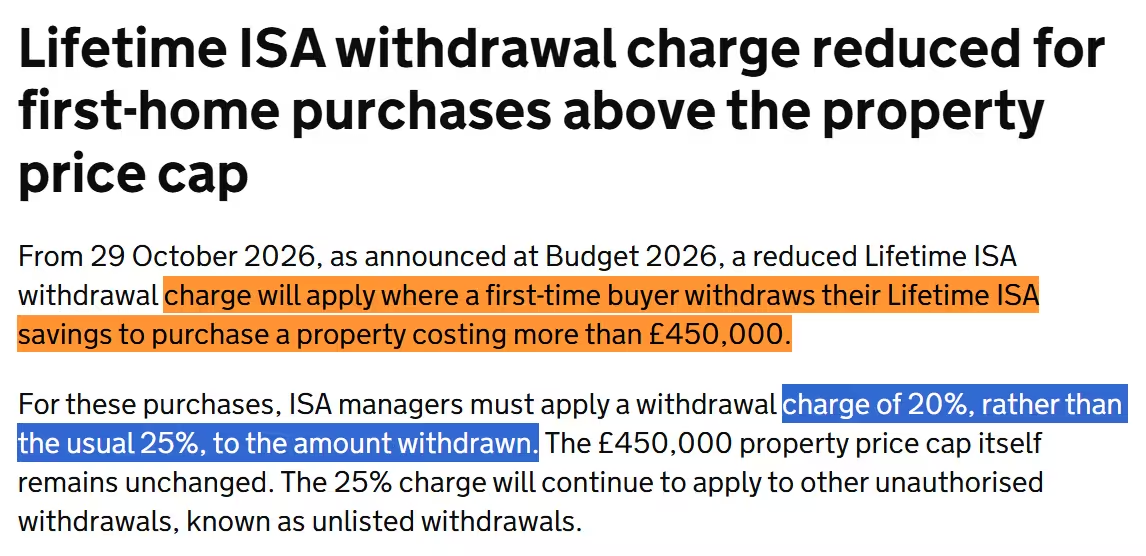
HMRC’s October 2026 announcement confirming the reduced 20% Lifetime ISA withdrawal charge for first-home purchases above £450,000.
Can You Use a Lifetime ISA to Buy Your First Home in 2027?
Yes. A Lifetime ISA can support a qualifying first-home purchase in the UK, provided the necessary conditions are met.
The saver must normally have held the account for at least 12 months from their first payment, purchase the property with an eligible residential mortgage and arrange the withdrawal through a conveyancer.
The buyer must intend to occupy the property as their main residence.
An investment property, holiday home or property purchased exclusively for letting would not ordinarily qualify.
What Happens If You Previously Owned Property?
Having previously owned residential property, including a share inherited from someone else, can prevent an individual from using the Lifetime ISA first-home withdrawal benefit.
This restriction can also apply where the property was outside the UK.
Someone who has previously owned a home may still be eligible to open a Lifetime ISA within the opening age rules, but they would normally need to consider it as a later-life savings vehicle rather than an account for buying another home.
How Does a Lifetime ISA Withdrawal Work During a House Purchase?
When the buyer is ready to proceed, they should notify the Lifetime ISA provider and appoint a solicitor or conveyancer.
The provider and conveyancer complete the necessary declarations, including confirmation of the purchase price and eligibility.
The provider transfers the approved withdrawal directly to the conveyancer rather than paying the buyer personally.
The property purchase is generally expected to complete within 90 days of the Lifetime ISA withdrawal, although extensions can be available in eligible circumstances.
Importantly, the funds can contribute towards the purchase price, including deposit arrangements. Buyers should discuss the payment schedule with their conveyancer before requesting a withdrawal.
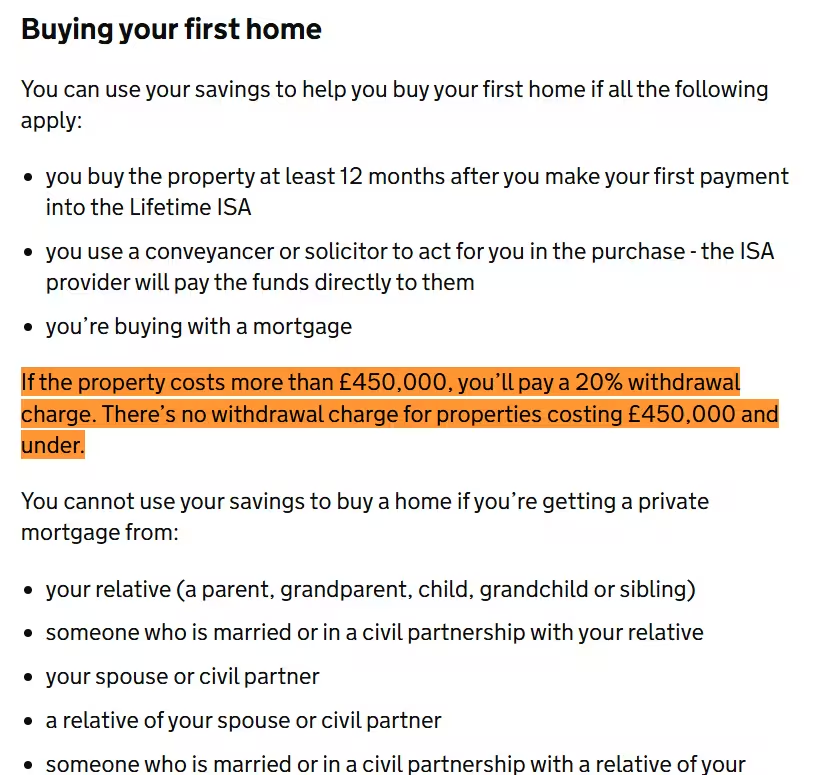
Government guidance explaining the 12-month holding period, first-home purchase requirements and conveyancer withdrawal process.
Can Two People Use Lifetime ISAs to Buy the Same Property?
Yes. Where two eligible first-time buyers are purchasing a home together, both can normally contribute their Lifetime ISA savings and government bonuses towards the purchase.
For example, two people who each save £4,000 in one tax year can receive £1,000 in government bonuses individually.
Their combined position would be:
| Savings element | Buyer A | Buyer B | Combined |
| Personal contribution | £4,000 | £4,000 | £8,000 |
| Government bonus | £1,000 | £1,000 | £2,000 |
| Total | £5,000 | £5,000 | £10,000 |
This makes coordinated saving potentially valuable for couples planning a joint purchase.
However, both people must satisfy the conditions for using their individual Lifetime ISAs.
A first-time buyer can also purchase with someone who previously owned a home, but only the qualifying Lifetime ISA holder can use their own account under the first-home rules.
Should Self-Employed Professionals and Entrepreneurs Open a Lifetime ISA?
For entrepreneurs, freelancers and self-employed professionals, the Lifetime ISA has a different financial role from a business reserve or working-capital account.
A qualifying individual can open the account regardless of whether their income comes from employment, freelance contracts, sole-trader profits or other legitimate sources.
However, the 25% bonus should not be confused with pension tax relief or a business expense deduction.
Lifetime ISA contributions are personal savings contributions. Making them does not ordinarily reduce taxable self-employment profits.
This is important because many business owners already need to balance several competing uses of cash: tax payments, operating expenses, debt repayments, emergency liquidity and retirement provision.
Our assessment identifies three priorities:
- First, maintain adequate working capital: A business owner should avoid committing funds needed for VAT, Income Tax, corporation tax or operational obligations to a restricted personal savings product.
- Second, compare retirement arrangements: Pension contributions can attract tax relief under the applicable rules, making them an important alternative to Lifetime ISA retirement saving.
- Third, evaluate the intended house purchase: Someone running a business who plans to buy their first home may find the Lifetime ISA bonus useful, but the mortgage application will also depend on income evidence, affordability and the lender’s criteria.
The relationship between retirement accounts and tax-efficient savings is explored further in our analysis of spending pension before ISA, particularly for people planning their longer-term financial position.
From a business finance perspective, the relevant question is not simply whether a 25% government bonus is attractive. It is whether the money can remain committed without disrupting personal or business liquidity.
Is It Better to Open a Lifetime ISA Before April 2027?
For someone already eligible and intending to use the account, opening and funding it before 5 April 2027 may provide an opportunity to use the 2026/27 contribution allowance.
The 2027/28 allowance then begins on 6 April 2027.
This creates two advantages for eligible savers who have suitable funds available: access to two separate annual contribution allowances and an earlier start to the 12-month property purchase qualifying period.
For example, someone who deposits £1 in March 2027 begins the 12-month period from that first payment.
If they instead wait until September 2027 to make their first contribution, the qualifying period begins correspondingly later.
However, an earlier deposit is not automatically worthwhile for everyone. A saver expecting to buy within a few months may not meet the 12-month requirement in time.
Likewise, a saver without sufficient emergency funds should consider the financial risk of locking money into a restricted account.
Will the Lifetime ISA Be Replaced After 2027?
The government confirmed in the Autumn Budget 2026 that a new First Time Buyer ISA is scheduled to launch in April 2029, replacing the Lifetime ISA for new savers.
This development is especially relevant to people opening a Lifetime ISA during 2027.
The planned replacement is designed specifically for first-home purchases rather than the dual purpose of homeownership and later-life saving.
| Feature | Lifetime ISA | Planned First Time Buyer ISA |
| Availability for new applicants | Until replacement launch | From April 2029 |
| Opening age | 18–39 | No upper age restriction planned |
| Annual contribution limit | £4,000 | £4,000 |
| Government bonus | 25% of eligible contributions | 25% of qualifying final balance |
| Maximum bonus | £1,000 per tax year | £20,000 cumulative |
| When bonus is paid | During the savings period | On qualifying home-purchase withdrawal |
| Retirement saving purpose | Yes | No |
| Qualifying property price limit | £450,000 | £450,000 |
Existing Lifetime ISA holders will be permitted to continue contributing to and using their accounts under the applicable Lifetime ISA rules after the replacement launches.
Another important point is that transfers from an existing Lifetime ISA into the new First Time Buyer ISA will not be permitted under the announced design. The government has, however, stated that both products may be used towards the same qualifying property purchase.
The planned replacement therefore does not mean that somebody who opens a Lifetime ISA in 2027 automatically loses access to the account in 2029.
The proposed Starter Investment ISA incentive is a separate policy initiative aimed at encouraging first-time investors and should not be confused with the confirmed First Time Buyer ISA timetable.
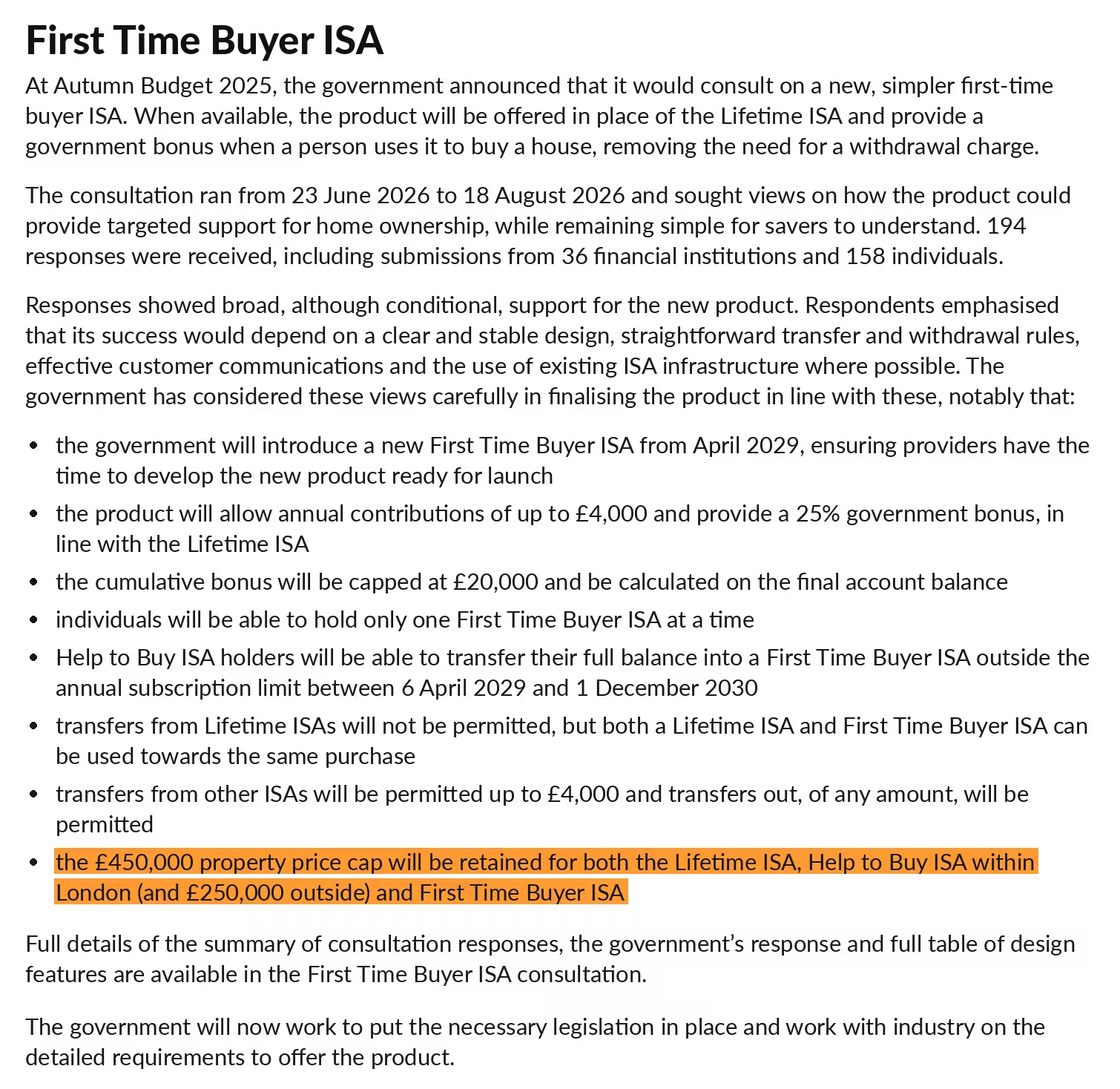
HM Treasury’s October 2026 update confirming the April 2029 First Time Buyer ISA launch and the arrangements for existing Lifetime ISA holders.
Can You Transfer a Lifetime ISA to Another Provider?
A Lifetime ISA does not have to remain with the original provider indefinitely.
Savers can generally transfer an existing Lifetime ISA to another Lifetime ISA provider that accepts transfers.
This could be useful if a Cash Lifetime ISA provider reduces its variable interest rate or another provider offers a more appropriate account.
The transfer should be completed using the official ISA transfer process.
Withdrawing the money personally and depositing it into another account is not equivalent to transferring the ISA and can trigger a withdrawal charge.
An important advantage of a correctly completed Lifetime ISA-to-Lifetime ISA transfer is that it preserves the original first-payment date for the 12-month qualifying period.
For instance, someone who first contributed in February 2027 and transferred their account in October 2027 would not ordinarily need to restart the 12-month period simply because they changed providers.
It is also important to distinguish a Lifetime ISA transfer from a transfer into an ordinary Cash ISA. Moving Lifetime ISA funds into a non-Lifetime ISA before age 60 generally triggers the 25% withdrawal charge unless an applicable exception is met.
What Mistakes Should You Avoid When Opening a Lifetime ISA?
The main financial risks arise not from the application form itself but from misunderstandings about withdrawals, contribution timing and the intended use of savings.
| Common mistake | Potential consequence | Better approach |
| Opening without making a first deposit | 12-month period does not begin | Make an eligible initial payment |
| Waiting until after turning 40 | Cannot normally open a new LISA | Apply and fund before 40 |
| Depositing money needed urgently | Possible 25% withdrawal charge | Keep accessible emergency savings |
| Assuming every first home qualifies | Government bonus may not be retained | Check property and mortgage conditions |
| Confusing Cash ISA rates with LISA rates | Incorrect earnings expectations | Compare the specific LISA product |
| Ignoring investment charges | Reduced investment returns | Examine the complete fee schedule |
| Withdrawing instead of transferring | Potential charges and lost ISA advantages | Use the formal transfer process |
| Assuming unused allowances carry forward | Lost contribution opportunity | Plan deposits around 5 April |
For those comparing more flexible savings arrangements, ordinary Cash ISAs may provide access to funds without the Lifetime ISA’s government withdrawal charge, although individual account terms and interest penalties can still apply.
The correct account structure depends on the financial objective, rather than the headline bonus alone.
Conclusion
Opening a Lifetime ISA in 2027 remains an option for eligible UK savers who want to build a first-home deposit or save for later life.
The 25% government bonus can increase qualifying contributions by up to £1,000 annually, while the October 2026 withdrawal reform reduces the charge for qualifying property purchases above £450,000.
However, applicants should examine age restrictions, contribution deadlines, account charges and access requirements before depositing money.
With the replacement First Time Buyer ISA scheduled for April 2029, understanding both current rules and confirmed future changes is essential for effective financial planning.
Frequently Asked Questions
Can I open a Lifetime ISA online in 2027?
Yes. Several providers allow eligible applicants to open Lifetime ISAs online or through mobile applications. Applicants normally need personal identification details, a National Insurance number and a qualifying opening deposit.
Can I open a Lifetime ISA with £1?
Yes, some providers offer a £1 opening deposit. However, minimum contributions vary between accounts, so applicants should check the provider’s current product requirements.
Can I open a Lifetime ISA if I am 39?
Yes. Eligible people aged 39 can open a Lifetime ISA, provided the application and first payment are completed before they turn 40.
Do I need to be employed to open a Lifetime ISA?
No. Eligible students, unemployed adults and self-employed individuals can open Lifetime ISAs. The main conditions concern age, residence and compliance with ISA regulations.
Can I open more than one Lifetime ISA?
An individual can hold multiple Lifetime ISAs, but can generally make new contributions to only one Lifetime ISA during each tax year, subject to specific exceptions and transfer rules.
Can I withdraw my Lifetime ISA money whenever I want?
Withdrawals are possible, but charges apply unless the withdrawal qualifies for an exception. The standard charge is 25%, while the special 20% charge applies to qualifying first-home purchases above £450,000.
Is a Lifetime ISA better than a pension?
Not necessarily. Workplace and personal pensions can provide tax relief and, where applicable, employer contributions. Lifetime ISAs offer a different bonus structure and access rules. The better arrangement depends on the person’s circumstances.
Will I still receive a Lifetime ISA bonus in 2027?
Yes. Under the confirmed rules, eligible contributions continue to receive a 25% government bonus, up to £1,000 per tax year.
Should I wait until 2029 for the new First Time Buyer ISA?
That depends on the intended purchase date, eligibility and savings strategy. Opening a Lifetime ISA earlier can start the 12-month qualifying period and provide access to contributions and bonuses before the replacement arrives.

More in Finance & Tax
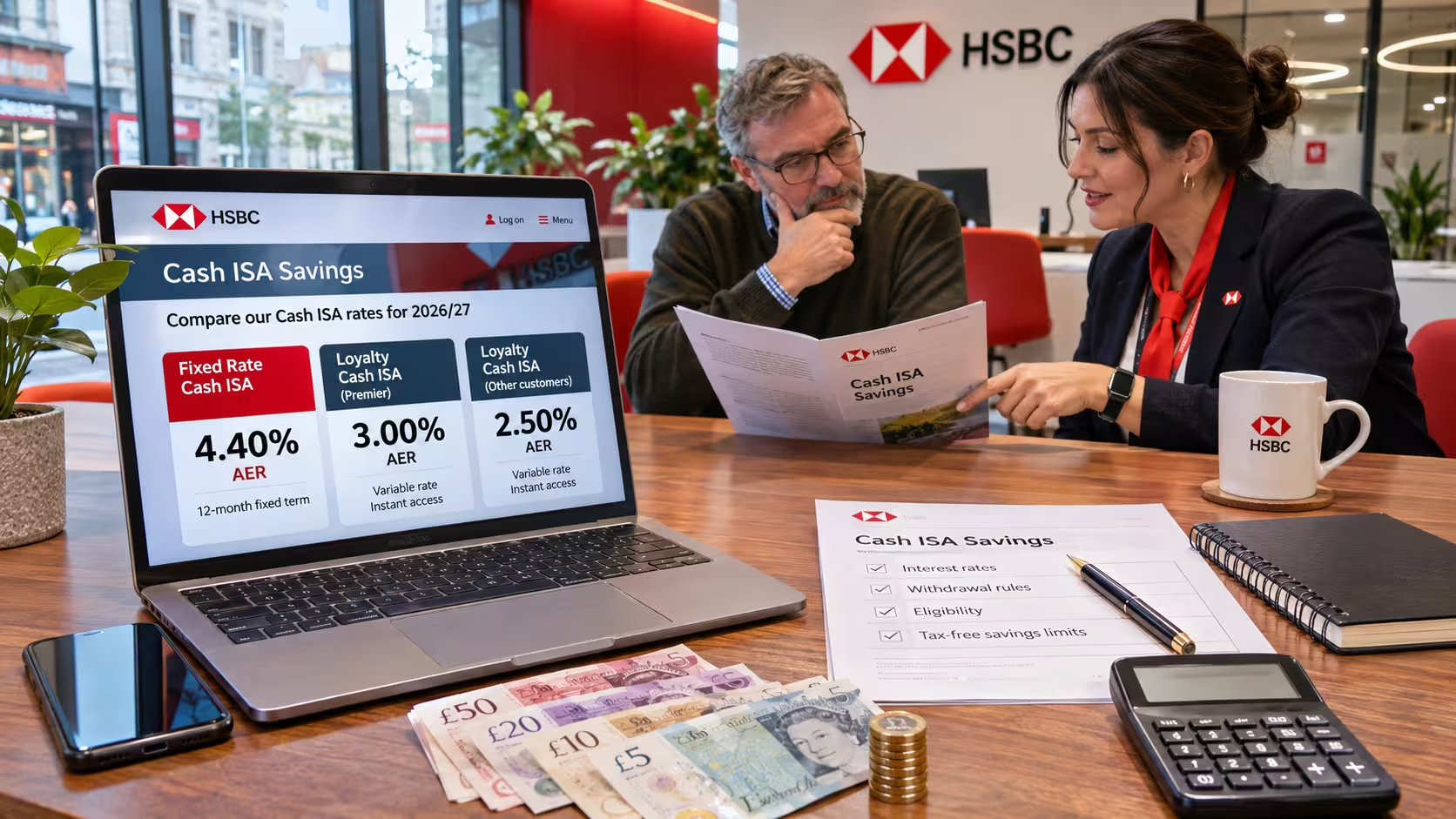
HSBC ISA Rates 2026/2027: Current Cash ISA Rates, Eligibility and Comparison
HSBC ISA rates currently range from 2.50% to 4.40% AER, depending on the Cash ISA and the customer’s account type. The HSBC Fixed Rate Cash ISA pays 4.40% AER tax-free, while the Loyalty Cash ISA pays 3.00% AER for HSBC Premier customers and 2.50% AER for customers with other eligible HSBC current accounts. The main […]
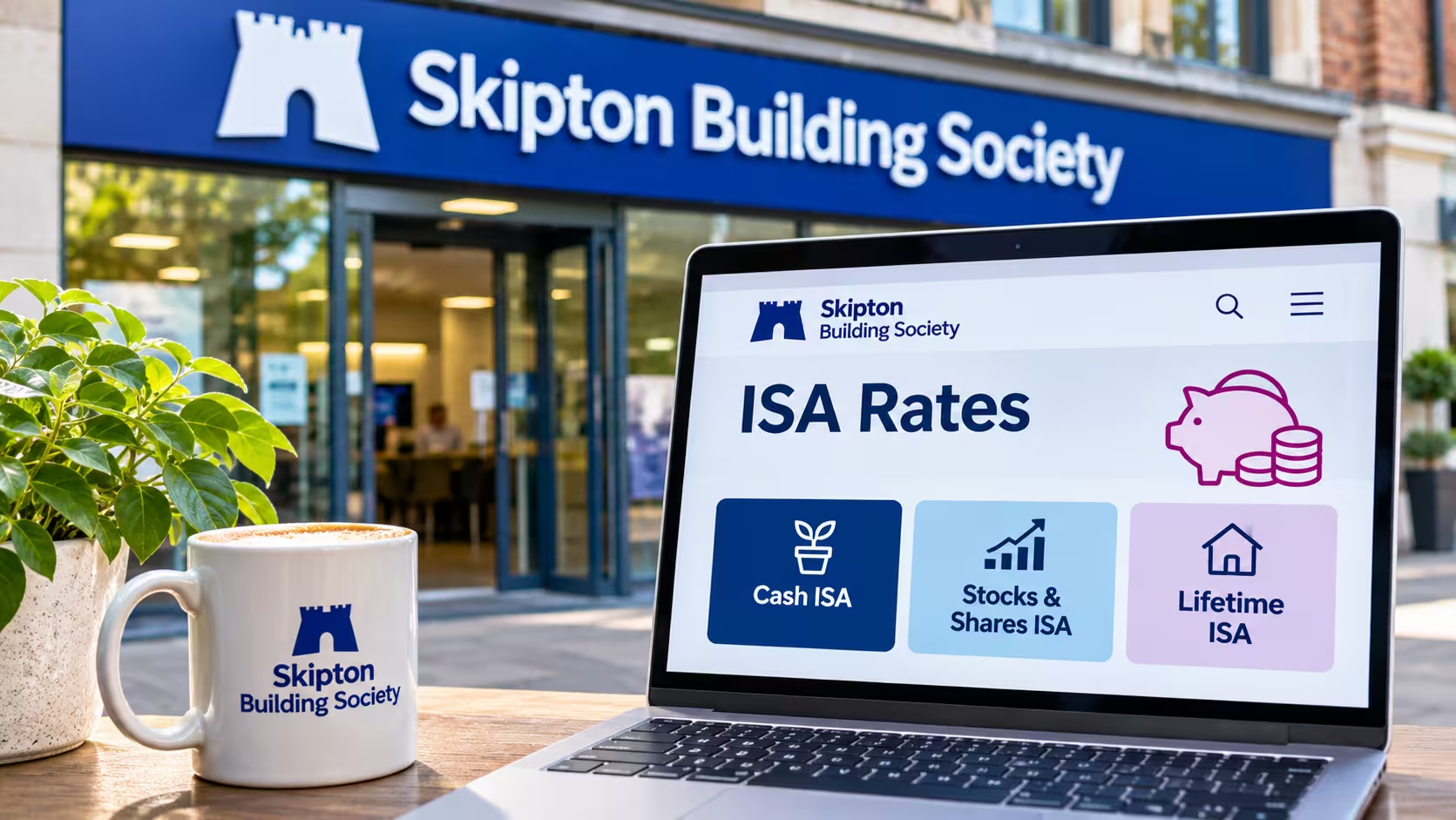
Skipton Building Society ISA Rates 2027: Latest Cash ISA Rates and 2026 Updates
Skipton Building Society ISA rates currently reach 5.05% AER tax-free on its five-year fixed-rate Cash ISA, while its 15-month fixed account offers 4.90% and its Bonus Cash ISA Saver pays 4.21% variable, including a temporary introductory bonus. For savers preparing their finances for 2027, these rates create different opportunities depending on how long they can […]