
Action Fraud received over 42,000 reports of job and investment scams targeting people looking for extra income in 2025, with total reported losses exceeding £190 million.
The side hustle economy’s growth has been matched by a parallel growth in scams designed to exploit people who are motivated to earn and less practised at evaluating opportunities quickly.
This article covers the 11 most frequently reported side hustle scam types operating in the UK in 2026, the specific red flags that identify each, and what to do if you have already been targeted.
For the full list of legitimate UK side hustle options, see our complete guide to UK side hustles.
The 11 Scams
Scam 1: The Fake Amazon Flex or Delivery App Job

- The scam: fake recruitment messages offering Amazon Flex, Deliveroo, or DHL delivery work with unusually high pay rates (£22–£35/hour advertised). You are directed to a website that mimics the real platform and asked to pay a “registration fee,” “DBS fee,” or “uniform deposit” upfront.
- Red flags: legitimate platforms never charge you to work for them. Amazon Flex registration is free at flex.amazon.co.uk. Deliveroo registration is free. Any delivery platform asking for upfront payment is fraudulent.
- Action: report to Action Fraud (actionfraud.police.uk) and to the impersonated brand.
Scam 2: The Fake Survey Site

- The scam: a survey site heavily promoted on social media that promises £5–£10 per survey. You complete surveys for weeks, accumulate earnings, then discover the minimum payout threshold is £50–£100 and your balance is mysteriously reset, or the site simply disappears before payout.
- Red flags: no independent review trail (check Trustpilot and the r/beermoney subreddit for the platform name); payout threshold is high and cannot be verified; payments are only described as “credits” or “points” with no stated cash equivalent.
- Reality check: for how to spot which survey sites are legitimate, see our guide on which survey sites are worth your time.
Scam 3: The Envelope Stuffing or “Simple Task” Offer

- The scam: an advertisement promises you can earn £300–£500/week stuffing envelopes, data entry, or completing “simple tasks” from home. You pay a setup fee (£20–£100) to receive the starter kit. The starter kit contains instructions for you to place the same advertisement and recruit others — a classic pyramid recruitment model.
- Red flags: any opportunity where the income depends on recruiting others rather than on the quality of your work. Any “starter kit fee.”
Scam 4: The Investment Coaching or Trading Signal Scam

- The scam: an Instagram or TikTok account showing a lavish lifestyle offers to teach you to trade forex, crypto, or binary options. For £99–£999, you access “signals” or “coaching.” The signals are either useless or designed to make you deposit with a fraudulent broker who disappears with your funds.
- Red flags: lifestyle-based social media promotion; vague or unverifiable credentials; platforms requiring you to open an account with a specific, often offshore broker; too-good-to-be-true returns cited.
Scam 5: The Mystery Shopper Cheque FraudScam 5: The Mystery Shopper Cheque Fraud

- The scam: you receive an unsolicited email or letter offering mystery shopping work. It comes with a cheque for £2,000–£3,000. Instructions say to deposit the cheque and transfer £1,500–£2,500 to a “vendor” as part of the assignment, keeping the rest as pay. The cheque is fraudulent and bounces after you have sent the transfer.
- Red flags: unsolicited offer you did not apply for; any offer that asks you to transfer money to a third party as part of the work; payment by cheque before you have done anything.
Scam 6: The Fake AI Training Platform

- The scam: as AI training has grown in popularity, fake platforms have emerged mimicking Outlier, Mindrift, and DataAnnotation. They invite you to complete unpaid onboarding tasks (claiming these are standard), collect your personal information including bank details, and either disappear or extract payment for premium access.
- Red flags: legitimate AI training platforms never charge you upfront fees. Outlier is at outlier.ai (owned by Scale AI). Mindrift is at mindrift.ai. DataAnnotation is at dataannotation.tech. Any site with a similar name or design that charges fees or asks for payment information before you start working is fraudulent.
For how to identify legitimate AI training platforms, see our guide on AI side hustles UK.
Scam 7: Vinted and Marketplace Buyer Fraud

- The scam: a buyer contacts you on Vinted (or Facebook Marketplace, eBay) offering to pay via a method outside the platform — bank transfer, PayPal Friends and Family, or a fake escrow service. Once you ship the item, payment never arrives or the fake escrow service disappears.
- Red flags: any buyer requesting off-platform payment. Vinted Buyer Protection only applies to transactions processed through the Vinted checkout. Off-platform payment means no protection. For the full guide to safe Vinted selling, see our guide on how to verify Vinted buyer authenticity.
Scam 8: The Fiverr or Upwork Impersonation

- The scam: you receive an email claiming to be from Fiverr or Upwork about a new order or a security issue with your account. The link directs you to a clone site where you enter your credentials — which are then used to access your real account and redirect payouts.
- Red flags: always access Fiverr and Upwork by typing the URL directly, never from email links. Check the sender’s email address carefully — legitimate Fiverr emails come from @fiverr.com only.
Scam 9: The Fake Influencer Partnership

- The scam: you are contacted by a “brand” on Instagram offering to pay you £200–£500 to promote their product. They send the product, ask you to post, then send a “payment confirmation” that is actually a fake cheque or ask you to pay “import fees” before receiving your payment. Variations include asking you to send cryptocurrency as a “deposit” before they send your payment.
- Red flags: brand accounts with low follower counts, recent creation dates, or no business website. Any influencer partnership that requires you to pay anything before receiving payment. Legitimate brand partnerships never require upfront payment from the creator.
Scam 10: Fake HMRC Side Hustle Letters

- The scam: a convincing letter or email, formatted to look like HMRC correspondence, claims that you owe undeclared tax on side hustle income and threatens penalties unless you pay immediately via a link or phone number. These have increased significantly since HMRC’s genuine platform reporting letters became more widely known.
- Red flags: HMRC never requests immediate payment via email. HMRC never uses urgent threat language demanding same-day payment. Legitimate HMRC correspondence asks you to log into your personal tax account. If in doubt, go directly to gov.uk and log in — do not use any contact details in the suspicious communication.
Scam 11: The Fake Etsy or Amazon Seller Course

- The scam: a paid course costing £99–£997 promises to teach you to make £3,000–£10,000/month selling on Etsy or Amazon FBA. The course contains publicly available information, the earnings claims are based on best-case scenarios, and the primary income model of the course seller is the course itself rather than Etsy or Amazon selling.
- Red flags: income guarantees; testimonials that cannot be independently verified; course pricing that far exceeds the cost of freely available information on YouTube and seller forums; high-pressure sales tactics.
- Reality check: legitimate Etsy and Amazon selling is possible and profitable for some. But the knowledge to start is freely available, and courses costing hundreds of pounds typically do not provide meaningfully better information than free resources.
How to Report a Scam?
- Action Fraud: actionfraud.police.uk or 0300 123 2040. The UK’s national fraud and cyber-crime reporting centre. Reports are passed to the National Fraud Intelligence Bureau.
- Citizens Advice: citizensadvice.org.uk. For advice on what to do next and how to recover losses where possible.
- Financial Conduct Authority (FCA) ScamSmart: fca.org.uk/scamsmart. For investment and trading scams.
- HMRC fraud reporting: gov.uk/report-suspicious-emails-websites-phishing. For fake HMRC correspondence.
- The platform itself: if you have encountered a scam impersonating a real platform (Amazon, Etsy, Vinted, Fiverr), report directly to that platform’s trust and safety team. Most major platforms have a dedicated fraud reporting mechanism.
Frequently Asked Questions
How do I check if a side hustle platform is legitimate?
Search the platform name on Reddit (r/beermoney, r/WorkOnline), Trustpilot, and Companies House (companies-house.service.gov.uk for UK-registered companies).
Look for evidence of payments in independent reviews. Check how long the company has been operating. Legitimate platforms have a track record; scams are typically new.
I was scammed and paid upfront fees. Can I get the money back?
Possibly. If you paid by credit card, use chargeback through your card provider. If by debit card, contact your bank for a chargeback. If by bank transfer, contact your bank immediately — some transfers can be recovered if reported quickly.
For BACS transfers that have cleared, recovery is not guaranteed but report to Action Fraud and your bank regardless.
Are all “make money from home” Instagram accounts scams?
Not all, but a high proportion of them are. The specific red flags are: income screenshots without verifiable context, lifestyle displays designed to create aspiration, affiliate links to products that pay the account owner for referrals, and testimonials from what appear to be fake accounts.
Legitimate operators exist on Instagram but their content demonstrates the actual work, not the lifestyle it theoretically enables.
What to Read Next?
For the legitimate survey site options, see our guide on how to spot which survey sites are legitimate.
For legitimate AI training platforms, see our guide on AI side hustles UK.
Verified as of 24 June 2026.

More in News & Updates
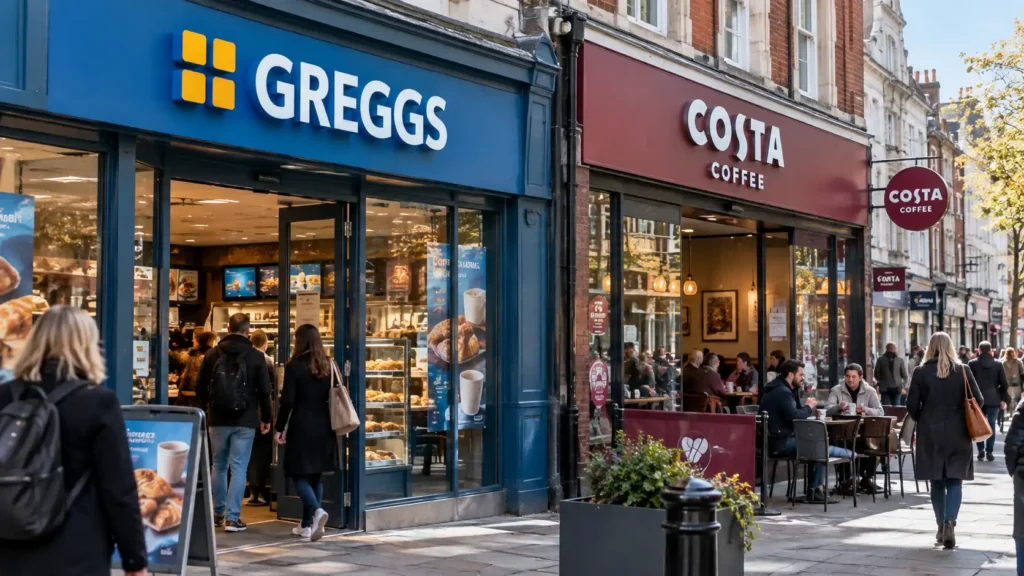
Greggs Overtakes Costa UK: How the Bakery Became Britain’s Biggest Branded Coffee Operator
Greggs has overtaken Costa Coffee to become the largest overall operator in the UK branded coffee shop market by outlet count, according to Allegra World Coffee Portal’s Project Café UK 2026 research. The market study counted 2,737 Greggs outlets versus 2,707 Costa Coffee locations, giving Greggs a narrow lead of 30 sites. Starbucks remained third […]

UK Budget 2026: What Changed for Side Hustlers?
The 2026 fiscal year brought two government statements side hustlers needed to track: the Autumn Budget 2025 (delivered 26 November 2025) which set the 2026/27 tax parameters, and the Spring Statement 2026 (delivered 3 March 2026) which confirmed the position with no new tax changes. This article separates what actually changed for side hustlers from […]