
Yes. An eligible UK saver can put up to £20,000 into ISAs in every tax year. For the current 2026/27 tax year, which runs from 6 April 2026 to 5 April 2027, the overall adult ISA allowance is £20,000.
The allowance resets on 6 April each year. It does not matter how much has already accumulated inside existing ISAs because the limit applies to new subscriptions, not the total balance.
There are two important catches.
First, unused ISA allowance normally does not carry forward. Someone who contributes only £12,000 during 2026/27 cannot add the unused £8,000 to the following year’s allowance.
Second, the rules for Cash ISAs are changing. From 6 April 2027, people aged under 65 will generally be limited to £12,000 a year in Cash ISAs, although their total annual ISA allowance will remain £20,000. People aged 65 and over will retain the ability to subscribe up to £20,000 to Cash ISAs.
For a broader breakdown of the current limits, see how much can be put in an ISA.
Can £20,000 Be Put Into an ISA Every Year?
Yes. A qualifying saver effectively receives a new adult ISA subscription allowance at the beginning of every UK tax year.
That means a person could contribute:
| Tax year | Maximum overall adult ISA contribution |
| 2025/26 | £20,000 |
| 2026/27 | £20,000 |
| 2027/28 | £20,000 |
| 2028/29 | £20,000 |
| 2029/30 | £20,000 |
| 2030/31 | £20,000 |
The Government has confirmed that the overall annual ISA subscription limit is scheduled to remain at £20,000 until 5 April 2031. The Lifetime ISA limit remains £4,000 and the Junior ISA limit remains £9,000 over the same period.
The £20,000 is not a lifetime limit. Someone who contributes the maximum for five consecutive years could therefore have paid £100,000 of new money into ISAs, before taking account of interest, dividends or investment growth.
Does the £20,000 ISA Allowance Reset Every Year?

Yes. The ISA allowance operates by tax year, not calendar year.
The 2026/27 allowance runs from:
6 April 2026 to 5 April 2027
A fresh allowance then starts on:
6 April 2027
Unused allowance is normally lost after 5 April.
For example, if a saver contributes £7,000 during 2026/27, the unused £13,000 cannot be carried forward. The saver starts the next tax year with the standard allowance applying for that year, rather than £20,000 plus £13,000.
This differs from pensions, where unused annual allowance can sometimes be carried forward from earlier tax years.
Can £20,000 Be Put Into More Than One ISA?
Yes.
The £20,000 is an overall annual allowance, not a separate £20,000 allowance for each ISA type.
During 2026/27, someone might divide the allowance as follows:
| ISA | Contribution |
| Cash ISA | £8,000 |
| Stocks and Shares ISA | £8,000 |
| Lifetime ISA | £4,000 |
| Total | £20,000 |
Alternatively, a saver who does not use a Lifetime ISA could currently put the entire £20,000 into a Cash ISA or Stocks and Shares ISA.
Since changes introduced from April 2024, savers can also subscribe to more than one ISA of the same type in the same tax year, subject to the overall allowance. A person could therefore use two different Cash ISA providers if desired.
Lifetime ISAs have additional restrictions, including the £4,000 annual payment limit.
How Much Can Be Put Into Each Type of ISA?
The following table shows the main position for 2026/27.
| ISA type | 2026/27 limit | Access | Main risk | Common use |
| Cash ISA | Up to £20,000 within overall allowance | Depends on account | Inflation and changing interest rates | Cash savings and emergency reserves |
| Stocks and Shares ISA | Up to £20,000 within overall allowance | Usually accessible, but investments must be sold | Investment values can fall | Longer-term investing |
| Innovative Finance ISA | Up to £20,000 within overall allowance | Product dependent | Borrower/platform and investment risk | Peer-to-peer and eligible alternative investments |
| Lifetime ISA | £4,000 | Restricted | Withdrawal charge can apply | First home or later-life savings |
| Junior ISA | £9,000 per child | Normally locked until 18 | Depends on cash or investments | Long-term savings for children |
A saver does not get £20,000 for a Cash ISA plus another £20,000 for a Stocks and Shares ISA.
All adult ISA subscriptions must normally fit inside the same £20,000 overall limit.
What Changes to the £20,000 ISA Rule From April 2027?
The headline £20,000 ISA allowance is staying, but the way younger savers can use it will change.
From 6 April 2027, the annual Cash ISA subscription limit for someone under 65 will become £12,000.
The overall ISA allowance remains £20,000.
For example, an under-65 saver could potentially use the allowance as:
| ISA type | Example 2027/28 contribution |
| Cash ISA | £12,000 |
| Stocks and Shares ISA | £8,000 |
| Total | £20,000 |
Someone aged 65 or over will continue to have a Cash ISA limit of up to £20,000, subject to the overall annual ISA allowance.
The distinction matters because statements such as “everyone can put £20,000 into a Cash ISA every year” will no longer be accurate from 6 April 2027.
Anyone currently comparing savings accounts can check the latest Cash ISA rates before deciding where to hold cash.
Is the £20,000 ISA Allowance Per Person or Per Household?
The ISA allowance is per person.
It is not a household, family or married-couple allowance.
An ISA cannot normally be held jointly, which means each eligible adult controls their own allowance.
For a couple in 2026/27:
| Person | Potential ISA contribution |
| Partner one | £20,000 |
| Partner two | £20,000 |
| Combined | £40,000 |
A married couple or two eligible partners could therefore potentially place £40,000 a year between their individual ISAs.
It is important to understand the ownership position. One partner cannot simply transfer their unused ISA allowance to the other. If money is given to a spouse or partner so that the other person can use their ISA allowance, the ISA and money held within it belong to the person whose name is on the account.
How Much Could a Family Put Into ISAs Each Year?
Junior ISAs make the family-wide figure considerably larger.
The Junior ISA subscription limit is £9,000 per child for 2026/27. Junior ISA subscriptions are separate from an adult’s £20,000 allowance.
For example, a family containing two eligible adults and two children could potentially subscribe:
| Family member | Annual amount |
| Adult one | £20,000 |
| Adult two | £20,000 |
| Child one Junior ISA | £9,000 |
| Child two Junior ISA | £9,000 |
| Potential family total | £58,000 |
That does not mean the family has one shared £58,000 allowance.
The adults each have an individual £20,000 allowance and each child has their own £9,000 Junior ISA allowance.
Money placed into a Junior ISA also belongs to the child. It should therefore not be treated as another account in which parents can temporarily park their own savings. A child can generally take control of managing the account at 16, with withdrawals normally available from age 18.
Who Can Put £20,000 Into an ISA?
ISA eligibility is sometimes overlooked.
For a standard adult ISA, a person generally needs to be:
- At least 18 years old
- Resident in the UK for tax purposes, subject to limited exceptions
- Opening the ISA in their own name
The minimum age for opening adult Cash ISAs changed from 16 to 18 from April 2024.
A Lifetime ISA has additional age requirements. Someone generally needs to open and make their first payment into a Lifetime ISA before turning 40.
GOV.UK currently states that an adult generally needs to be resident in the UK, although qualifying Crown servants working overseas and their spouses or civil partners can be exceptions.
Children under 18 may instead be eligible for Junior ISAs.
What Happens to an ISA If Someone Moves Abroad?
Moving abroad does not automatically mean an existing ISA has to be closed.
If someone opens an ISA while eligible and later becomes non-UK resident, the ISA can normally remain open and continue benefiting from its UK ISA tax treatment.
Existing ISAs may also generally be transferred between providers.
However, a person who becomes non-UK resident normally cannot make new ordinary ISA subscriptions until becoming UK resident again, unless an exception applies.
The ISA provider should be told when the account holder ceases to be UK resident.
There are specialist exceptions, including certain Crown servants and some permitted replacement or inherited ISA subscriptions, so unusual circumstances may need to be checked with the provider or HMRC.
Does Interest or Investment Growth Count Towards the £20,000?
No.
The £20,000 annual limit applies to new money subscribed, not the returns that money earns after entering the ISA.
Suppose someone pays £20,000 into a Stocks and Shares ISA and its investments later rise in value to £24,000.
The £4,000 investment growth does not use another £4,000 of ISA allowance.
The same principle applies to Cash ISA interest.
If £20,000 earns £900 of interest, the resulting £20,900 balance does not constitute an ISA-limit breach.
Over many years, an ISA portfolio can therefore grow considerably beyond £20,000.
What Does £20,000 a Year Look Like After Five Years?
For a simple five-year illustration, assume £20,000 is added to the ISA at the start of each year and the money earns an average 5% annual return. With no fees and a constant return, total contributions of £100,000 could grow to around £116,038 by the end of Year 5. This is only an example, as actual savings rates and investment returns can change.
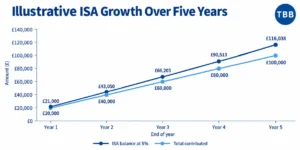
| End of year | Total contributed | ISA balance at 5% |
| Year 1 | £20,000 | £21,000 |
| Year 2 | £40,000 | £43,050 |
| Year 3 | £60,000 | £66,203 |
| Year 4 | £80,000 | £90,513 |
| Year 5 | £100,000 | £116,038 |
After five years, £100,000 of contributions would have grown to approximately £116,038 under those assumptions.
For comparison, suppose exactly the same deposits were held in a taxable savings account earning the same 5% before tax, but the saver was a 40% taxpayer who had already used their Personal Savings Allowance.
The effective return after 40% tax on the interest would be approximately 3%.
Under the same simplified assumptions, the account would be worth about:
£109,368
That is roughly £6,670 less than the ISA example after only five years.
This example is illustrative rather than a forecast. Investment returns can rise or fall, savings rates change, personal tax circumstances differ and taxable investment accounts are subject to different rules for dividends and capital gains.
What Happens If Someone Has Already Used the Full £20,000 ISA Allowance?
Using the ISA allowance does not necessarily mean all further saving or investing has to stop.
Several alternatives may be available depending on the person’s objectives.
Use a Spouse or Partner’s ISA Allowance
If a spouse or partner still has unused ISA capacity, they can use their own allowance.
Two eligible adults can potentially shelter £40,000 between their separate ISAs during 2026/27.
The money placed into the second person’s ISA legally belongs to that person, so ownership should be considered before transferring funds.
Consider Pension Contributions
Pensions provide a different form of tax-efficient saving.
The standard pension annual allowance for 2026/27 is £60,000, although the effective limit can be lower for higher earners and people who have flexibly accessed pension benefits.
Tax relief is also subject to separate earnings rules.
A pension should not be treated as a direct ISA replacement because access rules are much more restrictive.
Use a General Investment Account
A General Investment Account, commonly called a GIA, can be used when ISA capacity has been exhausted.
There is no equivalent £20,000 subscription cap, but investments outside an ISA can create taxable dividends and capital gains.
For 2026/27, the individual Capital Gains Tax annual exempt amount is £3,000, while the dividend allowance is £500.
Someone building a large taxable portfolio may therefore need to consider tax reporting and portfolio management more carefully.
Consider Premium Bonds
Premium Bonds can provide another tax-free home for cash.
An individual can currently hold up to £50,000 in Premium Bonds. Prizes are free of UK Income Tax and Capital Gains Tax.
However, Premium Bonds do not pay guaranteed interest. Returns depend on prize draws, so they are structurally different from a savings account or Cash ISA.
Use Ordinary Savings Accounts
A taxable savings account may still be suitable, particularly where a saver remains within their Personal Savings Allowance.
For 2026/27, the Personal Savings Allowance is:
- £1,000 for basic-rate taxpayers
- £500 for higher-rate taxpayers
- £0 for additional-rate taxpayers
Interest above the available allowance may be taxable.
Can Money Be Withdrawn and Put Back Without Using the Allowance Twice?
Sometimes.
This depends on whether the ISA is flexible.
A flexible ISA can allow a saver to withdraw money and replace it during the same tax year without the replacement consuming additional ISA allowance.
For example, suppose a saver:
- Pays £10,000 into a flexible ISA.
- Withdraws £3,000.
- Wants to put the £3,000 back before the end of the same tax year.
With a qualifying flexible ISA, the replacement can generally be made without using another £3,000 of allowance.
The person could still have £10,000 of ordinary unused allowance available, subject to the precise circumstances.
With a non-flexible ISA, withdrawing money does not normally restore the allowance.
GOV.UK gives the example of someone contributing £10,000 and then withdrawing £3,000. With a flexible ISA, £13,000 may then be available to pay in during that tax year; with a non-flexible ISA, only the unused £10,000 remains.
Not every provider offers flexible terms, so the account conditions should be checked before withdrawing money with the intention of replacing it.
What Is an Additional Permitted Subscription?
The normal £20,000 limit is not the only ISA subscription allowance that can exist.
When an ISA holder dies, their surviving spouse or civil partner may qualify for an Additional Permitted Subscription, usually shortened to APS.
An APS can provide the surviving spouse or civil partner with an additional ISA subscription entitlement connected to the deceased person’s ISA value.
Crucially, it is separate from the survivor’s normal annual ISA allowance.
A qualifying spouse could therefore potentially use their normal £20,000 allowance and make an additional subscription under the APS rules.
HMRC’s rules also allow APS entitlement in certain circumstances even where the surviving spouse or civil partner did not directly inherit the ISA assets.
Because deadlines and valuation rules apply, someone dealing with an inherited ISA should contact the ISA provider before moving the assets or making subscriptions.
Can More Than £20,000 Already Be Held in an ISA?
Absolutely.
There is no general rule limiting the total value of an adult ISA portfolio to £20,000.
The £20,000 limit controls annual subscriptions.
Someone who had contributed £20,000 every year for ten years could have contributed £200,000 before allowing for returns.
If those investments had also grown, the portfolio might be worth substantially more.
The growth itself does not use future ISA allowance.
What Happens If More Than £20,000 Is Accidentally Paid In?
Someone who believes they have exceeded the annual ISA subscription limit should avoid trying to fix the problem simply by withdrawing random amounts.
HMRC and ISA providers have procedures for dealing with invalid or excess subscriptions.
The appropriate correction can depend on whether the mistake occurred in the current or an earlier tax year.
Contacting the ISA provider is normally the sensible first step. Where necessary, HMRC can determine how an invalid subscription should be repaired.
Can £20,000 Be Put Into a Cash ISA Every Year?
For 2026/27, an eligible saver can still potentially put the full £20,000 adult allowance into Cash ISAs.
That position changes on 6 April 2027 for people under 65.
From that date:
- The overall annual ISA allowance remains £20,000
- The under-65 Cash ISA limit becomes £12,000
- People aged 65 and over retain a Cash ISA limit of £20,000
- The Lifetime ISA limit remains £4,000
- The Junior ISA limit remains £9,000
This makes the distinction between the overall ISA allowance and the Cash ISA sub-limit increasingly important.
Is It Worth Using the Full £20,000 ISA Allowance Every Year?
There is no universal requirement to use the full allowance.
Using an ISA can be valuable because qualifying interest, dividends and capital gains are sheltered from UK tax, but contributing the maximum should not take priority over basic financial needs.
A saver may first need to consider:
- Emergency cash requirements
- Expensive debt
- Planned short-term spending
- Pension provision
- Investment risk
- Access requirements
- Whether savings would generate taxable income outside an ISA anyway
Someone with £20,000 available for a future house deposit may have very different priorities from someone investing for retirement in 25 years.
The allowance is a tax wrapper, not an instruction to invest regardless of circumstances.
Final Thoughts
A UK saver can currently put up to £20,000 into ISAs every tax year, and a new allowance becomes available each 6 April.
For 2026/27, the full £20,000 can still potentially be held in Cash ISAs, Stocks and Shares ISAs, Innovative Finance ISAs or a combination, while a Lifetime ISA has its own £4,000 sub-limit.
Couples receive separate allowances, meaning two eligible adults could potentially shelter £40,000 a year, while Junior ISAs can add a further £9,000 per eligible child.
The main change to plan for arrives on 6 April 2027. The overall £20,000 ISA allowance remains, but people under 65 will generally be restricted to £12,000 of new Cash ISA subscriptions each year.
That distinction makes it increasingly important to separate the question “how much can be put into ISAs?” from “how much can be put specifically into a Cash ISA?”
Frequently Asked Questions
Can I Put £20,000 in an ISA Every Year?
Yes. The overall adult ISA allowance is £20,000 for 2026/27 and resets at the beginning of each tax year. The Government has said the overall £20,000 limit will remain until April 2031.
Can I Put £20,000 Into a Cash ISA and Another £20,000 Into a Stocks and Shares ISA?
No. The £20,000 is one overall adult ISA allowance. Putting £20,000 into a Cash ISA during 2026/27 would normally use the entire annual allowance.
Can I Have Two ISAs?
Yes. Savers can hold multiple ISAs and, under rules applying since April 2024, can generally subscribe to multiple ISAs of the same type during a tax year, while remaining within the overall subscription limit. Lifetime ISAs have additional restrictions.
Does Unused ISA Allowance Carry Over?
No. Ordinary unused ISA allowance normally expires at the end of the tax year on 5 April.
Can a Husband and Wife Each Put £20,000 Into an ISA?
Yes, provided each person is eligible. Each has their own individual £20,000 annual allowance, allowing a couple potentially to subscribe £40,000 between their separate ISAs during 2026/27.
Does Interest Count Towards the £20,000 ISA Limit?
No. Interest, dividends and investment growth generated inside the ISA do not count as new subscriptions.
Can an ISA Be Worth More Than £20,000?
Yes. There is no £20,000 maximum total ISA balance. The limit applies to new annual subscriptions.
How Much Can a Family Put Into ISAs?
Two eligible adults can potentially contribute £40,000 between their adult ISAs in 2026/27. Each eligible child also has a separate £9,000 Junior ISA limit. A two-adult, two-child household could therefore potentially subscribe £58,000 across four individually owned ISA allowances.
What Happens if the Full £20,000 Allowance Has Already Been Used?
Possible alternatives include a spouse or partner’s unused ISA allowance, pension contributions, a General Investment Account, Premium Bonds or ordinary savings accounts. Tax treatment, access and risk differ between these options.
Can Money Withdrawn From an ISA Be Put Back?
A flexible ISA can allow eligible withdrawals to be replaced during the same tax year without using additional allowance. A non-flexible ISA does not normally restore allowance when money is withdrawn.
Can Someone Continue Paying Into an ISA After Moving Abroad?
Generally not. Existing ISAs can normally remain open and retain their UK tax advantages, but a person who becomes non-UK resident usually cannot make new ordinary subscriptions until becoming UK resident again, unless a specific exception applies.
Is the Cash ISA Allowance Being Cut to £12,000?
Yes, for people under 65 from 6 April 2027. The overall annual ISA allowance remains £20,000, so the remaining allowance may potentially be used through other qualifying ISA types. People aged 65 and over retain a £20,000 Cash ISA limit.

More in Finance & Tax

Best Cash ISA Rates UK 2026: Highest Easy-Access and Fixed ISA Rates Compared
The best cash ISA rates currently reach around 4.61% AER for easy-access accounts and 4.93% AER for longer fixed terms, although rates can change quickly and the highest-paying account is not automatically the best choice for every saver. For 2026/27, adults can still put up to £20,000 into ISAs across the tax year. However, a […]

How Much Can You Put in an ISA? UK Limits for 2026/27 and 2027 Changes
A person can put up to £20,000 into ISAs during the 2026/27 tax year, which runs from 6 April 2026 to 5 April 2027. The £20,000 allowance is per person, not per household, and it can be divided between Cash ISAs, Stocks and Shares ISAs, Innovative Finance ISAs and a Lifetime ISA. There is an […]