
Updated: November 2026 | Covers confirmed 2026/27 rules and announced changes planned for 2027
Starting a side hustle during maternity leave in the UK can provide additional income, financial independence and an opportunity to build a flexible business.
However, earning money while receiving maternity pay requires careful consideration of employment status, HMRC rules and benefit entitlement.
A mother receiving Statutory Maternity Pay (SMP) can generally undertake genuine self-employed work without losing SMP. The position is different for someone receiving Maternity Allowance, where working days can directly affect benefit payments.
For 2027, another development makes small business opportunities particularly relevant. The government announced in October 2026 that it intends to increase the tax-free trading allowance from £1,000 to £3,000 from 6 April 2027, subject to legislation.
We analysed UK maternity-pay rules, self-employment obligations, startup costs, potential earnings and the flexibility of different business models.
Our findings indicate that the strongest maternity-leave side hustles generally combine low financial risk with flexible working arrangements and limited ongoing commitments.
This detailed guide examines 12 opportunities, compares their earning potential, explains the rules for SMP and Maternity Allowance, and helps new mothers decide whether a side business is financially worthwhile.
Can You Start a Side Hustle While on Maternity Leave in the UK?
Yes. Starting a side hustle on maternity leave is possible in the UK, but the effect on maternity payments depends on the type of work you undertake and the maternity benefits you receive.
Many mothers are employed before giving birth and receive SMP through their employer. Others, including self-employed mothers, may qualify for Maternity Allowance from the Department for Work and Pensions (DWP).
These arrangements have different rules.
| Situation | Can you earn side-hustle income? | Main consideration |
| Receiving SMP and genuinely self-employed | Generally yes | Self-employment does not normally affect SMP |
| Receiving Maternity Allowance | Limited working permitted | Self-employed work counts towards KIT days |
| Employed on maternity leave with a pre-existing second job | Potentially yes | Qualifying-week rules matter |
| Starting a new employed job after childbirth | SMP may be affected | Weeks worked for the new employer are relevant |
| Receiving enhanced contractual maternity pay | Depends on terms | Employment contract and maternity policy |
| Receiving Universal Credit | Generally yes | Income and profit must be reported and can affect UC |
| Unpaid maternity-leave period | Generally possible | Contractual, health and benefits rules still matter |
The distinction between employment and self-employment is particularly important.
Someone selling their own digital products, providing freelance services or operating an independent online store may be genuinely self-employed. However, a worker engaged through an agency or a platform may have a different employment or tax status.
The label used by a platform is not sufficient by itself.
We recommend understanding the difference between a side hustle and a second job before accepting paid work.
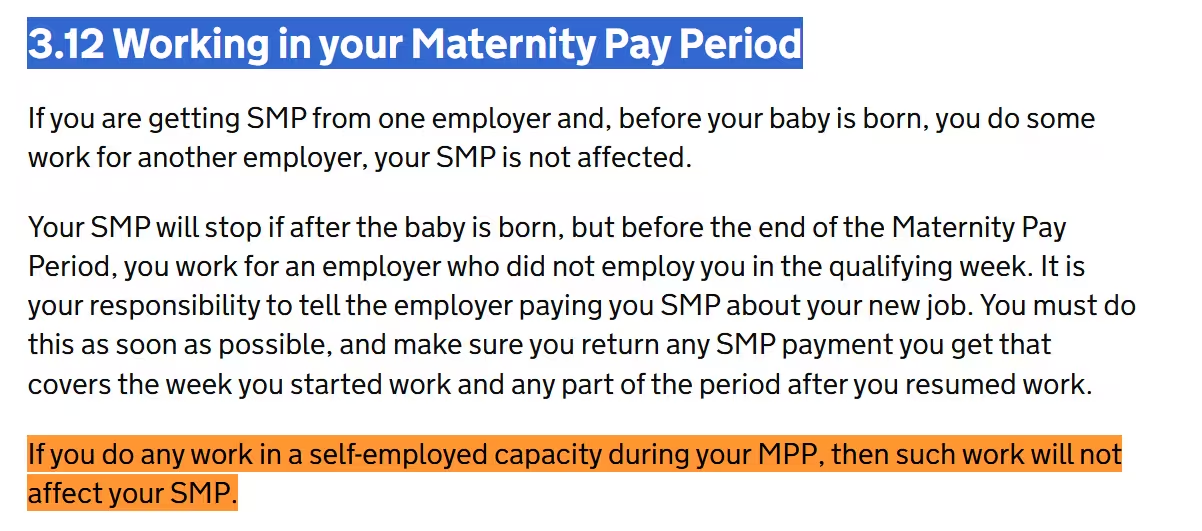
Official HMRC guidance confirms that genuine self-employed work during the Statutory Maternity Pay period does not normally affect SMP entitlement.
How Much Maternity Pay Can You Receive in 2026 and 2027?
Statutory Maternity Pay provides eligible employees with payments for up to 39 weeks, although statutory maternity leave can last up to 52 weeks.
The amount received depends on previous average earnings and the stage of maternity leave.
Confirmed Statutory Maternity Pay Rates for 2026/27
| Maternity period | Payment |
| First six weeks | 90% of average weekly earnings before tax |
| Following 33 weeks | £194.32 weekly or 90% of average earnings, whichever is lower |
| Final 13 weeks of a full 52-week leave | No statutory maternity pay |
| Total statutory paid period | Up to 39 weeks |
The £194.32 standard weekly rate applies from 5 April 2026.
For employees to qualify for SMP under the 2026/27 rules, they generally need average weekly earnings of at least £129, alongside the required employment history and notice conditions.
SMP is subject to Income Tax and National Insurance through payroll where applicable.
Employers sometimes provide enhanced or occupational maternity pay above the statutory minimum. Those additional payments may come with conditions, so employment contracts require separate attention.
What about 2027/28?
The standard SMP rate for the 2027/28 tax year had not been officially confirmed as of 11 November 2026. Mothers planning finances for April 2027 onwards should check the subsequently published rate rather than treating £194.32 as a guaranteed figure for the next tax year.
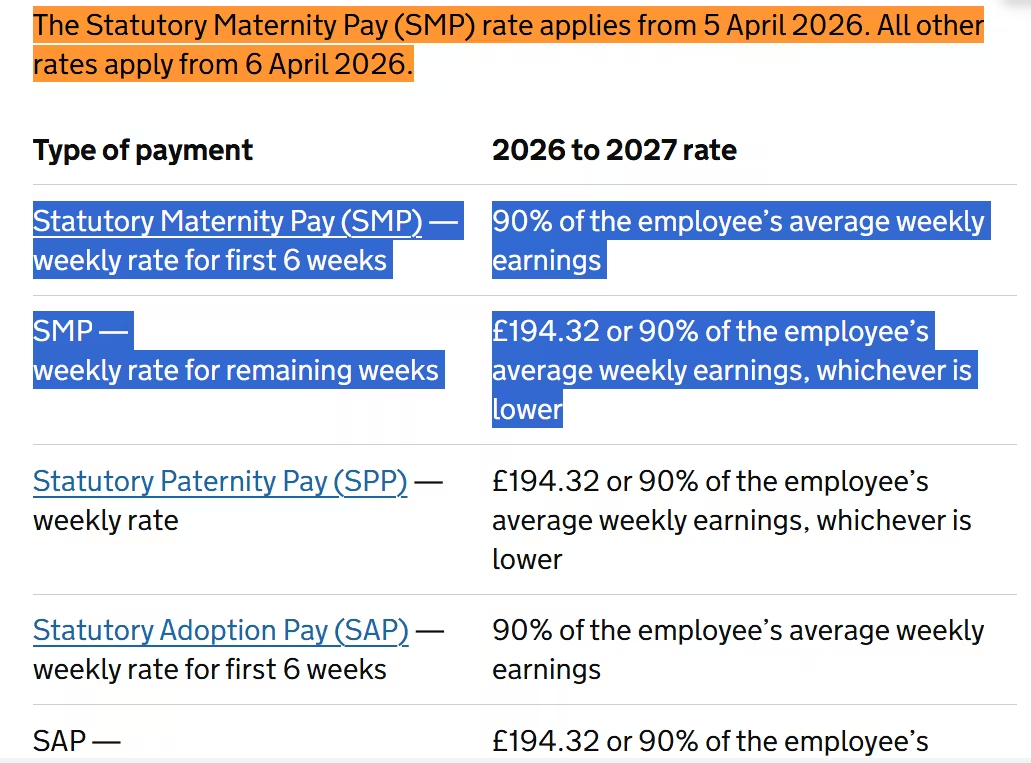
GOV.UK confirms the £194.32 weekly Statutory Maternity Pay rate for 2026/27, alongside the 90% average earnings calculation.
What Are the 12 Best Side Hustles on Maternity Leave in the UK?
Our assessment prioritises four practical factors: working-time flexibility (35%), affordability of setup (25%), earning potential (25%) and manageability around childcare and recovery (15%).
Each percentage score represents our editorial assessment against those factors. It is not a verified customer satisfaction rating or a prediction of success.
| Side hustle | Illustrative earning potential | Initial setup budget | Our suitability score |
| Selling unwanted clothes and baby items | £30–£250 from an initial clear-out | £0–£20 | 96% |
| Selling digital downloads | £0–£300 monthly once established | £0–£50 | 94% |
| Freelance proofreading | £12–£25 per billable hour | £0–£50 | 92% |
| Virtual assistant services | £15–£30 per billable hour | £0–£100 | 91% |
| Online tutoring | £18–£35 per lesson hour | £0–£50 | 89% |
| Social media support | £100–£350 per small client monthly | £0–£75 | 88% |
| Freelance bookkeeping | £15–£35 per billable hour | £50–£250+ | 86% |
| User-generated content creation | £50–£200 per small project | £0–£100 | 84% |
| AI evaluation and data tasks | £10–£25 per active hour | £0–£30 | 82% |
| Handmade products | £50–£300 monthly in sales | £50–£200 | 79% |
| Home baking | £60–£300 monthly in sales | £75–£250 | 76% |
| Paid online surveys | £10–£60 monthly | £0 | 72% |
Earnings are illustrative planning ranges, not verified average earnings. Actual income can be zero, depends on client demand, and is before relevant costs and taxes. Hourly figures refer to paid or billable time, not time spent finding customers.
1. Selling Unwanted Clothes and Baby Items — 96% Suitability
Selling unwanted personal belongings is one of the simplest ways to generate additional money without establishing a full business.
Popular categories include maternity clothes, baby outfits, children’s clothing, unused accessories and household items.
Platforms such as Vinted, eBay and local resale marketplaces make it possible to list items from home.
Why we rate it highly: A parent can photograph products, prepare listings and package orders whenever convenient. There is no obligation to accept regular customers or meet fixed working hours.
For example, selling 20 unwanted items at an average price of £8 would generate £160 before any selling or postage costs.
Our review of Vinted earning opportunities highlights the importance of distinguishing sales income from genuine profit.
There is also a significant tax distinction. Selling your own unwanted belongings is generally not the same as trading. Buying products specifically to resell for a profit, however, may constitute a business.
For someone receiving Maternity Allowance, active commercial reselling may also count as working. The tax treatment of sales and the benefit rules are separate questions.
2. Selling Digital Products — 94% Suitability
Digital products offer one of the strongest long-term business models for mothers who prefer to work from home.
Potential products include printable planners, household budgeting templates, wedding planners, educational worksheets, meal-planning sheets, spreadsheets and downloadable design templates.
Unlike physical products, digital downloads usually require no packaging or postal fulfilment.
Our financial assessment: The initial workload involves creating products, writing descriptions, pricing and finding customers. Once established, additional sales may require relatively little fulfilment work, although customer service, product updates and promotion still take time.
Consider a digital planner selling for £6.
If a seller makes 50 sales in a month, revenue equals £300. If associated fees and software costs total £60, the illustrative cash profit is £240 before tax.
This is not guaranteed passive income. New stores can experience long periods without sales.
A beginner interested in digital products can explore the process of starting an Etsy side hustle before investing in paid advertising.
3. Freelance Proofreading and Editing — 92% Suitability
Proofreading can be suitable for mothers with strong written English, attention to detail and previous office, education or publishing experience.
Potential clients include small businesses, academic professionals, website owners, independent authors and marketing agencies.
Common assignments involve reviewing spelling, grammar, punctuation, clarity and document consistency.
The main advantage is that much of the work is asynchronous. A client can provide a document and agree on a deadline without requiring continuous live communication.
An illustrative £20 hourly rate for six billable hours per week would produce £120 weekly revenue.
However, client acquisition, administration and revisions may involve additional unpaid time.
We consider proofreading most suitable for parents who already possess the required skills and can agree realistic turnaround times rather than accepting urgent assignments.
4. Virtual Assistant Services — 91% Suitability
A virtual assistant supports businesses remotely with administrative tasks.
Services may include email management, appointment scheduling, spreadsheet updates, document formatting, customer correspondence, data entry and basic social media administration.
Many small businesses cannot justify employing a full-time administrative worker but still need regular support.
Our financial assessment suggests that virtual assistance becomes more attractive when the individual offers a defined service rather than advertising unrestricted availability.
For example, five billable hours weekly at £20 per hour would produce approximately £400 over a four-week period.
The main difficulty is avoiding work that requires immediate replies while caring for a newborn.
An asynchronous task package with agreed delivery times is generally more manageable than live customer support.
See the detailed virtual assistant startup guide for service planning, pricing and finding clients.
5. Online Tutoring — 89% Suitability
Online tutoring allows individuals with subject knowledge to provide lessons remotely.
Potential subjects include mathematics, English, science, languages, music theory and examination preparation.
An illustrative four one-hour lessons each week at £25 per lesson would produce £400 in revenue over four weeks, before any costs.
The earning potential can be attractive compared with lower-paid microtasks.
However, tutoring requires uninterrupted time and preparation. Parents may need reliable childcare or another adult to look after the baby during lessons.
Tutoring can also involve safeguarding and appropriate insurance considerations, especially where children are involved.
Our UK tutoring side hustle guide covers practical startup requirements.
We rate tutoring highly for mothers who already have educational experience, but less highly where childcare arrangements are unpredictable.
6. Social Media Management — 88% Suitability

Small businesses increasingly need help maintaining their online presence.
A freelance social media assistant may offer post scheduling, caption writing, content calendars, basic design, inbox organisation and performance reporting.
The business model works best when services are packaged into monthly deliverables.
For example, two small clients paying £175 a month each would generate £350 in monthly revenue before expenses.
We would prioritise scheduled content and reporting services rather than live community management, as the latter may require immediate responses throughout the day.
Existing marketing experience helps, but a clear portfolio can be more useful than purchasing expensive introductory courses.
7. Freelance Bookkeeping — 86% Suitability
Bookkeeping is a potentially sustainable long-term business for mothers with accounting, finance or administrative experience.
Small businesses regularly need help recording transactions, reconciling bank accounts, organising invoices and maintaining financial records.
Unlike one-off selling, bookkeeping can create repeat monthly income.
However, it requires accuracy, professional responsibility and an understanding of the relevant regulatory requirements.
In the UK, some bookkeeping services may require anti-money-laundering supervision. Qualifications, insurance and professional membership may also be relevant depending on the services provided.
Our bookkeeping side hustle analysis examines the role of AAT qualifications and the economics of starting.
We recommend this option primarily to mothers who already have suitable knowledge or intend to build a business after maternity leave.
8. User-Generated Content Creation — 84% Suitability
User-generated content, commonly called UGC, involves producing photographs, demonstrations or short videos for brands.
A creator might produce product demonstrations, lifestyle videos or simple promotional material without maintaining a large social media following.
For a new mother, relevant commercial niches could include household organisation, home products, parenting accessories and family lifestyle content.
A small video project might be priced at £50–£200, depending on production time, revisions and usage rights.
The financial risks include spending too much time creating unpaid samples, purchasing unnecessary equipment or accepting unclear contracts.
Our assessment favours fixed-scope projects where clients specify deliverables and payment terms.
Mothers should not feel obliged to feature their baby or disclose private family information to generate income.
9. AI Evaluation and Data Tasks — 82% Suitability
AI-related contract work can include reviewing written responses, checking factual accuracy, categorising content and evaluating language quality.
Some opportunities allow tasks to be completed remotely without customer calls.
However, availability is irregular, and platform acceptance may depend on assessments, language skills, subject expertise or location.
For this reason, we would not build a maternity-leave household budget around expected AI-task earnings.
The effective hourly rate should include time spent qualifying for tasks and waiting for suitable work.
The broader market is covered in our AI side hustles comparison.
Before accepting tasks, confirm whether the agreement creates genuine self-employment rather than PAYE employment.
10. Selling Handmade Products — 79% Suitability
Creative businesses can be attractive to mothers who already make jewellery, knitted products, personalised gifts, artwork or home accessories.
The financial challenge is that selling handmade goods involves more than the cost of materials.
Packaging, platform charges, equipment, failed products, delivery and time all affect profitability.
Suppose a handmade item sells for £20, with £9 in materials, packaging and platform fees.
The cash contribution would be £11 before overheads, tax and the value of the seller’s time.
If it took an hour to make, photograph and package, the business would generate substantially less than £20 for that hour.
A specialised business such as candle making may also involve product safety and labelling requirements.
We recommend beginning with small batches and confirmed customer interest rather than purchasing large quantities of stock.
11. Starting a Home Baking Business — 76% Suitability
Home baking may appeal to mothers who already make cakes, biscuits, brownies or celebration products.
There can be opportunities through local customer orders and repeat business.
Nevertheless, home food businesses require more administration than many online guides suggest.
Food business registration, hygiene requirements, allergen information, safe preparation and suitable facilities must be considered.
In most cases, a new food business must register with the relevant local authority at least 28 days before trading begins.
There are also time-sensitive production requirements. Customer orders may need to be prepared on specific days, which can be difficult alongside unpredictable childcare.
The detailed home baking business guide explains the legal setup.
Our assessment is that baking can work well for experienced home bakers with family support, but it is not necessarily the easiest maternity-leave business to operate.
12. Paid Online Surveys — 72% Suitability

Paid surveys offer a low-commitment option for parents who are not ready to manage customers or operate a larger business.
Tasks may involve giving opinions about consumer products, shopping habits, online services or advertising.
The main benefit is convenience.
However, surveys usually offer limited earning potential, and users may be screened out after spending time answering eligibility questions.
We therefore classify surveys as supplementary income rather than a serious substitute for maternity pay.
Our comparison of UK paid survey sites helps distinguish potentially worthwhile services from low-value opportunities.
For mothers needing more substantial earnings, a skill-based freelance service is generally a stronger commercial proposition.
Does Self-Employment Affect Statutory Maternity Pay?
Genuine self-employment does not normally stop Statutory Maternity Pay received from a separate employed position.
This is a major advantage for mothers exploring a small business during maternity leave.
For example, a marketing employee receiving SMP could potentially start an independent freelance writing business and earn money from separate customers without affecting her statutory maternity payments.
However, several conditions still matter.
First, the work must genuinely be self-employed. Calling an activity freelance does not automatically determine its legal status.
Second, the mother’s employment contract may contain restrictions on outside work, competing activities, confidentiality or conflicts of interest.
Third, enhanced maternity-pay arrangements may have separate contractual conditions.
Fourth, self-employed profits can still create tax liabilities and affect means-tested benefits.
We recommend checking the relevant employment contract and understanding whether someone can remain employed while operating as a sole trader.
What Happens If You Start a New Employed Job?
Working for a new employer after childbirth can affect SMP if that employer did not employ you in the statutory qualifying week.
The rules are more nuanced than simply saying that every second job automatically ends maternity payments.
Existing second employment, work performed before childbirth and employment that began after the qualifying week may be treated differently.
HMRC guidance distinguishes maternity weeks in which an individual works for a new employer from weeks when no such work takes place. There are also specific rules concerning the ending of that employment.
Before accepting a new PAYE job, agency assignment or employment contract, seek confirmation of its effect on SMP.
For mothers seeking flexible income, genuine self-employment may be a more suitable arrangement, provided the work and contractual restrictions are compatible.
What Are Keeping in Touch Days During Maternity Leave?
Keeping in Touch days, commonly called KIT days, allow an eligible employee to perform limited work for her employer during maternity leave without automatically ending her leave or losing SMP.
Employees can generally work up to ten KIT days by agreement with their employer.
These days can cover training, occasional duties, meetings or activities related to returning to work.
Several points are important:
- KIT days are voluntary for both employee and employer.
- Any work performed on a day normally counts as a full KIT day, even if the employee works for only one hour.
- Payment for KIT days must be agreed, subject to applicable statutory requirements.
- Working beyond ten KIT days can mean losing SMP for weeks in which additional work takes place and may bring maternity leave to an end.
- KIT days cannot be used during the compulsory maternity-leave period immediately following childbirth.
A common misconception is that every additional day beyond the permitted ten permanently eliminates all remaining SMP. The actual consequences depend on the relevant statutory rules and working arrangements.
Importantly, genuine self-employed work performed independently of the employer paying SMP does not normally consume that employer’s KIT-day allowance.
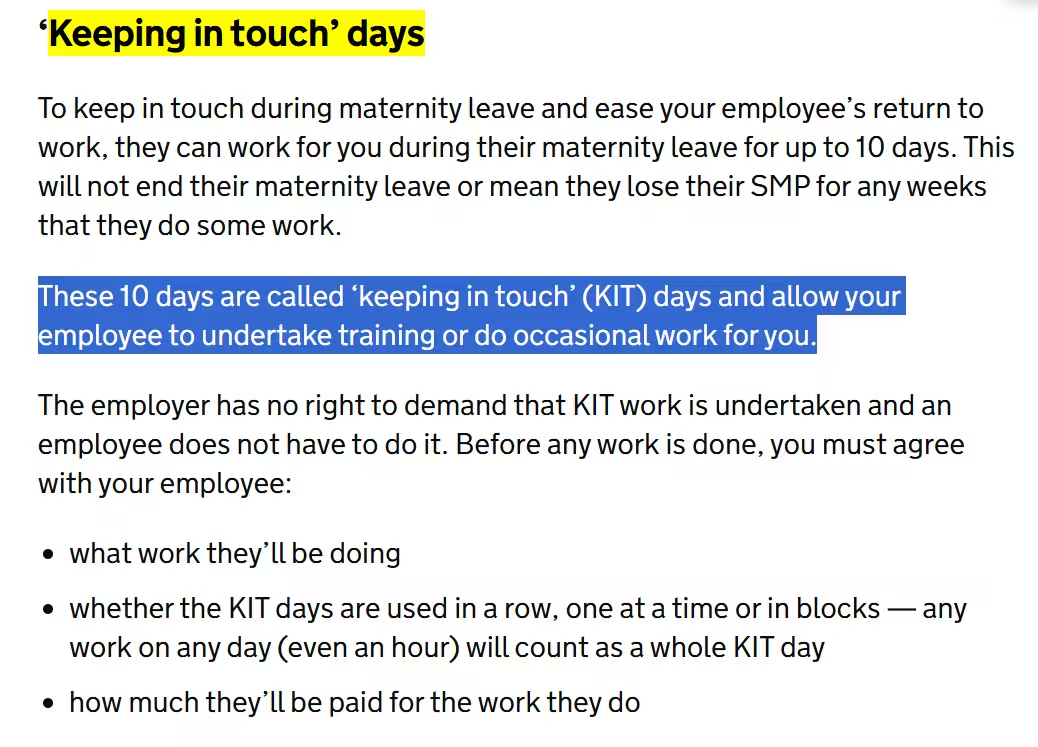
HMRC explains the ten-day KIT entitlement, how partial working days are counted and the consequences of exceeding the limit.
Can You Run a Side Hustle While Receiving Maternity Allowance?
Yes, limited work may be permitted, but the rules are more restrictive than for someone receiving SMP.
Maternity Allowance is generally intended for eligible mothers who cannot receive Statutory Maternity Pay, including many self-employed women.
Under the confirmed 2026/27 arrangements, the standard maximum Maternity Allowance is £194.32 per week, or 90% of average earnings if that is lower. Some claimants qualify for a lower rate depending on their circumstances.
The central distinction is that self-employed work counts towards the ten permitted KIT days for Maternity Allowance.
This includes actively carrying out business duties, even if the work is not performed for a traditional employer.
For example, a self-employed designer receiving Maternity Allowance who completes client assignments on several separate days may be using her permitted KIT days.
When more than ten days of work are undertaken, the DWP may disqualify payments for additional days or impose a more significant restriction, depending on the circumstances.
It is not safe to assume that working every evening is permitted simply because the total weekly hours are low.
There is also a difference between carrying out work and receiving money from earlier activity.
For example, income arriving from a business while the claimant performs no work may be treated differently from income generated by actively completing new assignments.
We recommend contacting the Maternity Allowance service before starting or restarting regular self-employment, and reporting every relevant working day.
How Much Side-Hustle Income Is Tax-Free in 2027?
The tax position is especially important for mothers planning to begin a small business during 2027.
In October 2026, the UK Government announced plans to increase the trading allowance and associated Self Assessment reporting threshold from 6 April 2027.
The legislation was proposed for Finance Bill 2026–27.
| Tax rule | 2026/27 confirmed | 2027/28 announced plan |
| Trading allowance | £1,000 | £3,000 |
| Relevant Self Assessment reporting threshold | Generally £1,000 gross trading income | Planned £3,000 |
| Relevant income period | 6 April 2026–5 April 2027 | 6 April 2027–5 April 2028 |
| Legislative position | Existing law | Subject to Finance Bill legislation |
The proposed higher allowance is particularly relevant to low-cost activities such as proofreading, digital downloads and small freelance projects.
However, three qualifications matter.
First, the threshold concerns qualifying gross trading receipts rather than earnings after expenses.
Second, the tax allowance does not automatically protect Maternity Allowance or Universal Credit.
Third, the £3,000 change should only be treated as operative from April 2027 once the necessary legislation takes effect.
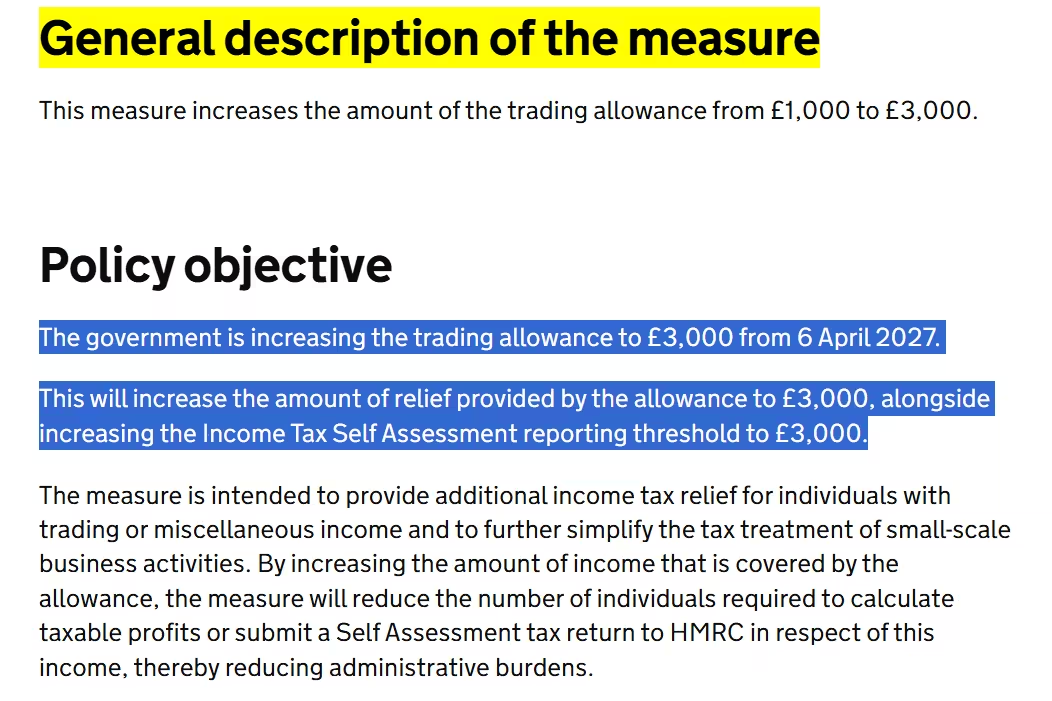
HMRC’s October 2026 announcement outlines the proposed increase in the trading allowance from £1,000 to £3,000 from 6 April 2027.
How Does the Trading Allowance Work in Practice?
Consider a mother who operates a small design service and generates £2,400 in qualifying gross trading income during a tax year.
Under the current £1,000 rules, that amount exceeds the threshold that would normally require reporting.
Under the proposed £3,000 allowance from April 2027, the same qualifying annual receipts could be covered by the higher allowance, subject to the applicable conditions.
This could make small side businesses easier to manage.
However, the allowance does not mean that someone can ignore business records, contractual obligations or Universal Credit reporting requirements.
Our explanation of the UK trading allowance provides further background on the existing rules.
How Much Could You Actually Keep From a Maternity-Leave Side Hustle?
Revenue and profit are not the same.
A side hustle generating £300 in sales may produce considerably less cash profit once operating costs are deducted.
Our three scenarios show why mothers should evaluate earnings after expenses rather than relying on advertised hourly rates.
Example 1: Virtual Assistant Work
| Calculation | Four-week period |
| Five billable hours weekly | 20 hours |
| Hourly client rate | £20 |
| Total revenue | £400 |
| Software and business costs | £20 |
| Illustrative profit before tax | £380 |
If this workload were repeated for twelve four-week periods, total revenue would reach £4,800.
This would exceed both the current £1,000 threshold and the proposed £3,000 threshold for 2027/28.
It would therefore be necessary to assess tax reporting requirements and choose the appropriate treatment of qualifying expenses.
Example 2: Digital Downloads
| Calculation | Monthly amount |
| 50 product sales | £300 |
| Platform and processing costs | £45 |
| Software expenses | £15 |
| Illustrative profit before tax | £240 |
The business has a potentially attractive contribution margin, but obtaining those 50 sales requires customer demand.
Low operating costs do not automatically translate into a high effective hourly rate, especially when product creation and marketing are considered.
Example 3: Small Reselling Business
| Calculation | Monthly amount |
| Sales of stock bought for resale | £220 |
| Stock purchase costs | £110 |
| Postage, packaging and fees | £25 |
| Illustrative profit before tax | £85 |
This example shows why turnover alone is a poor measure of financial success.
A mother might generate £220 in revenue yet retain only £85 before tax and other costs.
Separately, selling unwanted personal belongings normally has different tax implications from purchasing stock for resale.
For more detailed calculations, our side hustle tax guide explains how different income streams interact with HMRC rules.
Should You Claim the Trading Allowance or Actual Business Expenses?
A qualifying sole trader generally needs to compare the available trading allowance with deductible actual business expenses.
The two approaches cannot ordinarily be combined against the same income.
For example, under the announced 2027/28 proposal:
- Gross qualifying income: £5,000
- Actual allowable expenses: £1,200
- Proposed trading allowance: £3,000
Using actual expenses would leave £3,800 in taxable trading profit before other adjustments.
Using the proposed £3,000 allowance would leave £2,000 instead.
The allowance would therefore produce the lower taxable figure in this simplified example.
Conversely, a business with £4,000 of qualifying expenses may achieve a better result by claiming actual costs.
Our guide to allowable side hustle expenses explains common categories such as software, materials, equipment and platform fees.
The best option depends on individual income, expenses and tax circumstances.
Will a Side Hustle Reduce Universal Credit During Maternity Leave?
A side hustle may affect Universal Credit even where the income is covered by HMRC’s trading allowance.
This is because tax rules and means-tested benefit calculations operate independently.
For mothers receiving SMP, statutory maternity payments generally count as earnings when Universal Credit is calculated.
Self-employed income is also assessed, and claimants must report business income and allowable expenses for each monthly assessment period.
For 2026/27, the monthly work allowances for eligible claimants are:
| Circumstances | Monthly work allowance |
| Universal Credit includes housing costs | £427 |
| No housing costs included | £710 |
These allowances apply to eligible households, including those responsible for children.
After the applicable work allowance has been used, Universal Credit generally decreases by 55p for each additional £1 of earnings counted in the calculation.
Example: Earning £200 Additional Profit
Assume a mother has already used her available work allowance through SMP and other relevant earnings.
If she generates an additional £200 of assessable self-employed earnings, the potential Universal Credit reduction would be:
£200 × 55% = £110.
She would retain an effective £90 increase in household income before any additional tax or other consequences.
This simplified example illustrates why £200 of business profit does not necessarily result in £200 of additional disposable income.
The actual calculation depends on the household’s income, allowable expenses, deductions, circumstances and assessment period.
The rules are different for Maternity Allowance. MA is treated as unearned income for Universal Credit, and the relevant payment is deducted pound for pound from the UC award rather than using the earnings taper.
The subject is explained further in our side hustles and Universal Credit guide and benefits income-limit analysis.
Does the Minimum Income Floor Apply to New Mothers?
Not every self-employed Universal Credit claimant is subject to the Minimum Income Floor.
Its application depends on whether the person is classified as gainfully self-employed, whether an eligible startup period applies and their work-related requirements.
The main carer of a child under one is not normally expected to look for work under Universal Credit rules.
This is relevant when assessing work-related conditions, but it does not eliminate the requirement to report self-employment income and expenses.
We recommend discussing individual circumstances with a Universal Credit work coach rather than assuming that every new business automatically receives a twelve-month exemption.
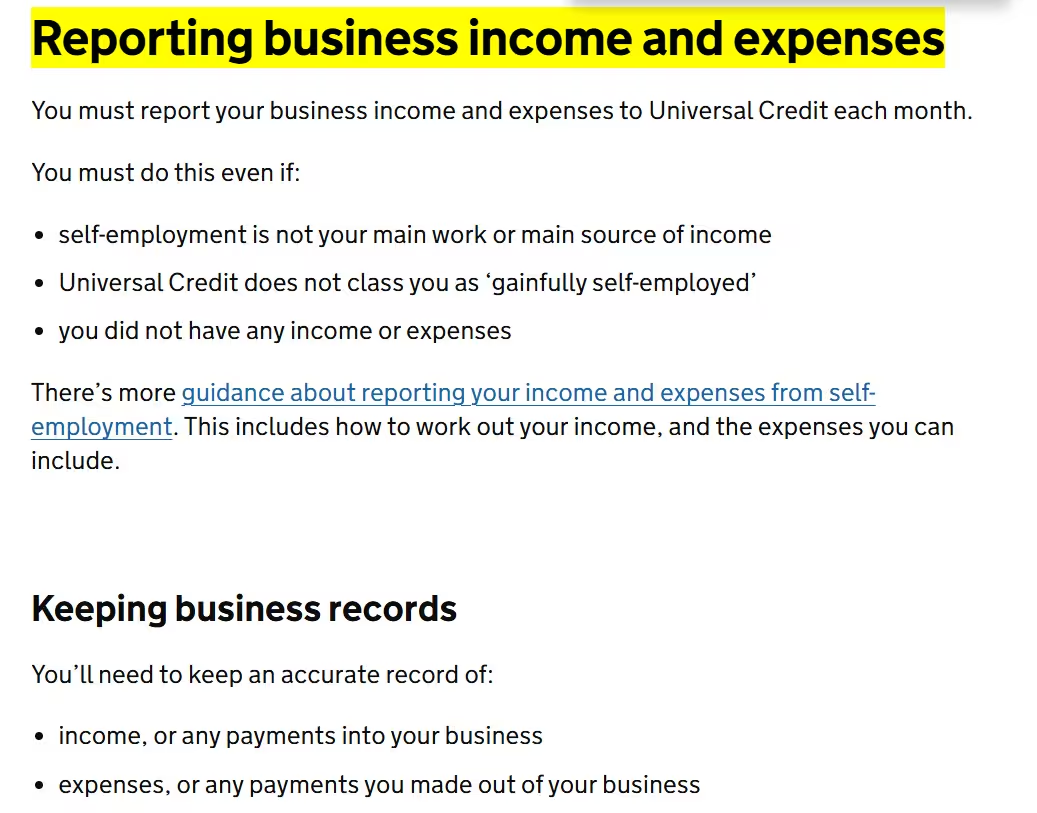
GOV.UK explains how self-employed income must be reported to Universal Credit and when the Minimum Income Floor may apply.
How Do You Start a Side Hustle During Maternity Leave Without Taking Unnecessary Financial Risks?
The strongest approach is to start with financial safeguards rather than a target income figure.
- Step 1: Confirm Your Maternity-Pay Position: Identify whether you are receiving SMP, Maternity Allowance, enhanced employer maternity pay or another arrangement.Check the specific rules before accepting work.
- Step 2: Review Your Employment Contract: Look for restrictions relating to outside employment, conflicts of interest, confidentiality, competing businesses and enhanced maternity pay.Our guide on telling an employer about a side hustle covers these contractual considerations.
- Step 3: Select One Low-Cost Opportunity: Avoid launching several businesses simultaneously.Our analysis favours using an existing skill, such as administration, writing, design or teaching, because it reduces both setup expenses and training requirements.Those without available startup capital can explore zero-investment side hustles.
- Step 4: Set a Realistic Working Schedule: A newborn’s routine can change unexpectedly.Rather than accepting fixed daily commitments, prioritise projects with agreed deadlines and opportunities to decline work.Protect time for recovery, feeding, rest and childcare. There is no requirement to monetise maternity leave.
- Step 5: Check Registration and Insurance Requirements: Depending on the activity, a mother may need to register as self-employed, obtain insurance, comply with food safety rules or meet sector-specific obligations.The sole trader registration process explains the practical steps for operating a business in the UK.
- Step 6: Record Income, Expenses and Working Days: Maintain records of customer payments, operating costs, business purchases and invoices.If receiving Maternity Allowance, recording actual working days is especially important.Someone already registered for Self Assessment should also monitor relevant registration and filing deadlines.
- Step 7: Review Profitability Before Expanding: After the first month, calculate the net financial return.
Our suggested formula is:
Effective hourly return = profit before tax ÷ total hours spent on the business
Include unpaid activities such as customer acquisition, administration, travel and product preparation.
This measure provides a more accurate comparison than advertised hourly rates.
If a business produces £120 in profit but requires 20 hours of work, the effective return is only £6 per hour.
That may be acceptable for a developing business, but it should be understood before committing more time or money.
Which Maternity-Leave Side Hustles Should You Avoid?
Not every popular side hustle is appropriate for new mothers.
Our assessment identifies several categories that may carry disproportionate financial, legal or operational risks.
| Side hustle type | Main concern | Our assessment |
| Multi-level marketing schemes | Stock purchases, recruitment pressure and uncertain returns | High caution |
| Expensive dropshipping packages | Advertising costs, customer disputes and weak margins | High caution |
| Guaranteed-income online courses | Unsupported earnings claims and upfront fees | High caution |
| New PAYE employment during SMP | Potential effect on maternity payments | Check before accepting |
| Regular active trading during Maternity Allowance | KIT-day restrictions | High caution |
| Delivery work immediately after childbirth | Physical demands, costs and recovery | Generally unsuitable initially |
| Businesses requiring large stock purchases | Financial exposure if demand is weak | High caution |
A side hustle should improve household finances rather than create new obligations that exceed its potential benefit.
The most important financial question is not how much revenue a business might generate, but how much value it can realistically contribute after costs, tax, benefit interactions and time commitments.
What Changes in 2027 for Maternity Leave and Side Businesses?
Three developments deserve particular attention.
- First, the proposed trading allowance increase: The government’s October 2026 announcement provides for a £3,000 allowance and corresponding reporting threshold from 6 April 2027, subject to the Finance Bill being enacted.
- Second, statutory maternity payment uprating: The confirmed 2026/27 figures remain the relevant published baseline until the government releases the 2027/28 rates.
- Third, employment protections: The government’s updated Employment Rights Act implementation timetable schedules enhanced dismissal protections for pregnant women and new mothers and flexible-working reforms for October 2027. These are workplace rights rather than separate exemptions from maternity-pay or tax rules.
For mothers considering returning to employment while maintaining a small business, these developments make forward financial planning especially relevant.
Our assessment is that 2027 could offer improved tax treatment for modest self-employment income, but that should not be confused with unrestricted permission to work while receiving Maternity Allowance.
Our Final Financial Assessment: Is a Side Hustle Worth Starting on Maternity Leave?
A maternity-leave side hustle can be worthwhile when the activity fits the parent’s personal circumstances and provides a meaningful financial return.
Our analysis places selling unwanted belongings, digital downloads, proofreading and virtual assistant services among the most suitable options because they generally require limited startup capital and offer comparatively flexible working patterns.
However, the best option depends on whether the mother receives SMP or Maternity Allowance, the time available, existing skills, childcare support and household benefit entitlement.
The announced increase in the trading allowance to £3,000 from April 2027 could further support small-scale entrepreneurship if enacted as planned.
We recommend beginning with one manageable activity, confirming the maternity-pay rules before working, testing genuine customer demand and reviewing profit after expenses.
The strongest side hustle is not necessarily the one with the highest advertised income. It is the one that generates sustainable financial value without jeopardising maternity entitlement, household stability or personal wellbeing.
Editorial note: Legal and financial information reviewed in November 2026. Proposed 2027 changes and illustrative earnings should be checked against updated official rules before decisions are made. This article provides general information rather than individual legal, tax or benefits advice.
Frequently Asked Questions
Can I Earn £500 a Month While on Maternity Leave in the UK?
Potentially, yes. If the income comes from genuine self-employment, it will not normally affect SMP. However, Maternity Allowance rules, employment contracts, Income Tax and Universal Credit can change the outcome. The amount alone does not determine eligibility.
Can I Start an Etsy Business While Receiving Statutory Maternity Pay?
Generally, yes, where the Etsy business is genuine self-employment and compatible with contractual restrictions. Trading income may still need to be declared to HMRC and reported for Universal Credit purposes.
Can I Sell on Vinted Without Paying Tax During Maternity Leave?
Selling unwanted personal belongings is generally not subject to Income Tax as trading income. However, buying goods specifically for resale can be trading. Separate Capital Gains Tax rules may apply to certain valuable possessions.
Can I Work From Home While Receiving Maternity Allowance?
Limited work is possible, but self-employed activity counts towards the ten permitted KIT days. Working beyond that limit can affect payments. You should contact the Maternity Allowance service before undertaking regular paid work.
How Much Can I Earn Tax-Free From a Side Hustle in 2027?
The government announced plans to raise the trading allowance from £1,000 to £3,000 from 6 April 2027, subject to legislation. It applies to qualifying gross trading income and does not automatically exempt income from Universal Credit reporting.
Do I Need to Tell My Employer About a Side Hustle During Maternity Leave?
There is no universal requirement to disclose every side hustle, but the employment contract may require notification or permission. Enhanced maternity-pay conditions, conflicts of interest and confidential information also need consideration.
Will Earning Money From Home Reduce My Universal Credit?
It can. Self-employed earnings are assessed under Universal Credit rules, separately from HMRC’s trading allowance. Where the earnings taper applies, UC generally reduces by 55p for each £1 above the applicable work allowance.

More in By Profession

Highest Paid Jobs UK: Top 20 Careers by Salary in 2026
The highest paid jobs in the UK are concentrated around senior business leadership, medicine, technology, aviation, finance, transport and specialist management. But there is an important difference between the highest typical salary and the highest salary someone could potentially earn. For the clearest comparison, this guide ranks occupations using median full-time gross annual earnings from […]

SOC Code With Salary: UK Skilled Worker Rates List 2026
A UK SOC code identifies the type of work a person will perform. For most new Skilled Worker visa applications, the salary must be at least £41,700 per year or the full going rate for the relevant SOC 2020 occupation code, whichever is higher. Lower thresholds may apply to qualifying new entrants, people with relevant […]