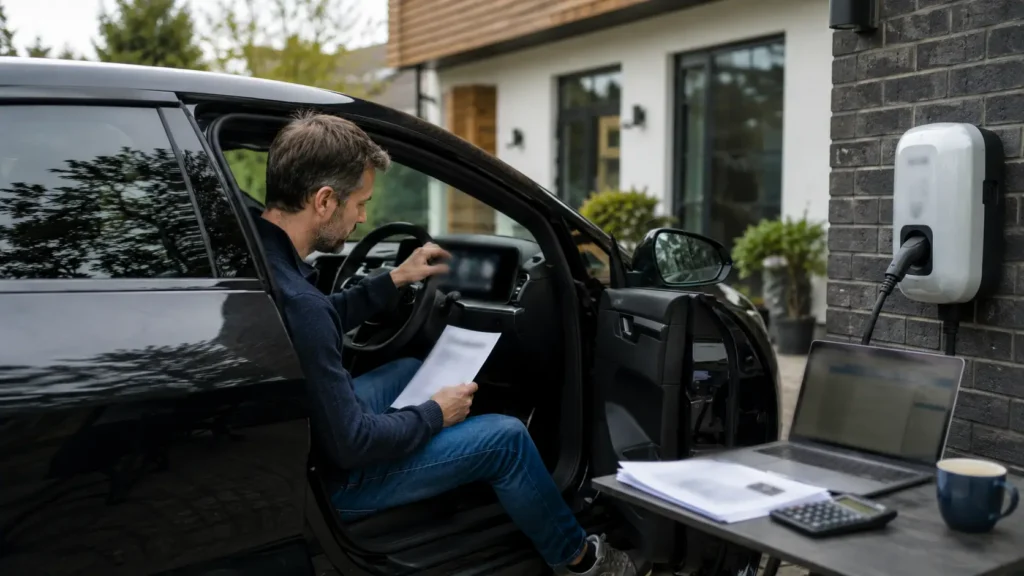
Electric car drivers in the UK will face a new pay-per-mile road tax from 1 April 2028. Officially known as Electric Vehicle Excise Duty, or eVED, the charge will be calculated using the number of miles recorded on a vehicle’s odometer.
Battery-electric and hydrogen fuel-cell cars will initially be charged 3p per mile, while plug-in hybrid cars will pay 1.5p per mile.
The mileage charge will be paid in addition to normal Vehicle Excise Duty, rather than replacing the annual road-tax system. It will apply to existing and newly registered electric cars when their VED is first renewed after the new rules begin.
The government has confirmed the policy and published draft legislation, although detailed regulations and operational guidance may still be amended before April 2028.
EV Pay Per Mile Road Tax: Key Facts
| Question | Confirmed position |
| Official name | Electric Vehicle Excise Duty |
| Abbreviation | eVED |
| Start date | 1 April 2028 |
| Fully electric car rate | 3p per mile |
| Hydrogen fuel-cell car rate | 3p per mile |
| Plug-in hybrid rate | 1.5p per mile |
| Ordinary hybrid cars included? | No |
| Electric vans included? | No, not when the scheme launches |
| Does eVED replace normal road tax? | No |
| Who will administer it? | DVLA |
| How will mileage be measured? | Odometer readings, supported by MOT mileage records |
| Is compulsory GPS tracking planned? | No |
| Will rates increase? | Yes, initially in line with inflation from 2029/30 |
The government’s Electric Vehicle Excise Duty policy states that motorists will provide an odometer reading and estimate their mileage for the coming tax period.
Is EV Pay Per Mile Road Tax Definitely Happening?

The government has formally confirmed its intention to introduce Electric Vehicle Excise Duty from 1 April 2028 and has published draft legislation to amend the existing Vehicle Excise and Registration Act 1994.
That makes eVED more than a general proposal or a possible future road-pricing experiment. However, it is not currently payable, and the final administrative regulations still need to be completed before the scheme begins.
The confirmed policy includes:
- A 3p-per-mile charge for battery-electric cars
- A 3p-per-mile charge for hydrogen fuel-cell cars
- A 1.5p-per-mile charge for plug-in hybrid cars
- Annual mileage estimates
- Odometer reporting
- Reconciliation of estimated and actual mileage
- Payment through the existing VED system
- Annual checks using MOT mileage records where available
The initial rates will be increased from the 2029/30 financial year in line with the Consumer Prices Index. This means the charge is unlikely to remain exactly 3p and 1.5p per mile indefinitely.
How Much Will EV Pay Per Mile Tax Cost?
At the initial rate of 3p per mile, a fully electric car travelling 8,000 miles a year would incur an annual eVED charge of £240.
The calculation is:
8,000 miles × £0.03 = £240
A plug-in hybrid covering the same mileage would pay £120 at the initial 1.5p rate.
Estimated Annual eVED Costs
| Annual mileage | Fully electric car at 3p | Plug-in hybrid at 1.5p |
| 3,000 miles | £90 | £45 |
| 5,000 miles | £150 | £75 |
| 8,000 miles | £240 | £120 |
| 10,000 miles | £300 | £150 |
| 12,000 miles | £360 | £180 |
| 15,000 miles | £450 | £225 |
| 20,000 miles | £600 | £300 |
| 30,000 miles | £900 | £450 |
These figures cover eVED only. Drivers may also have to pay ordinary Vehicle Excise Duty and, where applicable, the Expensive Car Supplement.
The government estimates that an electric-car driver covering 8,000 miles would initially pay approximately £20 per month in eVED. It compares this with roughly £40 per month in fuel duty for an average petrol or diesel driver covering the same distance.
EV Pay-Per-Mile Road Tax Calculator
Estimate Electric Vehicle Excise Duty, ordinary VED and any Expensive Car Supplement. The published starting rates are 3p per mile for fully electric and hydrogen fuel-cell cars and 1.5p per mile for plug-in hybrids from 1 April 2028.
Important: This is an estimate, not a DVLA bill. eVED is scheduled from 1 April 2028 and published rates may later be uprated. Check the official eVED policy and current electric-vehicle tax rates before making financial decisions.
Will Electric Cars Still Pay Normal Road Tax?
Electric cars will continue to pay ordinary VED alongside the new mileage charge.
Electric-vehicle exemptions from VED ended on 1 April 2025.
Under the rates applying from 1 April 2026 to 31 March 2027:
- An electric car registered on or after 1 April 2025 pays £10 in its first year
- It normally moves to the £200 standard annual rate from its second year
- An electric car registered between 1 April 2017 and 31 March 2025 normally pays £200
- An electric car registered between 1 March 2001 and 31 March 2017 normally pays £20
Current electric-vehicle tax rates can be checked through the government’s vehicle-tax guidance for electric and low-emission vehicles.
VED rates are normally reviewed and uprated, so drivers should not assume that the current £200 standard rate will still apply when eVED begins in 2028.
How Will The EV Mileage Charge Be Collected?
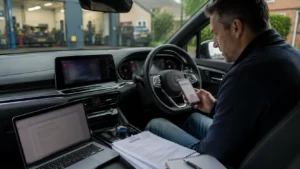
Electric Vehicle Excise Duty will be incorporated into the existing DVLA road-tax process.
When renewing VED, the registered keeper will normally need to:
- Provide the car’s current odometer reading.
- Estimate the number of miles the car will cover during the next tax period.
- Pay the estimated charge upfront or through monthly Direct Debit payments.
- Provide another mileage reading at the end of the period.
- Settle any underpayment or receive credit for an overpayment.
For example, someone estimating 5,000 miles at 3p per mile would have an annual eVED liability of £150. When paid monthly, that would be £12.50 per month.
The eVED payment will be collected alongside ordinary VED rather than through a completely separate tax account.
What Happens If the Mileage Estimate Is Wrong?
Drivers will not necessarily be penalised simply because their annual mileage differs from their original estimate.
At the end of the tax period, the DVLA will compare the estimated mileage with the updated odometer reading.
Where the driver has travelled further than estimated, the system is expected to calculate a balancing payment. The government intends to allow motorists either to pay the amount at once or spread the adjustment into the following year.
Where the driver has travelled fewer miles than estimated, the DVLA intends to issue a credit that can be offset against the following year’s eVED liability.
Final guidance on adjustments, enforcement and unusual mileage circumstances is expected before the scheme begins.
Will Drivers Need a Tracking Device?
The government is not proposing compulsory satellite tracking, GPS equipment or real-time monitoring of where an electric car is driven.
The main system will use:
- Driver-supplied odometer readings
- Existing MOT mileage information
- Additional mileage checks for newer cars that have not yet reached their first MOT
A standard MOT already records a vehicle’s mileage. Where that information is available, the government expects it to be used to verify that the driver’s reported mileage is reasonable and up to date.
Many modern electric cars contain telematics capable of recording journeys, but the government has said it will not make the use of those systems compulsory for eVED. Future technology-based reporting systems would be optional.
Will Miles Driven Abroad Count?
Miles driven abroad in a UK-registered electric car are expected to count towards eVED.
The system is based on the difference between odometer readings, not the location in which each mile was driven. The government ruled out calculating the charge according to when or where someone drives because that would require more intrusive monitoring.
Consequently, someone taking a UK-registered EV through France, Spain or another country would generally still pay eVED on those miles.
Which Vehicles Will Pay EV Pay Per Mile Road Tax?
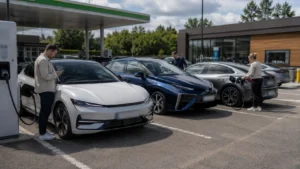
The charge will initially apply to UK-registered cars that fall into one of three categories.
Battery-Electric Cars
- Battery-electric vehicles, commonly described as fully electric cars, will pay 3p per mile.
Hydrogen Fuel-Cell Cars
- Hydrogen fuel-cell electric cars will also pay 3p per mile under the published policy.
Plug-In Hybrid Cars
- Plug-in hybrid electric vehicles will pay the reduced rate of 1.5p per mile.
- Plug-in hybrids can run on electricity or petrol. They may therefore pay eVED on their total mileage while also indirectly paying fuel duty when petrol is purchased.
- The government chose a reduced flat rate rather than requiring drivers to report which individual miles were completed in electric mode and which were completed using the combustion engine.
EV Pay-Per-Mile Tax Eligibility Checker
Check whether a vehicle is expected to enter Electric Vehicle Excise Duty when the mileage charge starts. The result reflects the published launch scope and is not an official DVLA eligibility decision.
Important: Published launch rules include qualifying battery-electric, plug-in hybrid and hydrogen fuel-cell cars. Electric vans, motorcycles, buses, coaches and HGVs are outside the initial scope. Read the official eVED policy for the latest position.
Are Ordinary Hybrid Cars Included?
Non-plug-in hybrid cars will not initially pay eVED.
An ordinary hybrid receives its external energy from petrol or diesel rather than being plugged into an electricity supply. Its owner already contributes through fuel duty when purchasing fuel.
However, ordinary hybrids remain subject to the normal VED rules that apply to their registration date and emissions.
Are Electric Vans, Motorcycles and Lorries Included?
Electric vans, motorcycles, buses, coaches and heavy goods vehicles will be outside the mileage-charge system when eVED is introduced in April 2028.
The initial scheme applies to vehicles registered as cars. The government says the electric transition for other vehicle categories is less advanced, although their treatment could be reviewed in future.
Electric vans already pay ordinary vehicle tax. Most are currently placed in the standard light-goods vehicle tax class, but they will not initially face the additional 3p-per-mile eVED charge.
Will Existing Electric Cars Have to Pay?

The mileage charge will not be limited to electric cars purchased after April 2028.
All qualifying UK-registered electric and plug-in hybrid cars are expected to enter the system when their VED is first renewed after 1 April 2028.
For example, an EV with a VED renewal date of 1 June would normally enter the eVED system at its first renewal after the commencement date. Drivers will not necessarily all begin paying on exactly 1 April.
The measure is expected to affect approximately 5.6 million vehicles during the 2028/29 financial year.
Will Disabled Drivers Be Exempt?
People receiving certain disability-related benefits may continue to qualify for an exemption or reduction from ordinary VED. However, the published eVED design does not provide the same general exemption from the mileage charge.
The government’s reasoning is that disabled drivers of petrol or diesel cars are not normally exempt from fuel duty at the pump. Therefore, qualifying electric cars driven by people who receive the mobility component of benefits such as Personal Independence Payment or Disability Living Allowance are expected to remain within eVED.
Individual circumstances and final rules should be checked when official DVLA guidance is published before April 2028.
Why Is The Government Introducing A Mileage Charge?
Petrol and diesel drivers contribute to government revenue through fuel duty every time they buy fuel. Electric-car drivers do not pay an equivalent duty on the electricity used for charging.
As more motorists switch to electric vehicles, fuel-duty receipts are expected to decline. The government says eVED is intended to replace some of that lost revenue while linking the amount paid to the distance driven.
It also argues that all vehicles contribute to:
- Road wear
- Congestion
- Infrastructure costs
- The continuing cost of maintaining the road network
The Treasury forecasts that eVED could raise approximately £1.1 billion in 2028/29, increasing to £1.865 billion in 2030/31.
What Will EV Pay Per Mile Tax Mean for Businesses?
Businesses operating electric company cars will need to include eVED in their fleet budgets from April 2028.
A business with 20 electric cars, each covering 15,000 miles per year, could initially face:
20 vehicles × 15,000 miles × 3p = £9,000 per year
This would be additional to normal VED, insurance, charging, servicing, leasing and other fleet costs.
Businesses may also need systems for:
- Recording odometer readings
- Estimating annual mileage
- Monitoring high-mileage vehicles
- Reconciling underpayments and overpayments
- Allocating costs between vehicles, employees or departments
- Managing vehicles returned during a tax period
The government expects the overall administrative effect on most businesses to be limited, but acknowledges that the impact may be material for large fleets. Special arrangements are being developed for leasing and rental companies, including the ability to estimate mileage centrally.
Drivers using a personal car for work should also ensure they have appropriate cover. The potential cost of adding business use to car insurance depends on the occupation, mileage, vehicle and type of journeys being made.
Business Fleet eVED Cost Estimator
Estimate the mileage-based charge for a mixed fleet of fully electric, hydrogen fuel-cell and plug-in hybrid cars, then add ordinary VED and the Expensive Car Supplement.
Important: The result assumes every entered vehicle remains in service for the full year and travels the stated mileage. Fleet replacements, mid-year disposals and final DVLA reconciliation could change the amount. Review the official eVED policy before budgeting.
Can Self-Employed Drivers Claim eVED as an Expense?

HMRC has not yet published specific tax-deduction instructions for eVED costs incurred from April 2028.
Under the current rules, a self-employed person using the actual-cost method may claim the qualifying business proportion of expenses such as insurance, repairs, fuel and vehicle-tax licence fees. Private use must be excluded.
The available deductions are explained further under allowable expenses for self-employed people.
Alternatively, eligible sole traders and partnerships may use HMRC simplified mileage expenses. For the 2026/27 tax year, the rates are:
- 55p per mile for the first 10,000 qualifying business miles
- 25p per mile above 10,000 miles
The flat mileage rate is intended to cover the cost of buying and running the vehicle. A person using simplified mileage cannot normally claim fuel, insurance, servicing and vehicle tax separately for the same car.
The latest rules are available through HMRC’s simplified vehicle expenses.
Electric delivery drivers and other high-mileage workers should consider the charge when calculating real earnings. The cost breakdown for Amazon Flex drivers in the UK demonstrates how mileage, insurance, charging and vehicle depreciation can materially change take-home income.
Is eVED the Same as a Business Mileage Rate?
Electric Vehicle Excise Duty should not be confused with an employer’s mileage reimbursement rate.
They perform different functions:
| Payment or rate | Purpose |
| eVED | Road tax paid according to total vehicle mileage |
| Approved Mileage Allowance Payment | Tax-free limit for reimbursing an employee who uses a personal vehicle for work |
| Simplified mileage expense | Flat-rate tax deduction for eligible self-employed drivers |
| Advisory electric rate | Reimbursement benchmark for electricity used in a fully electric company car |
From 6 April 2026, the approved mileage rate for an employee using a personal car or van is 55p per business mile for the first 10,000 miles and 25p thereafter.
For fully electric company cars, HMRC’s advisory electric rates from 1 June 2026 are 7p per mile for home charging and 15p per mile for public charging. These figures can change and are unrelated to the 3p eVED tax rate.
Does the Expensive Car Supplement Still Apply?
A zero-emission car registered on or after 1 April 2025 can also face the VED Expensive Car Supplement where its original list price exceeds £50,000.
The supplement normally applies for five years, beginning with the vehicle’s second tax year. Optional extras included in the original list price can affect whether the threshold is exceeded.
The supplement is separate from eVED. A qualifying higher-value electric car may therefore face:
- Standard annual VED
- The Expensive Car Supplement
- Electric Vehicle Excise Duty based on mileage
The £50,000 threshold applies to zero-emission cars under the current rules and may be reviewed again before 2028.
Will Electric Cars Still Be Cheaper to Run?
The mileage charge will reduce some of the tax advantage associated with owning an electric car, particularly for high-mileage drivers.
However, the overall cost comparison will continue to depend on:
- Home or public charging costs
- Vehicle purchase price
- Insurance
- Servicing and repairs
- Depreciation
- Finance or leasing costs
- Annual mileage
- Petrol and diesel prices
- VED and the Expensive Car Supplement
- Company-car tax where relevant
The eVED rate of 3p per mile is lower than the government’s estimated average fuel-duty contribution of approximately 6p per mile from petrol and diesel cars.
Charging costs can vary considerably. Current HMRC advisory figures place electricity at approximately 7p per mile for home charging and 15p per mile for public charging, although these are reimbursement benchmarks rather than guaranteed consumer prices.
At the initial 3p rate, a home-charged EV with an indicative electricity cost of 7p per mile would have a combined charging and eVED cost of approximately 10p per mile before insurance, depreciation, servicing and ordinary VED.
Personal EV Tax and Running-Cost Comparison
Compare an electric or plug-in hybrid car with a petrol or diesel car using editable mileage, energy, fuel, tax, insurance and servicing assumptions.
Important: This is a scenario tool, not a quote or total-cost-of-ownership calculation. Replace every default with the driver's actual figures. HMRC's current advisory electric rates are available through official advisory fuel-rate guidance.
Final Summary
EV pay per mile road tax will introduce a new cost for electric-car drivers from 1 April 2028.
Battery-electric and hydrogen fuel-cell cars will initially pay 3p per mile, while plug-in hybrids will pay 1.5p. The charge will be administered by the DVLA using estimated mileage, odometer readings and annual reconciliation.
It will not replace existing road tax. Electric-car owners may still have to pay ordinary VED and, for higher-value vehicles, the Expensive Car Supplement.
Someone driving a fully electric car for 8,000 miles a year would initially pay approximately £240 in eVED. A 15,000-mile driver would pay £450, while a vehicle covering 20,000 miles would incur a £600 charge.
The policy has been confirmed and draft legislation has been published, but payment procedures, enforcement arrangements and some detailed rules may still be refined before the scheme comes into effect.
Frequently Asked Questions
When does EV pay per mile road tax start?
Electric Vehicle Excise Duty is scheduled to start on 1 April 2028. A qualifying car will normally enter the system at its first VED renewal after that date.
How much is EV road tax per mile?
Fully electric and hydrogen fuel-cell cars will initially pay 3p per mile. Plug-in hybrids will pay 1.5p per mile.
Does the mileage charge replace annual road tax?
No. eVED will be added to ordinary Vehicle Excise Duty.
How will the government know how many miles an EV has travelled?
Drivers will report odometer readings. These readings can be checked against mileage recorded during MOT tests or other required mileage checks.
Will an EV need a tracker?
No compulsory GPS tracker or telematics system has been announced. The scheme is based primarily on odometer readings.
Are electric vans charged per mile?
Electric vans will not be included when eVED begins in April 2028. The initial scheme applies to qualifying cars.
Do miles driven abroad count?
Yes. Mileage completed abroad in a UK-registered qualifying car is expected to count because the charge uses total odometer mileage.
Will used electric cars have to pay?
Yes. Existing qualifying EVs and plug-in hybrids will enter the system when their VED is renewed after the commencement date.
What happens when an electric car is sold?
The government is expected to provide detailed rules covering changes of keeper, refunds, credits and mileage reconciliation before implementation. Buyers and sellers should record the odometer reading at the point of transfer.
Can the 3p rate increase?
Yes. The rate is due to be uprated in 2029/30 and in later years in line with CPI inflation.

More in Finance & Tax

Nationwide ISA Rates 2026: Current Cash ISA Rates, Fixed Terms and Access Rules
Nationwide ISA rates currently reach 4.70% AER tax-free, with the building society offering four fixed-rate Cash ISAs alongside its 1 Year Triple Access ISA. As of 1 October 2026, Nationwide’s current fixed Cash ISA rates are 4.50% for one year, 4.55% for two years, 4.65% for three years and 4.70% for five years. Its 1 […]

When Does ISA Allowance Reset? UK Rules for 2026/27 and 2027
The ISA allowance resets on 6 April every year, when the new UK tax year begins. For the current 2026/27 tax year, the annual adult ISA allowance is £20,000, covering money contributed between 6 April 2026 and 5 April 2027. Anything left unused when 5 April ends normally disappears rather than carrying into the next […]