
You can put up to £20,000 into ISAs during the 2026/27 tax year, which runs from 6 April 2026 to 5 April 2027. The £20,000 allowance is per person, not per household, and can be divided between Cash ISAs, Stocks and Shares ISAs, Innovative Finance ISAs and a Lifetime ISA.
There is one important sub-limit only £4,000 can be contributed to a Lifetime ISA, and that £4,000 forms part of the £20,000 overall allowance rather than sitting on top of it.
A separate £9,000 Junior ISA allowance is available for eligible children and does not use a parent’s own £20,000 ISA allowance.
The rules are also due to change substantially from 6 April 2027, particularly for Cash ISAs, so savers planning deposits or transfers should distinguish between the rules applying now and those scheduled for the next tax year.
How Much Can You Put in an ISA in 2026/27?
The maximum adult ISA subscription for the 2026/27 tax year is £20,000.
That is the total amount of new money a person can normally contribute across their adult ISAs between 6 April 2026 and 5 April 2027.
| ISA type | 2026/27 maximum | Does it count towards the £20,000 total? |
| Cash ISA | Up to £20,000 | Yes |
| Stocks and Shares ISA | Up to £20,000 | Yes |
| Innovative Finance ISA | Up to £20,000 | Yes |
| Lifetime ISA | £4,000 | Yes |
| Junior ISA | £9,000 | No, it is a separate allowance for the child |
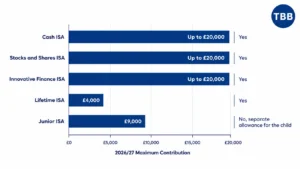
A saver does not receive £20,000 for each adult ISA type. The £20,000 is one overall annual allowance that can be divided between eligible accounts. GOV.UK confirms that a saver can use the full allowance in one account or spread it across several.
For example, somebody could contribute £10,000 to a Cash ISA, £6,000 to a Stocks and Shares ISA and £4,000 to a Lifetime ISA. The combined total would be £20,000, so the full annual allowance would have been used.
Alternatively, a person who does not use a Lifetime ISA could place the entire £20,000 into a Cash ISA in 2026/27.
Anyone comparing where to hold the cash portion can also look at current Yorkshire Building Society ISA rates or compare a broader selection through the site’s coverage of Martin Lewis best ISA rates for 2026.
Is the £20,000 ISA Allowance Per Person or Per Household?
The ISA allowance is per individual.
There is no shared household or married-couple ISA allowance, and an ISA cannot be held jointly with another person. GOV.UK states that an ISA must be held individually.
That means a couple where both adults are eligible could potentially contribute:
| Person | Maximum adult ISA subscription in 2026/27 |
| Partner 1 | £20,000 |
| Partner 2 | £20,000 |
| Combined | £40,000 |
The £40,000 is not technically a joint allowance. Each person independently owns and controls their own £20,000 annual ISA allowance.
A family could potentially shelter still more money if eligible children also have Junior ISAs, because the children’s £9,000 annual limits are separate from the adults’ allowances.
Does ISA Interest or Investment Growth Count Towards the £20,000 Limit?
No. The annual ISA allowance applies to new subscriptions into the ISA, not to returns subsequently generated inside it.
If somebody contributes £20,000 to a Stocks and Shares ISA and the investments later rise to £22,500, the additional £2,500 does not use another £2,500 of ISA allowance.
Likewise, if £20,000 held in a Cash ISA generates interest, that interest does not reduce the person’s ISA allowance for the following year.
The ISA wrapper is designed so that eligible interest, investment income and capital gains generated inside it remain sheltered from UK tax under the ISA rules.
This distinction is important because the value of an ISA can legitimately grow far beyond the annual subscription limit.
A person who has accumulated £100,000 or £200,000 within ISAs over many years is not breaking the rules. The annual restriction applies to qualifying new subscriptions made during each tax year.
How Much Can You Put in a Lifetime ISA?
The Lifetime ISA has its own annual payment cap of £4,000.
The Government adds a 25% bonus, potentially worth up to £1,000 each year. A person can generally continue contributing until age 50, provided the Lifetime ISA was opened and the first payment made before the person turned 40.
The £4,000 Lifetime ISA limit sits inside, rather than on top of, the overall £20,000 ISA allowance.
For example:
| Contribution | Amount |
| Lifetime ISA | £4,000 |
| Cash ISA | £8,000 |
| Stocks and Shares ISA | £8,000 |
| Total ISA subscriptions | £20,000 |
| Potential LISA government bonus | £1,000 |
The £1,000 government bonus does not mean the saver has exceeded the annual £20,000 subscription limit.
Lifetime ISAs also have additional withdrawal rules. Withdrawals made outside qualifying circumstances can normally face a withdrawal charge, so a Lifetime ISA should not be treated as an ordinary easy-access savings account.
How Much Can You Put in a Junior ISA?
The Junior ISA allowance is £9,000 for 2026/27.
The money can be divided between a Cash Junior ISA and Stocks and Shares Junior ISA, but total new contributions for that child cannot exceed £9,000 during the tax year.
Anyone can contribute to the Junior ISA, including parents, grandparents and other relatives, but the money legally belongs to the child.
A child can take control of managing the account at 16 but normally cannot withdraw the money until reaching 18.
Importantly, money paid into a child’s Junior ISA does not reduce an adult’s personal £20,000 ISA allowance.
A parent could therefore contribute £20,000 to their own adult ISAs and separately put money towards the child’s £9,000 Junior ISA allowance, subject to the child’s total Junior ISA subscriptions remaining within £9,000.
Can You Pay Into More Than One ISA of the Same Type?
Yes. An important ISA reform took effect on 6 April 2024, allowing adults to subscribe to multiple ISAs of the same type during a tax year, provided they remain within their overall allowance.
That means somebody could, for example, contribute to two different Cash ISAs during 2026/27 rather than being restricted to a single Cash ISA provider.
Lifetime ISAs are an exception a saver can still subscribe to only one Lifetime ISA during a tax year.
This flexibility can be useful where somebody wants to divide cash between an easy-access ISA and a fixed-rate account.
However, the saver remains responsible for ensuring total adult ISA subscriptions do not exceed £20,000.
What Happens to Unused ISA Allowance?
Unused ISA allowance is normally lost at the end of the tax year.
It cannot be carried forward in the way some pension allowances can.
If somebody contributes only £8,000 during 2026/27, the unused £12,000 does not increase their allowance for 2027/28.
Once the tax year ends on 5 April 2027, that unused portion expires. HMRC’s ISA guidance confirms that unused subscription capacity from an earlier year cannot be carried into the next year.
This is why the period leading up to 5 April is often referred to as “ISA season”, as savers decide whether to use their remaining annual allowance before it disappears.
That does not mean somebody should invest simply to use an allowance. Investment decisions should still reflect time horizon, risk tolerance, emergency-cash requirements and broader financial circumstances.
What Happens If You Put More Than £20,000 Into ISAs?
Going over the annual ISA subscription limit does not automatically mean the person’s entire ISA permanently loses its tax advantages.
HMRC has a process known as ISA repair for certain invalid subscriptions.
If an oversubscription is identified during the current tax year, the provider can generally remove the excess subscription and related gains to correct the error. Valid investments remaining within a repaired ISA may keep their tax exemption.
Where an error relates to a previous tax year, the process is different. HMRC can identify discrepancies through information supplied by ISA providers and may contact the investor before instructing the ISA manager what action to take.
Providers should not simply repair a previous-year investor error without the appropriate HMRC instruction.
The affected invalid subscriptions can lose their tax exemption for the period between the first invalid payment and the repair. Income or gains attributable to the excess may therefore become taxable.
A saver who believes the limit has been exceeded should contact the ISA provider rather than attempting to fix the problem by casually withdrawing money, particularly where the error relates to a previous tax year.
This matters because withdrawals and ISA transfers have their own rules, and an incorrect self-transfer can create another problem.
How Do Flexible ISA Withdrawals Affect the Allowance?
A flexible ISA can allow money to be withdrawn and replaced during the same tax year without the replacement using additional annual allowance.
For example, suppose somebody contributes £10,000 to an ISA during 2026/27 and then withdraws £3,000.
With a flexible ISA, they could normally put the £3,000 back during the same tax year and still have their original £10,000 of unused annual allowance available.
With a non-flexible ISA, replacing that £3,000 would normally count as another £3,000 subscription, leaving only £7,000 of the original allowance available.
GOV.UK provides this same distinction between flexible and non-flexible ISAs.
Not every ISA is flexible, so the account’s terms should be checked before withdrawing money on the assumption that it can simply be replaced.
What Is Changing to ISA Limits From April 2027?
The biggest forthcoming ISA change affects Cash ISAs.
From 6 April 2027, the Government intends to reduce the annual Cash ISA subscription limit to £12,000 for people under 65, while retaining the overall ISA limit at £20,000.
The £20,000 overall adult ISA allowance, £4,000 Lifetime ISA limit and £9,000 Junior ISA limit are scheduled to remain at those levels until 5 April 2031.
The position is expected to look like this:
| ISA rule | 2026/27 | From 6 April 2027 |
| Overall adult ISA allowance | £20,000 | £20,000 |
| Cash ISA limit for most under-65s | £20,000 | £12,000 |
| Cash ISA limit where age-65 protection applies | £20,000 | £20,000 |
| Lifetime ISA limit | £4,000 | £4,000 |
| Junior ISA limit | £9,000 | £9,000 |
For an eligible saver under 65 who wants to use the full £20,000 allowance in 2027/28, no more than £12,000 could normally be placed into Cash ISAs.
For example, £12,000 could go into Cash ISAs and the remaining £8,000 could potentially be allocated to Stocks and Shares or Innovative Finance ISAs.
There is no requirement to invest the remaining £8,000. Investments carry the possibility of losses, so an individual should not take investment risk solely because the Cash ISA allowance has been reduced.
Readers particularly interested in the cash side can compare the current market through Martin Lewis best ISA rates for 2026, which also covers how the forthcoming £12,000 restriction changes the role of Cash ISAs.
How Does the Age-65 Cash ISA Rule Actually Work?
This is one of the most easily misunderstood parts of the 2027 reform.
The Government’s June 2026 ISA reform factsheet says entitlement to the higher £20,000 Cash ISA limit applies from the start of the tax year in which the person turns 65.
The rule therefore does not simply switch on at the person’s 65th birthday.
For example, consider somebody who turns 65 on 1 February 2028.
Because that birthday falls within the 2027/28 tax year, which began on 6 April 2027, the higher limit would apply from the start of that tax year rather than waiting until February.
This distinction matters for anyone aged 64 around the beginning of the 2027/28 tax year.
Are ISA Transfer Rules Also Changing in 2027?
Yes, and this is one of the most important parts of the reform.
Under the rules scheduled for 6 April 2027, transfers from non-Cash ISAs into Cash ISAs will generally be prohibited where the under-65 rules apply.
Cash ISA-to-non-Cash ISA transfers can continue.
The Government says the restriction is intended to stop somebody contributing £20,000 to a Stocks and Shares or Innovative Finance ISA and subsequently moving the money into a Cash ISA as a way of circumventing the £12,000 cash subscription cap.
For people who qualify for the age-65 protection, the Government says the transfer restriction will be disapplied from the beginning of the tax year in which they turn 65.
This change makes the direction of future ISA transfers considerably more important.
Under the current 2026/27 rules, GOV.UK generally allows ISA transfers between types, subject to special rules for Lifetime and Junior ISAs.
When transferring an existing ISA, savers should use the receiving provider’s formal ISA transfer process.
Simply withdrawing the money and paying it into another account can cause the money to be treated as a new subscription and potentially lose the protection attached to previous years’ ISA funds.
What Happens to Cash Held Inside a Stocks and Shares ISA From 2027?
The Government has announced another anti-circumvention measure that has received less attention than the £12,000 headline limit.
From April 2027, investors will still be able to hold cash within a non-Cash ISA, but the Government plans a 22% charge on interest or alternative finance returns generated by that cash. The ISA manager, rather than the individual investor, would account for the charge to HMRC.
The proposed rules are intended to discourage investors from using Stocks and Shares or Innovative Finance ISAs as substitute Cash ISAs.
The Government also intends to stop non-Cash ISAs being made up entirely of assets classified as cash-like.
Under the June 2026 proposal, money market funds are the assets specifically identified for this treatment, although partial exposure within a diversified portfolio would remain possible.
As of 7 September 2026, these changes are scheduled for 6 April 2027 and have been the subject of draft regulations and technical consultation, so savers should check the final regulations before acting on the future rules.
What Changed for Cryptoasset ETNs in ISAs in 2026?
Another relatively new ISA rule took effect on 6 April 2026.
Cryptoasset exchange-traded notes, or cETNs, are now treated as qualifying investments for Innovative Finance ISAs rather than Stocks and Shares ISAs.
New cETN purchases cannot normally be made inside a Stocks and Shares ISA from 6 April 2026. However, cETNs already held within a Stocks and Shares ISA immediately before that date can continue to qualify while they remain there.
This is a specialist rule and will not affect most ordinary Cash ISA savers, but it illustrates why ISA guidance needs to be checked regularly rather than relying on older summaries.
Who Is Eligible to Open an ISA?
For most adult ISAs, a person must now be 18 or over and meet the relevant UK residence rules.
This is worth emphasising because older ISA information sometimes says that Cash ISAs are available from age 16. The standard minimum age increased to 18 from 6 April 2024, subject to transitional protection that applied to certain existing 16- and 17-year-old savers.
A Lifetime ISA has additional age rules: the first payment normally needs to be made before age 40, and contributions can continue until 50.
ISA applications also require identifying information including a permanent residential address, date of birth and National Insurance number, or confirmation that the applicant does not qualify for one.
HMRC’s rules are becoming stricter from 6 April 2027 regarding National Insurance information for accounts receiving subscriptions.
UK residents are the main eligible group, although specific exceptions apply to certain Crown servants, armed forces personnel and qualifying spouses or civil partners living overseas.
What Happens to an ISA If You Move Abroad?
A person who opens an ISA while UK resident can generally keep the ISA after moving abroad.
The existing savings and investments can remain within the wrapper and retain their UK ISA tax treatment.
However, once the person becomes non-UK resident, they normally cannot continue making new subscriptions unless a specific exception applies, such as qualifying Crown employment or being the spouse or civil partner of an eligible Crown employee.
The ISA provider should be told when UK residence ends.
Existing ISAs can still generally be transferred between providers while the account holder is abroad, and subscriptions may resume if the person later returns and becomes UK resident again.
The country in which the person becomes resident may have its own tax treatment for the ISA, so the UK tax-free status does not necessarily mean another country’s tax authority will also treat the account as exempt.
How Has the ISA Allowance Changed Over Time?
ISAs were introduced in 1999, replacing Personal Equity Plans and Tax-Exempt Special Savings Accounts.
The allowance has increased substantially since then.
| Tax year / period | Overall adult ISA limit | Cash limit |
| 1999/00 | £7,000 | £3,000 |
| 2008/09 | £7,200 | £3,600 |
| 2010/11 | £10,200 | £5,100 |
| 2011/12 | £10,680 | £5,340 |
| 2012/13 | £11,280 | £5,640 |
| 2013/14 | £11,520 | £5,760 |
| From July 2014 | £15,000 | £15,000 |
| 2015/16 | £15,240 | £15,240 |
| 2016/17 | £15,240 | £15,240 |
| 2017/18 onwards | £20,000 | £20,000 |
| 2026/27 | £20,000 | £20,000 |
| From 2027/28 | £20,000 | £12,000 for under-65 rules |
HMRC’s historical statistics confirm that the adult ISA allowance started at £7,000, increased over time and reached the current £20,000 level from 6 April 2017.
The 2027 reform therefore represents an unusual change: the overall ISA allowance is staying at £20,000 while the amount that most under-65 savers can place specifically into Cash ISAs is being reduced.
Is There a Limit on How Much You Can Have in an ISA Overall?
There is no general lifetime ceiling on the total value someone can accumulate within ISAs.
The key restriction is on new annual subscriptions, not the total account balance.
Someone who contributes within the permitted annual limits for many years can build an ISA portfolio worth hundreds of thousands of pounds.
Investment growth, dividends and interest generated within the account can increase its value further without those returns themselves becoming new ISA subscriptions.
That is why long-standing ISA investors can legitimately have balances far above £20,000.
Can You Transfer an Old ISA Without Using the Current Year’s Allowance?
Generally, yes.
A formal transfer of existing ISA money between providers is different from making a new subscription.
Someone with £50,000 accumulated from earlier tax years can therefore potentially transfer that £50,000 to another eligible ISA without using £50,000 of the current £20,000 allowance.
The receiving provider must carry out the transfer under the ISA transfer process. GOV.UK warns that withdrawing the money personally instead of using the official transfer procedure can mean the funds cannot simply be reinvested while preserving their existing ISA status.
This distinction becomes particularly important ahead of the April 2027 changes because transfers from non-Cash ISAs into Cash ISAs are due to become restricted for affected under-65 savers.
Final Thoughts
For 2026/27, the answer to “how much can you put in an ISA?” is straightforward at the highest level: £20,000 per eligible adult.
The detail matters, however. The £20,000 is shared across adult ISA types, the Lifetime ISA has a £4,000 sub-limit, Junior ISAs have their own £9,000 allowance, unused allowance normally disappears after 5 April, and investment growth or interest generated inside an ISA does not count as a new contribution.
The biggest change arrives on 6 April 2027, when the Cash ISA subscription limit is scheduled to fall to £12,000 for most under-65 savers while the overall £20,000 ISA allowance remains unchanged.
Transfers from non-Cash ISAs into Cash ISAs are also due to be restricted, while the age-65 protection applies from the beginning of the tax year in which the saver turns 65.
Because these reforms are still approaching and detailed regulations are being finalised during 2026, anyone making decisions for the 2027/28 tax year should check the latest official ISA rules on GOV.UK before contributing or transferring substantial amounts.
This article is for general information only and does not constitute personal financial, investment or tax advice. Tax treatment depends on individual circumstances and ISA rules can change.
Frequently Asked Questions
How much can I put in an ISA in 2026?
The maximum overall ISA subscription for the 2026/27 tax year is £20,000 per eligible adult. This can be divided between different eligible ISA types, although Lifetime ISA contributions are capped at £4,000.
Can I put £20,000 into a Cash ISA and £20,000 into a Stocks and Shares ISA?
No. The £20,000 allowance covers eligible adult ISA subscriptions combined. Putting £20,000 into a Cash ISA in 2026/27 would normally use the entire annual allowance.
Can I pay into two Cash ISAs in the same year?
Yes. Since 6 April 2024, adults can generally subscribe to multiple ISAs of the same type during a tax year, provided total subscriptions remain within the annual allowance. The Lifetime ISA has a separate one-LISA-per-tax-year restriction.
Does unused ISA allowance carry over?
No. Unused adult ISA allowance normally expires at the end of the tax year on 5 April and cannot be carried forward into the next year.
Does my partner get their own ISA allowance?
Yes. ISA allowances are individual. Each eligible adult has their own £20,000 annual allowance for 2026/27, meaning two eligible partners could potentially contribute £40,000 between their separately owned ISAs. ISAs cannot be jointly owned.
Does ISA interest count towards the £20,000 allowance?
No. Interest, dividends and investment growth generated within an ISA do not themselves use additional annual subscription allowance. The restriction applies to qualifying new contributions.
What happens if my ISA grows above £20,000?
Nothing simply because the value exceeds £20,000. The limit applies to annual subscriptions, not the total market value of the ISA.
What happens if I accidentally contribute more than £20,000?
Certain oversubscriptions can be corrected through ISA repair. For a current-year mistake, the provider may remove the excess and associated gains. Previous-year errors may require HMRC involvement before the provider acts.
Can I put £20,000 into a Cash ISA in 2027?
For most savers under the age-65 rules, no. From 6 April 2027 the Cash ISA subscription limit is scheduled to fall to £12,000, although the overall adult ISA allowance remains £20,000.
What happens if I turn 65 during the 2027/28 tax year?
Under the Government’s announced rules, entitlement to the £20,000 Cash ISA limit starts from the beginning of the tax year in which the person turns 65, rather than starting only on their birthday.
Can I transfer a Stocks and Shares ISA to a Cash ISA after April 2027?
For affected under-65 savers, the Government plans to prohibit transfers from non-Cash ISAs into Cash ISAs from 6 April 2027. The restriction is due to be lifted from the start of the tax year in which the saver turns 65.
How much can I put into a Junior ISA?
The Junior ISA subscription limit is £9,000 for 2026/27, and the Government has announced that this limit will remain £9,000 through 2030/31.
How much can I put into a Lifetime ISA?
Up to £4,000 per tax year. The Government can add a 25% bonus worth up to £1,000 annually. That £4,000 contribution forms part of the person’s overall £20,000 adult ISA allowance.
Can I keep my ISA if I move abroad?
Yes. An existing ISA can normally remain open and retain its UK tax advantages. However, a person who becomes non-UK resident generally cannot make new subscriptions until becoming UK resident again, unless a qualifying exception applies.

More in Finance & Tax

Best Cash ISA Rates UK 2026: Highest Easy-Access and Fixed ISA Rates Compared
The best cash ISA rates currently reach around 4.61% AER for easy-access accounts and 4.93% AER for longer fixed terms, although rates can change quickly and the highest-paying account is not automatically the best choice for every saver. For 2026/27, adults can still put up to £20,000 into ISAs across the tax year. However, a […]

Martin Lewis Best ISA Rates 2026: MSE Picks Explained
The Martin Lewis best ISA rates currently highlighted by MoneySavingExpert (MSE) include a range of easy-access and fixed Cash ISA options. MSE, the consumer finance website founded by Martin Lewis, regularly reviews savings products to identify competitive rates and important account conditions. As of 2 September 2026, MSE highlighted easy-access Cash ISA rates of up […]