
The best cash ISA rates currently reach around 4.61% AER for easy-access accounts and 4.93% AER for longer fixed terms, although rates can change quickly and the highest-paying account is not automatically the best choice for every saver.
For 2026/27, adults can still put up to £20,000 into ISAs across the tax year. However, a major rule change arrives on 6 April 2027: most people under 65 will be limited to £12,000 a year in Cash ISAs, while the overall ISA allowance remains £20,000. People aged 65 or over will retain a £20,000 Cash ISA limit.
Anyone deciding where to put savings should therefore look beyond the headline interest rate. Access restrictions, bonus periods, transfers, FSCS protection, withdrawal penalties and whether the account is flexible can materially change which Cash ISA is best.
Best Cash ISA Rates at a Glance
The table below uses nationally available rates highlighted in the latest major comparison data checked immediately before publication.
| Cash ISA type | Leading rate | Provider example | Access |
| Easy access | 4.61% AER | Trading 212 | Variable, withdrawals allowed |
| Easy access for transfers | 4.60% AER | Chip | Variable |
| 1-year fixed | 4.74% AER | Charter Savings Bank | Fixed |
| 2-year fixed | 4.83% AER | Tandem Bank | Fixed |
| 3-year fixed | 4.83% AER | Charter Savings Bank | Fixed |
| 5-year fixed | 4.93% AER | Tandem Bank | Fixed |
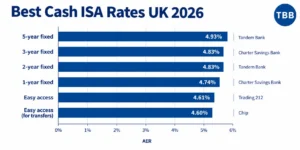
MoneySavingExpert’s market update on 11 September 2026 listed Trading 212 at 4.61% for easy-access new money, Chip at 4.60% for transfers, Charter Savings Bank at 4.74% for one year, Tandem at 4.83% for two years, Charter at 4.83% for three years and Tandem at 4.93% for five years.
Rates can move daily. Different comparison services can also briefly show different leaders because their product feeds are updated at different times. Moneyfacts, for example, reported a 4.75% expected profit rate from Al Rayan Bank through Meteor Savings for one-year money on 10 September.
That is why the publication date matters almost as much as the table itself.
What Is a Cash ISA?
A Cash ISA is a savings account in which eligible interest is protected from UK Income Tax.
Unlike an ordinary savings account, interest earned inside a Cash ISA does not use the saver’s Personal Savings Allowance.
The main types are:
- Easy-access Cash ISAs for money that may be needed quickly.
- Notice Cash ISAs requiring advance notice for withdrawals.
- Fixed-rate Cash ISAs paying a fixed rate for a defined period.
- Regular-saving Cash ISAs designed for monthly contributions.
AER, or Annual Equivalent Rate, makes it easier to compare accounts by showing the annualised return including the effect of interest compounding.
How Much Can You Put in a Cash ISA in 2026/27?
The overall adult ISA allowance is £20,000 for the 2026/27 tax year.
It can be divided between eligible ISA types. For example, someone could contribute £12,000 to a Cash ISA and £8,000 to a Stocks and Shares ISA.
A Lifetime ISA has its own £4,000 annual contribution ceiling, but that £4,000 still forms part of the overall £20,000 adult ISA allowance.
A fuller breakdown of the current limits is available in Top Business Blog’s 2026/27 ISA allowance rules.
The Cash ISA allowance changes in April 2027
From 6 April 2027:
| Saver | Maximum annual Cash ISA subscription |
| Under 65 | £12,000 |
| 65 or over | £20,000 |
| Overall adult ISA allowance | £20,000 |
The Government also plans anti-circumvention rules, including restrictions on transfers from non-Cash ISAs into Cash ISAs for under-65s and rules affecting cash-like holdings in non-Cash ISAs.
The £12,000 change does not mean people under 65 lose the remaining £8,000 of the overall allowance. It means that amount would normally need to go into another eligible ISA type if the saver wanted to use the full £20,000.
Investment risk should not, however, be taken simply to use an allowance.
Best Easy-Access Cash ISA Rates
Easy-access Cash ISAs are normally most suitable for money that may need to be withdrawn at short notice.
Trading 212 Cash ISA – 4.61% AER
Trading 212 currently advertises 4.61% AER variable for eligible promotional customers.
Its current headline rate includes a promotional bonus, while the underlying rate tracks the Bank of England Bank Rate at a stated margin below it. Interest accrues daily and is paid monthly.
The important point is that the headline number is not necessarily permanent.
A saver should check:
| Feature | What to check |
| Headline rate | Whether a promotional bonus is included |
| Bonus duration | When the promotional element expires |
| Eligible deposits | Whether the bonus applies to new money, transfers or both |
| Underlying rate | What the account pays after the promotion |
| Flexibility | Whether withdrawn money can be replaced without using more allowance |
Trading 212’s current advertised 4.61% includes a promotional component for qualifying current-tax-year contributions.
Sidekick – understand where the money actually goes
Sidekick illustrates why Cash ISA comparisons should not stop at the headline AER.
Its structure can spread deposits between underlying UK banks. Recent terms have used HSBC, Lloyds and Santander Financial Services, with the underlying allocation affecting FSCS coverage.
A promotional rate can also apply differently to new money and transferred ISA money.
This is exactly the type of detail that a simple “highest rate” table misses.
Chip – good transfer rate, but read the withdrawal process
Chip has recently been among the leading options for Cash ISA transfers.
One practical detail is that withdrawals may involve connecting a nominated account through Open Banking. Alternative anti-fraud verification can be available where that is unsuitable.
Savers transferring or closing the account should also check exactly when accrued interest is paid and whether any unpaid accrued interest could be lost.
For another view of the leading providers, bonus mechanics and current market positioning, see the site’s Martin Lewis ISA rate picks.
Best Fixed Cash ISA Rates
Fixed Cash ISAs exchange flexibility for greater certainty.
The rate normally stays unchanged during the fixed term, making the account useful when a saver values certainty more than immediate access.
| Term | Leading September 2026 rate | Example provider |
| 1 year | 4.74% | Charter Savings Bank |
| 2 years | 4.83% | Tandem Bank |
| 3 years | 4.83% | Charter Savings Bank |
| 5 years | 4.93% | Tandem Bank |
The striking feature of the current market is that there is not a huge difference between some shorter and longer fixes.
A saver might therefore reasonably ask whether an additional three or four years of restriction is worth only a relatively small increase in AER.
That depends on what happens to interest rates next.
Why Are Cash ISA Rates Around These Levels?
The Bank of England’s Bank Rate is currently 3.75%, following the Monetary Policy Committee’s July 2026 decision to leave it unchanged. Its next scheduled decision is 17 September 2026.
Savings providers do not simply copy Bank Rate. Pricing is influenced by several factors.
| Factor | Possible effect on Cash ISA rates |
| Bank Rate rises | Variable savings rates may rise |
| Expected future rate rises | Longer fixed rates can become more competitive |
| Expected cuts | Providers may reduce fixed rates before Bank Rate actually falls |
| Competition for deposits | Banks may temporarily offer higher rates |
| Funding requirements | Providers needing deposits can price aggressively |
| Market and gilt yields | Can affect longer-term savings pricing |
| Promotional campaigns | Temporarily boost easy-access headline rates |
This is why a five-year rate can sometimes move before the Bank of England changes Bank Rate.
As September 2026 began, energy-price uncertainty and inflation concerns had also reduced expectations of imminent monetary easing, helping to keep the interest-rate outlook uncertain.
Should You Choose Easy Access or Fix Your Cash ISA?
Neither structure is universally better.
| Choose easy access when… | Consider fixing when… |
| The money forms part of an emergency fund | The money will not be needed soon |
| A house purchase or large bill may arise | Certainty matters more than flexibility |
| Rates may rise and flexibility is important | A current rate looks attractive for the full term |
| The saver wants freedom to transfer | The saver wants protection against future rate cuts |
It can also be sensible to split savings rather than making one all-or-nothing decision.
For example, part of a balance could remain easy access while another portion is fixed.
Can You Withdraw From a Fixed Cash ISA?
Fixed Cash ISA does not necessarily mean the money is literally inaccessible.
Cash ISA rules generally require providers to permit access, but the provider may impose a substantial interest penalty or require the ISA to be closed or transferred.
Penalties can amount to several months of interest.
A higher rate is therefore not automatically better if there is a realistic chance that the money will be needed early.
What Happens When a Fixed Cash ISA Matures?
This is an easy place to lose money through inertia.
When the fixed term ends, the provider will normally give maturity instructions. If the saver does nothing, the balance may move into another account whose rate is substantially lower than the original fix.
A practical approach is to review the account several weeks before maturity and compare:
Maturing ISA → check new rate → compare market → instruct ISA transfer → preserve tax-free status
Do not assume the provider’s default maturity account is competitive.
How Do Cash ISA Transfers Work?
The most important transfer rule is simple:
Do not withdraw the money into an ordinary bank account when the intention is to preserve its ISA status.
Instead, the new ISA provider should normally be asked to arrange an official ISA transfer.
Cash ISA transfer flow
1. Choose the new Cash ISA
↓
2. Check that it accepts ISA transfers
↓
3. Complete the new provider’s transfer instruction
↓
4. New provider contacts the existing provider
↓
5. Existing ISA is transferred within the ISA system
↓
6. Tax-free status is preserved
Manually withdrawing old ISA money can remove it from the ISA wrapper.
This is particularly important where large balances have accumulated over several tax years, because the saver may not have enough current-year allowance to put the money back.
What Is a Flexible Cash ISA?
A flexible ISA allows qualifying withdrawals to be replaced within the same tax year without necessarily using extra ISA allowance.
Suppose someone contributes £10,000 during 2026/27.
They then withdraw £3,000.
With a flexible ISA, they could normally contribute up to £13,000 before 5 April 2027: the unused £10,000 of their allowance plus the £3,000 withdrawn.
With a non-flexible ISA, only the unused £10,000 would remain available.
GOV.UK confirms this treatment for flexible ISAs.
Flexibility is therefore valuable for people who expect money to move in and out during the year.
How Safe Is Money in a Cash ISA?
For ordinary eligible deposits, the Financial Services Compensation Scheme currently protects up to £120,000 per eligible person, per authorised institution.
The limit increased from £85,000 to £120,000 on 1 December 2025.
The phrase per authorised institution matters.
Two brands can share the same banking licence.
Examples currently relevant to Cash ISA comparisons include:
- Virgin Money and Nationwide.
- Bank of Ireland UK and Post Office-branded savings.
If two brands share a licence, the £120,000 protection applies across the combined eligible deposits rather than separately to each brand.
Someone holding £100,000 with one brand and another £80,000 with a second brand under the same licence would therefore not automatically have £180,000 of standard deposit protection.
Be Careful With Non-Standard Cash ISAs
Not every product carrying the words “Cash ISA” necessarily holds customers’ money in exactly the same way as a conventional bank deposit.
Some newer products can use qualifying money market funds, or QMMFs.
These typically invest in low-risk, short-term instruments, but the legal and compensation structure can be more complicated.
MoneySavingExpert has excluded some QMMF-based products from its core Cash ISA best-buy tables because FSCS protection can depend on the exact circumstances rather than being as straightforward as an ordinary protected bank deposit.
Anyone considering a non-standard structure should check:
- What actually holds the money.
- Whether capital is treated as a bank deposit or fund investment.
- Which entity provides FSCS protection.
- Whether accrued but unpaid interest is covered.
- Whether the provider, custodian and underlying institution have separate roles.
A rate that is a few basis points higher is not necessarily worth accepting a structure the saver does not understand.
Why Shared Banking Licences Matter?
Suppose someone already has:
- £90,000 with Nationwide.
- £50,000 with Virgin Money.
If the relevant accounts sit under the same authorised institution for FSCS purposes, the balances cannot simply be treated as two independent £120,000 protection limits.
The saver should check the FSCS bank and savings protection information before moving a large ISA balance.
This becomes increasingly important for older savers who may have accumulated substantial ISA balances over many tax years.
Is a Cash ISA Actually Worth It?
A Cash ISA is most valuable when the interest that would otherwise be earned outside the ISA becomes taxable.
For 2026/27, the Personal Savings Allowance is:
| Tax position | Personal Savings Allowance |
| Basic-rate taxpayer | £1,000 |
| Higher-rate taxpayer | £500 |
| Additional-rate taxpayer | £0 |
Savings interest above the applicable allowance can be taxable.
Someone with only a small savings balance may therefore earn all of their ordinary savings interest tax-free anyway.
That can make a higher-paying normal savings account more attractive than a lower-paying Cash ISA.
The Cash ISA Tax-Comparison Multiplier
Once the Personal Savings Allowance has already been used, a useful way to compare an ISA with a taxable savings account is to calculate the gross taxable rate required to match the ISA’s tax-free return.
Using a 4.61% Cash ISA:
| Taxpayer | Current savings tax rate | Taxable account rate needed to match 4.61% tax-free |
| Basic rate | 20% | 5.76% |
| Higher rate | 40% | 7.68% |
| Additional rate | 45% | 8.38% |
The calculation is:
ISA rate ÷ (1 − tax rate)
For a basic-rate taxpayer:
4.61% ÷ 0.80 = 5.76%
This comparison only makes sense for interest that would actually be taxable. A saver still comfortably inside their Personal Savings Allowance should not automatically apply the multiplier to every pound of savings.
How Much Tax Could a Cash ISA Actually Save?
The following illustration assumes:
- Both accounts pay 4.61%.
- There is no other taxable savings interest.
- The saver remains within the stated tax band.
- The starting rate for savings does not apply.
| Savings balance | Annual interest at 4.61% | Basic-rate tax avoided | Higher-rate tax avoided | Additional-rate tax avoided |
| £10,000 | £461 | £0 | £0 | £207.45 |
| £30,000 | £1,383 | £76.60 | £353.20 | £622.35 |
| £60,000 | £2,766 | £353.20 | £906.40 | £1,244.70 |
This demonstrates why asking only “which account has the highest rate?” can produce the wrong answer.
For a basic-rate taxpayer with £10,000 and no other savings interest, the Personal Savings Allowance could already shelter all £461.
For an additional-rate taxpayer, there is no Personal Savings Allowance, so the ISA tax shelter can become useful much sooner.
Cash ISAs Become More Important for Some Savers From April 2027
Another change receives less attention than the £12,000 Cash ISA limit.
From 6 April 2027, the Government has legislated for savings Income Tax rates of:
- 22% at the basic savings rate.
- 42% at the higher savings rate.
- 47% at the additional savings rate.
The Personal Savings Allowance is scheduled to remain £1,000 for basic-rate taxpayers and £500 for higher-rate taxpayers.
So although the annual Cash ISA subscription limit falls for most under-65s, the tax cost of holding larger savings balances outside an ISA is also due to increase.
That makes preserving existing ISA balances particularly important.
When an Ordinary Savings Account Can Beat a Cash ISA?
A Cash ISA is not automatically the best home for every pound.
Consider a basic-rate taxpayer with no other savings interest.
If a normal savings account pays 5% on £10,000, annual interest would be £500.
That remains below the £1,000 Personal Savings Allowance.
If the best comparable Cash ISA paid 4.61%, the ISA would return approximately £461 instead.
In that situation, the ordinary savings account could deliver the better net result because no tax is due anyway.
As balances increase, however, the tax calculation changes.
Who Should NOT Automatically Choose a Cash ISA?
A Cash ISA may be less compelling where:
The Personal Savings Allowance already protects all interest
Someone paying no tax on savings interest may be better comparing the net return rather than prioritising the ISA label.
Ordinary savings pay materially more
If the tax-free benefit is worth less than the rate difference, ordinary savings can win.
The money is intended for decades rather than a few years
Cash provides stability but can lose purchasing power to inflation over long periods.
Someone with a long investment horizon and sufficient tolerance for market risk may instead consider investment-based wrappers.
High-cost debt is outstanding
Holding large amounts of low-interest cash while paying substantially higher borrowing costs may produce a poor overall financial result.
Access restrictions do not fit the goal
A fixed ISA paying slightly more is not attractive if an early withdrawal penalty is likely.
Cash ISA or Stocks and Shares ISA?
The decision mainly depends on time horizon and risk.
| Cash ISA | Stocks and Shares ISA |
| Capital does not normally fluctuate with stock markets | Investments can rise and fall |
| Suitable for short-term goals | More commonly considered for longer horizons |
| Interest is predictable on fixed accounts | Returns are uncertain |
| Useful for emergency or near-term money | Usually unsuitable for emergency cash |
| Inflation can erode real value | Potential for higher long-term returns but also losses |
Cash should not be moved into investments simply because the Cash ISA limit is falling in 2027.
The appropriate wrapper depends on what the money is for.
Cash ISA or Pension?
A pension and Cash ISA solve different problems.
A Cash ISA provides accessible tax-free savings.
A pension normally provides tax advantages designed specifically for retirement, but access is heavily restricted and pension withdrawals have their own tax rules.
For many people, the better question is not “ISA or pension?”
It is:
How much money must remain accessible, and how much can genuinely be committed until retirement?
Cash ISA or Lifetime ISA?
A Lifetime ISA can be particularly relevant to eligible first-time buyers.
Eligible savers can contribute up to £4,000 a year, with the Government adding a 25% bonus, subject to LISA rules.
However, withdrawals outside the permitted circumstances can trigger a withdrawal charge.
A normal Cash ISA does not provide the 25% LISA bonus but is generally much more flexible.
A Practical Wrapper-Stacking Strategy
There is no universal order, but someone using several tax wrappers could think about their money in layers.
Immediate-access emergency cash
↓
Workplace pension contributions and any employer contribution
↓
Lifetime ISA where eligible and suitable for a first-home or retirement objective
↓
Cash ISA for short- and medium-term tax-free savings
↓
Stocks and Shares ISA or additional pension contributions for suitable long-term money
The right sequence depends on access needs, tax position, age, employment benefits and tolerance for investment risk.
The important point is that a Cash ISA does not have to compete with every other wrapper. Different wrappers can perform different jobs.
Best Cash ISA by Life Stage
Students and Younger Adults
Easy access will often matter more than squeezing out the final 0.1 percentage point because moving costs, deposits and unexpected bills can arise.
Those intending to buy their first home should also understand the Lifetime ISA before allocating the entire annual savings budget to an ordinary Cash ISA.
First-time Buyers
Cash may be appropriate for a house deposit needed within the next few years because stock-market volatility could be problematic close to the purchase date.
An eligible Lifetime ISA can potentially sit alongside a Cash ISA.
Self-employed People
Cash reserves can be particularly important because income can fluctuate.
A self-employed saver may need separate money for emergency costs, tax liabilities and longer-term savings rather than locking everything into the account with the highest fixed rate.
Higher-rate Taxpayers
The £500 Personal Savings Allowance can be exceeded relatively quickly at today’s rates.
For example, at 4.61%, approximately £10,846 would generate around £500 of annual interest.
Interest above that level could start becoming taxable if there is no other allowance available.
Additional-rate Taxpayers
There is no Personal Savings Allowance.
That means tax-free ISA interest can be useful from the first pound that would otherwise generate taxable savings income.
Over-65s
The April 2027 reform is particularly important for this group because people qualifying for the age protection will retain a £20,000 Cash ISA limit rather than dropping to £12,000.
Don’t Ignore Building Societies and Branch Accounts
Large national comparison tables often prioritise products that are accessible to almost everybody.
Local and branch-based building societies can therefore be overlooked.
That does not mean local accounts always pay more.
For example, Nottingham Building Society currently lists fixed Cash ISA rates including approximately:
| Term | Nottingham BS rate |
| 1 year | 4.65% |
| 2 years | 4.70% |
| 3 years | 4.75% |
| 5 years | 4.80% |
Some can be operated through branches as well as online, which may appeal to savers who prefer face-to-face banking.
Suffolk Building Society, meanwhile, currently lists a 3.75% Single Access ISA alongside its other Cash ISA products, showing why regional products still need to be compared rather than assumed to be market-leading.
The useful lesson is to check both national best-buy tables and accessible local societies.
How to Compare Cash ISAs Properly?
The headline AER should be only the first filter.
Before opening an account, compare:
| Question | Why it matters |
| Is the rate fixed or variable? | Variable rates can fall |
| Does the rate include a bonus? | The return may drop when it expires |
| How long does the bonus last? | Determines the real long-term value |
| Does it accept ISA transfers? | Essential for moving old ISA money |
| Does the best rate apply to transfers? | Some promotions cover only new money |
| Is the ISA flexible? | Withdrawals may be replaceable |
| What is the minimum deposit? | Some market leaders require £1,000–£5,000 |
| What is the withdrawal penalty? | Important for fixed ISAs |
| Who actually holds the money? | Relevant to FSCS protection |
| Is there a shared banking licence? | Can reduce total protected deposits |
| How is the account managed? | App, online, branch or post may matter |
| What happens at maturity? | Default rates can be poor |
Beware of Cash ISA Scams and Clone Firms
High savings rates can attract scammers.
The FCA has continued issuing warnings in 2026 about clone firms that copy the names or credentials of authorised businesses.
Before sending a large amount of money:
- Check the firm using the FCA Firm Checker or Financial Services Register.
- Use the telephone number or website listed on the official register rather than details supplied in an unsolicited message.
- Be suspicious of pressure to transfer money immediately.
- Check which legal entity actually holds the deposit.
- Confirm FSCS protection independently.
A plausible-looking website and an unusually high “exclusive ISA rate” are not enough.
Best Cash ISA Rates: Final Verdict
The highest Cash ISA rate is not necessarily the best Cash ISA.
As of mid-September 2026, leading nationally available rates are around 4.61% for easy access and approximately 4.74% to 4.93% across leading fixed terms.
Easy-access accounts can be better for emergency funds and short-term goals, while fixed ISAs provide certainty where access is unlikely to be needed.
Tax position matters just as much.
A basic-rate taxpayer whose interest remains below the £1,000 Personal Savings Allowance may find that a higher-paying ordinary savings account produces the better return. Higher- and additional-rate taxpayers can reach the point where an ISA saves tax much sooner.
The other major consideration is 6 April 2027. Most under-65s are due to see their Cash ISA subscription limit fall from £20,000 to £12,000, while people aged 65 and over keep the £20,000 Cash ISA limit.
Existing ISA wealth therefore becomes increasingly valuable: transferring it correctly preserves the tax shelter without consuming a new year’s allowance.
Frequently Asked Questions
What is the Best Cash Isa Rate Right Now?
Leading easy-access rates are around 4.61% AER, while the best longer fixed Cash ISAs are approaching 4.93% AER based on market data checked in September 2026. Rates can change at short notice.
What is the Best Easy-access Cash ISA Rate?
The leading nationally available easy-access rate is currently around 4.61% AER, although promotional terms and eligibility should be checked.
What is the Best One-year Cash ISA?
Leading one-year fixed Cash ISA rates are currently around 4.7% to 4.75% AER.
What is the Best Two-year Cash ISA?
Leading two-year rates are around 4.8% AER, with Tandem recently paying 4.83%.
What is the Best Three-year Cash ISA?
Leading three-year Cash ISA rates are currently around 4.83% AER.
What is the Best Five-year Cash ISA?
Five-year market-leading rates are close to 4.93% AER, but locking money away for five years should be weighed against access needs and future rate changes.
How Much Can I Put in a Cash ISA in 2026/27?
Up to £20,000, provided total adult ISA contributions remain within the overall £20,000 annual ISA allowance.
What Happens to the Cash ISA Allowance in 2027?
From 6 April 2027, the Cash ISA limit is scheduled to become £12,000 for most people under 65. Eligible people aged 65 or over retain a £20,000 Cash ISA limit.
Can I Have More Than One Cash ISA?
Yes. Current ISA rules allow savers to subscribe to more than one ISA of the same type, subject to the overall annual subscription limit and individual provider terms.
Can I Transfer an Old Cash ISA?
Yes, provided the receiving provider accepts transfers. Use the formal ISA transfer process rather than withdrawing the money manually.
Does Transferring an ISA Use My £20,000 Allowance?
A properly completed transfer of existing ISA money does not normally count as a new subscription against the current year’s allowance.
Can I Withdraw Money From a Cash ISA?
Yes, although account terms can impose restrictions or penalties. Fixed-rate Cash ISAs can charge substantial interest penalties.
What is a Flexible Cash ISA?
It is an ISA that allows qualifying withdrawals to be replaced within the same tax year without the replacement necessarily using additional allowance.
Are Cash ISAs Tax-free?
Eligible interest earned inside the ISA is free from UK Income Tax.
Is a Cash ISA Better Than a Normal Savings Account?
Not always. Someone whose ordinary savings interest stays inside their Personal Savings Allowance may obtain a better net return from a higher-paying taxable account.
What is the Personal Savings Allowance in 2026/27?
It is £1,000 for basic-rate taxpayers, £500 for higher-rate taxpayers and £0 for additional-rate taxpayers.
Is a Cash ISA Protected by FSCS?
Eligible deposits with UK-authorised institutions can currently receive up to £120,000 of FSCS deposit protection per eligible person, per authorised institution.
Is the £120,000 FSCS Limit Per Bank Account?
No. It is generally per eligible person, per authorised institution. Several brands can share one banking licence.
Can Cash ISA Rates Fall?
Variable rates can fall. Fixed Cash ISA rates normally remain unchanged for the agreed fixed period.
Should I Choose a Fixed or Easy-access Cash ISA?
Easy access generally suits money that could be needed soon. Fixed rates can suit money that can remain untouched and where rate certainty is important.
What Happens When My Fixed Cash ISA Ends?
The provider will normally offer maturity options. Check the replacement rate rather than automatically allowing the money to roll into a lower-paying account.
Can I Move a Cash ISA to a Stocks and Shares ISA?
Under current rules, transfers between eligible ISA types can generally be possible through the formal transfer process. New restrictions affecting certain transfers into Cash ISAs are planned from April 2027.
Is a Cash ISA Worth It for a Basic-rate Taxpayer?
It depends on the balance and other savings interest. If total taxable savings interest remains below the £1,000 Personal Savings Allowance, the ISA may provide no immediate tax saving.
Is a Cash ISA Worth It for a Higher-rate Taxpayer?
It can become valuable quickly because the Personal Savings Allowance is only £500.
Is a Cash ISA Worth It for an Additional-rate Taxpayer?
Potentially more so because additional-rate taxpayers receive no Personal Savings Allowance.
Can I Lose Money in a Cash ISA?
A conventional deposit Cash ISA does not normally fluctuate like an investment, but balances above FSCS limits may be exposed if an institution fails. Non-standard structures such as QMMF-based products should be examined separately.
Are Cash ISAs Suitable for Long-term Investing?
They can preserve capital and provide tax-free interest, but cash may lose purchasing power to inflation over long periods. Investment-based ISAs offer different risks and potential returns.
Do Local Building Societies Offer Better Cash ISA Rates?
Sometimes, but not automatically. Regional or branch-based accounts can be worth checking alongside national best buys, particularly where branch access is important.
How Often Should Cash ISA Rates Be Reviewed?
Easy-access accounts should be checked periodically because variable rates and promotional bonuses change. Fixed ISA holders should review the market before maturity.

More in Finance & Tax
How Much Can You Put in an ISA? UK Limits for 2026/27
You can put up to £20,000 into ISAs during the 2026/27 tax year, which runs from 6 April 2026 to 5 April 2027. The £20,000 allowance is per person, not per household, and can be divided between Cash ISAs, Stocks and Shares ISAs, Innovative Finance ISAs and a Lifetime ISA. There is one important sub-limit […]
Martin Lewis Best ISA Rates 2026: MSE Picks Explained
The Martin Lewis best ISA rates currently highlighted by MoneySavingExpert (MSE) include a range of easy-access and fixed Cash ISA options. MSE, the consumer finance website founded by Martin Lewis, regularly reviews savings products to identify competitive rates and important account conditions. As of 2 September 2026, MSE highlighted easy-access Cash ISA rates of up […]