
Searching for how to avoid paying tax on rental income usually means finding legitimate ways to reduce a landlord’s UK tax bill rather than hiding rent from HM Revenue & Customs.
There are circumstances in which a landlord can legally pay little or even no Income Tax on rental income.
The result might come from the £1,000 property allowance, unused Personal Allowance, Rent a Room relief, allowable expenses, previous property losses or the way a genuinely jointly owned property is divided between its owners.
However, rental income cannot legally be concealed, redirected through another bank account or omitted from a tax return simply to avoid tax.
For the 2026/27 tax year, landlords also need to consider two important changes that older articles frequently miss.
Making Tax Digital for Income Tax is now compulsory for the first qualifying group of landlords, while new property-specific Income Tax rates will start from 6 April 2027.
Can a Landlord Legally Pay No Tax on Rental Income?
Yes. A landlord can legally have no Income Tax liability where the calculation produces no taxable rental profit or the taxable amount is covered by an available allowance or relief.
For example, no Income Tax may ultimately be payable where:
| Situation | Possible Result |
| Gross qualifying property income is £1,000 or less | Property allowance may cover it |
| A landlord has unused Personal Allowance | Rental profit may fall within the allowance |
| A qualifying room is let in the main home | Up to £7,500 may qualify for Rent a Room relief |
| Allowable expenses equal rental income | No taxable property profit may remain |
| Previous property losses are available | They may reduce later property profits |
| Property is genuinely owned between two people | Each owner is taxed on the appropriate share |
| A company owns the property | Profits are subject to Corporation Tax rather than personal rental Income Tax |
The important distinction is that tax reduction must follow the actual facts and tax legislation. A landlord cannot simply decide that rent belongs to someone else or treat private expenditure as a rental-business cost.
How Is Rental Income Taxed in 2026/27?
HMRC generally taxes rental profit, rather than simply taxing every pound of rent received.
A simplified calculation is:
Rental income − allowable expenses = taxable property profit
Rental income can include rent as well as payments received from tenants for services connected with the property, such as heating, cleaning or other charges.
Where an individual owns several UK rental properties, income and allowable expenditure will normally form part of the same UK property business, with profits and losses calculated across that business.
For 2026/27, the standard Personal Allowance remains £12,570. In England, Wales and Northern Ireland, taxable non-savings income is normally charged at 20%, 40% and 45% across the relevant bands.
Someone earning more than £100,000 may gradually lose the Personal Allowance, with £1 of allowance withdrawn for every £2 of adjusted net income above £100,000.
What About Scottish Landlords?
Scottish taxpayers have different Income Tax bands.
For 2026/27, Scottish rates on relevant non-savings income run from 19% through 20%, 21%, 42%, 45% and 48%, depending on the taxpayer’s income level.
This means a generic calculation based solely on the English 20%, 40% and 45% rates should not automatically be applied to every UK landlord.
Can the £1,000 Property Allowance Eliminate Rental Tax?
The property allowance provides individuals with up to £1,000 of tax-free qualifying property income per tax year.
Where total qualifying gross property income is £1,000 or less, the income can normally be covered completely by the allowance, subject to HMRC’s exclusions.
Where income exceeds £1,000, a landlord may sometimes choose to deduct the £1,000 allowance instead of actual property expenses.
Consider a landlord receiving £8,000 of rent with only £600 of qualifying expenses.
| Calculation | Taxable Property Income |
| £8,000 less £600 actual expenses | £7,400 |
| £8,000 less £1,000 property allowance | £7,000 |
In this simplified case, the property allowance gives the lower taxable figure.
However, the allowance generally cannot be combined with actual property expenses for the same property business. It also cannot be used to manufacture a property loss.
What If the Property Has a Mortgage?
This is where the choice becomes more complicated.
HMRC states that the property allowance cannot be used in a tax year where the residential finance-cost tax reducer is applied.
A mortgaged residential landlord may therefore need to compare using the £1,000 allowance against claiming actual expenses and the available finance-cost reduction.
Automatically selecting the £1,000 allowance can therefore increase the final tax bill in some circumstances.
Which Rental Expenses Can Reduce Taxable Profit?
For many landlords, actual expenses will produce a larger deduction than the £1,000 property allowance.
Common qualifying costs include letting-agent fees, property-management fees, buildings and contents insurance, Council Tax paid by the landlord, utilities paid by the landlord, cleaning, gardening, advertising, ground rent, service charges, certain legal and accountancy costs and genuine maintenance or repairs.
The expense must normally relate to the property business.
HMRC distinguishes between repairs and capital improvements. Repairing a broken boiler, replacing damaged roof tiles or redecorating between tenants may normally qualify as revenue expenditure.
Building an extension or substantially improving a property beyond its previous condition will generally be capital expenditure instead.
Good records matter just as much as identifying the expense. Invoices, receipts, contractor bills, letting-agent statements and bank records can support the figures entered on a return.
Broader landlord record-keeping and regulatory responsibilities are also covered in TopBusinessBlog’s rental property compliance requirements.
Can Furniture and Appliances Reduce Rental Income Tax?
A furnished residential landlord should also consider Replacement of Domestic Items Relief.
It can potentially cover the cost of replacing items such as beds, sofas, carpets, curtains, fridges, crockery and similar domestic items supplied for tenants.
The key word is replacement.
Buying the initial sofa for a newly furnished rental property does not normally qualify under this relief. Replacing an existing qualifying sofa may.
If the replacement is substantially better than the original item, the deduction can also be restricted to exclude the improvement element.
This is an area where old landlord articles can be misleading because references to the historic wear-and-tear allowance are no longer appropriate for ordinary residential lettings.
Can Mortgage Interest Be Deducted From Rental Income?
Not directly in the usual way for an individual residential landlord.
Since the full implementation of the finance-cost restriction, mortgage interest and other qualifying residential finance costs are generally no longer deducted from rent when calculating an individual’s taxable property profit.
Instead, a landlord may receive a basic-rate tax reduction.
For 2026/27, that generally means a reduction calculated at 20% of the lowest applicable amount under HMRC’s rules.
For example:
| Item | Amount |
| Annual rent | £18,000 |
| Non-finance allowable expenses | £4,000 |
| Property profit before finance relief | £14,000 |
| Mortgage interest | £8,000 |
| Potential basic-rate finance-cost reduction | Up to £1,600 |
The landlord does not simply calculate £18,000 − £4,000 − £8,000 and declare £6,000 of property profit.
Instead, the property profit before mortgage-interest relief may be £14,000, with the finance-cost reduction then applied to the Income Tax calculation subject to HMRC’s restrictions.
Mortgage capital repayments do not receive the same tax relief.
This distinction is particularly important for higher-rate landlords because Section 24 can result in taxable property income being considerably higher than the property’s actual cash surplus.
Can Previous Rental Losses Reduce the Tax Bill?
Yes, in appropriate circumstances.
Where an ordinary UK property business makes a genuine tax loss, that loss will generally be carried forward against future profits of the same property business.
For example:
| Tax Year | Property Result |
| Year 1 | £5,000 loss |
| Year 2 | £9,000 profit |
| Profit remaining after qualifying carried-forward loss | £4,000 |
The loss generally cannot simply be deducted from employment salary or an unrelated business, except under limited statutory rules.
HMRC also states that losses from property businesses conducted in different legal capacities cannot necessarily be combined.
This gives landlords another reason not to choose the £1,000 property allowance automatically.
Where genuine expenses exceed rental income, using actual expenditure may create a property loss that can have value in a later year, whereas the property allowance cannot create a loss.
Can Rent a Room Relief Make Rental Income Tax-Free?
The Rent a Room Scheme can be significantly more generous than the normal £1,000 property allowance.
An individual providing furnished accommodation in their only or main home can potentially receive up to £7,500 a year in gross receipts tax-free.
Where the income is shared with another person, the limit is normally £3,750 each.
For receipts above the threshold, there can be a choice between calculating the ordinary rental profit after expenses or using the Rent a Room alternative calculation under which the amount over the exemption threshold is taxable.
Someone considering short-term room letting can find a more detailed breakdown of the rules in TopBusinessBlog’s coverage of Airbnb spare-room income and Rent a Room relief.
The £1,000 general property allowance and Rent a Room relief should not simply be stacked together against the same income.
Can Rental Income Be Put in a Lower-Earning Spouse’s Name?
Joint ownership can sometimes reduce a household’s overall Income Tax liability, but rental income cannot simply be placed on whichever partner’s tax return produces the smallest bill.
For married couples and civil partners living together, income from jointly owned property is normally taxed 50:50, even where the underlying ownership is unequal.
Where the couple genuinely holds unequal beneficial interests, they can potentially use Form 17 to ask HMRC to tax the income according to the actual ownership proportions.
Evidence of the unequal beneficial ownership is required, and HMRC’s guidance requires the declaration to be made within the applicable 60-day period.
For example, if the genuine beneficial ownership and income entitlement is 80% to one spouse and 20% to the other, a valid Form 17 declaration may allow the rental income to follow that 80:20 ownership split.
Form 17 does not create ownership.
A landlord cannot retain the true beneficial ownership personally but simply allocate the taxable rent to a spouse who pays less tax.
Changing ownership itself also needs careful planning. Transfers between spouses and civil partners living together generally benefit from Capital Gains Tax no-gain/no-loss treatment, but taking responsibility for mortgage debt can create Stamp Duty Land Tax consequences.
Legal ownership, beneficial ownership, mortgage conditions and future Capital Gains Tax exposure should therefore be examined before changing the structure simply to reduce annual rental tax.
Is Buying Property Through a Limited Company More Tax-Efficient?
Sometimes, but not automatically.
A property company is not affected by the individual residential landlord Section 24 restriction in the same way. Qualifying finance costs can normally be dealt with within the company’s tax calculation.
For the financial year beginning 1 April 2026, Corporation Tax remains:
| Company Profit Position | Corporation Tax Treatment |
| £50,000 or less | 19% small-profits rate, subject to the rules |
| £50,000 to £250,000 | Marginal Relief can apply |
| More than £250,000 | 25% main rate |
The thresholds can be reduced where there are associated companies.
However, comparing 19% Corporation Tax with 40% personal Income Tax and declaring the company automatically better would be misleading.
The company owns the money after Corporation Tax. If the owner wants the profit personally, another tax charge may arise when funds are extracted.
For 2026/27, dividend rates above the £500 dividend allowance are 10.75%, 35.75% and 39.35%, depending on the shareholder’s tax band.
Company mortgages may also have different costs, and companies create accounting and filing obligations.
Transferring an existing personally owned property into a company can be particularly expensive. A transfer to a connected company can cause Stamp Duty Land Tax to be calculated using market value, while Capital Gains Tax may also need consideration.
Company ownership is therefore usually a decision to model before purchasing a property, rather than a simple last-minute technique for eliminating Income Tax.
Can Pension Contributions Reduce a Landlord’s Tax?
Pension contributions can sometimes reduce a person’s wider Income Tax exposure, particularly where the individual also has employment or qualifying self-employed earnings.
They may also affect adjusted net income, which can matter where income is above £100,000 and the Personal Allowance is being withdrawn.
However, ordinary rental income is generally property income rather than relevant UK earnings for pension contribution relief.
Landlords should therefore not assume that £40,000 of rental profit automatically permits a £40,000 personal pension contribution receiving tax relief purely because of that rental income.
This distinction has become even more important since the old Furnished Holiday Lettings regime ended.
Do Holiday Lets Still Receive Special Tax Treatment?
No special Furnished Holiday Lettings regime applies for Income Tax from 6 April 2025.
The previous regime gave qualifying FHL businesses advantages in areas including finance costs, capital allowances, certain Capital Gains Tax reliefs and pension calculations.
Those special rules have now been abolished.
A landlord should therefore be cautious when reading older articles suggesting that converting a normal buy-to-let into a qualifying furnished holiday let will automatically bypass Section 24 or create the former FHL tax advantages.
Those articles may be describing rules that no longer apply.
Does Making Tax Digital Change How Landlords Report Income?
Yes.
Making Tax Digital for Income Tax became compulsory for the first qualifying landlords from 6 April 2026.
The current timetable is:
| Qualifying Income Shown for the Relevant Test Year | MTD Start Date |
| More than £50,000 in 2024/25 | 6 April 2026 |
| More than £30,000 in 2025/26 | 6 April 2027 |
| More than £20,000 in 2026/27 | 6 April 2028 |
Qualifying income considers relevant gross self-employment and property income rather than merely the final taxable profit.
Affected landlords need compatible software to maintain digital records and send quarterly updates to HMRC.
MTD does not create four separate Income Tax bills. The normal annual tax-return and payment process still applies.
TopBusinessBlog has a detailed explanation of Making Tax Digital for landlords and self-employed people for those who need to check the qualifying-income test and reporting timetable.
What Changes to Rental Income Tax From April 2027?
This is one of the most important forward-looking points for landlords.
Finance Act 2026 provides for separate property-income tax rates from the 2027/28 tax year.
For property income subject to the new rates in England, Wales and Northern Ireland, the rates will be:
| Property Income Band | Rate From 6 April 2027 |
| Property basic rate | 22% |
| Property higher rate | 42% |
| Property additional rate | 47% |
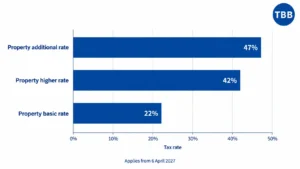
The change increases each of the current corresponding property-income rates by two percentage points.
Residential finance-cost relief will also be calculated using the new 22% property basic rate once the change takes effect.
The legislation also provides for devolved property-income rate powers, meaning Scottish landlords in particular should check the rates applicable to them for 2027/28 once the relevant Scottish tax position is confirmed.
Landlords considering a purchase, refinancing or ownership restructure should consequently model future years rather than basing the decision entirely on the 2026/27 tax rates.
Which Rental Tax Avoidance Schemes Should Landlords Avoid?
Landlords should be particularly sceptical of arrangements promising that rental profits can effectively disappear for tax purposes while ownership and economic benefit remain largely unchanged.
HMRC published an updated Spotlight 63a in April 2026 concerning property-business arrangements involving hybrid partnerships and indemnities.
The arrangements can involve an LLP with a corporate member and may be promoted as a way to bypass mortgage-interest restrictions or substantially reduce Income Tax.
HMRC’s stated position is that the arrangements do not work as claimed and that users could ultimately face unpaid tax, interest, penalties and promoter fees.
A conventional limited company used to acquire and operate rental properties is not automatically such a scheme. The warning concerns specific promoted arrangements that claim tax results HMRC believes are unsupported by the legislation.
The safest distinction is simple: legitimate tax planning uses reliefs Parliament has provided and reflects genuine ownership and transactions. Artificial arrangements designed primarily to manufacture deductions or move taxable profits require much greater scrutiny.
What Happens If Rental Income Was Not Declared?
Ignoring past rental income is not a tax-saving strategy.
HMRC operates the Let Property Campaign for many landlords who need to disclose previously undeclared property income and bring their tax affairs up to date.
Tax, interest and potentially penalties can still be payable, although making a voluntary disclosure can affect the penalty position.
TopBusinessBlog’s explanation of HMRC landlord tax disclosures covers the disclosure route, time limits and the distinction between recent Self Assessment returns and older undeclared years.
A landlord discovering an earlier error should therefore deal with it rather than attempting to offset the problem with aggressive planning in later years.
When Does Rental Income Need to Be Reported to HMRC?
The reporting obligation should be considered separately from whether tax is ultimately payable.
HMRC’s current public guidance states that an individual generally needs to contact HMRC where property income exceeds £1,000 but is no more than £2,500.
Self Assessment is generally required where property profit after allowable expenses exceeds £2,500 or gross property income before expenses exceeds £10,000.
Different circumstances can still create reporting obligations, particularly where a person already completes Self Assessment or cannot use the property allowance.
For rental income arising during 2026/27, someone who needs to register for Self Assessment would normally need to notify HMRC by 5 October 2027, with the online return and tax generally due by 31 January 2028.
Landlords already within Making Tax Digital may also have digital record-keeping and quarterly-update obligations during the year.
What Is the Most Effective Legal Way to Reduce Rental Income Tax?
There is no single strategy that works for every landlord.
For a landlord receiving a very small amount of rent, the £1,000 property allowance may be enough.
For a landlord with substantial running costs, claiming every genuine expense may produce the better result.
Someone letting a room in their main home may find Rent a Room relief substantially more valuable.
A married couple or civil partners with genuinely unequal ownership may need to examine the Form 17 rules.
A heavily mortgaged higher-rate landlord may want to model personal ownership against future company ownership, while considering Corporation Tax, dividend tax, mortgage costs and transfer taxes rather than looking at Section 24 in isolation.
The correct approach is therefore to calculate the position in this order:
- Establish the correct gross property income and ownership.
- Check whether the property allowance or Rent a Room rules apply.
- Compare the allowance with actual allowable expenditure.
- Include Replacement of Domestic Items Relief where appropriate.
- Apply carried-forward property losses correctly.
- Calculate residential finance-cost relief separately.
- Consider the landlord’s other income and available Personal Allowance.
- Check whether joint ownership, company ownership or pension planning changes the wider tax position.
- Model the April 2027 property-tax changes before making long-term decisions.
- Report the correct figures to HMRC and retain supporting records.
The objective should not be to make genuine rental income invisible. It should be to ensure that every legitimate deduction, allowance and relief is used correctly while avoiding structures that create unnecessary tax or compliance risk.
Frequently Asked Questions
How much rental income is tax-free in the UK?
The property allowance can cover up to £1,000 of qualifying gross property income. A landlord may also have unused Personal Allowance, while qualifying Rent a Room income has a separate £7,500 threshold.
Can a landlord claim both the £1,000 allowance and expenses?
Generally no. A landlord normally chooses between the property allowance and actual expenses for the relevant property business.
Can mortgage payments be deducted from rental income?
The capital repayment cannot be deducted. Individual residential landlords generally receive a tax reduction for qualifying finance costs rather than deducting mortgage interest directly from rental profit.
Can rental income be paid directly to a spouse to save tax?
Simply redirecting the rent does not necessarily transfer the tax liability. The beneficial ownership and genuine entitlement to the property income need to support the tax treatment.
Does putting a rental property into a company avoid tax?
No. It changes the tax regime. Corporation Tax applies to company profits, and further tax can arise when money is extracted personally. Transferring an existing property can also have CGT and SDLT consequences.
Is Airbnb income tax-free?
Not automatically. A person renting furnished accommodation in their main home may qualify for Rent a Room relief, but a separate property or non-qualifying letting is normally dealt with under the ordinary property-income rules.
Will landlords pay more tax from April 2027?
For property income subject to the new England, Wales and Northern Ireland rates, the basic, higher and additional property rates become 22%, 42% and 47% from 6 April 2027. Individual circumstances and devolved tax rules still need to be considered.

More in Finance & Tax

Nationwide ISA Rates 2026: Current Cash ISA Rates, Fixed Terms and Access Rules
Nationwide ISA rates currently reach 4.70% AER tax-free, with the building society offering four fixed-rate Cash ISAs alongside its 1 Year Triple Access ISA. As of 1 October 2026, Nationwide’s current fixed Cash ISA rates are 4.50% for one year, 4.55% for two years, 4.65% for three years and 4.70% for five years. Its 1 […]

When Does ISA Allowance Reset? UK Rules for 2026/27 and 2027
The ISA allowance resets on 6 April every year, when the new UK tax year begins. For the current 2026/27 tax year, the annual adult ISA allowance is £20,000, covering money contributed between 6 April 2026 and 5 April 2027. Anything left unused when 5 April ends normally disappears rather than carrying into the next […]