
Working as a self-employed gardener in the UK can provide a reliable income, particularly for people who build a regular customer base and develop specialist horticultural skills. However, one of the biggest decisions when starting or expanding a gardening business is determining how much to charge customers.
The self-employed gardener hourly rate in the UK typically ranges from £25 to £40 for general garden maintenance in 2026, although some gardeners charge less for straightforward work and experienced professionals can charge £45–£50 or more.
Across London and the South East, gardening charges are frequently higher because of transport expenses, parking restrictions, local demand and the cost of operating a small business.
From a financial perspective, choosing an hourly rate is not simply about matching competitors. A gardener charging £35 per hour does not necessarily earn £35 personally.
That fee must cover equipment, insurance, fuel, travelling, administrative work, taxation and periods when no customer work is available.
We analysed current UK gardening price information, professional industry guidelines and the financial requirements of operating a sole-trader business to establish what different rates mean in practice.
The following breakdown covers hourly charges, regional differences, annual earnings, operating costs, tax responsibilities and the pricing strategies that can make a gardening business financially sustainable.
What Is the Average Self-Employed Gardener Hourly Rate in the UK?
For 2026, general residential gardeners commonly charge around £20–£40 per hour, depending on the type of service, customer arrangements and location.
Professional gardeners who hold relevant qualifications, maintain commercial equipment and work with established customers may charge considerably more.
| Gardener category | Indicative hourly rate |
| Beginner offering basic maintenance | £20–£30 |
| General self-employed gardener | £25–£40 |
| Established and experienced gardener | £35–£50 |
| Experienced gardener in London | £40–£55 |
| Specialist horticultural gardener | £45–£65+ |
| Two-person gardening team | £55–£90+ combined |
These are indicative pricing ranges rather than regulated tariffs or guaranteed market averages. The individual gardener’s operating costs and service requirements determine whether a particular rate is profitable.
The distinction between a general consumer rate and the price charged by a qualified specialist is important.
A customer hiring somebody to mow a small lawn might pay £25 per hour, while a homeowner engaging a horticulturist for specialist pruning or long-term garden management may reasonably pay considerably more.
In practice, the cheapest hourly rate does not always represent the lowest total cost. An experienced gardener might complete a specialist task more efficiently and with less risk of damaging valuable plants.
How Much Do Qualified Self-Employed Gardeners Charge in 2026?
Professional experience plays an important role in gardening prices.
The Gardeners Guild’s 2026 professional gardening cost guidance provides estimates based on experience and business operating requirements.
| Professional experience | Estimated daily charge | Published hourly guidance |
| Up to four years | £210 | £28 |
| Four to ten years | £272 | £36 |
| Ten years or more | £343 | £46.70 |
The organisation’s figures are based on research involving professional members and assumptions about chargeable working hours.
Its published £343 daily figure and £46.70 hourly figure do not reconcile exactly when divided by the stated 7.5 hours, so they should be treated as indicative estimates rather than precise conversions.
The underlying business message is more important: experienced gardeners generally need to charge enough to recover the cost of delivering a professional service.
Qualifications and expertise may support higher rates where the work involves:
- Specialist horticultural knowledge and plant identification.
- Fruit-tree, rose or ornamental shrub pruning.
- Garden restoration and planting schemes.
- Plant health assessments and soil improvement.
- Maintaining high-value residential gardens.
- Working with specialist machinery.
- Managing commercial or heritage gardens.
Customers are paying for professional judgement and consistent outcomes, not solely the number of hours spent on their property.
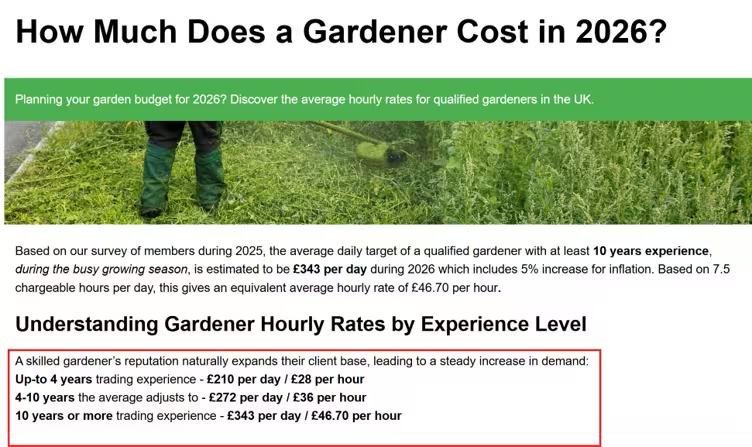
Professional gardening rates in 2026 vary according to experience, with established gardeners typically commanding higher daily charges.
What Is the Self-Employed Gardener Hourly Rate in London and Other UK Regions?
Location influences the cost of providing gardening services, particularly when a self-employed business requires regular travel between customers.
London gardeners often face higher fuel, parking, vehicle insurance and general business costs than providers operating in smaller towns.
The Professional Gardeners’ Guild publishes regional recommended minimum rates for self-employed professionals.
| UK region | 2026 recommended hourly rates |
| London | £30–£51 |
| South East and East Anglia | £29–£41 |
| Scotland, Wales and other UK regions | £26.50–£41 |
These are professional guidelines, not fixed prices charged by every gardener in those regions.
Why Do London Gardeners Often Charge More?
A gardener working in Chelsea, Hampstead, Richmond or Islington may have higher operating expenses than somebody maintaining several nearby properties in a rural town.
Parking fees, congestion, limited vehicle access and additional travelling can reduce the number of billable hours available each day.
For example, a gardener charging £40 per hour for five customer hours generates £200 in daily turnover.
If another two hours are spent travelling and another half-hour preparing equipment and administering the business, the actual turnover across that 7.5-hour working day is approximately £26.67 per working hour, before expenses and tax.
This difference explains why a London gardening business may need a higher advertised hourly charge even when its owner does not earn a proportionately higher income.
How Much Should Self-Employed Gardeners Charge for Different Services?
Gardening businesses rarely operate with one universal price for every task.
The equipment required, working conditions, specialist knowledge and amount of waste generated can all affect the final quotation.
| Gardening service | Indicative charging approach |
| Lawn mowing and edging | £25–£40 per hour or fixed visit fee |
| Weeding and border maintenance | £25–£40 per hour |
| Regular garden maintenance | £25–£40 per hour |
| Planting and soil preparation | £30–£45 per hour plus materials |
| Specialist pruning | £35–£55 per hour |
| Hedge cutting | £30–£50+ per hour or fixed quotation |
| Seasonal garden clearance | Fixed job price or day rate |
| Garden management consultation | £40–£75+ per hour |
| Small landscaping projects | Project quotation |
| Green waste removal | Separately calculated disposal charge |
These figures are useful for preparing an initial business price list, but they should not replace a proper assessment of each job.
How Should Lawn Mowing Be Priced?
Lawn mowing is one of the more predictable gardening services.
However, a small lawn requiring only 30 minutes of cutting can still involve travel, equipment preparation, unloading and payment administration.
Charging strictly for 30 minutes of labour may therefore be unprofitable.
A fixed minimum visit fee is often more practical, particularly for customers who require fortnightly maintenance.
Why Does Hedge Cutting Cost More?
Hedge cutting can involve greater physical effort, specialist equipment and additional waste.
A professional may also need to assess access, working height, nearby obstacles and the suitability of the job for their qualifications and insurance.
Because the amount of work can vary considerably, larger hedge-cutting projects are usually better priced through an individual quotation.
Should a Self-Employed Gardener Charge Hourly, Daily or Per Job?
The pricing method should reflect how predictable the work is and who carries the financial risk if a task takes longer than expected.
| Pricing model | Best suited to | Main advantage |
| Hourly | Regular maintenance and flexible work | Covers actual labour time |
| Half-day | Small scheduled projects | Reduces lost time between customers |
| Daily | Large gardens and extended maintenance | Improves scheduling efficiency |
| Fixed project price | Clearances, planting schemes and landscaping | Gives the customer price certainty |
| Recurring maintenance agreement | Weekly or fortnightly visits | Provides more predictable business income |
For routine gardening, hourly rates remain straightforward.
However, established businesses can sometimes earn more consistently by combining regular maintenance contracts with separately quoted specialist projects.
A gardener charging £35 per hour for a seven-hour day would invoice £245.
If the same gardener agrees to a £200 day rate for seven hours, the effective hourly charge falls to approximately £28.57.
The reduction may still make commercial sense if the customer provides predictable work, eliminates travelling between properties and reduces administration.
Our financial assessment is that day-rate discounts should be calculated against the genuine efficiency gained, rather than offered automatically.
How Can a Self-Employed Gardener Calculate a Profitable Hourly Rate?
A sustainable hourly charge should be based on the amount the business needs to generate annually.
The calculation must account for desired profit, business expenses, an allowance for unexpected costs and realistic billable working hours.
Minimum hourly charge = (Desired annual pre-tax profit + Annual business costs + Contingency) ÷ Annual billable hours
Consider a gardener who wants to operate a full-time business with the following financial requirements.
| Financial requirement | Annual amount |
| Desired profit before personal tax | £30,000 |
| Vehicle, fuel, equipment and business expenses | £8,000 |
| Contingency for quiet periods and repairs | £2,000 |
| Required turnover | £40,000 |
Assume the gardener expects to invoice five hours per day across 220 working days.
This produces 1,100 billable hours annually.
The required hourly rate is therefore:
£40,000 ÷ 1,100 = £36.36 per hour
Charging £37 would approximately meet the forecast if the gardener achieves all expected billable hours and the cost assumptions prove accurate.
However, a standard rate closer to £39–£40 could provide more protection against cancellations, additional equipment expenses and unexpectedly quiet periods.
Why Are Billable Hours More Important Than Total Working Hours?
Self-employed gardeners spend considerable time on activities that do not generate an immediate customer payment.
These include preparing quotations, maintaining machinery, travelling, purchasing supplies, bookkeeping and promoting the business.
A gardener working 40 hours each week may only invoice 25–30 hours.
For example:
| Weekly activity | Hours |
| Chargeable customer work | 27 |
| Travelling and loading equipment | 5 |
| Quotations and customer administration | 3 |
| Maintenance and purchasing supplies | 3 |
| Bookkeeping and business development | 2 |
| Total working hours | 40 |
In this illustration, only 67.5% of working time is directly billable.
At £35 per chargeable hour, weekly turnover would be £945.
Spread across the full 40 working hours, that is equivalent to £23.63 per hour before business expenses and personal tax.
This is why pricing solely against the hours spent physically gardening can produce misleading earnings expectations.
What Business Expenses Reduce a Gardener’s Actual Earnings?
One of the most useful findings in professional gardening research is that business operating costs can consume a substantial proportion of turnover.
The Gardeners Guild estimates average annual operating costs of approximately 23% of turnover for professional gardening businesses.
That proportion includes expenditure on vehicles, insurance, tools, repairs, training and other operational requirements.
For a business generating £40,000 annually, applying a 23% cost assumption gives approximately £9,200 in annual operating costs.
The remaining £30,800 is business profit before the owner’s personal tax and National Insurance, rather than take-home pay.
What Expenses Should a Gardener Budget For?
| Business expense | Why it matters |
| Van or business vehicle | Transporting machinery and supplies |
| Fuel and parking | Travelling between customers |
| Equipment purchases | Mowers, trimmers, blowers and hand tools |
| Repairs and servicing | Keeping machinery operational |
| Public liability insurance | Protection against covered third-party claims |
| Protective clothing | Appropriate equipment for safe working |
| Waste disposal | Lawful handling of commercial garden waste |
| Advertising and website | Customer acquisition |
| Accounting software | Tracking income, expenses and tax |
| Training and qualifications | Maintaining professional competence |
| Replacement equipment | Funding future machinery purchases |
Tax-deductible expenses should be distinguished from personal spending and owner drawings.
Gardeners can check how different costs are treated under the rules for allowable self-employed business expenses.
A sensible business budget should also distinguish between recurring expenses, one-off capital purchases and cash reserved for future replacements.
For example, purchasing a new mower may produce an immediate cash outflow even where its tax treatment differs from ordinary running expenses.
How Much Can a Self-Employed Gardener Earn Per Year in the UK?
Annual earnings depend more on billable hours, customer retention and business costs than on the advertised hourly rate alone.
We modelled three potential gardening business arrangements using different hourly charges and realistic working patterns.
These are illustrative financial scenarios, not survey averages or guaranteed earnings.
| Financial measure | Part-time gardener | Full-time gardener | Experienced gardener |
| Hourly charge | £30 | £38 | £48 |
| Billable hours per week | 18 | 28 | 30 |
| Working weeks per year | 44 | 46 | 45 |
| Annual turnover | £23,760 | £48,944 | £64,800 |
| Annual business expenses | £5,500 | £10,000 | £14,000 |
| Profit before personal tax | £18,260 | £38,944 | £50,800 |
| Estimated Income Tax | £1,138 | £5,275 | £7,752 |
| Estimated Class 4 National Insurance | £341 | £1,582 | £2,273 |
| Estimated annual income after these taxes | £16,781 | £32,087 | £40,775 |
| Monthly equivalent | £1,398 | £2,674 | £3,398 |
The tax calculations use 2026/27 Income Tax rules applicable in England, Wales and Northern Ireland, assuming the standard £12,570 Personal Allowance, no other income and the stated expenses being deductible. Scottish Income Tax can produce different results.
The estimates do not include pension contributions, student loan repayments, other individual adjustments or additional cash requirements such as payments on account.
They also assume that customers pay for all the billable hours forecast.
What Do These Earnings Figures Tell Us?
A gardener charging £48 per hour does not automatically earn twice as much as somebody charging £24.
Higher-rate businesses may need more expensive machinery, specialist insurance and additional training. They may also work fewer chargeable hours if demand for their specialist services is irregular.
Conversely, an established gardener earning £38 per hour from a tightly scheduled network of regular customers may generate stronger cash flow than someone advertising £50 but struggling to fill their calendar.
For a self-employed business, consistent chargeable work and cost control are just as important as the headline rate.
How Does Seasonal Demand Affect Self-Employed Gardening Income?
Gardening is a seasonal occupation, and that should influence both annual budgets and pricing decisions.
The Gardeners Guild reports that professional gardeners can experience an average winter income reduction of approximately 36%.
Shorter daylight hours, wet weather, freezing conditions and reduced customer demand can make winter months less profitable.
A gardener who budgets using peak summer working hours throughout the year may therefore overestimate expected income.
How Can Gardeners Reduce Seasonal Income Risk?
A more resilient business can combine seasonal services instead of relying exclusively on lawn cutting.
Potential services include:
- Spring preparation, planting and lawn maintenance.
- Summer mowing, weeding and border care.
- Autumn leaf clearing and seasonal pruning.
- Winter garden tidying and suitable maintenance.
- Year-round commercial grounds maintenance.
- Planned planting, consultation and garden management.
Professional gardeners should only undertake seasonal work where weather conditions, safety requirements and horticultural considerations make it appropriate.
From a financial planning perspective, maintaining a reserve during profitable summer months can help cover winter expenses.
A gardener relying entirely on spring and summer bookings should be particularly cautious about committing to vehicle finance or expensive equipment repayments that continue throughout the year.
How Can Gardeners Improve Their Profit Margin Without Increasing Working Hours?
Increasing the hourly price is one method of improving revenue, but it is not the only one.
Small operational changes can produce meaningful gains.
Consider a gardener working five chargeable hours daily at £35 per hour. Daily turnover is £175.
If better scheduling allows another hour of customer work without adding a full additional working hour, daily turnover increases to £210.
That is a 20% increase in daily revenue, before accounting for any additional direct costs.
Practical improvements include grouping customers by postcode, reducing unnecessary journeys, scheduling repeat visits and keeping equipment in reliable working condition.
Regular customers can also reduce the time spent obtaining new business.
Should Gardeners Offer Maintenance Packages?
Recurring maintenance arrangements are particularly useful for small gardening businesses.
For example, a customer may agree to two visits each month at £70 per visit.
The annual contract value is:
£70 × 2 × 12 = £1,680
Ten comparable customers would represent £16,800 in potential annual contracted revenue, assuming all planned visits are completed and paid.
Packages should clearly explain seasonal changes, the work included, cancellation rules and how unsuitable weather affects visits.
A recurring agreement does not eliminate commercial risk, but it can make future income more predictable.
Should Self-Employed Gardeners Introduce a Minimum Visit Charge?
A minimum visit fee protects the business against small jobs that involve disproportionate travel and administration.
For example, a customer may request 30 minutes of weeding.
At £35 per hour, charging exactly 30 minutes would generate only £17.50.
If the visit requires 20 minutes of travelling each way, preparation and equipment cleaning, the job could consume considerably more than an hour of business time.
A minimum charge of £35–£50, depending on location and work requirements, may be more commercially sensible.
Some gardeners instead require a two-hour booking or offer a fixed-price lawn-maintenance service.
The minimum charge should always be explained before the work begins.
Should Gardeners Charge Extra for Travel, Materials and Waste Removal?
Travel, supplied materials and waste disposal should be accounted for when preparing customer quotations.
They may be included within a fixed service price or shown separately.
For example, a quotation might include:
| Quotation item | Example charge |
| Two hours of garden maintenance | £70 |
| Materials supplied | £15 |
| Green waste removal | £20 |
| Total before any applicable VAT | £105 |
This is an illustrative quotation, not a standard price for all customers.
The final amount should reflect the actual materials, transport requirements, disposal arrangements and agreed work.
Does a Gardener Need Permission to Transport Garden Waste?
Transporting garden waste commercially can bring waste-carrier registration and disposal obligations.
The relevant rules depend on the nature and origin of the waste and where the business operates.
Gardeners working in England should check Environment Agency requirements. Businesses operating in Wales, Scotland or Northern Ireland should consult the relevant national regulator.
Commercial gardening waste should not automatically be taken to household recycling centres, as councils may impose restrictions or charges.
A responsible business should also be able to explain where it disposes of waste and provide appropriate documentation where required.
How Much Tax Does a Self-Employed Gardener Pay in 2026/27?
Self-employed gardeners normally pay tax on their taxable business profits rather than their total customer receipts.
For a sole trader, taxable profit generally starts with turnover less allowable business expenses, subject to the applicable tax rules and adjustments.
For 2026/27, the standard UK Personal Allowance remains £12,570, subject to eligibility and reductions at higher incomes.
The main Income Tax bands for non-savings income in England, Wales and Northern Ireland are:
| Taxable income band | Income Tax rate |
| Personal Allowance, normally up to £12,570 | 0% |
| £12,571–£50,270 | 20% |
| £50,271–£125,140 | 40% |
| Above £125,140 | 45% |
The Personal Allowance reduces for adjusted net income above £100,000. Scottish residents are subject to different Income Tax bands for their non-savings, non-dividend income.
What National Insurance Does a Self-Employed Gardener Pay?
Self-employed gardeners can also be liable for Class 4 National Insurance.
| 2026/27 self-employed profit | Class 4 National Insurance |
| Up to £12,570 | No Class 4 payable |
| Above £12,570 to £50,270 | 6% |
| Above £50,270 | 2% on the excess |
Class 2 National Insurance is generally treated as paid where qualifying profits are at least £7,105 in 2026/27.
For lower profits, voluntary Class 2 contributions may be available at £3.65 per week.
Gardeners should not confuse National Insurance thresholds with business turnover, because contributions are generally assessed against profits.
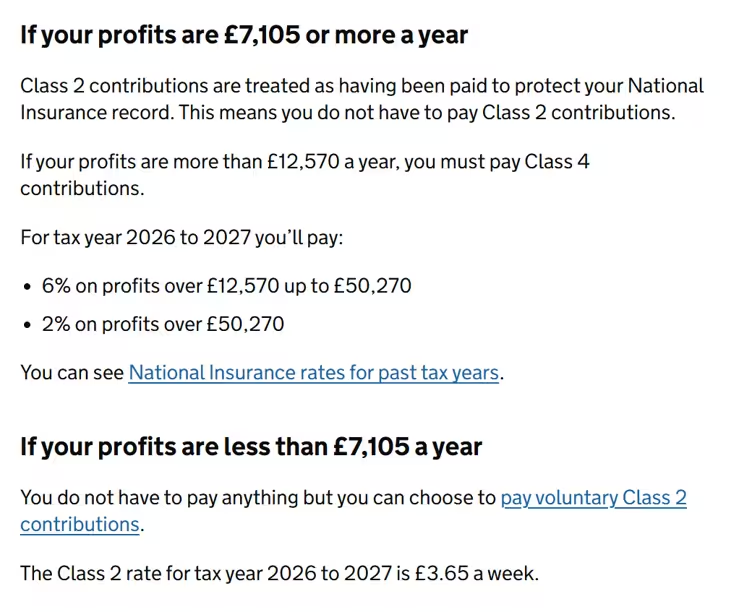
HMRC’s 2026/27 self-employed National Insurance thresholds and contribution rates.
Does a Self-Employed Gardener Need to Register With HMRC?
A person operating a gardening business as a sole trader will normally need to register for Self Assessment where gross trading income exceeds £1,000 in a tax year, unless an exception applies.
Someone starting a gardening business during the 2026/27 tax year would generally need to register by 5 October 2027 where registration is required.
The first online Self Assessment return and payment for that tax year would normally be due by 31 January 2028.
Gardeners can follow the relevant steps for registering as a sole trader, including record keeping and notification requirements.
Can Gardeners Use the £1,000 Trading Allowance?
The trading allowance may benefit people who occasionally earn money from gardening.
For example, someone receiving £800 from occasional gardening work during a tax year may qualify for full trading allowance relief.
However, the £1,000 threshold relates to gross trading income, not profit.
Where gross income exceeds the threshold, eligible taxpayers may be able to deduct either the trading allowance or their actual allowable expenses.
They cannot normally deduct both against the same trading income.
A full-time gardener with substantial vehicle and equipment expenses will often benefit more from claiming actual allowable costs.
The rules are explained in more detail under the £1,000 trading allowance for self-employed income.
When Does a Self-Employed Gardener Need to Register for VAT?
VAT registration becomes an important consideration as a gardening business expands.
The compulsory UK VAT-registration threshold in 2026 is generally more than £90,000 of taxable turnover over the previous rolling 12 months. Registration may also be required where turnover is expected to exceed that threshold in the next 30 days alone.
Businesses below the threshold can sometimes register voluntarily.
A VAT-registered gardener supplying standard-rated services will generally need to account for VAT, normally at 20%.
For example:
- Hourly labour charge excluding VAT: £40
- VAT at 20%: £8
- Total customer charge: £48
Residential customers generally cannot recover VAT, meaning registration can affect the final price they pay.
Commercial clients that are VAT-registered may be able to recover input VAT, subject to the normal rules.
A gardener approaching the threshold should therefore consider the composition of their customer base and the impact on pricing.
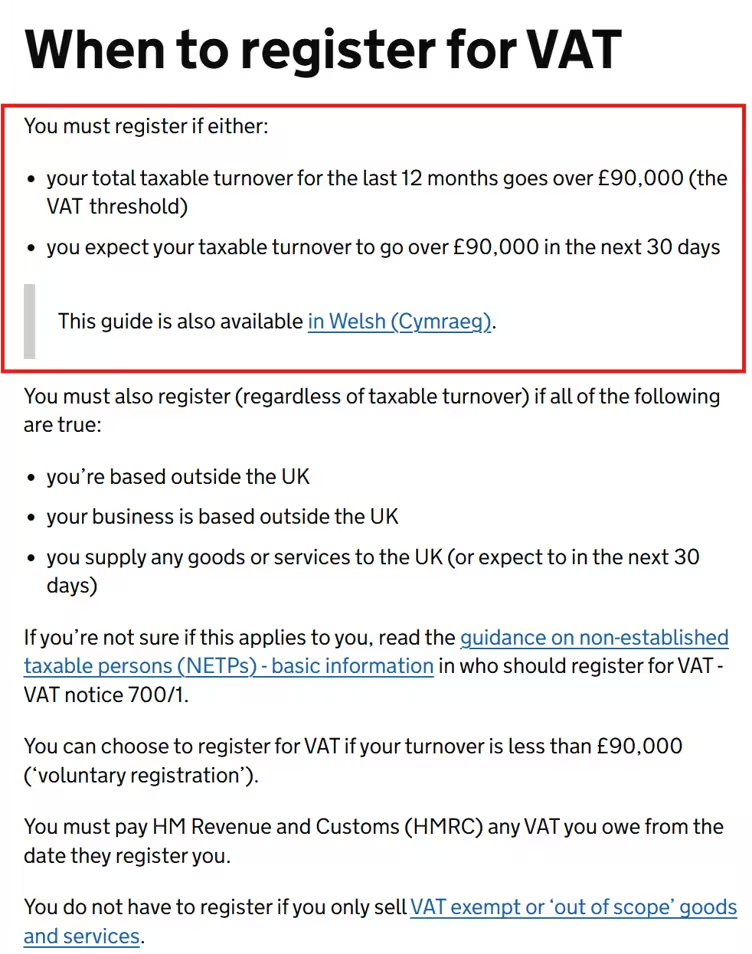
The UK VAT-registration threshold is £90,000 of taxable turnover, assessed using a rolling 12-month period.
Does Making Tax Digital Affect Self-Employed Gardeners in 2026?
Making Tax Digital for Income Tax is now an important part of business administration for qualifying sole traders.
The scheme was introduced in stages from 6 April 2026.
The relevant qualifying income is generally gross self-employment and property income before expenses, rather than business profit.
| Qualifying income in the relevant tax year | Mandatory MTD start date |
| More than £50,000 in 2024/25 | 6 April 2026 |
| More than £30,000 in 2025/26 | 6 April 2027 |
| More than £20,000 in 2026/27 | 6 April 2028 |
Exemptions and other eligibility conditions can apply.
Eligible gardeners must use compatible software to maintain digital records and submit quarterly income and expense updates, alongside their annual tax return obligations.
For businesses expanding towards £30,000–£50,000 in gross annual income, it is sensible to consider accounting systems before compliance becomes compulsory.
The implications of Making Tax Digital for self-employed people are therefore relevant to gardening businesses planning growth.
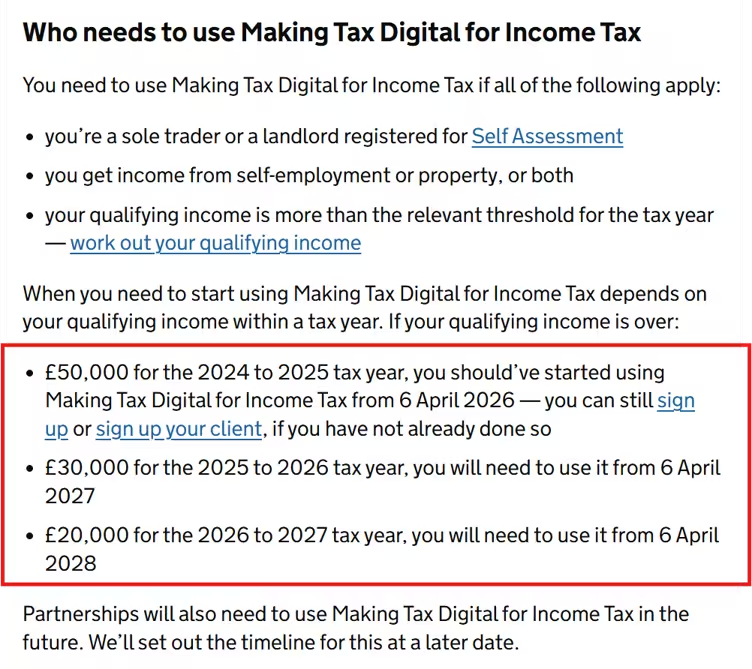
HMRC’s Making Tax Digital timetable showing the introduction of income-reporting requirements from April 2026 to April 2028.
Should Gardeners Use Accounting Software to Track Earnings?
Reliable financial records are essential for understanding whether a particular hourly rate is actually profitable.
A gardener should be able to identify how much revenue is generated by customer, how much is spent on fuel and equipment, and how much remains available after tax.
Accounting software can make it easier to monitor unpaid invoices, record expenses, track turnover and prepare the information needed for Self Assessment.
A small business can assess its options through a comparison of sole trader accounting software, paying attention to cost, invoicing functionality and Making Tax Digital compatibility.
It is also sensible to maintain a separate business bank account, even where this is not legally compulsory for a sole trader.
Keeping business transactions separate from personal spending makes financial management more straightforward.
How Often Should a Self-Employed Gardener Increase Hourly Rates?
Gardening businesses should review their prices at least annually.
Operating costs do not remain fixed. Fuel, insurance, machinery, waste disposal and professional expenses can all increase.
The Professional Gardeners’ Guild recommended a 3.75% increase across its 2026 guideline ranges.
That is a professional recommendation rather than a mandatory increase for individual sole traders.
For illustration, increasing a £35 hourly charge by 3.75% would produce a new rate of approximately £36.31.
If a gardener charges £35 for 1,200 billable hours, annual turnover is £42,000.
Increasing that rate to £37, while keeping the same billable hours, would raise annual turnover to £44,400.
That represents a 5.7% revenue increase.
However, the extra income only improves business profit to the extent it is not offset by additional costs or lost customer bookings.
The strongest approach is to review service costs and customer demand rather than applying identical price increases without examining individual accounts.
Is It Better to Be a Self-Employed Gardener or an Employed Gardener?
Self-employment offers control over pricing, customer relationships and working hours.
Employment offers different advantages, including more predictable wages and statutory employment protections.
| Factor | Employed gardener | Self-employed gardener |
| Income | Agreed salary or wage | Depends on customer invoices |
| Pricing control | Usually set by employer | Set by the business owner |
| Holiday pay | Statutory entitlement applies | Must be funded from earnings |
| Equipment | Often provided by employer | Usually a business responsibility |
| Tax administration | Usually PAYE | Usually Self Assessment |
| Customer acquisition | Usually handled by employer | Business owner’s responsibility |
| Financial risk | Generally lower | Generally higher |
| Growth potential | Career progression | Expand prices, services and customer base |
A self-employed gardener charging £40 per hour might initially appear considerably better paid than an employee.
However, the comparison changes after allowing for business expenses, unpaid holidays, pensions and periods without customer work.
It is also important to understand the distinction between a sole trader and a self-employed worker before selecting a business structure.
For somebody with a strong local customer base and the ability to manage finances independently, self-employment can be commercially attractive.
For someone who values predictable monthly income and reduced administrative responsibility, employment may be the more suitable option.
What Should Customers Check Before Hiring a Self-Employed Gardener?
Customers should compare the overall service rather than simply choosing the lowest hourly charge.
A useful quotation should explain the tasks included, expected duration and whether additional costs will arise.
Customers should consider whether:
- The gardener has relevant experience for the work.
- Appropriate public liability insurance is in place.
- Machinery and specialist activities are covered.
- Materials are included or charged separately.
- Waste disposal is arranged lawfully.
- Travel and minimum visit charges are explained.
- VAT is included where applicable.
- Cancellation and payment terms are clear.
A gardener offering a slightly higher hourly rate may deliver better value through reliable attendance, specialist knowledge and efficient working.
Similarly, a lower-cost gardener may be perfectly suitable for straightforward lawn maintenance.
The appropriate choice depends on the type of garden, the complexity of the work and the service expected.
How Can a New Self-Employed Gardener Build a Profitable Business?
Starting a gardening business does not necessarily require expensive premises or a large workforce.
However, it does require financial discipline and a practical approach to developing customers.
New gardeners should concentrate on building a local reputation, maintaining reliable equipment and developing a realistic working schedule.
Focus on Regular Customers
Weekly and fortnightly maintenance arrangements can provide more reliable income than relying entirely on one-off bookings.
Regular work also reduces the time spent advertising and quoting.
Keep the Service Area Manageable
Accepting customers across a wide geographical area can create unnecessary fuel costs and unpaid travel time.
A compact customer route is often more profitable than a larger number of distant jobs.
Avoid Underpricing Specialist Work
A gardener should not charge a basic lawn-maintenance rate for tasks requiring extensive training, expensive machinery or additional risk.
Where work requires professional certification or falls outside available insurance, it should be referred to an appropriately qualified specialist.
Set Aside Money for Tax and Equipment Replacement
Business profit is not the same as disposable income.
Reserving funds for Income Tax, National Insurance, future equipment purchases and quieter months is essential.
New gardeners should also understand whether their first Self Assessment bill could include payments on account, which can create a larger cash requirement than expected.
Conclusion
The self-employed gardener hourly rate in the UK generally falls between £25 and £40 for routine maintenance in 2026, while experienced and specialist professionals can charge considerably more.
However, a sustainable gardening business depends on more than achieving a competitive hourly rate. Equipment, travel, insurance, seasonal demand, taxation and unpaid administration all influence actual earnings.
Our analysis indicates that gardeners should concentrate on profitable billable hours, repeat customers, reliable cash flow and disciplined cost management.
An appropriately priced service supported by consistent professional standards offers a stronger long-term business model than competing solely on the lowest hourly charge.
Frequently Asked Questions
What Is a Fair Hourly Rate for a Self-Employed Gardener in the UK?
Around £25–£40 per hour is a reasonable indicative range for general maintenance in 2026. Qualified specialists and gardeners in higher-cost locations may charge more.
Is £30 Per Hour Expensive for a Gardener?
Not necessarily. £30 per hour falls within common UK gardening price ranges and must cover equipment, travel, insurance and business expenses.
How Much Does a Self-Employed Gardener Charge Per Day?
Typical general gardening day rates can range from approximately £160 to £260, while highly experienced professionals may charge above £300.
Can a Self-Employed Gardener Earn £40,000 a Year?
Yes, an established gardener can potentially generate £40,000 or more in annual business profit, but this depends on their rates, billable hours, customer demand and expenses.
Do Self-Employed Gardeners Need Insurance?
Public liability insurance is strongly advisable, although it is not universally mandatory for every gardening sole trader. Employers’ liability insurance may be legally required where staff are employed.
Do Gardeners Charge More in London?
Often, yes. Higher operating costs, parking restrictions and stronger demand for professional services can contribute to higher charges.
Can Gardeners Charge Extra for Green Waste Removal?
Yes. Gardeners can quote separately for waste collection, transport and lawful disposal, provided the charges are clearly agreed with the customer.
Does a Self-Employed Gardener Have to Pay VAT?
VAT registration is generally compulsory when taxable turnover exceeds £90,000 over a rolling 12-month period, or the relevant forward-looking threshold test is met. Smaller businesses may register voluntarily.
How Much Should a Beginner Gardener Charge?
A beginner might consider £20–£30 per hour for basic maintenance, but should first calculate actual operating costs and assess local competition.
Is Gardening a Profitable Self-Employed Career?
It can be. Profitability depends on regular bookings, efficient customer scheduling, appropriate pricing, equipment costs and managing seasonal fluctuation.

More in Finance & Tax

Skipton Building Society ISA Rates 2027: Latest Cash ISA Rates and 2026 Updates
Skipton Building Society ISA rates currently reach 5.05% AER tax-free on its five-year fixed-rate Cash ISA, while its 15-month fixed account offers 4.90% and its Bonus Cash ISA Saver pays 4.21% variable, including a temporary introductory bonus. For savers preparing their finances for 2027, these rates create different opportunities depending on how long they can […]

Coventry Building Society ISA Rates 2027: Latest Cash ISA Rates, 2026 Updates and Our Expert Review
Coventry Building Society ISA rates are an important consideration for UK savers looking to earn tax-free interest in 2027. Whether you want to lock away money for a guaranteed return, maintain access to emergency savings or transfer an existing ISA, choosing the right account can make a significant difference to your annual interest. Our analysis […]