
Finding the best 2 year fixed rate ISA in the UK involves more than choosing the bank offering the highest interest rate. Savers must also consider minimum deposits, early withdrawal penalties, ISA transfer rules and how interest is calculated over the two-year period.
Our analysis of the UK savings market in October 2026 found several two-year fixed Cash ISAs offering interest rates above 5% AER, while established banks and building societies provide alternative accounts with different deposit requirements and access conditions.
For households, self-employed professionals and business owners managing personal savings, understanding these differences can make a meaningful financial impact. This guide examines ten providers, potential returns, tax advantages and the important decisions to consider before fixing savings for two years.
What Is the Best 2 Year Fixed Rate ISA in the UK Right Now?
As of 24 October 2026, UBL UK advertises a two-year fixed Cash ISA paying 5.10% AER, with a minimum opening deposit of £2,000.
Close Brothers Savings follows at 5.07% AER, while Shawbrook Bank offers a 5.06% AER two-year fixed-rate product for eligible new customers depositing at least £10,000.
However, the highest percentage rate is not automatically the most suitable account.
Someone saving £2,000 may prefer a different provider from someone transferring £50,000 accumulated in Cash ISAs over several years.
Our comparison focuses on interest rates, deposit requirements, account accessibility, potential interest earnings and how individual products fit different personal savings circumstances.
Best 2 Year Fixed Rate ISA Comparison Table – October 2026
| Provider | 2-Year Interest Rate (AER) | Minimum Deposit | Account Type |
| UBL UK | 5.10% | £2,000 | Fixed Cash ISA |
| Close Brothers Savings | 5.07% | £10,000 | Fixed Cash ISA |
| Shawbrook Bank | 5.06% | £10,000 | Fixed Rate Plus Cash ISA |
| Charter Savings Bank | 5.01% | £5,000 | Fixed Cash ISA |
| Aldermore Bank | 5.01% | £1,000 | Fixed Cash ISA |
| Kent Reliance | 4.92% | £1,000 | Fixed Cash ISA |
| Furness Building Society | 4.86% | £1,000 | Fixed Cash ISA |
| Tandem Bank | 4.85% | Check current app terms | Fixed Cash ISA |
| Santander | 4.80% | £500 | Fixed Rate ISA |
| Nationwide Building Society | 4.55% | £1 | Fixed Cash ISA |
Rates are snapshots from publicly available provider information checked on 24 October 2026. They are not an exhaustive ranking of every Cash ISA on the market. Rates, issues and eligibility may change. Some comparison websites display higher figures for individual providers than their public product pages; applicants should always confirm the latest account summary box.
Which Banks Offer the Best 2 Year Fixed Rate ISA Accounts?
1. UBL UK – 5.10% AER
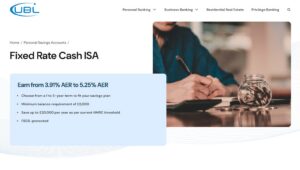
Check the UBL 2 Year Fixed Rate ISA Here
UBL UK’s two-year fixed-rate Cash ISA is among the highest-paying accounts identified in our October 2026 comparison.
The bank requires a minimum deposit of £2,000 and permits existing Cash ISA savings to be transferred into the account.
Savers can choose different interest payment arrangements, including monthly, annually or on maturity, although the available gross rates may depend on the selected payment frequency.
An important condition is the early withdrawal charge.
Customers who close the two-year ISA before maturity normally face a deduction equivalent to 180 days’ gross interest. Partial early withdrawals are not permitted.
UBL UK’s published illustration shows that £2,000 deposited at the advertised two-year maturity option could grow to approximately £2,209.20.
For someone with an existing Cash ISA balance and no expected need for the money over the next two years, the fixed rate provides certainty about the applicable return.
2. Close Brothers Savings – 5.07% AER

Check the Close Brothers Savings 2 Year Fixed Rate ISA Here
Close Brothers Savings advertises a two-year Fixed Rate Cash ISA paying 5.07% AER.
The minimum deposit is £10,000, making it more appropriate for savers who already have a substantial lump sum.
Interest is calculated daily, credited annually and at maturity, and compounded within the account.
Customers must generally provide their deposit or ISA transfer instructions within ten days to secure the advertised terms.
Our comparison shows that the gap between this account and UBL UK’s 5.10% offer is only 0.03 percentage points.
On a £10,000 deposit, that difference represents approximately £6 over two years, assuming equivalent annual compounding.
Consequently, deposit requirements, transfer arrangements and early closure conditions may matter more than this relatively small difference.
3. Shawbrook Bank – 5.06% AER
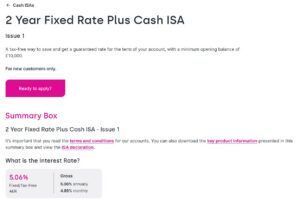
Check the Shawbrook Bank 2 Year Fixed Rate ISA Here
Shawbrook Bank’s two-year Fixed Rate Plus Cash ISA advertises 5.06% AER.
This particular product is intended for new customers and requires an opening balance of at least £10,000.
The bank also offers other fixed-rate Cash ISA accounts, so customers should distinguish the Plus product from its standard two-year offering.
This distinction is important because two products from the same provider can have different rates and eligibility conditions.
For someone transferring money from an existing ISA, the bank’s funding deadlines and accepted transfer procedures should be checked before applying.
A 5.06% fixed rate offers certainty over two years, although early access could result in an interest deduction.
4. Charter Savings Bank – 5.01% AER
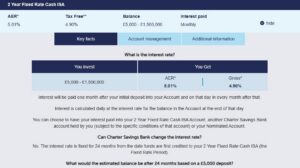
Check the Charter Savings Bank 2 Year Fixed Rate ISA Here
Charter Savings Bank advertises a two-year fixed-rate Cash ISA paying 5.01% AER, with a minimum investment of £5,000.
Its fixed-rate accounts may offer monthly or annual interest options.
Customers can generally choose whether eligible interest payments remain within the ISA or are paid to an appropriate nominated account.
The provider states that its fixed-rate products can be withdrawn from sale without notice.
This makes the application and funding window particularly important. Opening an account does not always mean the bank will accept unlimited additional money throughout the fixed term.
For someone depositing £5,000 or more, Charter offers another option when comparing interest payment frequency, access restrictions and tax-free saving.
5. Aldermore Bank – 5.01% AER

Check the Aldermore Bank 2 Year Fixed Rate ISA Here
Aldermore Bank’s two-year Fixed Rate Cash ISA advertises 5.01% AER, with a minimum opening balance of £1,000.
It provides monthly or annual interest payment options, subject to its account conditions.
Interest is calculated daily, and the chosen fixed rate remains unchanged during the contractual term.
Aldermore also permits eligible Cash ISA transfers, making it relevant to savers consolidating existing balances.
One practical advantage is the relatively accessible £1,000 minimum.
A saver does not necessarily need a five-figure deposit to obtain an interest rate close to the leading offers.
However, a fixed-rate account still requires careful consideration of early-access costs and the timing of future financial commitments.
6. Kent Reliance – 4.92% AER
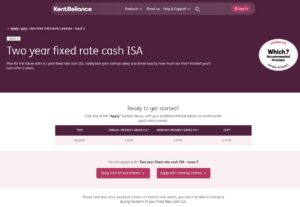
Check the Kent Reliance 2 Year Fixed Rate ISA Here
Kent Reliance offers a two-year fixed-rate Cash ISA, Issue 5, with an advertised interest rate of 4.92% AER.
The minimum opening balance is £1,000.
The account provides a choice of monthly or annual interest payments and a 14-day cooling-off period.
Kent Reliance also offers other ISA terms, which may interest savers considering different maturity dates.
Although 4.92% is below the highest rate in our table, the account illustrates why ISA comparisons should include more than one provider.
Its suitability will depend on the saver’s preferred deposit amount, interest arrangements, application method and withdrawal conditions.
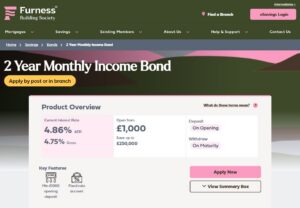
7. Furness Building Society – 4.86% AER
Check the Furness Building Society 2 Year Fixed Rate ISA Here
Furness Building Society advertises a two-year fixed-rate ISA paying 4.86% AER.
Customers can open the account with £1,000, subject to eligibility and product conditions.
The building society supports online account access and provides information about applying through other available channels.
Furness states that its two-year product is designed for savers who can leave their money untouched until maturity.
It is therefore less suitable for emergency savings or money required for near-term expenses.
The account may be relevant to individuals who prefer building societies or want a fixed return without committing the £10,000 minimum required by some competitors.
8. Tandem Bank – Provider-Page Rate of 4.85% AER

Check the Tandem Bank 2 Year Fixed Rate ISA Here
Tandem Bank offers fixed-rate Cash ISAs through its mobile-app-based savings service.
Its public fixed-rate comparison page displayed 4.85% AER for the two-year option when checked, although some recent independent rate tables displayed 5.08%.
That discrepancy is precisely why the latest rate must be confirmed inside Tandem’s current account application and summary box rather than relying on an older comparison.
The bank’s two-year product applies an early-access penalty equivalent to 180 days’ interest.
Tandem also offers an instant-access Cash ISA, giving customers an alternative if retaining withdrawal flexibility is more important than fixing their savings.
Anyone considering the account should verify its opening deposit requirement and latest rate before transferring money.
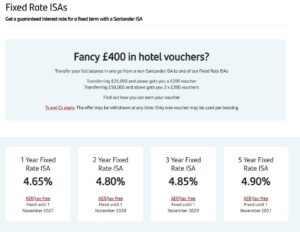
9. Santander – 4.80% AER
Check the Santander 2 Year Fixed Rate ISA Here
Santander’s two-year Fixed Rate ISA advertises 4.80% AER, with a minimum opening balance of £500.
Unlike some accounts offering a term measured from the deposit date, Santander’s advertised product has a specified maturity date of 1 November 2028.
The quoted AER assumes funds are deposited by 1 November 2026. Depositing at a different time can affect the total interest earned over the actual period.
Customers who need early access must normally close the account, with a charge equivalent to 120 days’ interest.
Santander also accepts eligible ISA transfers within its specified funding window.
This account demonstrates an important comparison point: a product described as a two-year ISA may have a fixed calendar maturity date rather than guaranteeing exactly 24 months of interest from every possible deposit date.
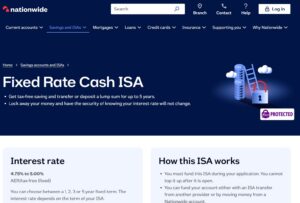
10. Nationwide Building Society – 4.55% AER
Check the Nationwide Building Society 2 Year Fixed Rate ISA Here
Nationwide Building Society advertises a two-year Fixed Rate Cash ISA paying 4.55% AER.
The minimum opening deposit is £1, making it accessible to savers with smaller amounts.
Nationwide provides online and branch-based services, although opening options and eligibility can differ depending on whether the applicant is an existing customer.
Its fixed-rate ISA normally requires account closure for early withdrawal, with an interest penalty.
While Nationwide’s advertised two-year rate is lower than several specialist savings providers, the product may appeal to customers who value access to an established branch network.
Savers specifically comparing Nationwide products can examine the latest Nationwide ISA rates across one-year, two-year, three-year and five-year terms.
How Does a 2 Year Fixed Rate Cash ISA Work?
A two-year fixed-rate Cash ISA is a personal savings account that pays a predetermined interest rate for a fixed period.
Once the account is funded and the applicable fixed rate is secured, the provider cannot normally reduce that contractual rate during the term.
For example, someone opening an ISA at 5.10% AER can benefit from that agreed return even if comparable rates for new savers subsequently fall.
The main features include:
- Fixed interest rate: The agreed rate remains unchanged throughout the fixed period.
- Tax-free interest: Qualifying interest earned within the Cash ISA is exempt from UK Income Tax.
- Restricted access: Withdrawals or transfers before maturity may trigger charges.
- Minimum deposits: Each provider sets its own opening balance.
- Funding windows: Many accounts accept additional money only shortly after opening.
- Maturity arrangements: Savers can normally select another account, transfer the balance or withdraw money when the term ends.
A fixed Cash ISA is not the same as a fixed-rate savings bond.
Although both may provide guaranteed interest rates, an ordinary savings bond does not automatically have the same tax-free treatment as a Cash ISA.
How Much Interest Could £5,000, £10,000 or £20,000 Earn Over Two Years?
The financial difference between rates becomes easier to understand when expressed in pounds rather than percentages alone.
For illustration, consider a two-year account offering 5.10% AER, with all interest effectively retained and compounded annually.
| Initial Savings | Interest After Year 1 | Estimated Total Interest After 2 Years | Estimated Final Balance |
| £2,000 | £102.00 | £209.20 | £2,209.20 |
| £5,000 | £255.00 | £523.01 | £5,523.01 |
| £10,000 | £510.00 | £1,046.01 | £11,046.01 |
| £15,000 | £765.00 | £1,569.02 | £16,569.02 |
| £20,000 | £1,020.00 | £2,092.02 | £22,092.02 |
These figures use annual effective compounding as a standardised illustration. Actual account balances can differ because providers calculate and pay interest differently, including monthly payments, external interest payments and daily-interest calculations.
Why Does Compounding Matter?
Compounding occurs when interest itself begins earning additional interest.
For a £10,000 balance at an effective annual rate of 5.10%:
First year:
£10,000 × 5.10% = £510
Balance after year one:
£10,510
Second year:
£10,510 × 5.10% = £536.01
Total interest:
£1,046.01
However, this formula should not automatically be applied to every provider.
If the bank pays interest into an external current account rather than retaining it in the ISA, the amount accumulated inside the fixed account may be different.
AER remains the standard measure for comparing advertised savings rates on a broadly equivalent annual basis.
Is a 2 Year Fixed Rate ISA Better Than a 1 Year ISA?
The answer depends on whether the saver values flexibility or certainty.
A one-year fixed ISA allows money to become available sooner, while a two-year fixed ISA protects the interest rate for longer.
For example, UBL UK’s advertised one-year Cash ISA rate was 4.98% AER, compared with 5.10% AER for its two-year product.
The immediate rate advantage is only 0.12 percentage points.
However, the two-year account also removes the need to find another competitive rate after the first year.
One-Year vs Two-Year Fixed ISA Comparison
| Feature | 1-Year Fixed ISA | 2-Year Fixed ISA |
| Interest rate certainty | 12 months | Approximately 24 months |
| Access without an early-exit penalty | Sooner | Later |
| Exposure to rates falling at renewal | Earlier | Delayed |
| Opportunity to benefit from higher future rates | Sooner | Restricted during the term |
| Common purpose | Shorter savings goals | Medium-term savings |
| Main consideration | Reinvestment rate | Longer commitment |
An often overlooked issue is the reinvestment rate.
Suppose a saver could earn 4.98% for the first year. To approximately match the compounded return of a two-year 5.10% fix, they would then need to earn around 5.22% in the second year.
That future rate may or may not be available.
This highlights the advantage of rate certainty, but it also shows why a two-year account is not automatically superior.
If interest rates rise significantly, someone who committed to a lower fixed rate may miss out.
Savers who expect to need money within 12 months can also examine the best 1 year fixed rate ISA options before choosing a longer commitment.
What Are the Advantages and Disadvantages of a 2 Year Fixed Rate ISA?
Advantages
- Protection against falling savings rates: The contractual interest rate will not normally fall during the agreed fixed period, even if the Bank of England reduces Bank Rate.
- Tax-free interest: Interest earned within a Cash ISA is generally exempt from Income Tax, which can be particularly useful for savers whose other savings interest already exceeds their Personal Savings Allowance.
- Predictable returns: The fixed rate makes it easier to estimate how much money should be available at maturity, provided the account conditions are followed.
- Protection for eligible deposits: Eligible deposits with UK-authorised institutions benefit from Financial Services Compensation Scheme protection, subject to the scheme’s limits.
- Reduced exposure to short-term interest-rate changes: A two-year fix prevents the interest rate on an existing account from immediately changing with market conditions.
Disadvantages
- Early withdrawal penalties: Some providers deduct 120, 150 or 180 days’ interest, depending on the account’s contractual terms.
- Reduced flexibility: Money needed for unexpected bills may be expensive or inconvenient to access.
- Missing higher future rates: A fixed return can become less competitive if interest rates increase.
- Inflation risk: Even a 5% nominal interest rate does not guarantee that savings will increase in purchasing power.
- Limited additional deposits: Many fixed-rate products only accept funding during a short period following account opening.
Our financial assessment is that the largest mistake is often not choosing a rate that is marginally below the market leader. It is locking away money that may be needed before maturity.
What Happens If Money Is Withdrawn Before the Two Years End?
Early withdrawal conditions vary considerably between providers.
Some Cash ISAs permit early closure with an interest deduction, while others restrict the types of withdrawals available.
For example, the published two-year account terms show:
| Provider | Example Early Access Condition |
| UBL UK | 180 days’ gross interest; full withdrawal |
| Tandem Bank | 180 days’ interest |
| Santander | 120 days’ interest |
| Close Brothers Savings | Early closure charge; check application terms |
| Nationwide | Closure required with an early-access charge |
These conditions are product-specific and must be checked against the latest account documents.
Example of a 180-Day Interest Penalty
Suppose a saver deposits £10,000 into a Cash ISA paying 5% annually.
The approximate annual interest would be £500.
A 180-day interest penalty would be around:
£500 × 180 ÷ 365 = £246.58
The actual charge depends on the provider’s calculation method and account terms.
This is particularly important for someone withdrawing money shortly after opening the account.
If very little interest has accumulated, certain products may deduct part of the penalty from the original deposit.
A fixed Cash ISA should therefore generally be funded with money that can remain untouched until maturity.
How Much Can Be Invested in a 2 Year Fixed Rate ISA in 2026?
For the 2026/27 tax year, the overall adult ISA allowance is £20,000.
This tax year runs from 6 April 2026 until 5 April 2027.
Eligible savers can divide their allowance between permitted ISA products, including Cash ISAs and Stocks and Shares ISAs.
The allowance applies to new subscriptions across the person’s eligible ISAs, rather than providing a separate £20,000 limit for every account.
For example:
| ISA Type | New Contributions in 2026/27 |
| 2-Year Fixed Cash ISA | £12,000 |
| Easy-Access Cash ISA | £3,000 |
| Stocks and Shares ISA | £5,000 |
| Total | £20,000 |
The individual has used the full annual ISA allowance.
Existing ISA balances accumulated in previous tax years do not automatically use the current year’s subscription allowance.
A saver could therefore transfer an existing £40,000 Cash ISA balance into a qualifying new fixed-rate ISA, subject to the receiving provider’s terms, without treating that existing balance as £40,000 of new subscriptions.
The rules are explained further in the annual £20,000 ISA allowance guidance.
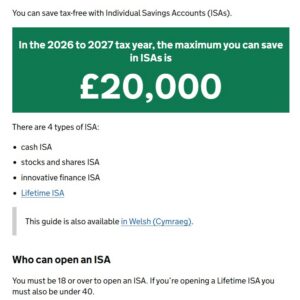
GOV.UK’s official ISA overview confirming the £20,000 annual allowance for the 2026/27 tax year.
What Will Happen to the Cash ISA Allowance From April 2027?
One of the most important issues for savers planning a two-year Cash ISA is the change scheduled to begin on 6 April 2027.
The Government has confirmed that the annual Cash ISA subscription limit will be reduced for individuals aged under 65.
| ISA Rule | 2026/27 | From 6 April 2027 |
| Overall annual adult ISA allowance | £20,000 | £20,000 |
| Cash ISA limit for under-65s | £20,000 | £12,000 |
| Cash ISA limit for those aged 65 or over | £20,000 | £20,000 |
| Stocks and Shares ISA | Within overall allowance | Within overall allowance |
| Lifetime ISA annual contribution limit | £4,000 | £4,000 |
The age-65 entitlement applies from the beginning of the tax year in which a saver turns 65.
The reform also introduces restrictions on moving money from non-Cash ISAs into Cash ISAs, with an exemption from the relevant transfer restriction for those aged 65 or over.
Will Existing Two-Year Fixed ISAs Be Affected?
The lower Cash ISA subscription limit does not mean existing qualifying ISA savings above £12,000 must be withdrawn.
Money accumulated legitimately in previous years can remain inside the tax-free ISA wrapper.
For example, someone aged 40 who deposits £20,000 during 2026/27 can keep that existing amount in their fixed ISA after April 2027.
The new £12,000 Cash ISA allowance generally concerns new subscriptions from the 2027/28 tax year.
The distinction matters because a two-year fixed ISA opened in October 2026 will extend beyond the date when the new rules begin.
Can an Existing Cash ISA Be Transferred Into a 2 Year Fixed Rate ISA?
Yes. Existing Cash ISA balances can normally be transferred to another eligible Cash ISA provider, provided the receiving account accepts transfers.
The important requirement is to use the official ISA transfer procedure.
A saver should not simply withdraw existing ISA money into a personal current account and then pay it into another ISA, expecting the original tax-free status and allowance treatment to be preserved automatically.
The transfer should instead be arranged through the new ISA provider.
How to Transfer an ISA Correctly?
- Compare two-year fixed-rate Cash ISA accounts and confirm that the preferred provider accepts transfers.
- Check whether the existing account has an early withdrawal penalty or notice requirement.
- Open or apply for the new Cash ISA.
- Complete the receiving provider’s official ISA transfer request.
- Confirm whether a full or partial transfer is accepted.
- Allow the providers to complete the transfer and check the receiving balance.
- Retain confirmation of the transferred amount and the new maturity date.
Cash ISA transfers should normally be completed within 15 working days, although some transfers may take longer.
Existing ISA transfers and new subscriptions should be recorded separately when monitoring the annual allowance.
Someone managing several products can also examine whether more than one ISA can be held and funded in the same tax year.
Is a 2 Year Fixed Rate Cash ISA Completely Tax-Free?
Qualifying interest earned inside a Cash ISA is exempt from UK Income Tax.
This is the main distinction between an ISA and an ordinary savings account.
For money held outside an ISA, tax treatment may depend on the saver’s total taxable savings interest and their applicable allowances.
The Personal Savings Allowance for 2026/27 is:
| Income Tax Band | Personal Savings Allowance |
| Basic rate | £1,000 |
| Higher rate | £500 |
| Additional rate | £0 |
These allowances apply to eligible non-ISA savings interest, with additional rules potentially applying to low-income savers.
Example: Higher-Rate Taxpayer
Suppose a higher-rate taxpayer has £20,000 in an ordinary savings account earning 5% interest.
That account generates approximately £1,000 over one year.
If the person has no other taxable savings interest, the first £500 may fall within their Personal Savings Allowance.
The remaining £500 would ordinarily be taxable at the applicable rate.
At a 40% savings income tax rate, the tax would be approximately £200.
If the same interest qualified for tax-free treatment inside a Cash ISA, that £200 tax liability would not arise on the ISA interest.
The practical advantage depends on individual tax circumstances, the tax year and the rate available on competing ordinary savings accounts.
A Cash ISA is not automatically the highest-returning choice simply because it is tax-free.
Savers with unused Personal Savings Allowance should compare the after-tax interest available from both account types.
Is Money Safe in a 2 Year Fixed Rate Cash ISA?
Eligible deposits held with UK-authorised banks and building societies benefit from protection under the Financial Services Compensation Scheme.
From 1 December 2025, the standard deposit compensation limit increased to £120,000 per eligible person, per authorised institution.
This means the protection limit is not necessarily renewed for every separate account or banking brand.
For example, someone holding £70,000 in one account and £60,000 in another account under the same banking licence may have a combined £130,000 exposure.
Under the standard £120,000 limit, £10,000 could be above the protection threshold.
Special rules can apply to qualifying temporary high balances following certain major life events.
For most savers comparing two-year ISAs, the practical considerations are:
- Check that the provider is appropriately authorised.
- Confirm which legal institution holds the deposit.
- Identify whether other banks share the same banking licence.
- Include other eligible deposits held with that institution.
- Do not assume every unfamiliar savings brand has separate FSCS protection.
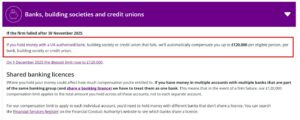
The FSCS official deposit protection page showing the £120,000 protection limit and how shared banking licences affect compensation.
Is a 2 Year Fixed Rate ISA Suitable for Business Owners and Self-Employed Professionals?
A two-year fixed-rate Cash ISA can be useful for business owners managing their personal savings.
However, it is important to distinguish personal wealth from business working capital.
A Cash ISA is held by an eligible individual. It is not a business savings account into which a limited company can simply place its own funds.
For a sole trader, personal and business money can be legally connected, but tax obligations and operating expenses still need careful management.
For a limited company director, money legally belonging to the company should not be treated as personal ISA savings without an appropriate and properly accounted-for transfer into personal ownership.
When Could a Fixed ISA Make Financial Sense?
Consider a self-employed professional who has:
- £30,000 in personal savings
- £8,000 reserved for emergencies
- £5,000 expected to be needed for near-term expenses
- £17,000 available for longer-term saving
The person may decide that the £17,000 is suitable for a fixed-rate Cash ISA, depending on existing ISA subscriptions and personal circumstances.
By comparison, placing the entire £30,000 into fixed savings could create unnecessary liquidity pressure.
For entrepreneurs, cash-flow flexibility is particularly important because irregular income, tax payments, business investment and unforeseen expenses can arise before an ISA reaches maturity.
The relevant question is not simply how much interest could be earned, but how much money can genuinely be committed without creating financial strain.
Should Savings Be Split Between Fixed and Easy-Access ISAs?
Splitting savings between accounts can provide a balance between earning interest and retaining liquidity.
For example, an individual with £20,000 of available ISA allowance might allocate:
| Account | Allocation | Main Purpose |
| 2-Year Fixed Cash ISA | £12,000 | Medium-term savings |
| Easy-Access Cash ISA | £5,000 | Emergency reserves |
| 1-Year Fixed Cash ISA | £3,000 | Shorter-term savings |
| Total | £20,000 | Diversified access arrangements |
This is an illustration rather than a recommended allocation for every saver.
The appropriate proportions depend on income stability, existing emergency savings, outstanding debts and upcoming expenditure.
A saver who needs most of the money within the next six months may obtain more practical value from easy access than from a slightly higher fixed interest rate.
There is also the option of creating an ISA maturity ladder.
Instead of fixing all eligible savings for two years simultaneously, a saver can spread money across accounts ending at different times, subject to ISA and provider rules.
This approach can make it easier to access some funds without having to close every fixed-rate account early.
What Should Be Checked Before Opening a 2 Year Fixed Rate ISA?
Our comparison identifies several important checks that can be overlooked when interest rates dominate the decision.
Check the Actual Fixed Period
Some accounts mature exactly two years after opening or funding.
Others have a fixed calendar maturity date.
These arrangements can produce different total interest payments.
Check How Interest Is Paid
Monthly interest, annual interest and interest paid on maturity are not always economically identical.
The contractual gross rate and compounding arrangements should be examined alongside AER.
Check the Funding Window
Some providers allow only ten or fourteen days for an opening deposit.
Others provide longer periods.
Missing the deadline could mean receiving a different rate or having to submit a new application.
Check ISA Transfer Restrictions
A provider may accept Cash ISA transfers but not transfers from every other type of ISA.
Transfers from existing fixed-rate accounts can also trigger charges.
Check Account Access and Early Closure
A product allowing early closure with a penalty is different from one permitting partial withdrawals.
Read the actual withdrawal terms rather than relying on a generic description such as “fixed for two years”.
Check the Provider’s Protection Arrangements
The FSCS limit applies to eligible deposits at an authorised institution, not automatically to every brand or savings account.
Check Whether an Ordinary Savings Account Pays More After Tax
For someone whose non-ISA savings interest remains within the Personal Savings Allowance, a higher-paying conventional savings account could potentially produce a better net result.
The wider UK Cash ISA interest-rate comparison can also help savers distinguish between flexible, short-term and longer-term ISA products.
What Happens When a 2 Year Fixed Rate ISA Matures?
When the two-year fixed term ends, the provider will normally explain the available maturity options.
Depending on the bank and product, these may include transferring the balance into another ISA, moving it to a variable-rate holding account or withdrawing the money.
Savers should not assume the account will automatically continue paying the original fixed rate.
The next available interest rate may be higher or lower.
Before maturity, it is worth checking:
- The exact maturity date
- The total interest earned
- The rate offered on any replacement account
- Whether maturity instructions must be submitted in advance
- How transfers to another ISA provider will be handled
- Whether money will remain within the ISA tax wrapper
For someone planning a property purchase, retirement expenditure or another major financial commitment, maturity arrangements should be considered when first opening the account.
Final Thoughts
The best 2 year fixed rate ISA is not necessarily the account with the highest advertised percentage.
Our October 2026 comparison identifies rates from 4.55% to 5.10% AER among ten providers, with important differences in minimum deposits, interest payment arrangements, early access and account management.
For savers who have a clear two-year savings horizon, a competitive fixed Cash ISA can provide predictable interest earnings and protection against future reductions in savings rates.
However, flexibility remains valuable. Households, entrepreneurs and self-employed professionals should avoid committing money required for emergencies, business obligations or near-term financial commitments.
With the Cash ISA allowance changing for under-65s from April 2027, understanding subscription limits, transfers and the treatment of existing savings is also increasingly important.
The most effective approach is to compare the interest rate alongside the full account conditions, confirm the provider’s current offer and choose a fixed term that fits the intended use of the money.
Frequently Asked Questions
What Is the Highest 2 Year Fixed Rate Cash ISA in October 2026?
UBL UK advertised 5.10% AER in our comparison checked on 24 October 2026. Rates and availability can change, so the latest provider information should be checked before applying.
Can I Put £20,000 Into a 2 Year Fixed Rate ISA?
Yes, an eligible saver can potentially contribute £20,000 during the 2026/27 tax year, provided they have sufficient unused overall ISA allowance and the provider accepts the deposit.
Can I Open Two Fixed Rate Cash ISAs?
Yes. Current ISA rules generally allow eligible adults to contribute to multiple Cash ISAs within the applicable annual subscription limit, although providers may impose their own account restrictions.
Can I Transfer £50,000 From an Existing ISA?
Potentially, yes. Existing qualifying ISA funds from previous years can generally be transferred without using the current year’s allowance, provided the receiving provider accepts the transfer and the correct process is followed.
Will a Fixed ISA Rate Fall if the Bank of England Reduces Interest Rates?
The agreed contractual fixed rate normally remains unchanged until maturity, irrespective of subsequent Bank Rate decisions.
Is a 2 Year Fixed ISA Better Than an Easy-Access ISA?
A fixed ISA offers interest-rate certainty, while an easy-access ISA normally offers greater flexibility. The more suitable option depends on when the money may be required.
Can I Lose Money in a Fixed Rate Cash ISA?
Early closure penalties can reduce returns and, under some product terms, may affect the original deposit. Inflation can also reduce purchasing power even when the nominal account balance grows.
Is a Two-Year Fixed ISA Worth It in 2026?
It may be worthwhile for eligible savers who want predictable, tax-free interest and do not expect to need the money before maturity. The decision should still account for alternative savings rates, tax circumstances and withdrawal restrictions.

More in Finance & Tax

Are Betting Winnings Taxable in the UK and Why Not?
Anyone who’s ever landed a decent win on a horse or cashed out a football accumulator will know the feeling. The celebration fades, and then the question creeps in: does HMRC want a slice? It’s a fair thing to wonder, given that most income in the UK gets taxed one way or another. But betting […]

Best 1 Year Fixed Rate ISA UK 2026: Top Cash ISA Rates Compared
The best 1 year fixed rate ISA in the UK currently pays up to 4.98% AER tax-free, with UBL UK offering the highest verified rate in our October 2026 comparison. Shawbrook Bank follows at 4.97%, while Vanquis Bank offers a competitive 4.96% alongside a lower minimum opening deposit. However, choosing the best one-year fixed Cash […]