
Home care in the UK typically costs around £26 to £38 per hour based on published 2026 market prices. The latest available market data shows a median hourly rate of £33.49 in September 2026, although care involving specialist support, multiple carers or unsocial hours can cost considerably more.
For families planning home care in 2027, an hourly budget of approximately £30 to £40 is a practical starting point for comparing private providers. This is a planning range, not a confirmed national average for 2027.
Our analysis of the latest care market data, provider pricing, staffing costs and social care funding rules highlights a significant financial challenge: even two hours of professional home care daily can cost more than £24,000 annually.
The financial position becomes more complicated when families consider pension income, council support, disability benefits, care worker wages and the cost of arranging long-term assistance.
This article examines how much home care costs per hour, what is changing in 2027, which care arrangements provide value for money and how families can avoid unnecessary expenditure without compromising care quality.
How Much Does Home Care Cost Per Hour in the UK in 2027?
There is no government-fixed hourly rate for privately arranged home care in the UK.
Providers set their prices according to staffing costs, travel requirements, care complexity, operating expenses and demand.
The latest available September 2026 market figures provide an important starting point for financial planning in 2027.
| Home care pricing indicator | Latest available figure |
| Broad UK hourly care range in 2026 | £26–£38 |
| Median visiting-care price, September 2026 | £33.49 per hour |
| Lower quartile of advertised prices | £30 per hour |
| Upper quartile of advertised prices | £36 per hour |
| 90th-percentile advertised rate | £37.50 per hour |
| Providers charging at least £35 hourly | 36.7% |
| Annual increase in median visiting-care prices | 4.7% |
| Homecare Association minimum sustainable price, England 2026/27 | £34.42 per hour |
These figures are not interchangeable.
The £33.49 median represents the middle advertised hourly price among providers with published rates on Lottie’s platform at the end of September 2026.
By comparison, the Homecare Association’s £34.42 figure represents an estimated sustainable cost of delivering regulated home care in England for the 2026/27 financial year. It is not a legally mandated minimum consumer price.
The association’s research also indicates that the average local authority homecare commissioning fee in England was £25.37 per hour in 2026/27.
This difference matters because local authority purchasing rates and privately advertised hourly prices represent different parts of the care market.
Our assessment is that families should use published market prices as a budgeting reference but obtain written quotations from providers operating in their postcode.
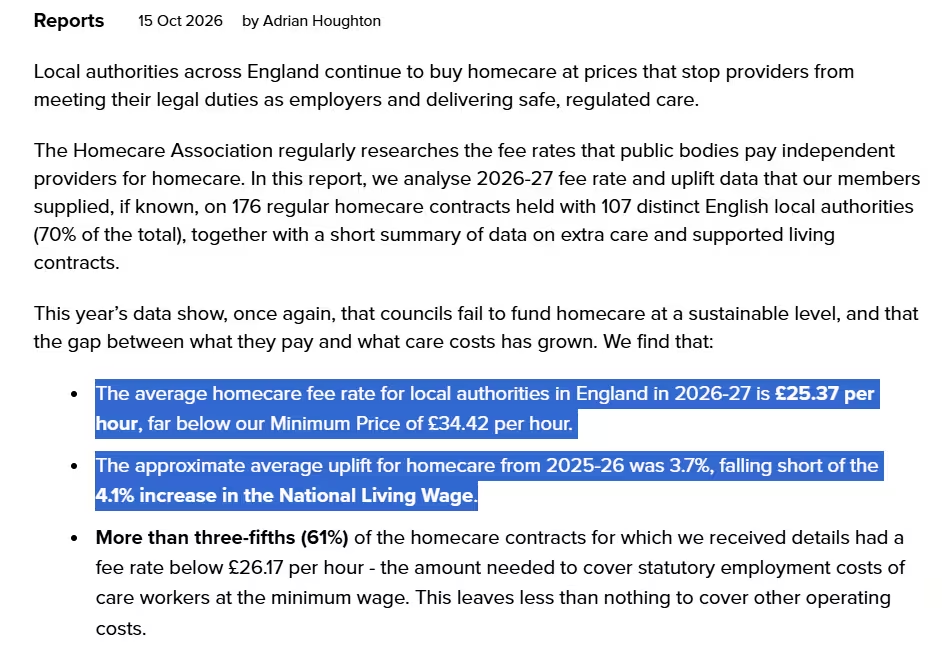
Homecare Association’s 2026/27 minimum homecare price of £34.42 per hour.
What Will Change in Home Care Prices During 2027?
The most important confirmed development affecting 2027 home care costs is the increase in the National Living Wage.
From 1 April 2027, the minimum hourly wage for workers aged 21 and over will rise from £12.71 to £13.21.
This represents an increase of approximately 3.9%.
Care providers employing workers at or near the statutory minimum will therefore face higher direct wage costs.
However, salaries represent only part of an agency’s total expenditure.
Providers must also budget for:
- Employer National Insurance and pension contributions
- Paid holiday and statutory sick pay
- Recruitment and staff training
- Travel time and mileage
- Supervision and care management
- Insurance and regulatory compliance
- Emergency staff cover
- Scheduling and administrative systems
Higher employment costs can contribute to increases in customer fees, although the relationship is not automatic.
Providers may absorb some additional expenditure, improve operational efficiency or adjust pricing according to their commercial circumstances.
What Could Home Care Cost Per Hour in 2027?
To illustrate the financial effect of possible price increases, we modelled different scenarios using the September 2026 median of £33.49 per hour.
| Annual price-change scenario | Illustrative hourly cost | Annual cost for 14 hours weekly |
| No increase | £33.49 | £24,381 |
| 3.9% increase | £34.80 | £25,332 |
| 5% increase | £35.16 | £25,600 |
| 7% increase | £35.83 | £26,087 |
| 10% increase | £36.84 | £26,819 |
Figures are rounded estimates based on 52 weeks of care. They are scenarios rather than provider quotations or official 2027 forecasts.
A 5% increase in hourly charges would add approximately £1,219 annually to a 14-hour weekly care package.
For families relying on pensions and fixed savings, even a relatively modest percentage increase can have a considerable cumulative effect.
Our financial assessment is that care budgets should account for the possibility of annual price reviews rather than assume the first quoted rate will remain unchanged indefinitely.
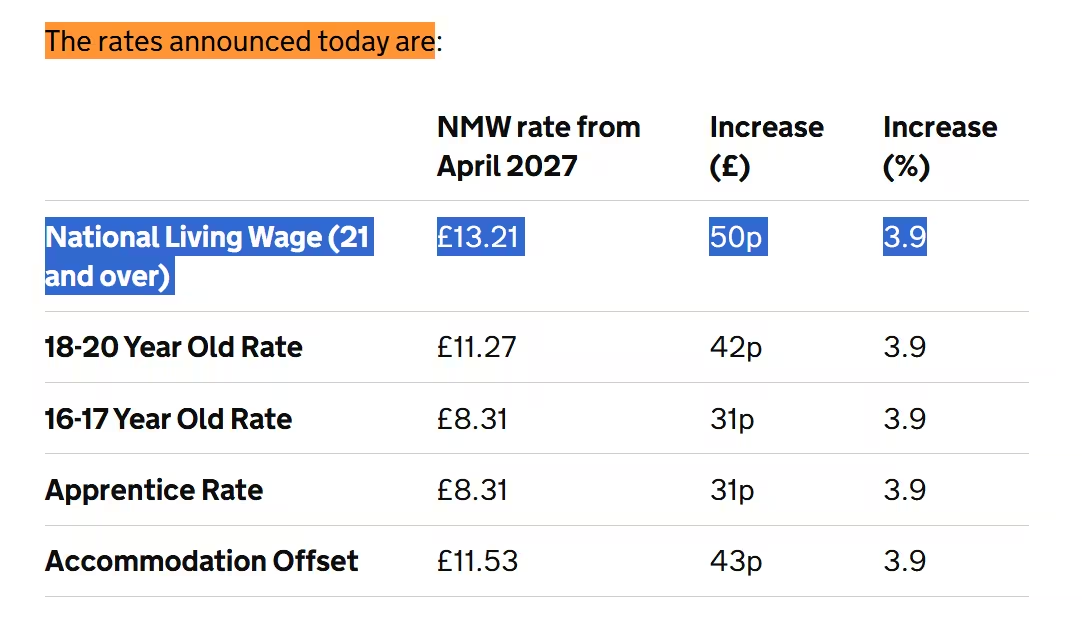
Confirmed National Living Wage increase to £13.21 from April 2027.
How Much Does Home Care Cost Weekly, Monthly and Annually?
The hourly price is only one part of the financial calculation.
The total bill depends primarily on the number of paid care hours and the frequency of visits.
Using the September 2026 median hourly rate of £33.49, we calculated the following costs.
| Care hours per week | Weekly cost | Average monthly cost | Annual cost |
| 5 hours | £167 | £726 | £8,707 |
| 7 hours | £234 | £1,016 | £12,190 |
| 10 hours | £335 | £1,451 | £17,415 |
| 14 hours | £469 | £2,032 | £24,381 |
| 21 hours | £703 | £3,048 | £36,571 |
| 28 hours | £938 | £4,063 | £48,761 |
| 35 hours | £1,172 | £5,079 | £60,952 |
| 40 hours | £1,340 | £5,805 | £69,659 |
Monthly figures use 52 weeks divided by 12 months, rather than assuming every month contains exactly four weeks.
These examples exclude additional fees and assume the same hourly rate applies to every visit.
How Much Does Two Hours of Home Care a Day Cost?
Two hours per day, seven days per week, equals 14 hours of care.
At £33.49 per hour, the calculation is:
- Daily cost: £66.98
- Weekly cost: £468.86
- Average monthly cost: approximately £2,032
- Annual cost: approximately £24,381
At an illustrative 2027 rate of £35 per hour, the same care package would cost £25,480 annually.
This shows why families should compare annual care costs rather than focus exclusively on an hourly quotation.
Why Do Some Home Care Providers Charge More Than Others?
Two agencies providing similar assistance may charge substantially different prices.
The difference often reflects their operating model, staffing arrangements, location and specialist capabilities.
Location and Travel Expenses
Providers in London and other higher-cost areas may face greater recruitment, salary and operating expenses.
Rural services can also be expensive because carers may travel considerable distances between clients.
However, a precise city-by-city price comparison requires local provider data. A national median cannot establish the current average for every region.
Families should obtain at least three comparable quotations where provider availability permits.
Personal Care and Specialist Requirements
Basic companionship, meal preparation and routine domestic assistance may require less specialist training than more complex personal care.
People requiring dementia support, advanced mobility assistance or complex medication management may need additional staff training and supervision.
The price will also depend on whether the service involves ordinary personal care or regulated clinical interventions.
Single-Carer and Double-Handed Visits
Certain care plans require two workers to complete tasks safely.
For example, someone who needs assistance with complex transfers or repositioning may require double-handed care following a risk assessment.
At £35 per carer per hour, one hour involving two carers could cost £70.
If that support is required daily, the annual cost of those visits alone reaches £25,480.
This is why a professional care assessment should establish the actual staffing requirements before a family commits to a long-term package.
Weekend, Evening and Bank Holiday Charges
Some agencies apply higher prices outside standard daytime hours.
Others offer one rate across the week.
A provider charging £35 on weekdays and 25% more on Sundays would charge £43.75 for the Sunday hour.
This 25% premium is an illustrative example rather than an industry-wide requirement.
The correct comparison is the total weekly bill covering the actual visit schedule.
Do 30-Minute Home Care Visits Cost Less?
Shorter visits usually have a lower total price than longer visits, but they do not necessarily provide a lower effective cost per hour.
A 30-minute visit may require the same journey, administration, scheduling and record-keeping as a 60-minute appointment.
Consequently, agencies may operate minimum visit lengths or minimum charges.
Recent 2026 care marketplace data also highlighted a mismatch between demand for brief visits and the minimum durations providers accept.
This can make short daily appointments harder to arrange.
Consider a simplified example.
| Visit arrangement | Charge | Effective hourly cost |
| One 60-minute visit | £35 | £35 |
| One 30-minute visit | £22 | £44 |
| Two separate 30-minute visits | £44 | £44 |
| One 45-minute minimum-charge visit | £30 | £40 |
These are examples of billing structures, not verified national averages.
For someone requiring help twice daily, two short visits may still be necessary because the care needs occur at different times.
Combining appointments merely to reduce expenditure would not be appropriate where it compromises medication, nutrition, hygiene or safety.
Our recommendation is to compare the cost per completed visit as well as the advertised hourly rate.
Is Hiring a Private Carer Cheaper Than Using a Home Care Agency?
Hiring an individual care worker directly can cost less than purchasing a fully managed agency service.
However, an individual worker’s hourly pay is not necessarily the family’s total employment cost.
Agency services normally include recruitment, management, scheduling, quality oversight and arrangements for replacement staff.
A directly employed personal assistant may provide more continuity and flexibility, but the household may become responsible for employment administration.
| Financial consideration | Home care agency | Directly employed carer |
| Advertised cost | Usually higher | May be lower |
| Recruitment | Managed by agency | Arranged by household |
| Payroll | Usually managed by agency | Household responsibility |
| Employer pension duties | Managed by agency | May apply to household |
| Holiday and sickness cover | Agency may provide cover | Separate cover often needed |
| Insurance | Agency business arrangements | Employer cover may be required |
| Quality supervision | Agency-led | Household must arrange appropriate oversight |
| Care continuity | Depends on staffing | May offer a regular individual carer |
A family directly employing a carer must establish the worker’s legal employment status.
Simply describing someone as self-employed does not remove employment obligations where the actual working arrangement creates an employer-employee relationship.
Anyone considering this approach should understand their employment responsibilities, including statutory pay, contracts and applicable pension duties.
Our financial view is that a directly employed carer should be compared against an agency using the full annual cost, not solely the worker’s hourly wage.
Can the Council Pay for Home Care in England?
Yes. Local authorities may contribute towards eligible home care costs following a care needs assessment and financial assessment.
A care needs assessment identifies the support a person requires.
A financial assessment considers their ability to contribute towards the cost.
In England, the established 2026/27 capital thresholds are:
| Assessable capital | General funding position |
| Above £23,250 | Usually responsible for full care costs |
| £14,250–£23,250 | Potential council support with an assessed contribution |
| Below £14,250 | Capital generally disregarded, although income may still contribute |
The amount paid by the council depends on assessed eligible needs, the personal budget and the individual’s financial circumstances.
A person does not automatically receive free care merely because their savings fall below £23,250.
The council may still require contributions from pensions or other assessable income.
Does the Value of Your House Count?
For someone receiving care while continuing to live in their own home, the value of that main residence is normally disregarded from the English social care financial assessment.
This differs from the rules that may apply after moving permanently into residential care.
Other property and investments may be treated differently.
Families considering longer-term residential arrangements should also understand who is responsible for care home fees before signing agreements.
A family member is not normally liable simply because they are listed as next of kin, although contracts or guarantees can create separate obligations.
Does the £86,000 Care Cap Apply in 2027?
The previously proposed £86,000 lifetime cap on eligible adult social care costs in England was not implemented.
The government cancelled the planned charging reforms, including that proposed cap.
Families should not assume their personal care costs will automatically stop after reaching £86,000.
The applicable means-testing system and any subsequent government changes should be checked before making significant financial decisions.
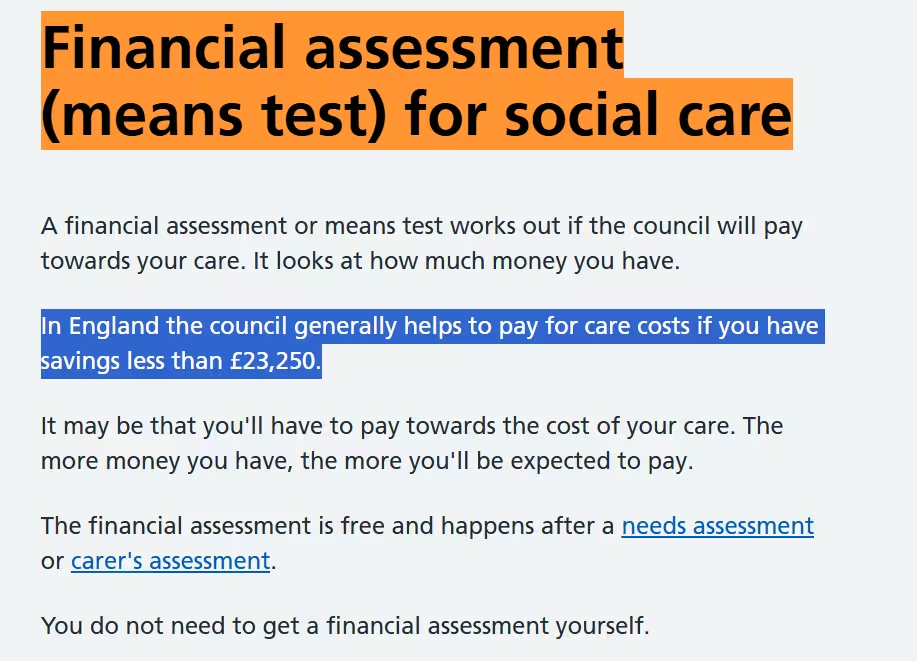
England’s social care financial assessment, including the £23,250 upper capital threshold and treatment of the main home.
How Do Home Care Funding Rules Differ Across the UK?
Adult social care operates under different rules in England, Wales, Scotland and Northern Ireland.
Private agency prices also vary between locations.
| UK nation | Main funding consideration |
| England | Needs and financial assessments determine council assistance |
| Wales | Assessed council-arranged non-residential care charges are capped at £100 per week under the current rules |
| Scotland | Eligible assessed personal care is provided free to adults |
| Northern Ireland | Trust-arranged domiciliary care is generally provided without a charge, subject to assessment and service arrangements |
Wales
The Welsh Government currently limits charges for qualifying council-arranged non-residential social care to £100 weekly.
Its published charging guidance also identifies a £24,000 savings and investment threshold relevant to the assessment.
The £100 maximum does not mean privately purchased home care from any chosen agency is limited to £100 weekly.
Families need to distinguish council-arranged support from independently contracted services.
Scotland
Scotland provides free personal care to adults assessed by their local authority as requiring it.
This can include assistance with washing, dressing, eating and personal hygiene.
Other non-personal services, including some domestic assistance, may remain chargeable.
Northern Ireland
Domiciliary care may be arranged through a Health and Social Care Trust according to assessed need.
Trust-arranged domiciliary care is generally free, although privately purchased services involve separate contracts and charges.
Because eligibility and delivery arrangements differ between nations, an English means-test figure should never be treated as a universal UK threshold.
Can the NHS Pay for Home Care?
Some people may qualify for NHS Continuing Healthcare, commonly known as NHS CHC.
This is particularly relevant where an adult has complex, intense or unpredictable health needs.
Eligibility is based on an assessment of whether the person has a primary health need rather than a particular diagnosis or savings balance.
For eligible individuals in England, NHS Continuing Healthcare can fund the assessed package of care in their own home.
The NHS provides an explanation of free care and NHS Continuing Healthcare.
Importantly, a dementia diagnosis or disability does not automatically establish eligibility.
Families concerned about substantial ongoing medical or nursing needs should ask whether an NHS Continuing Healthcare assessment is appropriate.
Is Home Care Free After Leaving Hospital?
Some people qualify for short-term reablement or intermediate care after illness, injury or hospital treatment.
In England, eligible intermediate care and reablement services are generally provided free for up to six weeks.
However, this is not an automatic entitlement to unlimited free home care.
Long-term support may require a separate social care assessment and financial contribution.
Can Attendance Allowance Help Pay for Home Care?
Attendance Allowance may provide financial support to eligible people who have reached State Pension age and require assistance or supervision because of a disability or health condition.
The confirmed 2026/27 weekly rates are:
| Attendance Allowance rate | Weekly payment | Annual equivalent |
| Lower rate | £76.70 | £3,988.40 |
| Higher rate | £114.60 | £5,959.20 |
Attendance Allowance is not means-tested.
It is not restricted to paying a particular home care provider.
However, receiving the benefit does not necessarily mean the entire amount can be treated as extra disposable income when calculating council care contributions.
For example, the higher rate of £114.60 is equivalent to approximately 3.4 hours of privately arranged home care weekly at £33.49 per hour.
This demonstrates its financial value while also showing that it will rarely cover a substantial care package by itself.
Pension Credit, PIP and certain other benefits may also be relevant depending on the individual’s age and circumstances.
Where relatives provide unpaid care, the interaction between employment income, caring responsibilities and benefits may require separate assessment.
Our review of benefits and additional income also highlights why people receiving means-tested support should check the consequences of changes to their earnings and savings.
Is Home Care Affordable on the State Pension?
The full new State Pension for 2026/27 is £241.30 weekly.
At the September 2026 median home care rate of £33.49 hourly, that amount would purchase approximately 7.2 hours of care.
This comparison does not deduct food, housing, utilities, transport or other living expenses.
Consider someone who requires two hours of assistance daily.
Their weekly home care bill would be approximately £469.
The amount exceeds the full weekly new State Pension by approximately £228.
Across a year, that difference represents almost £11,833.
The household would therefore require additional resources, care funding support or a different funding arrangement.
Retirees planning to meet costs through investments or pension withdrawals should consider the tax treatment of their assets.
Our analysis of spending pension savings before ISA funds explains why the withdrawal sequence can affect Income Tax and the amount of accessible retirement capital.
The lowest immediate tax bill is not always the best long-term outcome if the decision leaves insufficient liquidity for future care.
For anyone approaching retirement with an incomplete contribution history, understanding National Insurance and State Pension entitlement may also be relevant when assessing likely income.
Is Live-In Care Cheaper Than Hourly Home Care?
Live-in care is generally priced as a daily or weekly package rather than a standard hourly service.
The latest September 2026 Lottie data places the median advertised live-in care rate at approximately £230 daily, equivalent to £1,610 weekly.
That represents about £83,950 annually.
This does not mean a live-in carer works continuously for 24 hours without rest or receives no relief.
Packages differ in relation to breaks, sleeping arrangements, active night duties and replacement staffing.
A live-in arrangement may become financially competitive when someone needs a substantial amount of support throughout the day.
Using £33.49 per hour, 40 hours of visiting care would cost approximately £1,340 weekly.
At 48 hours, the weekly calculation exceeds £1,607.
However, these comparisons should not be interpreted as a universal financial break-even point.
The service delivered by 48 scheduled visiting hours is not identical to a live-in package with a different pattern of availability and support.
Families should compare the actual duties, rest arrangements, care coverage and additional household costs.
Is Home Care Better Value Than Residential Care?
Visiting home care can provide strong financial value when someone needs a limited number of scheduled hours each day.
Residential care may become more appropriate when support needs are continuous, complex or difficult to manage safely at home.
Our comparison uses illustrative 2026 market prices.
| Care arrangement | Approximate weekly cost |
| 10 hours of visiting care | £335 |
| 20 hours of visiting care | £670 |
| 30 hours of visiting care | £1,005 |
| 40 hours of visiting care | £1,340 |
| Median live-in care | £1,610 |
| National average residential care home fee, Q3 2026 | £1,431 |
A residential care home generally provides accommodation, staffing availability, meals and other services within its fee.
A person receiving care at home usually retains responsibility for their mortgage or rent, council tax where applicable, utilities, repairs and household expenditure.
Therefore, a financially accurate comparison needs to include these additional costs.
Our view is that home care is particularly attractive where care needs are intermittent and the person can live safely between visits.
When care needs increase significantly, a new assessment is more useful than repeatedly extending a package that may no longer meet the person’s requirements.
How Can Families Reduce Home Care Costs Without Reducing Quality?
The most effective cost-saving opportunities usually come from improving how care is assessed, scheduled and purchased.
Review Eligibility Before Paying Privately
A care needs assessment can identify support that may qualify for local authority assistance.
Families should also check whether NHS funding or benefits apply.
This can be more valuable than negotiating a small reduction in the hourly price.
Compare the Complete Care Package
Ask providers to quote for the same weekly schedule.
For example, a £32 hourly rate with additional travel charges may cost more than a £35 hourly rate that includes travel.
Compare the total estimated monthly invoice.
Avoid Paying for Unnecessary Minimum Visits
If clinically and practically appropriate, combining tasks into a longer scheduled visit may reduce inefficient travel-related charges.
However, care schedules should continue to meet assessed needs.
Review Specialist Care Requirements
Some people require specialist support for only part of their care schedule.
An appropriate care assessment may identify where ordinary personal care and specialist services can be organised efficiently.
Any staffing changes must remain consistent with professional risk assessments.
Review Contracts Before Annual Price Increases
Ask whether the agency increases rates every April, on the anniversary of the agreement or at another specified time.
The contract should explain the notice period and how any increase will be communicated.
Maintain Accessible Care Savings
Households expecting several years of care expenditure should avoid placing all available money into accounts that impose substantial early withdrawal restrictions.
Liquidity is particularly important when care needs increase unexpectedly.
A suitable emergency reserve can reduce the risk of having to sell investments at an unfavourable time.
Financial planning should also consider the potential impact of government funding changes and broader social care tax proposals, distinguishing confirmed policy from ideas that have not become law.
What Should Be Included in a Home Care Quotation?
A written quotation should be sufficiently detailed for a household to estimate its financial commitment.
| Information to request | Why it matters |
| Standard hourly charge | Establishes the headline rate |
| Minimum visit duration | Determines short-call costs |
| Weekend and bank holiday rates | Identifies premium charges |
| Travel or mileage fees | Prevents unexpected extras |
| Double-handed care rates | Important for complex mobility needs |
| Initial assessment fees | Clarifies setup costs |
| Annual fee reviews | Supports long-term budgeting |
| Cancellation policy | Identifies charges for missed appointments |
| Staff replacement arrangements | Provides continuity during absences |
| Notice period | Establishes contractual flexibility |
| Care plan and service agreement | Confirms the agreed services |
For a household purchasing care over several years, contract flexibility may be almost as important as a slightly lower hourly price.
For example, a saving of £1 per hour on a ten-hour weekly package equals £520 annually.
That saving may be outweighed by unexpected cancellation fees, supplementary charges or inadequate staffing cover.
How Should Families Rate and Compare Home Care Agencies?
We recommend evaluating providers against five financial and operational criteria rather than selecting the lowest quotation automatically.
The following is our proposed evaluation framework, not a set of independently audited ratings of particular agencies.
| Assessment criterion | Suggested weighting |
| Safety, registration and care quality | 35% |
| Price transparency and overall value | 25% |
| Staff continuity and reliability | 20% |
| Flexibility and care-plan suitability | 10% |
| Communication and complaints handling | 10% |
| Total | 100% |
Each provider can be assessed against these criteria using its published inspection information, care plan, contractual terms and evidence supplied during the assessment.
A provider scoring highly on price but poorly on safety should not automatically be treated as good value.
Families in England can check regulated home care services through the Care Quality Commission.
Equivalent oversight bodies operate in Wales, Scotland and Northern Ireland.
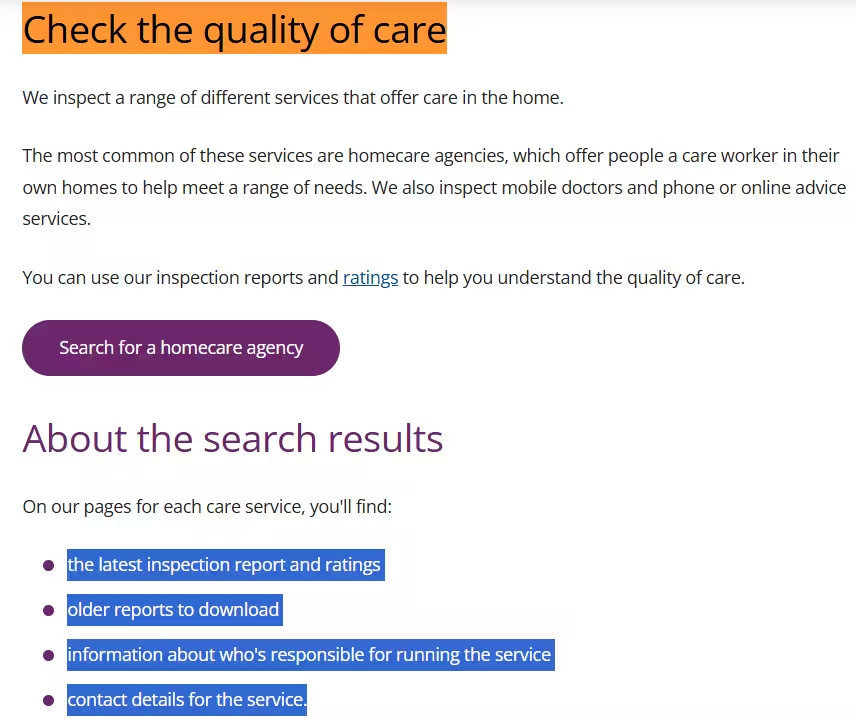
Official CQC home care provider search showing how to check registration, inspection information and service ratings.
What Should Families Budget for Home Care in 2027?
Based on current private-market rates and the confirmed increase in minimum wages, households planning for 2027 should prepare a budget that accommodates possible increases.
The most practical approach is to model different levels of weekly support.
| Household care requirement | Illustrative budget at £35/hour |
| 5 hours weekly | £9,100 annually |
| 10 hours weekly | £18,200 annually |
| 14 hours weekly | £25,480 annually |
| 21 hours weekly | £38,220 annually |
| 35 hours weekly | £63,700 annually |
These figures are budgeting examples, not confirmed average prices for 2027.
Families should also consider potential costs relating to:
- Home adaptations and equipment
- Additional transport or support services
- Overnight arrangements
- Unexpected increases in care needs
- Temporary respite arrangements
- Care coordination and specialist appointments
- Changes to benefits or assessed council contributions
An annual budget should be reviewed whenever the care plan changes.
For people with substantial retirement assets, it may be appropriate to coordinate care funding decisions with an independent regulated financial adviser who has experience in later-life care.
Final Assessment: How Much Should Families Expect to Pay?
Our analysis indicates that the most useful starting point for home care budgeting in 2027 is the latest available private-market evidence rather than older hourly estimates alone.
The September 2026 median of £33.49 per hour demonstrates that many households already face substantial expenses for regular visiting care.
Meanwhile, the confirmed increase in the National Living Wage from April 2027 adds another factor for care providers to consider when reviewing their operating costs.
For a household requiring two hours of assistance daily, a budget of approximately £25,000 annually is a sensible illustrative benchmark at £35 per hour, before additional charges.
However, the lowest hourly quotation is not necessarily the best financial decision.
Our assessment is that families should prioritise appropriate care needs assessments, transparent contractual terms, reliable staffing and eligibility for public financial support.
The aim should be to achieve sustainable, safe care at home without exhausting retirement resources unnecessarily or agreeing to a package that does not meet the individual’s needs.
Figures and policies reviewed using information available up to 10 November 2026. Future provider fees and public funding rules may change. Financial examples are illustrative and do not constitute personal financial or care advice.
Frequently Asked Questions
How much does a private home carer cost per hour in the UK?
Published 2026 data suggests that home care commonly costs around £26 to £38 hourly. The September 2026 median advertised rate was £33.49. The price paid in 2027 will depend on the provider, location and services required.
How much will one hour of home care cost in 2027?
There is no confirmed single national rate for 2027. A planning range of £30 to £40 hourly is reasonable for obtaining initial private agency quotations, although individual prices may fall outside that range.
How much does 24-hour home care cost?
The cost depends on whether the service is live-in care, continuous waking support or a package involving multiple carers. The September 2026 median live-in rate was about £1,610 weekly. Continuous one-to-one waking care is a different service and may cost substantially more.
Can pensioners receive free home care?
Some pensioners qualify for council-funded assistance or NHS Continuing Healthcare. Scotland also provides free assessed personal care to eligible adults. Eligibility differs by nation and personal circumstances.
Do I have to sell my home to pay for a visiting carer?
In England, the value of a person’s main home is normally disregarded when they continue living there and receive care at home. Other assets and income may still affect the financial assessment.
Is dementia home care more expensive?
It can be, particularly where additional staff training, complex support, supervision or multiple carers are required. A dementia diagnosis alone does not automatically mean every provider will charge a higher rate.
Does home care become more expensive at weekends?
Some providers apply weekend and bank holiday premiums, but others maintain consistent hourly charges. Families should request the complete weekly pricing schedule before agreeing to care.
Is home care VAT-free?
Qualifying welfare and domiciliary care services provided by appropriately regulated providers are generally exempt from VAT under the relevant rules.
Other services and staff-supply arrangements may receive different treatment. The agency should explain its invoicing position where necessary.
Can family members be paid to provide care?
In certain circumstances, payments may be possible through privately arranged employment or an approved direct payment arrangement.
Council-funded direct payments can impose specific restrictions on employing close relatives, particularly those living in the same household.
How often can home care agencies increase their prices?
There is no universal rule requiring every agency to increase prices at the same time or percentage. Charges and reviews depend on the contract, applicable consumer law and the provider’s terms. Any proposed increase should be checked against the agreement.

More in Finance & Tax

HSBC ISA Rates 2026/2027: Current Cash ISA Rates, Eligibility and Comparison
HSBC ISA rates currently range from 2.50% to 4.40% AER, depending on the Cash ISA and the customer’s account type. The HSBC Fixed Rate Cash ISA pays 4.40% AER tax-free, while the Loyalty Cash ISA pays 3.00% AER for HSBC Premier customers and 2.50% AER for customers with other eligible HSBC current accounts. The main […]

How to Open a Lifetime ISA in 2027?: Step-by-Step Guide, Eligibility and 2026 Rule Changes
Opening a Lifetime ISA in 2027 could help UK residents build a first-home deposit or create a tax-efficient savings fund for later life. The government provides a 25% bonus on eligible contributions, meaning someone who saves £4,000 in a tax year can receive an additional £1,000. However, choosing the right account involves more than finding […]