
Halifax ISA rates currently reach 4.10% AER tax-free, with the bank offering fixed-rate Cash ISAs, limited-withdrawal bonus ISAs, a variable Cash ISA and a Junior Cash ISA.
As of 5 October 2026, Halifax pays 4.00% AER on its one-year ISA Saver Fixed, while the two-year and five-year versions both pay 4.10% AER. Its ISA Bonus Saver can pay 3.00% AER variable where no more than two withdrawals are made during the account year.
Those figures, however, only tell part of the story.
Halifax is currently moving through a major transition as the Halifax brand changes to Lloyds. Cash ISA rules are also due to change substantially from April 2027, while Halifax itself applies a restriction that is stricter than the general HMRC rule on contributing to multiple Cash ISAs.
For savers, business owners and entrepreneurs managing personal cash reserves, the decision therefore needs to consider the interest rate, access, tax position, early-exit penalties, transfer rules and what happens when the initial account term finishes.
What Are the Current Halifax ISA Rates?
The main Halifax Cash ISA rates available when checked on 5 October 2026 are:
| Halifax ISA | Current rate | Minimum opening deposit | Access |
| 1 Year ISA Saver Fixed | 4.00% AER tax-free fixed | £500 | Early closure or ISA transfer only; charge applies |
| 2 Year ISA Saver Fixed | 4.10% AER tax-free fixed | £500 | Early closure or ISA transfer only; charge applies |
| 5 Year ISA Saver Fixed | 4.10% AER tax-free fixed | £500 | Early closure or ISA transfer only; charge applies |
| ISA Bonus Saver | 3.00% AER variable with 2 or fewer withdrawals | £1 | Withdrawals allowed |
| ISA Bonus Saver after 3+ withdrawals | 0.65% AER variable | £1 | Unlimited, but lower rate applies |
| ISA Reward Bonus Saver | 3.00% AER variable with 2 or fewer withdrawals | £1 | For qualifying Halifax current-account customers |
| ISA Saver Variable | 0.75%–1.00% AER variable | £1 | Unlimited withdrawals |
| Junior Cash ISA | 2.35% AER tax-free variable | £1 | Normally inaccessible until age 18 |
Rates can change for new customers, particularly on variable products, so a Halifax rate visible today should not be treated as a permanent offer.
This freshness point matters because some comparisons published only a few months ago still show Halifax fixed rates of 4.10% or 4.20%. Those are no longer the live rates displayed on Halifax’s current fixed ISA page.
Which Halifax ISA Currently Pays the Highest Rate?
The highest standard Halifax Cash ISA rate currently available is 4.10% AER tax-free.
It is available on both the:
- 2 Year ISA Saver Fixed
- 5 Year ISA Saver Fixed
That creates an unusual decision.
A saver does not currently receive a higher headline rate for committing money for five years rather than two.
If £20,000 were deposited and the 4.10% AER remained compounded annually, approximately:
| Term | Starting balance | Rate | Approximate balance at maturity |
| 1 year | £20,000 | 4.00% | £20,800 |
| 2 years | £20,000 | 4.10% | £21,673.60 |
| 5 years | £20,000 | 4.10% | £24,450.20 |
The five-year figure appears larger simply because interest has substantially longer to compound. The saver is still receiving the same annualised 4.10% rate as someone choosing the two-year product.
From a financial-planning perspective, giving up three additional years of flexibility for no additional AER requires careful consideration.
How Does the Halifax ISA Saver Fixed Work?
The Halifax ISA Saver Fixed is designed for money that does not need to remain immediately available.
The current terms are one, two or five years.
A minimum initial deposit of £500 is required. Halifax then gives the saver a 30-day funding window, during which additional deposits can be made subject to the applicable ISA allowance.
Once that funding period closes, additional deposits cannot normally be made to that fixed account.
The interest rate itself is fixed, meaning Halifax cannot reduce it during the agreed fixed term.
That can be valuable when a saver believes market interest rates may fall in the future.
The trade-off is access.
Halifax does not provide ordinary partial withdrawals from its ISA Saver Fixed. Instead, someone wanting their money early must normally close the account or transfer it to another ISA.
An early-access charge then applies.
How Much Does Halifax Charge for Leaving a Fixed ISA Early?
The charge depends on the original fixed term:
| Halifax fixed ISA | Early closure charge |
| 1 year | 90 days’ tax-free interest |
| 2 years | 180 days’ tax-free interest |
| 5 years | 365 days’ tax-free interest |
The five-year penalty is therefore particularly significant.
If circumstances change shortly after opening the account, the charge can materially reduce the return and Halifax warns that an early closure can potentially result in receiving back less than the amount originally deposited.
That is why a fixed Cash ISA should not normally be used as the only source of emergency savings.
For business owners, freelancers and entrepreneurs with less predictable personal cash flow, maintaining a separate accessible reserve can be particularly important.
A higher fixed percentage is of limited value if an unexpected personal tax bill, household expense or period of lower drawings later forces the account to be broken early.
Is the Halifax ISA Bonus Saver Better for Flexible Saving?
For people who need greater access, Halifax offers its ISA Bonus Saver.
The current headline rate is 3.00% AER tax-free variable, provided the saver makes no more than two withdrawals during the 12 months after opening.
If a third withdrawal is made, the rate falls to 0.65% AER tax-free variable from the month of that third withdrawal until the account year ends.
That creates an important distinction between being allowed to withdraw and being able to withdraw without affecting the return.
Halifax does not prevent additional withdrawals. Instead, it uses a sharply lower interest rate after the withdrawal threshold is crossed.
For example, someone expecting to access their ISA every few weeks should not assess this account as though it were an ordinary 3.00% easy-access ISA.
The saver is effectively being rewarded for keeping withdrawals infrequent.
What Is the Halifax ISA Reward Bonus Saver?
The ISA Reward Bonus Saver follows a similar structure.
It currently pays:
3.00% AER tax-free variable where two or fewer withdrawals are made during the account year.
After the third withdrawal, the applicable rate falls to 0.65% AER from that month until the account year ends.
The important difference is eligibility.
The Reward version is designed for customers with qualifying Halifax current accounts, including the Reward Current Account or Ultimate Reward Current Account.
For someone who already banks with Halifax, keeping current accounts and savings together may be convenient.
Convenience, however, should be valued separately from return.
A familiar mobile app does not compensate automatically for a substantially lower interest rate if another suitable Cash ISA pays materially more.
Is the Halifax ISA Bonus Saver a Flexible ISA?
Yes.
This is an important feature that can easily be overlooked when comparing Halifax ISA rates.
A flexible Cash ISA can allow money withdrawn during a tax year to be replaced within the same tax year without the replacement using additional ISA allowance, provided the relevant flexible ISA rules and account conditions are followed.
Suppose someone puts £15,000 into a flexible Cash ISA and later withdraws £5,000.
With the correct flexible ISA arrangement, they may be able to put that £5,000 back before the tax year ends without the replacement being treated as another £5,000 of new ISA subscription.
That flexibility can be valuable for people whose cash needs fluctuate.
However, Halifax’s Bonus Saver has two separate considerations:
- ISA flexibility determines how replacing withdrawn money affects the ISA allowance.
- Withdrawal frequency determines whether the account continues paying the higher 3.00% rate.
- Those rules should not be confused.
A withdrawal may be permitted under the flexible ISA rules while still contributing towards the withdrawal count that triggers the lower interest rate.
How Does the Halifax ISA Saver Variable Work?
The ISA Saver Variable provides greater access but currently pays substantially less than Halifax’s fixed-rate products.
The rate depends on the balance:
| Balance | Halifax ISA Saver Variable rate |
| £1–£24,999 | 0.75% AER tax-free |
| £25,000–£99,999 | 0.90% AER tax-free |
| £100,000+ | 1.00% AER tax-free |
The applicable percentage applies to the full qualifying balance rather than only the portion falling into each tier.
The account permits unlimited withdrawals and is flexible.
The weakness is clearly the interest rate.
Even a saver with £100,000 only reaches 1.00% AER under the current structure.
For someone primarily searching for return rather than maintaining an established Halifax relationship, this makes comparison particularly important.
How Competitive Are Halifax ISA Rates?
Halifax remains a major high-street banking name, but its current Cash ISA rates are not at the top of the UK market.
Current whole-of-market comparisons show easy-access Cash ISA rates around 4.60% AER, while some fixed Cash ISAs reach approximately 5.25% AER.
Against that background:
| Type | Halifax | Wider market snapshot | Approximate gap |
| Limited-access ISA | 3.00% | Up to around 4.60% easy access | 1.60 percentage points |
| 1-year fixed | 4.00% | Around 4.94% | 0.94 percentage points |
| 2-year fixed | 4.10% | Around 5.06% | 0.96 percentage points |
| Halifax highest fixed rate | 4.10% | Fixed market reaches around 5.25% | Up to 1.15 percentage points |
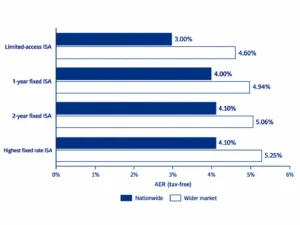
These figures are a market snapshot rather than permanent rates.
Anyone comparing providers can review the latest best Cash ISA rates before deciding whether the convenience of Halifax outweighs the rate difference.
The percentage-point gaps may sound modest, but they become significant on larger balances.
How Much Difference Can 0.94% Make on £20,000?
Consider a one-year Cash ISA.
At Halifax’s current 4.00%, £20,000 generates approximately:
£800 of interest over one year.
At 4.94%, the same £20,000 generates approximately:
£988 of interest.
That is a difference of around:
£188 in one year.
Because the interest is inside a Cash ISA, the comparison is straightforward: both returns would ordinarily remain sheltered from UK Income Tax while the money remains within the ISA rules.
For £5,000, the difference is smaller.
For someone with several years of ISA savings to transfer, however, small differences in percentage rates can translate into substantially larger amounts.
That is why rate comparison matters even for savers who prefer established high-street banks.
How Does Halifax Compare With Nationwide and Santander?
Halifax’s current fixed rates are also below some competing high-street and building-society offers.
For example, current Nationwide ISA rates reach 4.70% AER on Nationwide’s five-year fixed Cash ISA.
Meanwhile, recent Santander ISA rates include a one-year fixed account advertised at 4.65% AER.
Halifax currently pays 4.00% for one year and 4.10% for two or five years.
That does not automatically make Halifax a bad choice.
A saver might prioritise:
- Branch access
- An existing banking relationship
- Familiar online banking
- The ability to manage several finances in one app
- ISA transfer support
- A particular maturity date
- Early-closure conditions
- Flexible ISA features
But the opportunity cost should be visible.
Choosing Halifax purely because an existing current account is already there can mean accepting a lower return.
Why Are Halifax ISA Rates Different From the Bank of England Base Rate?
The Bank of England’s Bank Rate is 3.75% as of October 2026.
A common misunderstanding is that savings providers should therefore offer approximately the same rate.
Banks do not price savings accounts simply by copying Bank Rate.
Cash ISA pricing can depend on:
- How much customer funding the bank wants
- Expected future interest rates
- Competition from other providers
- Wholesale funding costs
- The duration of fixed deposits
- Customer acquisition strategy
- Existing deposit balances
- Promotional objectives
A bank that already has sufficient deposits may have less commercial reason to offer the highest savings rate.
A smaller provider seeking additional funding may be prepared to pay significantly more.
This helps explain why major high-street banks are not always at the top of Cash ISA comparison tables.
Can You Pay Into More Than One Halifax Cash ISA?
This is one of the most important Halifax-specific rules.
Under general UK ISA legislation, adults can now usually subscribe to more than one ISA of the same type during a tax year.
That means it is generally possible to contribute to multiple Cash ISAs with different providers, subject to the overall allowance.
The detailed rules are covered in can you have more than one ISA.
Halifax, however, imposes its own provider restriction.
It says customers can only pay into one Halifax Cash ISA during a tax year.
This is a Halifax account condition rather than a general prohibition on holding multiple Cash ISAs elsewhere.
For example, somebody could potentially contribute:
| ISA | 2026/27 contribution |
| Halifax Cash ISA | £10,000 |
| Cash ISA with another provider | £6,000 |
| Stocks and Shares ISA | £4,000 |
| Total | £20,000 |
The overall £20,000 limit has been used, but the saver has not necessarily broken the general ISA rules simply by using multiple providers.
Provider terms still need to be followed separately.
How Much Can You Put Into a Halifax ISA in 2026/27?
The overall adult ISA allowance for 2026/27 is £20,000.
The tax year runs from:
6 April 2026 to 5 April 2027.
The £20,000 allowance applies to new subscriptions across eligible adult ISAs rather than giving £20,000 of allowance to every account.
For example:
| Contribution | Amount |
| Halifax Cash ISA | £12,000 |
| Stocks and Shares ISA | £8,000 |
| Total subscriptions | £20,000 |
| Remaining allowance | £0 |
Existing ISA balances do not use the new year’s allowance simply by remaining invested or saved inside the ISA.
Someone could have £150,000 accumulated from previous tax years and still receive the standard new annual subscription allowance.
Our explanation of whether you can put £20,000 into an ISA every year covers this distinction in more detail.
What Changes to Cash ISAs in April 2027?
A major rule change takes effect from 6 April 2027.
For most people aged under 65:
Cash ISA subscription limit: £12,000
The overall adult ISA limit remains:
£20,000
People aged 65 or over will continue to qualify for a Cash ISA limit of up to £20,000.
That means an under-65 saver wishing to use the full £20,000 overall allowance from 2027/28 would generally not be able to place the entire amount into Cash ISAs.
For example:
| 2027/28 contribution | Amount |
| Cash ISA | £12,000 |
| Stocks and Shares ISA | £8,000 |
| Total | £20,000 |
That does not mean everybody should automatically invest the other £8,000.
Stocks and shares involve investment risk and can fall in value.
Someone who does not have the risk tolerance or appropriate investment horizon should not invest simply to maximise an ISA allowance.
The timing of the next annual limit is explained in more detail in when the ISA allowance resets.
Why Could Cash ISAs Become More Important for Tax Planning?
The value of the ISA wrapper is not determined only by the interest rate.
Money held inside a qualifying ISA can grow without UK Income Tax on the interest.
Outside an ISA, many savers rely on the Personal Savings Allowance.
Currently, this broadly allows:
| Taxpayer | Personal Savings Allowance |
| Basic-rate | £1,000 |
| Higher-rate | £500 |
| Additional-rate | £0 |
The significance of these allowances increases as interest rates and savings balances rise.
For example, £25,000 earning 5% produces:
£1,250 a year in interest.
A basic-rate taxpayer with no other relevant savings interest would already exceed a £1,000 Personal Savings Allowance in that simplified example.
Someone with £100,000 earning 5% would generate around:
£5,000 of annual interest.
For higher earners, entrepreneurs who have built substantial personal cash reserves, or people who expect future savings to increase, gradually sheltering money inside ISAs can therefore have strategic long-term value even where an ordinary savings account temporarily offers a slightly higher rate.
Can Business Owners Put Company Money Into a Halifax ISA?
A Cash ISA is a personal account, not a business savings account.
A limited company cannot simply use a director’s Halifax Cash ISA as somewhere to hold company cash.
Company money and personal money must remain properly distinguished.
For a company director, money would normally first need to become personal funds through an appropriate route, such as properly accounted-for salary, dividends or another legitimate extraction method, before personally owned cash could be contributed to an ISA.
The tax implications of extracting company funds can be considerably more important than a small difference between ISA interest rates.
For sole traders, the legal ownership position differs because the individual and business are not separate legal persons in the same way as a limited company, but proper accounting and provision for tax liabilities are still important.
An ISA should therefore be viewed as a personal wealth-management tool, not as corporate treasury management.
How Should Entrepreneurs Think About Halifax ISA Rates?
Looking at Cash ISAs through the concerns that commonly matter to founders, business owners and self-employed professionals, three factors repeatedly become important:
Liquidity, certainty and tax efficiency.
A founder with unpredictable dividend income may value flexibility more than another 0.20% of interest.
Someone who has recently sold a business and has substantial personal cash may care much more about maximising rates and FSCS protection.
A consultant with a stable income but significant cash reserves could reasonably split money between accessible savings and fixed terms.
For example:
- Emergency money could remain accessible.
- Money not required for 12 months could use a short fix.
- Longer-term wealth may be considered separately for investment.
- ISA allowances can be used progressively to build tax-efficient personal savings.
The appropriate structure therefore depends on cash-flow requirements rather than simply choosing the ISA with the largest percentage printed beside it.
Can You Transfer an Existing ISA to Halifax?
Halifax accepts eligible ISA transfers.
Using the official ISA transfer process is extremely important.
Someone with £40,000 accumulated in older Cash ISAs does not generally need £40,000 of current-year ISA allowance to transfer that existing ISA money.
An ISA transfer is fundamentally different from withdrawing £40,000 into an ordinary bank account and then attempting to deposit it again.
Withdrawing money incorrectly can cause it to lose its existing ISA tax protection.
Halifax also promotes an ISA transfer promise under which it can pay Cash ISA interest while eligible funds are moving to Halifax, provided the funds are free to transfer.
Anyone moving a substantial ISA should therefore initiate the transfer through the receiving ISA provider rather than manually withdrawing the money first.
What Happens When a Halifax Fixed ISA Matures?
At maturity, the ISA Saver Fixed does not simply continue indefinitely at the old fixed rate.
Halifax says that if no alternative instruction is given, the account changes into an Instant ISA Saver.
This is an important point because the follow-on rate may be substantially different from the maturing fixed rate.
A saver who carefully secured 4% or more for several years could therefore end up earning a much lower variable rate simply by failing to review the maturity options.
Halifax allows maturity instructions to be given shortly before the fixed term ends.
For anyone using fixed savings, a sensible financial routine is to review the account several weeks before maturity rather than waiting until after the rate has expired.
What Is the Halifax Instant ISA Saver?
The Instant ISA Saver primarily acts as a destination account for certain Halifax ISAs when their original term expires.
Customers generally cannot simply choose it as a new standalone account in the same way as an ordinary easy-access ISA.
The current rate is balance-dependent and can be considerably below Halifax’s fixed rates.
That makes maturity management particularly important.
A tax-free account can still be a poor savings account if the interest rate has become uncompetitive.
Tax efficiency and rate competitiveness are different questions.
What Does the Halifax-to-Lloyds Change Mean for ISA Customers?
This is one of the biggest developments surrounding Halifax in 2026.
Lloyds Banking Group announced in July that the Halifax brand will change to Lloyds.
The transition is gradual.
Existing Halifax customers are being moved towards Lloyds branding, the Lloyds app and Lloyds products over time.
Current Halifax savings pages state that customers using the Halifax app can continue applying for Halifax savings products during the transition.
Existing account details are not suddenly disappearing simply because the branding changes.
Halifax has said existing:
- Account numbers
- Sort codes
- Direct debits
- Standing orders
- Account features
continue to operate during the transition.
For someone searching “Halifax ISA rates”, however, the practical implication is important: the availability and application journey for Halifax-branded products may continue changing as Lloyds becomes the lead brand.
A rate comparison should therefore be made using the current application page rather than relying on an article published several months earlier.
Is Money in a Halifax Cash ISA FSCS Protected?
Eligible Halifax deposits are protected under the Financial Services Compensation Scheme.
The current standard deposit protection limit is £120,000 per eligible person, per authorised institution, following the increase from the previous £85,000 limit.
There is another important detail.
Halifax operates as a division of Bank of Scotland plc.
That means people with large balances across connected brands need to understand which legal banking entity actually holds their deposits rather than assuming every brand automatically provides an entirely separate £120,000 limit.
For most people with modest Cash ISA balances this will not create an immediate problem.
It becomes more important for entrepreneurs, investors, property sellers or long-term savers holding six-figure cash balances across multiple accounts.
Is a Halifax Cash ISA Worth It in 2026?
Halifax Cash ISAs have several strengths.
The bank is well established, provides digital and branch management, accepts eligible ISA transfers and offers both fixed and flexible Cash ISA structures.
The fixed-rate account also provides the certainty of knowing the AER for the chosen term.
However, the most significant weakness at present is rate competitiveness.
Halifax’s highest current standard fixed ISA rate is 4.10%, while competing Cash ISAs elsewhere in the UK market have recently exceeded 5%.
Its ISA Bonus Saver pays 3.00% where withdrawal conditions are met, while leading easy-access Cash ISA rates are considerably higher.
People prioritising convenience and an existing Halifax relationship may still find the products appropriate.
Those prioritising maximum return should compare the wider market before transferring or depositing substantial sums.
For another perspective on current market selections, the Martin Lewis best ISA rates comparison explains why the largest advertised percentage is not always the only factor worth considering.
Our Expert Review of Halifax ISA Rates
Our assessment is that Halifax’s current ISA range is stronger on familiarity, product structure and traditional banking access than on headline interest rates.
The two-year fixed ISA looks more rational than the five-year version for many savers because both currently pay 4.10%. Committing for an extra three years without receiving a higher AER creates a substantial flexibility cost.
The Bonus Saver is more interesting for people wanting access, particularly because it is flexible for ISA purposes. However, the drop from 3.00% to 0.65% after the third withdrawal means it needs active management.
The ISA Saver Variable offers the greatest everyday simplicity, but rates of 0.75% to 1.00% leave a considerable gap against the wider Cash ISA market.
For people who already bank with Halifax, convenience can reasonably carry some value. But on a £20,000 or £50,000 balance, the financial cost of accepting a rate one percentage point below a suitable alternative can quickly become too large to ignore.
The most appropriate approach is therefore to compare net outcome, access and restrictions, rather than choosing purely by brand familiarity.
Final Thoughts
Halifax ISA rates currently reach 4.10% AER tax-free, but the bank is not leading the wider Cash ISA market. Its fixed accounts provide certainty and established banking access, while its flexible bonus products may suit savers who need occasional withdrawals.
The biggest considerations are the rate gap against competitors, early-exit charges, Halifax’s one-Cash-ISA subscription rule, the transition to Lloyds and the Cash ISA allowance reduction arriving in April 2027. Comparing those factors together gives a much clearer answer than judging Halifax on the headline percentage alone.
Frequently Asked Questions
What is Halifax’s best Cash ISA rate right now?
Halifax’s highest standard Cash ISA rate is currently 4.10% AER tax-free, available on its two-year and five-year ISA Saver Fixed products.
What does Halifax pay on a one-year ISA?
The current Halifax one-year ISA Saver Fixed pays 4.00% AER tax-free fixed.
Does Halifax offer a 2-year Cash ISA?
Yes. Its two-year ISA Saver Fixed currently pays 4.10% AER tax-free and requires a minimum initial deposit of £500.
Does Halifax still have a 5-year ISA?
Yes. Halifax currently offers a five-year ISA Saver Fixed paying 4.10% AER tax-free, the same headline rate as its two-year fix.
Can I withdraw money from a Halifax fixed ISA?
Ordinary withdrawals are not available. The account can be closed or transferred early, but Halifax applies an interest-based charge of 90, 180 or 365 days depending on the original term.
Can I transfer an old Cash ISA to Halifax?
Yes. Eligible Cash ISAs can be transferred using the formal ISA transfer process. Old ISA funds should not normally be withdrawn manually if preserving their tax-free ISA status is important.
Does Halifax allow multiple Cash ISAs?
General ISA rules allow multiple Cash ISAs, but Halifax currently restricts customers to contributing to one Halifax Cash ISA in a tax year. Other Cash ISAs can potentially be held with different providers within the overall ISA rules.
Will my Halifax ISA become a Lloyds ISA?
The Halifax brand is gradually changing to Lloyds. Existing accounts continue operating during the transition, with Halifax saying account details and existing features remain unchanged until customers are told otherwise.

More in Finance & Tax

Best 1 Year Fixed Rate ISA UK 2026: Top Cash ISA Rates Compared
The best 1 year fixed rate ISA in the UK currently pays up to 4.98% AER tax-free, with UBL UK offering the highest verified rate in our October 2026 comparison. Shawbrook Bank follows at 4.97%, while Vanquis Bank offers a competitive 4.96% alongside a lower minimum opening deposit. However, choosing the best one-year fixed Cash […]

Moneybox Lifetime ISA Review 2026: Interest Rates, Bonuses, Fees and Is It Worth It?
The Moneybox Lifetime ISA is a UK savings and investment account designed to help eligible adults save for their first home or retirement. It offers a 25% government bonus on contributions of up to £4,000 each tax year, potentially adding £1,000 annually to a saver’s money. Moneybox offers both Cash and Stocks & Shares Lifetime […]